What Nevada Law Counts as a Highway
Riding your ATV or UTV across Nevada's stunning landscapes is an incredible experience, but navigating the rules of the road can feel like deciphering ancient hieroglyphs. One of the biggest points of confusion, and frankly, frustration, for many riders is understanding exactly what the state considers a "highway" when you're out exploring. This guide is here to cut through the legal jargon and help you understand what Nevada law counts as a highway, and why getting it wrong can lead to headaches, or worse, a costly citation.
The Basics: What Nevada Law Says About "Highways"
It's easy to assume that a "highway" only refers to those multi-lane paved monstrosities we drive our cars on, but in Nevada, the legal definition is much broader, encompassing many routes that might feel like off-road trails. Understanding this distinction is absolutely crucial for any ATV or UTV rider hoping to stay on the right side of the law.
Decoding NRS 484A.095: The Legal Definition
When we talk about what constitutes a "highway" in Nevada, the definitive answer comes directly from the law itself: Nevada Revised Statute (NRS) 484A.095. This isn't some obscure passage; it's the foundation for almost every interaction you'll have with law enforcement regarding road use. The statute defines a "highway" as "the entire width between the boundary lines of every way or place in this state open to the use of the public for purposes of vehicular traffic, whether or not the entire width thereof is used or has been prepared for vehicular traffic."
Let's break that down, because every word matters. The key phrase here is "open to the use of the public for purposes of vehicular traffic." This isn't just about asphalt; it's about access and intent. If the public can drive a vehicle on it, and it's intended for vehicular travel, it's likely a highway. This broad definition means it includes everything from the I-15 freeway to that dusty, unpaved county road winding through the high desert, provided it's open to the public and maintained for traffic. Think about it: a graded gravel road that the county maintains, maybe even with a county road number sign, absolutely fits this definition. It might feel like a back-country trail, but legally, it's a road, just like any paved street in Reno or Las Vegas.
Distinguishing "Highway" from "Off-Highway"
So, if that graded dirt road is a highway, what's "off-highway"? Generally speaking, an "off-highway" area is any place that doesn't meet the broad definition of a highway. This typically includes designated OHV trails, open public lands like those managed by the Bureau of Land Management (BLM) where cross-country travel is permitted, or private property where you have explicit permission to ride. The core difference lies in their primary purpose and legal designation. Highways are for general vehicular traffic; off-highway areas are for recreational, off-road vehicle use.
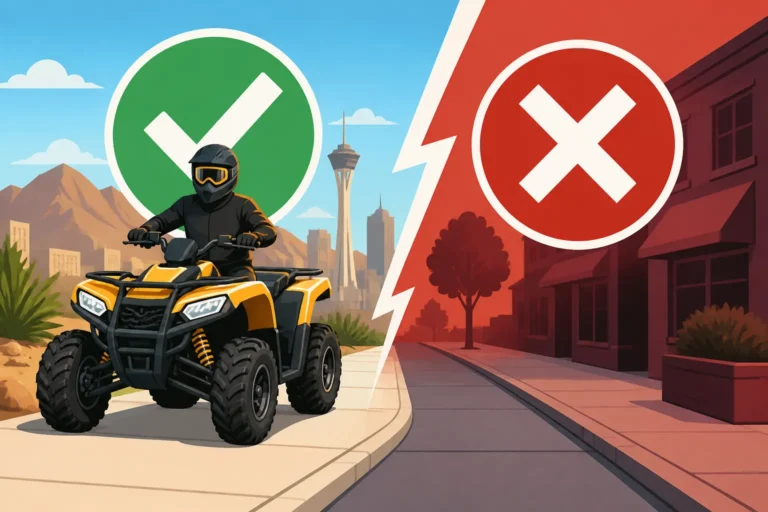
The biggest frustration for many riders stems from this distinction. That seemingly endless dirt track that looks exactly like a trail might, in fact, be a county-maintained highway. This is a common trap, especially for those venturing into rural Nevada where paved roads quickly give way to gravel and dirt. You might think you're "off-road" when, legally, you're on a public thoroughfare. While Nevada does have some provisions for limited street access, such as [Nevada's 2-Mile Limit on Paved Highway] for accessing trails, these rules apply to specific types of roads and come with strict requirements. It's not a blanket permission to treat any dirt path as an off-highway zone. Look for road signs, maintenance levels, and local area designations. But ultimately, the legal definition hinges on public vehicular access, not just the surface material.
Common Misconceptions and Real-World Scenarios
It's easy to fall into traps when you're out riding, especially when the terrain itself blurs the lines between what looks like a trail and what is legally considered a highway. Many common assumptions about dirt roads and private property simply don't hold up under Nevada law, leading to unfortunate encounters with law enforcement.
Dirt Roads Are Not Always "Off-Highway"
This is arguably the most significant misconception among ATV and UTV riders in Nevada. The prevailing thought often goes, "If it's dirt, it's off-road!" Unfortunately, that's just not how Nevada law sees it. As we just discussed, the legal definition of a "highway" focuses on public access for vehicular traffic, not the type of surface. This means a vast network of dirt and gravel roads across the state, many of which are maintained by counties or are part of the state highway system (even if unpaved), are indeed considered highways.
Imagine you're heading out to your favorite remote camping spot in Lincoln County. You drive your truck and trailer for miles down a paved road, then turn off onto what appears to be a rustic, unpaved track. It's got ruts, rocks, and the dust is flying – a perfect OHV paradise! You unload your UTV, eager to start your adventure. But if that "track" is actually a named county road, even if it's only graded once a year, you are technically on a highway. A deputy on patrol, seeing an unregistered OHV or one not equipped for road use, would be entirely within their rights to stop you. This scenario plays out frequently, catching riders off guard. It underscores why it's so vital to know [Which Nevada County Roads Qualify for ORVs] and to check your route carefully before you leave the pavement.
Private Roads vs. Public Access
Another area of confusion revolves around private roads. Common sense might tell you that a road on private land isn't a highway, and often that's true. If a road is truly private, meaning access is restricted, gated, or requires explicit permission from the landowner, it generally falls outside the "open to the use of the public" clause of the highway definition. For instance, a private drive leading to a ranch house or a road within a clearly marked, restricted-access mining claim typically wouldn't be considered a highway. In these cases, your OHV use would be governed by the landowner's rules, not public road laws, assuming you have permission to be there. [A Nevada Machine That Only Rides Private Land] doesn't need to be registered, but you need to prove it only rides private land.
However, the lines can get blurry. What if a "private" road is widely known and used by the public as the only access to a popular fishing hole or a segment of BLM land? In such cases, despite private ownership, the road could be interpreted as being "open to the use of the public" for vehicular traffic, especially if the owner has historically allowed such access without restriction. This is a nuanced area, and when in doubt, it's always safer to assume the road is public or verify its status with local authorities or the landowner. Don't rely solely on a "Private Road" sign if public access is routinely granted or implied; sometimes, signs are simply meant to deter specific types of traffic or liability, but don't negate public access for other purposes.
The "Improved Surface" Trap
Let's dispel another common myth: the idea that a "highway" must be paved. Some riders mistakenly believe that unless a road is made of asphalt or concrete, it's automatically an off-highway trail. This simply isn't true in Nevada. Remember the wording from NRS 484A.095: "whether or not the entire width thereof is used or has been prepared for vehicular traffic." This legal phrasing explicitly accounts for unpaved roads.
A gravel road, a graded dirt road, or even a well-traveled two-track that sees regular public vehicular use can easily qualify as a highway under Nevada law. The condition or "improvement" level of the surface is secondary to its status as a public thoroughfare for vehicles. This is particularly relevant in Nevada's vast rural areas, where countless miles of public roads are unpaved. The challenge for riders is that these roads often blend seamlessly into what look like pure off-road trails. Without clear signage or prior knowledge, it can be nearly impossible to distinguish between a legal OHV trail and a county highway simply by looking at the ground beneath your tires. This makes pre-ride planning and route verification absolutely essential to avoid inadvertently breaking the law.
Implications for ATV and UTV Riders
Understanding Nevada's definition of a "highway" isn't just an academic exercise; it has very real, tangible consequences for ATV and UTV riders. If you're caught operating your off-highway vehicle on a road legally defined as a highway without meeting the necessary requirements, you could face significant penalties.
Why the Definition Matters: Legality of Road Use
The moment your tires touch a surface that Nevada law defines as a "highway," your ATV or UTV is subject to an entirely different set of rules. This is where the rubber meets the road, quite literally. Unlike off-highway areas where you largely operate under OHV-specific regulations, highways require compliance with general motor vehicle laws. This includes having your machine properly registered and, in many cases, equipped for road use.
Nevada has specific requirements for what it calls a "Large All-Terrain Vehicle" to be legally operated on certain county roads. This is where concepts like [Nevada Street Legal UTV Requirements] come into play. To qualify for a [Nevada Large ATV Decal Cost], your machine must meet criteria such as having at least four wheels, being wider than 50 inches, weighing less than 2,400 pounds, having a gross vehicle weight rating of 6,000 pounds or less, and possessing a truck bed or seating for at least two passengers. Beyond the classification, you'll need specific equipment. This means functional headlights and taillights (with [Headlights and Taillights Visible 500 Feet]), a stop lamp, at least one mirror, a horn, and a spark arrester. Many riders turn to aftermarket solutions, and companies like SuperATV offer a comprehensive range of accessories, from mirrors and horns to full street-legal kits, to help bring your machine up to spec. Furthermore, you, as the operator, must possess a valid driver's license and carry proof of liability insurance, just like any other vehicle on the road. [Insurance and Nevada OHV Registration] is not just for accidents off-road; it's critical on public roads. Failing to meet any of these requirements can lead to citations, fines, or even having your machine impounded.
Crossing Roads and the 2-Mile Rule
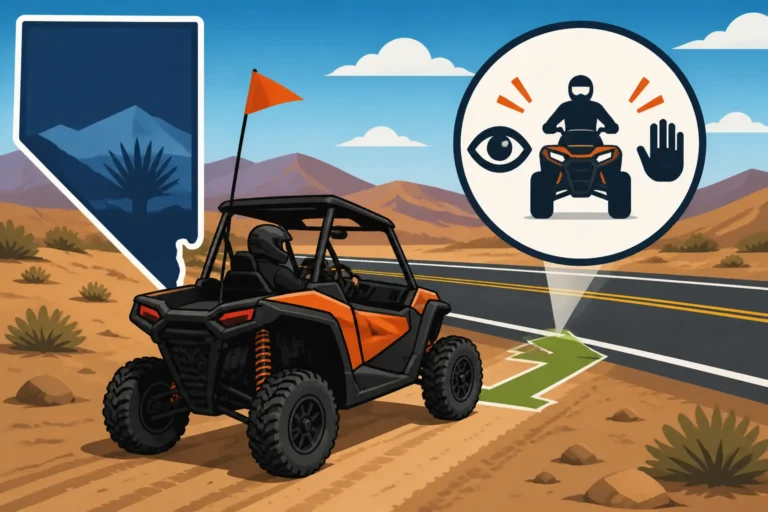
Nevada law does offer some limited exceptions for OHV operators to interact with public roads, but these are highly specific and not a free pass. The most basic interaction is the ability to [Crossing a Highway on an ATV in Nevada]. You can cross a highway at a right angle if it's done safely and quickly, essentially traversing from one off-highway area to another directly opposite. This is not for traveling along the highway, but merely crossing it.
Then there's the famous (or infamous) "2-mile rule." This provision allows you to operate your OHV for up to two miles on a minor county road to access a designated OHV trail or another off-highway area. However, this is not a universal right to ride on all roads. It's strictly limited to minor county roads, and only if local ordinances haven't prohibited it. Crucially, even when utilizing this 2-mile exception, your OHV must still comply with the equipment requirements for road use (lights, horn, mirror, etc.), and you must be licensed and insured. It's a provision designed for access, not for joyriding on paved shoulders or rural byways. Understanding these nuances is key to avoiding trouble.
Local Ordinances and Designated Routes
Adding another layer of complexity to road use are local ordinances. While state law defines what a highway is and sets general rules, individual counties and cities in Nevada have the authority to implement their own regulations regarding OHV operation on roads within their jurisdictions. This means that a road legally defined as a "highway" by the state might be explicitly closed to OHVs by a local government's ordinance.
For example, while some minor county roads might technically be open under the 2-mile rule, a county could pass an ordinance completely banning OHVs from all county roads, or restricting them to only specially designated routes. This is particularly common in more populated areas. [Nevada Cities Over 100,000 and Designated Routes], like Las Vegas or Reno, often have strict rules or ban OHVs entirely from most city streets, limiting them to specific marked routes if any exist. Even smaller towns, like Mesquite, have specific rules for [Riding the Street in Mesquite] that you need to be aware of. Similarly, [Washoe County Roads and Large ATVs] have their own unique set of regulations. Before you embark on any ride, it's vital to check the local ordinances of the county or city you'll be riding in. The best resources for this are the county's official website, local sheriff's department, or the [The Nevada Commission on Off-Highway Vehicles] website, which often provides links and information regarding local regulations and maps for designated routes. Don't assume that just because a road is open in one county, it's open in another; local control can dramatically change what's permissible.
Staying Compliant and Riding Smart
Given the complexities of what Nevada law counts as a highway, the best approach for any ATV or UTV rider is to be proactive. Knowledge and preparation are your best defenses against potential legal issues and ensure you can enjoy your ride without unexpected interruptions.
Preparing Your Machine for Potential Road Use
Even if your primary goal is to stick to designated trails and open desert, there will almost certainly come a time when you need to use a public road, even if only for a short distance to cross, link trails, or access fuel. Having your machine properly equipped for these eventualities is a smart move. Think of it as insurance for your ride.
Essential items include functional headlights and taillights that are clearly visible, a stop lamp (brake light), at least one rear-view mirror, and a horn. Many aftermarket parts manufacturers, like SuperATV, offer a wide array of products designed to help you meet these requirements without extensive modification. From simple bolt-on mirrors and universal horn kits to comprehensive street-legal conversion kits that include turn signals and license plate brackets, these upgrades can ensure your machine is compliant. Additionally, consider DOT-approved tires if you anticipate any significant road travel, as off-road tires, while great for the dirt, might not perform optimally or be legally compliant on pavement. Regular checks of your lighting, brakes, and tires should be part of your pre-ride routine, ensuring everything is in working order before you ever hit the dirt or pavement.
Know Before You Go: Researching Your Route
The most actionable advice we can give you is this: never assume. Before you ever load up your machine and head out, dedicate some time to thoroughly researching your planned route. This means more than just looking at a pretty trail map; it means understanding the legal status of the roads you'll encounter.
Utilize online resources like the Nevada Trail Finder, which often indicates designated OHV routes and open riding areas. Consult official Bureau of Land Management (BLM) travel management plans for the specific area you'll be in; these maps clearly delineate open routes, closed routes, and wilderness boundaries. Don't forget to check the websites of the relevant county or city for any OHV ordinances that might apply. If you're still unsure about the status of a particular road, don't hesitate to contact local law enforcement (the sheriff's department or state troopers) or the local BLM field office. They are the best resources for up-to-date and accurate information. Always carry physical or digital maps that clearly distinguish between designated OHV trails and public roads, and pay attention to signage on the ground.
When in Doubt, Don't Ride It
This is the golden rule, the ultimate piece of advice for any rider navigating the complex world of Nevada's road laws. If you are ever in doubt about whether a particular road is a "highway," or if your machine is legally equipped to ride it, or if local ordinances prohibit OHV use, then don't ride it. It's simply not worth the risk.
The penalties for operating an unregistered or illegally equipped OHV on a public highway can range from costly fines to impoundment of your machine. Beyond the financial burden, an accident on a public road where you are not compliant can lead to severe legal and insurance complications. It's far better to err on the side of caution, find an alternative route, or trailer your machine to a known, legal riding area. A little extra planning and prudence can save you a lot of hassle and ensure that your off-highway adventures remain fun, safe, and legal.
Disclaimer
This article is for general informational purposes only and does not constitute professional advice. Laws, prices and regulations vary by location and change over time. Consult a qualified professional for guidance on your specific situation.