What an OHV Title Looks Like
It can be incredibly confusing to navigate the world of OHV ownership, especially when you're trying to figure out all the official documents you need. Many riders, new and seasoned alike, often wonder, "What exactly is a Nevada OHV title, and what does it even look like?" It's not always as straightforward as a car title, and understanding this crucial piece of paper is key to smooth ownership, whether you're buying, selling, or just riding the trails with peace of mind. This guide will walk you through everything you need to know about the appearance, purpose, and importance of your Nevada Off-Highway Vehicle title.
Demystifying the Nevada OHV Title Document
When you first hold your Nevada OHV title, you might notice it looks quite different from your typical car or truck title. It’s a specialized document, specifically designed for off-highway vehicles like ATVs, UTVs, dirt bikes, and other machines that primarily ride off pavement. This isn't just a receipt or a permit; it's the fundamental proof of who legally owns the machine.
More Than Just a Piece of Paper: Its Purpose
Think of your Nevada OHV title as the birth certificate and deed of your off-highway vehicle rolled into one. It's the ultimate legal document that establishes you as the rightful owner. Without it, proving ownership can become a tangled mess, especially if your machine is ever stolen, lost, or involved in a dispute. This title doesn't grant you permission to ride on public lands – that's what your registration decal is for – but it is the foundational piece of paperwork required to obtain that decal in the first place. When you decide to sell your beloved quad or side-by-side, the title is what you’ll sign over to the new owner, officially transferring ownership from your hands to theirs. It’s a big deal, and understanding its weight is the first step in responsible OHV ownership in the Silver State.
Key Information You'll Find on a Nevada OHV Title
A Nevada OHV title is a compact document, usually printed on a standard letter-sized sheet, but don’t let its size fool you. It’s packed with critical data. You'll typically find the full legal name and address of the registered owner(s) prominently displayed. Below that, or in a similar key section, will be all the identifying information about your machine. This includes the Vehicle Identification Number (VIN), which is paramount. You'll also see the make (like Polaris, Can-Am, Honda, Yamaha), the model (RZR, Maverick, Foreman, YFZ), the year of manufacture, and the type of vehicle (ATV, UTV, dirt bike, etc.). It usually specifies the fuel type, and sometimes engine displacement.
Additionally, the title will likely indicate if there's a lienholder – meaning a bank or lender that holds a financial interest in your OHV until it's paid off. This is important information for any potential buyer to be aware of. There will also be an issue date, showing when the title was officially recorded, and a unique title number that identifies that specific document. Sometimes, if the machine was purchased new, you might see a "brand" indicating it was previously a manufacturer's certificate of origin (MCO) conversion. All this information is neatly laid out to provide a clear, unambiguous record of your machine and its legal owner.
The Distinctive Appearance of a Nevada OHV Title
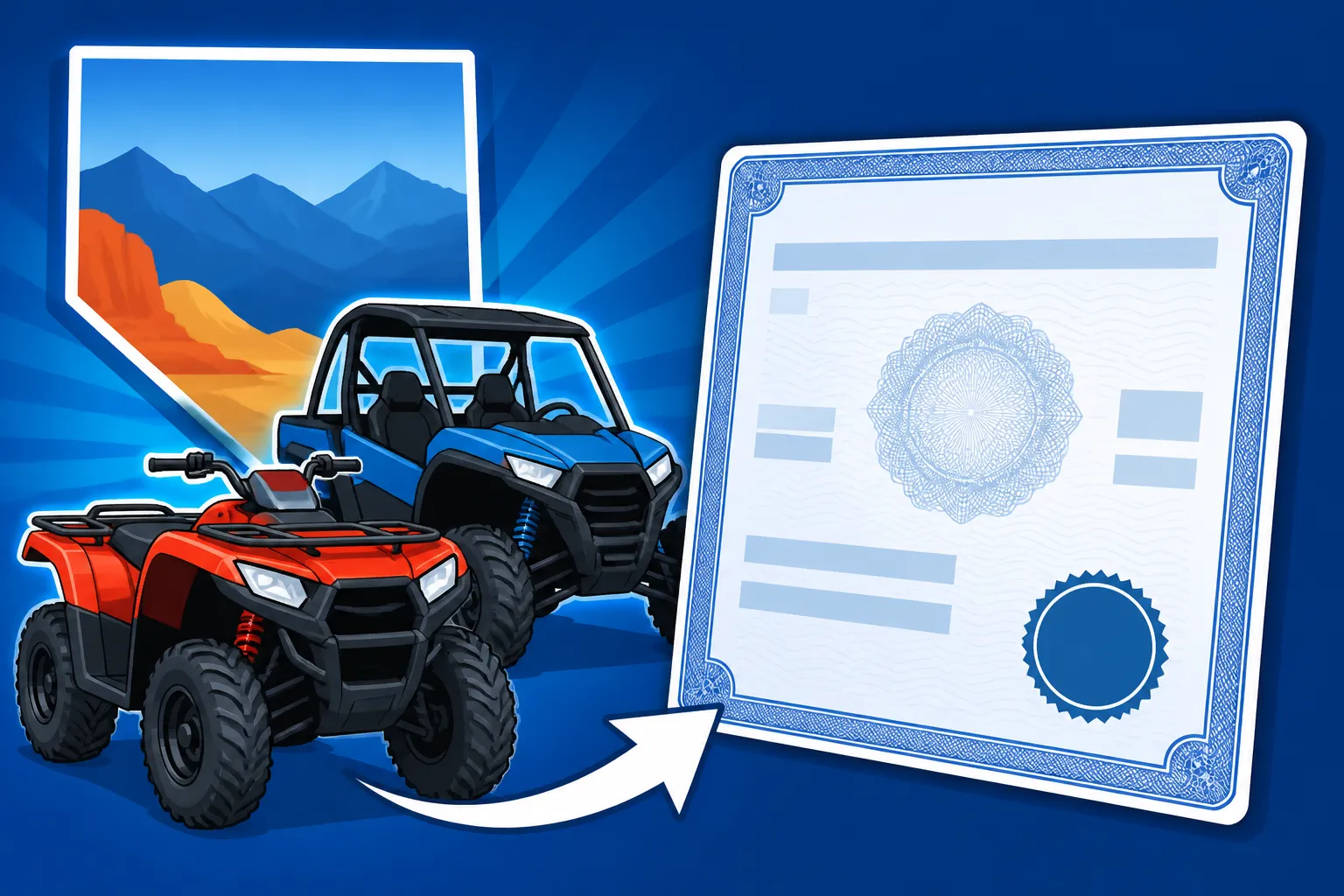
While the exact design can subtly change over time, a Nevada OHV title generally has a distinct appearance that sets it apart as an official government document. You can expect it to be printed on special, secure paper, often with a unique background pattern, color, or even a watermark to deter counterfeiting. It won't look like something you could just print out at home. The State of Nevada seal or emblem is usually present, adding to its official status. The layout is professional and organized, with clear sections for owner information, vehicle details, and any lienholder information.
Unlike a traditional license plate that goes on your vehicle, the title is a paper document that you keep in a safe place, like a fireproof box or secure file cabinet. It's designed for long-term storage, not for display on your machine. The text is typically crisp and legible, and there will be designated areas for signatures when the vehicle is sold or transferred. It's truly a testament to formal documentation, designed to be durable and easily verifiable by state authorities or potential buyers.
Why a Title is Essential for Nevada OHV Owners
The Nevada OHV title isn't just a bureaucratic hurdle; it's a cornerstone of responsible and secure off-highway vehicle ownership. Understanding its importance can save you a world of headaches down the line.
Proving Ownership Beyond a Shadow of a Doubt
Imagine this scenario: your prize ATV, which you've poured countless hours and dollars into, suddenly disappears. Or perhaps there's a dispute over who legally owns a machine you've been riding with a friend. In these stressful situations, your Nevada OHV title is your absolute best friend. It’s the definitive legal proof that the machine belongs to you. Police can use the VIN listed on the title to track stolen vehicles, and in any legal argument, that piece of paper trumps all other claims. Without it, you’d be left trying to piece together receipts, bills of sale, or even witness testimonies, which can be much harder to uphold in court. It provides an undeniable chain of ownership, ensuring that your investment is legally protected. This is particularly crucial for machines that often get moved between different locations or shared among family members.
The Critical Role in Buying and Selling
If you're in the market to buy a used OHV, or if you're planning to sell your current one, the title is the most important document in the transaction. As a buyer, receiving a properly signed-over title ensures that you are taking legal ownership, free and clear of any previous claims (unless a lien is noted, of course). It also helps confirm the machine isn't stolen. Without a title, you're essentially buying a machine that legally doesn't exist in the proper chain of ownership, which can lead to huge problems later on.
For sellers, signing over the title is how you formally relinquish responsibility and ownership. It ensures you won't be held liable for anything the new owner does with the machine. Many people use a bill of sale in addition to the title, and templates from services like LawDepot can ensure you have a comprehensive record of the transaction. But remember, the bill of sale is a supporting document; the title is the main event. Always insist on a properly executed title transfer when engaging in any OHV transaction to protect both parties. A clear title provides peace of mind and prevents potential legal quagmires down the road. You can learn more about [Titling an Off-Highway Vehicle in Nevada] through official channels.
How a Title Connects to Nevada Registration
While the title establishes ownership, the registration decal is what makes your OHV legal to ride on designated public lands in Nevada. These two pieces of paperwork are intertwined. To register your OHV and get that required decal, the Nevada Department of Motor Vehicles (DMV) – specifically the OHV Section – needs to see proof of ownership. The title is the primary way to do that. They want to ensure that the person registering the machine is indeed the legal owner.
If you purchase a new OHV from a dealer, they'll often handle the initial titling and registration paperwork for you, submitting the Manufacturer's Certificate of Origin (MCO) to get your first title and then applying for registration. For private party sales, you'll take the signed-over title to the DMV or a qualified OHV dealer to transfer ownership into your name and register the machine. There are rare exceptions, of course, such as when [Nevada OHV Registration Without a Title] is permitted for very specific circumstances, but generally, the title is a non-negotiable step in the process. Understanding this connection is vital for staying on the right side of the law and enjoying Nevada's vast trail systems. [What a Nevada OHV Decal Actually Proves] is purely about registration, not ownership.
Common Misconceptions and What Isn't a Title
It's easy to get various OHV documents confused, especially since many states have different rules for different types of vehicles. Let's clear up some common misunderstandings about what a Nevada OHV title is, and just as importantly, what it isn't.
Decal vs. Title: Understanding the Difference
This is perhaps the most frequent point of confusion for new OHV owners. Many people see the colorful decal stuck to the side or rear of an OHV and assume that's the "title." It's not. The decal is your proof of registration, which means you've paid the necessary fees and your machine is authorized to ride on public lands for a specific period. It's essentially a temporary permit that needs to be renewed. You'll often see them placed on the left side or rear of the machine, usually indicating the expiration year.
The title, on the other hand, is a permanent document proving ownership. You carry the registration card (which accompanies the decal) when you ride, but the title stays safe at home. While both are crucial for OHV enjoyment in Nevada, they serve completely different legal purposes. You wouldn't use your vehicle registration to prove you own your car in a sale, and the same principle applies here. [Why Nevada Issues a Decal and Not a Plate] further highlights the unique nature of OHV identification in the state. The [Nevada Title Costs Compared With Registration] also illustrates that these are separate financial obligations.
Bill of Sale vs. Title: Provisional vs. Permanent Proof
Another document that often gets confused with a title is a bill of sale. A bill of sale is an incredibly important piece of paper, especially when you're buying or selling a used OHV privately. It's a legal contract between the buyer and seller, outlining the terms of the sale, the purchase price, and often includes details about the condition of the machine and the date of transaction. Resources like LawDepot offer excellent templates for a [What a Nevada ATV Bill of Sale Should Carry], which can be immensely helpful in ensuring all necessary details are included.
However, a bill of sale, by itself, is not a title. It's provisional proof of a transaction, but it doesn't represent the state's official record of ownership. While it can be used in some cases to help obtain a title, especially for older machines or those lacking complete paperwork, it's generally secondary to the actual state-issued title. The title is the official document that the Nevada DMV recognizes for transferring legal ownership. Relying solely on a bill of sale without securing a proper title can lead to significant headaches, particularly if the original seller had no legal right to sell the machine in the first place.
Manufacturer's Certificate of Origin MCO/MSO
When you purchase a brand-new OHV from a dealership, you won't immediately receive a state-issued title. Instead, the dealer provides you with a Manufacturer's Certificate of Origin (MCO), sometimes called a Manufacturer's Statement of Origin (MSO). This document is essentially the "birth certificate" for your new machine, indicating that it has never been titled before and proving its origin from the factory.
The MCO is then submitted to the Nevada DMV as part of the initial titling and registration process. The DMV uses the MCO to issue the very first Nevada OHV title for that specific vehicle. So, while it's a critical document in the chain of ownership for a new machine, the MCO itself is not the final state title. It's a stepping stone. Once the state title is issued, the MCO's primary function is complete, and the title becomes the permanent proof of ownership.
When You Might Not Have a Nevada OHV Title (and What to Do)
While having a Nevada OHV title is the standard, there are specific situations where you might not have one, or where getting a new one can be a bit more complex. These scenarios require extra attention and understanding to ensure your OHV ownership remains legitimate and trouble-free.
Older Machines and the "No Title" Dilemma
It's not uncommon to encounter older OHVs, particularly those manufactured before Nevada's titling requirements were fully established or consistently enforced, that simply don't have a title. If you're looking at buying a vintage dirt bike or a classic three-wheeler from decades past, the seller might only have a bill of sale, or even just old registration paperwork. This situation can be tricky but isn't necessarily a deal-breaker.
For machines acquired before a certain cutoff date (which has changed over the years as OHV laws evolved), the state might have different requirements for establishing ownership. In such cases, a robust bill of sale, perhaps notarized, along with old registration documents, could be crucial. You might need to submit additional forms or provide an affidavit to the [The Nevada DMV OHV Section] to prove ownership before a new title can be issued in your name. It's a process that requires diligence and often involves more paperwork than a straightforward title transfer. Always verify the specific requirements for [Titles for Machines Acquired Before the Cutoff] with the DMV if you find yourself in this situation.
Lost or Damaged Titles: Steps to Replacement
Life happens, and sometimes important documents like your OHV title can get lost, damaged, or even destroyed in a fire or flood. If your Nevada OHV title has gone missing, don't panic. The DMV has a process for issuing a duplicate title. This typically involves filling out a specific form (often an application for duplicate title), providing your personal identification, and verifying the OHV's details, including the VIN. There will be a fee associated with getting a replacement.
It's a fairly common request, so the DMV staff are usually well-versed in guiding you through the steps. The key is to act promptly once you realize the title is gone, especially if you anticipate selling the machine soon. Waiting until the last minute can delay your transaction significantly. You can find detailed instructions and the necessary forms on the Nevada DMV website or by visiting one of their offices. For a comprehensive guide, check out [Replacing a Lost Nevada OHV Title].
Buying an OHV Without a Title: Risks and Remedies
One of the riskiest moves an OHV enthusiast can make is buying a machine that doesn't come with a clear title from the seller. While the allure of a cheap price might be strong, the headaches and potential legal issues can far outweigh any savings. Without a title, you have no definitive proof that the person selling the OHV actually owns it. You could unknowingly be buying a stolen machine, which would lead to its confiscation and you losing both the machine and your money. [Buying a Quad With No Paperwork at All] should always raise a red flag.
If you are considering such a purchase, extreme caution is advised. You absolutely must perform a thorough VIN check to ensure the machine isn't reported stolen. This can sometimes be done through law enforcement or online VIN databases. Get a detailed bill of sale, ensuring it includes all seller and buyer information, the OHV's VIN, make, model, year, and the full purchase price. You might even consider having it notarized. While a bill of sale can help establish your intent to purchase, it doesn't automatically grant you a title. You'll still need to go through the process of applying for a title, which might involve additional steps like proving the chain of custody or getting law enforcement verification. Using a template from a service like LawDepot for your bill of sale can help ensure you have as much legal protection as possible in these uncertain situations. Always proceed with extreme caution and understand the [Cost to Title an ATV in Nevada] if you have to go through extra steps. [Checking an ATV VIN Before You Buy] is a critical step to avoid future issues.
OHV Documentation Comparison
To help clarify the differences between these important documents, here’s a quick overview:
| Document Type | Primary Purpose | What It Looks Like | What It Proves | Where It Stays | Required For |
|---|---|---|---|---|---|
| Nevada OHV Title | Legal Proof of Ownership | Official state-issued paper, unique security features, VIN, owner info | Legal ownership | Safe at home, secure location | Selling, major transfers, initial registration |
| OHV Registration Decal | Permission to Ride on Public Lands | Sticker affixed to the OHV, shows expiration year | Current registration, fees paid | Attached to the OHV | Riding on public lands, trail access |
| Bill of Sale | Contract of Sale Between Buyer/Seller | Paper document, outlines transaction details, signatures | Transaction occurred on a specific date and terms | Keep for personal records | Supporting document for titling/registration, proof of purchase |
| MCO/MSO | Manufacturer's Origin (New Machines) | Manufacturer's official document, vehicle details, original owner | Vehicle's "birth certificate," never titled before | Submitted to DMV for first title | Initial titling of a brand-new OHV |
This article is for general informational purposes only and does not constitute professional advice. Laws, prices and regulations vary by location and change over time. Consult a qualified professional for guidance on your specific situation.