Plating a Machine in Another State to Ride Nevada
It’s a common scenario: you’ve seen those slick videos of folks cruising their UTVs down main streets, grabbing a burger, and then hitting the trails, all without ever trailering. It looks like the dream, right? Especially here in Nevada, where the trails are endless, but sometimes you just need to connect a few miles of pavement to get from one epic spot to another, or maybe just zip into town for some fuel or a cold drink. The idea of plating your beloved off-highway vehicle (OHV) in another state, one known for being a bit more "street-legal friendly," seems like a brilliant workaround. You might think, "If it's legal there, it must be legal here, too!" But before you start filling out paperwork for Montana or South Dakota, let's take a deep, honest look at why that strategy often falls flat when you cross into the Silver State. This guide will walk you through Nevada's specific laws regarding OHV road use and explain why out-of-state plates aren't the magic bullet you might hope for.
The Allure of Street-Legal OHVs in Nevada and the Reality Check
There’s a genuine desire among OHV enthusiasts to make their machines street legal. It’s not just about convenience; it’s about expanding the possibilities of your adventure. But Nevada, while being an incredible playground for off-roaders, has some pretty firm rules when it comes to riding your ATV or UTV on paved roads.
Why Riders Seek Street-Legal Status
Imagine this: you're out at Logandale Trails, having an amazing day, but you're low on gas and the nearest station is just a few miles down the highway. Or perhaps you want to explore different sections of the Silver State Trail that are broken up by paved county roads. Having a street-legal machine would mean you could simply hop on the pavement, take care of business, and get back to the dirt. No need to load up a trailer, drive to the gas station, unload, refuel, load back up, and then drive back to the trail. It's a huge time-saver and makes for a much more seamless experience.
The frustration is real when you're staring at a perfectly good paved road, knowing your destination is just a short distance away, but you're stuck because your machine isn't considered street legal. Many riders envision a world where they can ride from their garage, hit the trails, stop for lunch in a small town, and then ride back home. It's a vision of ultimate freedom, and it's completely understandable why so many people look for ways to make that a reality.
Nevada's Strict Stance on Street-Legal OHVs
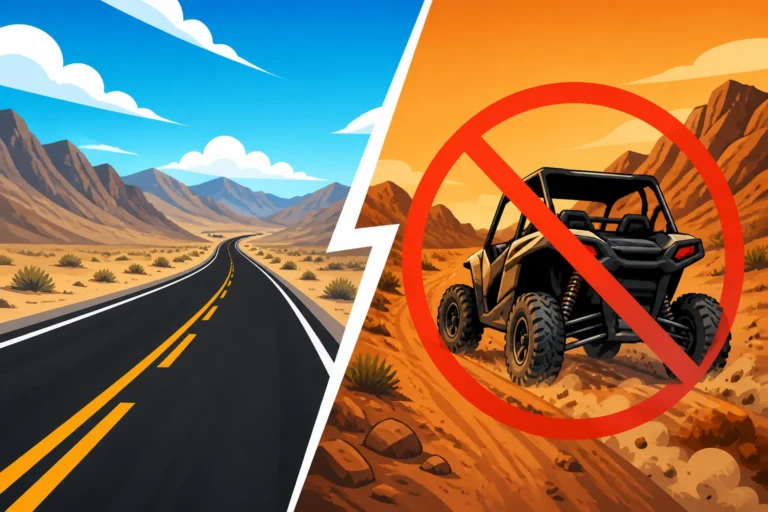
Here’s where the dream often bumps into reality: Nevada has some of the more restrictive laws when it comes to allowing OHVs on public roads. Unlike some other states where you can fairly easily register an ATV or UTV for street use, Nevada generally says "no" to regular off-highway vehicles on paved highways and most county roads. There are very specific, limited exceptions, which we'll dive into shortly, but the overarching principle is that these machines are for off-road use only.
The state’s statutes are designed to clearly differentiate between vehicles built and regulated for highway use and those intended for off-road environments. This means that a standard ATV or UTV, even one equipped with turn signals and a horn, typically won't qualify for full street legality here. This framework creates a significant hurdle for riders hoping to replicate the street-legal experiences they might see in other states or online. You'll find that the definitions for what is allowed are very narrow, often leading to disappointment for those who haven't done their homework.
The Appeal of Out-of-State Plates: A Common Misconception
It’s an attractive idea, isn't it? If your buddy in Arizona has a street-legal UTV, and you can ride it in Nevada, why can't you just get your own plated in Arizona? Or perhaps you've heard whispers about states like Montana or South Dakota being particularly friendly for street-legal OHV registrations, even for non-residents. This concept, while appealing, often overlooks critical nuances in how states recognize each other's vehicle laws.
The Theory: "If It's Legal There, It's Legal Everywhere"
The reasoning behind seeking an out-of-state plate is pretty straightforward: if a state like Montana or South Dakota allows you to register your UTV as street legal, and you get a license plate and registration for it, then it should be recognized as street legal in Nevada, right? After all, we generally accept driver's licenses and vehicle registrations from other states without question. People often assume that vehicle reciprocity laws, which allow your car or truck to be legal in any state it travels through, would extend to OHVs. They see this as a clever way to bypass Nevada's stringent requirements, believing that a valid registration from another jurisdiction makes their machine universally street legal.
Many riders are familiar with these states because they have specific statutory provisions that make it easier to register OHVs for limited street use. This has led to a cottage industry of services that help out-of-state residents obtain these registrations, specifically for off-road vehicles. The allure of a "Montana plate" or a "South Dakota plate" for your UTV is strong, promising hassle-free road travel no matter where you ride. However, this hope often clashes with the specifics of Nevada's statutes.
Nevada's Reciprocity Rules for OHVs
Here's the critical distinction: Nevada does offer reciprocity for off-highway vehicles, but this reciprocity is primarily for off-road use, not for making your machine street legal. If you have a valid OHV registration decal from your home state – say, a California Green Sticker or an Arizona decal – you are generally allowed to ride off-road in Nevada without needing to buy a Nevada OHV decal. This is a huge benefit for visitors, and it's codified in state law. You can enjoy Nevada's vast network of trails and dunes without a problem, for up to 15 days. [How Long an Out-of-State ATV Can Stay in Nevada] After those 15 days, if you’re still in Nevada and riding off-road, you’re technically supposed to get a Nevada OHV decal.
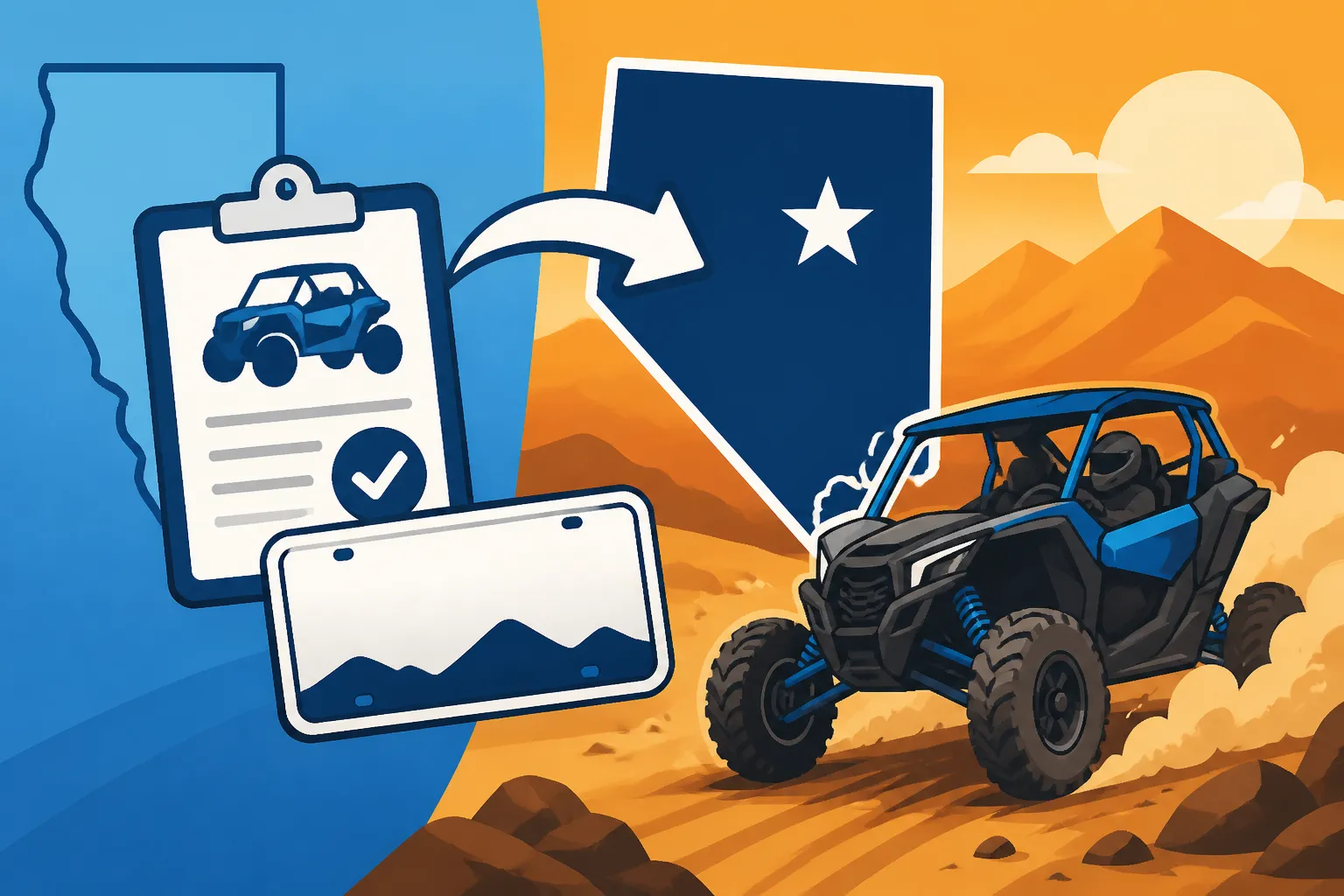
However, this courtesy doesn't extend to street legality. Nevada's law is clear: just because another state considers your UTV street legal and issues a license plate, that doesn't automatically grant you permission to drive it on Nevada's paved highways or county roads. The state distinguishes between general vehicle registration (which applies to cars and trucks) and OHV registration, especially concerning road use. So, while your out-of-state OHV decal allows you to tear up the dirt in the desert, it won't give you the green light to cruise down US-95. [Nevada Reciprocity With California]
The Hard Truth: Nevada and Out-of-State Street Plates
It’s time for a dose of reality. Many riders learn this lesson the hard way, often during a roadside stop with a curious deputy. While the idea of using an out-of-state plate as a loophole is persistent, Nevada's legal framework for OHV road use is specifically designed to prevent just that.
Why a Montana Plate Does Not Help on Nevada Pavement
Let’s be blunt: a Montana or South Dakota license plate on your UTV, while valid in those states, does not make your machine street legal on Nevada roads. Nevada's laws prioritize its own definitions and regulations for what constitutes a vehicle suitable for highway travel within its borders. When a Nevada law enforcement officer pulls you over, they aren't looking at where your vehicle is registered; they are looking at what your vehicle is and whether it complies with Nevada's specific statutes for road use.
This means that even if your UTV has a shiny license plate from another state, a Nevada deputy will still assess your machine against [What Nevada's NRS 490.043 Counts as a Large ATV]. They'll check for characteristics like vehicle width, total number of seats, and whether it has a cargo bed. More importantly, they'll be looking to see if you have the proper Nevada "Large ATV" decal displayed and if your vehicle meets all the stringent equipment requirements that Nevada sets forth for any OHV operating on its paved roads, even those few designated exceptions. It’s a Nevada-centric evaluation, and an out-of-state plate simply won’t override that. This is a common point of confusion, and unfortunately, it often results in citations for riders who thought they were playing by the rules. [What a Nevada Trooper Looks For on a County Road]
Nevada's "Large ATV" Exception and What It Means for Out-of-State Machines
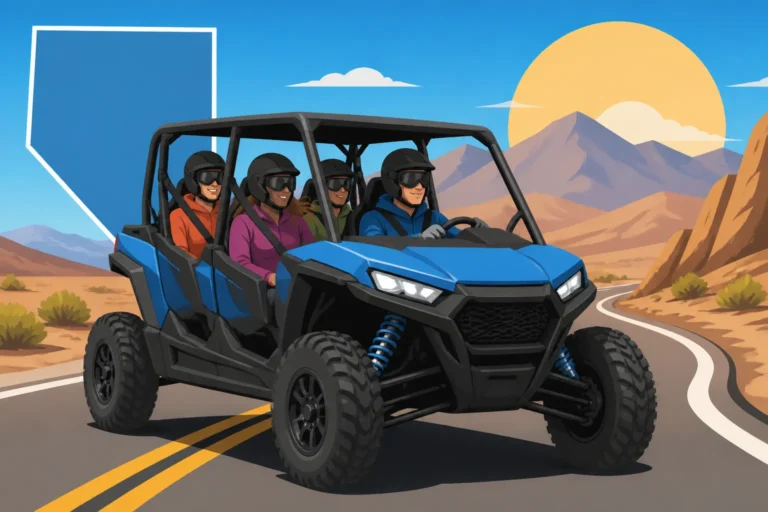
Nevada does have a very narrow exception for certain OHVs to operate on specific paved roads, known as the "Large All-Terrain Vehicle" designation. But this isn't a blanket "street legal" status, and it comes with significant caveats, especially for out-of-state machines. To qualify as a "Large ATV" in Nevada, your machine must meet very specific criteria: it has to be at least 50 inches wide, weigh at least 900 pounds, and either have at least four wheels and a truck-like bed, or at least four seats. [What Qualifies as a Large ATV in Nevada]
Here’s the rub for many popular sport UTVs: a two-seat sport quad, or even a two-seat sport UTV like a Polaris RZR or Can-Am Maverick, typically will not meet these criteria, primarily because they lack the required number of seats (unless it's a four-seater) or a truck-like bed. [Why a Two-Seat Sport Quad Fails Nevada's Test] So, even if it’s plated in another state, if it doesn’t physically meet Nevada's definition of a "Large ATV," it cannot legally ride on Nevada’s permitted roads. Furthermore, even if your out-of-state machine does meet these physical criteria, you're still expected to apply for and display a Nevada [Applying for a Nevada Large ATV Decal] if you intend to regularly ride on Nevada's designated roads. This decal is specific to Nevada and demonstrates that your machine has been assessed against the state's requirements. Simply having an out-of-state plate isn't enough; Nevada demands compliance with its own stringent rules for any road use beyond the most fleeting crossings.
Limited Paved Road Use for All OHVs in Nevada
So, if full street legality via an out-of-state plate is largely a bust, does that mean you can never put a tire on pavement in Nevada? Not entirely. There are very specific, limited circumstances under which any OHV can briefly use a paved road, but it's crucial to understand these are exceptions, not a green light for general road travel.
The 2-Mile Rule and Road Crossings
Nevada law does offer a very narrow allowance for OHVs to use paved roads for certain purposes. You are permitted to ride on a paved road for a maximum distance of two miles to connect two off-road trails, access essential services (like gas or food), or get to private property. This is commonly known as the "2-mile rule," and it's not a grant of street-legal status, but rather a limited exception to the general prohibition. [How Far You Can Ride Pavement in Nevada] This rule is a lifeline for many riders who need to link up trail systems or make a quick run into a small town for supplies, like when you're riding near Caliente or Pioche and need to refuel.
Beyond this, you are also generally allowed to make direct crossings of a highway or paved road. This means you can cross from one side of the road to the other to continue on an off-road trail, but you can’t ride along the road for any significant distance. When making such a crossing, you must yield to all oncoming traffic and do so safely and directly. This is a common maneuver near places like the Valley of Fire when you're moving between designated riding areas. [Crossing a Highway on a Nevada ATV] Understanding the difference between a crossing and riding along a road is vital to avoid a ticket.
County and City Ordinances
Adding another layer of complexity, Nevada's counties and cities have the authority to further regulate or restrict OHV use on roads within their jurisdictions. While state law provides the overarching framework, local governments can, and often do, designate specific routes where OHVs are allowed or, conversely, ban them entirely from certain roads. This means that even if a county road might theoretically fall under the state's 2-mile rule, a local ordinance could still prohibit OHV use on it.
Some areas are more welcoming than others. Mesquite, for example, has a reputation for being relatively OHV-friendly, with designated routes allowing riders to travel from their hotels or rental homes to the trails. [Mesquite and Its Reputation for Open Streets] This is a huge benefit for those staying at a local resort and wanting to ride straight from their accommodation. However, other areas, like parts of Washoe County, have much stricter regulations, with specific ordinances (like [Washoe County Ordinance 1507]) that tightly control or prohibit OHVs on certain county roads. Before you plan any ride that involves paved sections, it's absolutely crucial to check with the local county and city authorities for their specific rules. This is especially true for [Nevada Cities That Require Designated OHV Routes]; if a city hasn't explicitly designated a route, assume you cannot ride on its streets.
Essential Equipment for Any Nevada Road Use (Even Limited)
Even for the very limited road use exceptions in Nevada, you simply cannot roll out onto pavement without certain safety and equipment features. Whether you're making a quick 2-mile connection or simply crossing a highway, your machine needs to be prepared. This isn't just about legality; it's about common sense and safety on shared roadways.
Safety Gear for Limited Road Travel
First and foremost, personal safety gear is paramount. If you're going to be on any paved surface, even briefly, you and your passengers need to be wearing appropriate helmets. Nevada has specific [Nevada Helmet Law for Road Riding] that apply to anyone riding an OHV on a public road, even if it's just for a moment. This includes riders and passengers, regardless of age. Eye protection is also a must, as dust and debris can be kicked up by other vehicles, impairing your vision. If your UTV has seatbelts, they must be worn.
Beyond personal gear, think about how visible you are to other vehicles. Your OHV is often smaller and less conspicuous than a car or truck, especially at dusk or dawn. Bright clothing, reflective tape, and ensuring your machine's lights are functioning properly are not just good ideas—they can be life-savers. On a dusty desert trail, you might be the only one for miles, but on a county road, you're sharing space with much larger, faster vehicles.
Machine Equipment Requirements for Paved Surfaces
Nevada's law dictates specific equipment your OHV must have if it's going to operate on a highway, even under the limited exceptions. This isn't just a suggestion; it's a legal requirement designed for safety. Your machine needs:
- Headlights and Taillights: These must be capable of illuminating persons and vehicles at a distance of 500 feet. This isn't just about "being seen"; it's about "seeing."
- Stop Lamp: A functional brake light is crucial to signal your intentions to traffic behind you.
- Reflectors: Often integrated into taillights, but sometimes additional reflectors are needed to ensure visibility from all angles.
- Horn: A working horn is necessary to alert other drivers or pedestrians to your presence.
- Mirrors: You need at least one rearview mirror, properly mounted, to see traffic behind you. Many riders opt for two for better visibility.
- Spark Arrestor: While primarily an off-road requirement to prevent wildfires, it's also a must for any OHV operation, including limited road use.
These requirements are part of Nevada's [Nevada Equipment List for Road-Legal UTVs]. You can't just slap a license plate on your machine and call it good; you need to ensure it's properly outfitted. Many aftermarket companies, like SuperATV, offer various kits and components – from turn signal kits to mirrors and horns – that can help you meet these critical requirements. Utilizing such products helps ensure your machine is not only safer but also compliant if you find yourself on a paved road, preventing unnecessary fines and promoting responsible riding. Equipping your machine with these basics is not about making it "street legal" in the full sense, but about making it safe and compliant for the rare instances it is allowed on asphalt. [Nevada Headlight Requirements for Road Use]
| Equipment Feature | Requirement for Nevada Road Use (Limited) | Why It Matters |
|---|---|---|
| Headlights | Visible for 500 feet | Essential for visibility to others and for you to see the road, especially at dawn/dusk. |
| Taillights | Visible for 500 feet | Ensures you are seen from behind, critical for preventing rear-end collisions. |
| Stop Lamp (Brake Light) | Functional upon braking | Clearly signals your intention to slow down or stop to following traffic. |
| Reflectors | Visible from front, side, and rear | Passive safety measure, increasing visibility when lights may not be sufficient. |
| Horn | Audible from 200 feet | Allows you to alert other vehicles or pedestrians to your presence. |
| Rearview Mirror | At least one, properly mounted to view 200 feet to the rear | Crucial for monitoring traffic behind you before turning or slowing. |
| Spark Arrester | U.S. Forest Service approved (if on public lands) | Prevents wildfires; a general requirement for OHVs in Nevada. |
| Driver's License | Required for any road use | Proves you are qualified to operate a motor vehicle. |
| Liability Insurance | Required for Large ATVs on specific roads; advisable for any road use | Protects you financially in case of an accident. |
What to Do If You're Stopped by Law Enforcement
Even if you meticulously follow every rule and only use paved roads for the brief, permitted distances, there's always a chance you'll encounter law enforcement. Knowing how to handle such a situation can make a big difference in the outcome.
Know Your Rights and the Law
First and foremost, stay calm and be respectful. Deputies and state troopers are just doing their job, ensuring everyone on the roads is safe and compliant with the law. When stopped, acknowledge the officer, turn off your engine, and keep your hands visible. Being polite and cooperative goes a long way. This is not the time to argue or try to school the officer on nuances of out-of-state plating; save those conversations for a lawyer if necessary.
Understand that even if you think you're compliant, an officer might have a different interpretation, or simply be verifying your status. [What a Deputy Asks for at a Roadside Stop] They will want to see your identification and any relevant vehicle documentation. Be prepared to explain your route and why you are on the paved road (e.g., "I'm crossing to the next trail section" or "I'm heading to the gas station two miles down"). Ignorance of the law is generally not an acceptable excuse, so make sure you've researched the specific county and state rules for your planned ride.
Necessary Documentation
When riding your OHV, even off-road, you should always carry certain documents. If you venture onto a paved road, these become even more critical. You'll need:
- Driver's License: This is a fundamental requirement for operating any motor vehicle on a public road, including an OHV under Nevada's limited exceptions. [Carrying a License on a County Road Ride]
- Proof of OHV Registration: If you're a Nevada resident, this means your current Nevada OHV decal and the corresponding registration card. If you're visiting from out-of-state, your valid out-of-state OHV registration (decal and card) is what you'll present. Remember the 15-day limit for out-of-state machines for off-road use.
- Proof of Insurance: While not always required for off-road use, [Insurance and Nevada OHV Registration] is mandatory for "Large ATVs" operating on designated county roads. Even for limited use under the 2-mile rule, having liability insurance is a very smart move. It protects you financially in case of an accident, which can happen even on short paved sections.
It's a smart practice to keep all these documents in a waterproof bag or container, especially given the dusty and sometimes wet conditions you might encounter off-road. Many riders use a small dry bag or a secure, waterproof compartment on their machine to protect these vital papers from the elements. [Keeping Paperwork Dry in a Dusty Machine] Having them readily accessible and in good condition shows preparedness and can streamline any interaction with law enforcement.
Disclaimer
This article is for general informational purposes only and does not constitute professional advice. Laws, prices and regulations vary by location and change over time. Consult a qualified professional for guidance on your specific situation.