Nevada Rules for Carrying a Firearm on an ATV
Heading out into the vast Nevada backcountry on your ATV or UTV is one of life's great pleasures, offering freedom and adventure like no other. But if you're a responsible firearm owner, you've probably wondered about the rules for carrying your sidearm or rifle while you're out there. It's a common point of confusion, and nobody wants to inadvertently break the law. This comprehensive guide will break down the sometimes-complex regulations around carrying firearms on off-highway vehicles in Nevada, helping you navigate the legal landscape with confidence.
Understanding Nevada's General Firearm Carry Laws Off-Road
Before we dive into the specifics of ATVs and UTVs, it's really important to grasp the foundational firearm laws in Nevada. The state has a reputation for being fairly gun-friendly, and for good reason, but "gun-friendly" doesn't mean "no rules at all." These general principles lay the groundwork for what you can and can't do when you're out on the trails.
Open Versus Concealed Carry and OHVs
Nevada generally allows both open and concealed carry of firearms for individuals who are legally permitted to possess them, meaning no felony convictions or other disqualifying factors. Open carry means the firearm is visible to the public, like a handgun holstered on your hip or a rifle slung over your shoulder. Concealed carry means the firearm is not visible, typically requiring a concealed firearm permit (CFP) unless you're carrying it in your home, vehicle, or on your property.
Now, how does this apply to your ATV or UTV? This is where it gets a little nuanced. When you're riding your OHV, are you considered "in a vehicle" in the same way you are in your truck on a paved road? For open carry, it's generally accepted that if you're legally able to carry openly on foot in a given area, you can carry openly on your OHV, provided the firearm is secured properly and not being used in an illegal manner (like shooting from the moving vehicle). The challenge often lies in what constitutes "open" versus "concealed" when you're strapped into a UTV with a roof or a windshield, or if a rifle is in a scabbard. If it's easily visible to a deputy or ranger who might pull you over, it's generally considered open. If it's tucked away under a seat or in a closed compartment, you might be venturing into concealed territory, which would require a CFP. Always err on the side of caution and consider whether the firearm is truly visible or not.
Permitted and Prohibited Areas for Firearm Carry
The beauty of Nevada OHV riding is often found on vast tracts of public land, primarily managed by the Bureau of Land Management (BLM) and the U.S. Forest Service. These federal lands generally follow state firearm laws, so Nevada's open and concealed carry rules apply. However, it's crucial to remember that certain federal facilities (like visitor centers, ranger stations, or administrative offices on federal land) or designated wilderness areas might have restrictions. It's not common for OHV riders to be in these specific areas, but it's good to be aware.
State parks and wildlife management areas (WMAs) are where things can get a bit tighter. Many Nevada State Parks prohibit the possession or discharge of firearms, or restrict them to specific hunting seasons or designated shooting areas. Always check the specific rules for the state park you intend to visit, as they are not uniform. WMAs, managed by the Nevada Department of Wildlife (NDOW), are often set aside for hunting, so firearms are usually permitted during hunting seasons, but rules about loaded firearms in vehicles or shooting from roads can still apply.
Finally, while [Riding BLM Land in Nevada] is a common and popular activity, always be mindful of private property. Crossing private land without permission, especially with a firearm, can lead to serious trespass charges. The responsibility falls entirely on you to know exactly where you are riding. It’s a good practice to use GPS maps that show land ownership boundaries to avoid any accidental incursions.
Specific Considerations for Carrying on an ATV or UTV
When you're out on an ATV or UTV, the environment is dynamic, dusty, and often bumpy. This means that merely having a firearm with you isn't enough; you need to consider how it's stored and secured, and whether it's loaded. These practical considerations are not just about safety and preservation of your gear, but often touch upon legal compliance as well.
Securing Your Firearm While Riding
Safety should always be your top priority, both for yourself and others. An unsecured firearm can become a dangerous projectile in a rollover, fall out on rough terrain, or suffer damage from dust and impact. For rifles and shotguns, a sturdy scabbard or gun boot is almost essential. These can be mounted to the roll cage of a UTV or the racks of an ATV. Look for options that offer quick access while keeping the firearm protected and pointed in a safe direction. Many riders find products from brands like SuperATV to be excellent choices, offering a range of robust mounts and storage solutions specifically designed for the rigors of off-road use. They understand that a quick-release mount for your rifle or shotgun needs to be both secure on the roughest trails and accessible when you need it.
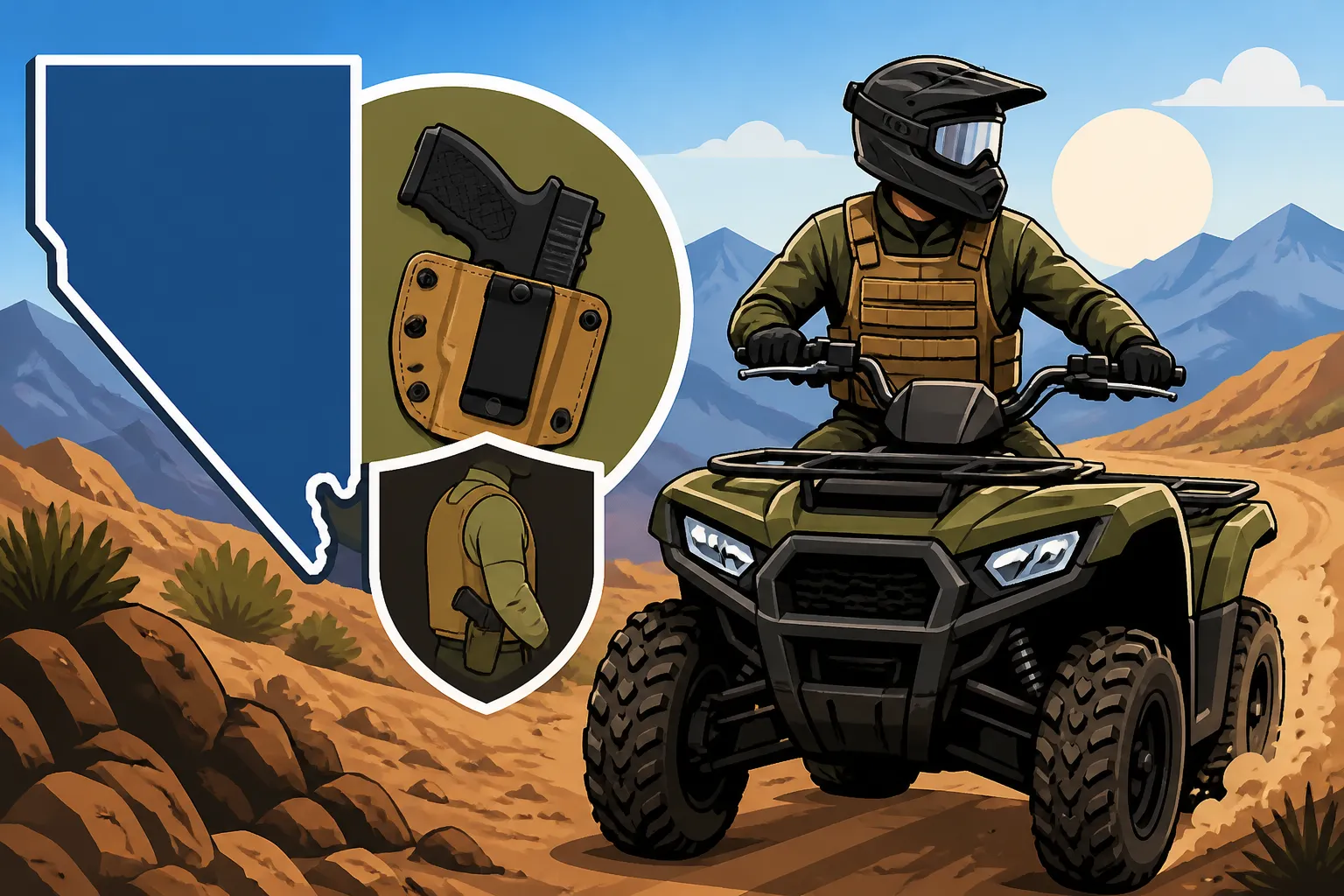
For handguns, a secure holster, either on your person or mounted within the vehicle, is key. If you're carrying on your person, ensure the holster retains the firearm securely, especially with the vibrations and bumps of off-road riding. If mounted in the vehicle, consider a lockable box or a secure mount that keeps the firearm out of sight and reach of unauthorized individuals, especially if you step away from your machine. Dust and moisture are constant companions in the Nevada desert, so choose storage solutions that offer some level of protection from the elements to keep your firearm in good working order.
Loaded Versus Unloaded Rules and Off-Highway Use
This is perhaps one of the most misunderstood aspects of firearm carry, particularly when hunting. Nevada law, under NRS 503.165, generally prohibits carrying a loaded rifle or shotgun in or on any vehicle standing on or along a public highway or road. The critical phrase here is "public highway or road." For handguns, a loaded handgun is generally permitted in a vehicle without a permit, as long as the carrier isn't otherwise prohibited from possessing a firearm.
However, when you're off the pavement, things can differ. While traversing designated trails or open BLM land, away from established roads and highways, some interpretations suggest that the "loaded rifle/shotgun in vehicle" rule might not strictly apply in the same way it would on, say, [Nevada's 2-Mile Limit on Paved Highway]. But here's the crucial caveat: if you are actively hunting, or if the area is considered a "way" that functions like a road, law enforcement may still interpret the rule broadly.
To avoid any doubt, especially if you're hunting, many experienced riders choose to transport long guns unloaded, with ammunition stored separately. This is a common best practice to avoid potential issues. For self-defense handguns, if you possess a concealed firearm permit (CFP), you can carry it loaded and concealed on your person or within the vehicle. If you're open carrying a handgun, it can generally be loaded. When in doubt, it's always safer to err on the side of caution with loaded long guns when moving on any path that could be considered a "road" by authorities.
Navigating Hunting Regulations and Firearm Carry on OHVs
Nevada is a prime destination for hunting, and OHVs are an indispensable tool for accessing remote areas. However, the convenience of an ATV or UTV comes with specific responsibilities and regulations when combined with hunting, especially concerning firearms.
Using OHVs for Hunting: What's Allowed and What's Not
The Nevada Department of Wildlife (NDOW) is very clear on certain aspects of hunting with OHVs. A fundamental rule is that you cannot shoot at, from, or over a vehicle, including an ATV or UTV. This means your firearm must be completely dismounted from the vehicle and you must be off the machine before taking a shot. Furthermore, you cannot pursue, harass, or herd wildlife with an OHV. Your machine is for transportation to and from your hunting spot, or for retrieving game, not as an active part of the hunt itself.
Think of it this way: your OHV is like a motorized pack mule, not a hunting blind or a weapon platform. While [Nevada Rules for Hunting From an ATV] often focus on the methods of taking game, they inherently restrict how firearms are used in conjunction with your vehicle. The temptation to take a quick shot from the seat of your UTV might arise, but resisting that urge is paramount to staying within the law and maintaining ethical hunting practices. Remember that these regulations are in place to ensure fair chase and public safety.
Transporting Game and Firearms Together
Once you've successfully harvested an animal, your OHV becomes invaluable for getting it out of the backcountry. When transporting both game and firearms, the same general firearm safety rules apply, but with the added context of your successful hunt. Ensure your firearm is unloaded, and ideally, cased or in a scabbard. Ammunition should be stored separately. This prevents any accidental discharge during transport and keeps the firearm clean and protected from blood or debris from the game.
When it comes to the game itself, ensure it's properly tagged as required by NDOW regulations. Many UTVs, especially utility models, come with cargo beds perfect for game transport. If you're using an ATV, you'll want a secure rack system or even a small trailer to ensure the game is transported respectfully and safely. Always think about the total weight capacity of your machine and any trailer you're towing. Overloading can be dangerous and could lead to an accident, potentially damaging your firearm or even leading to serious injury.
Common Misconceptions and Best Practices
The intersection of OHV use, public land, and firearm carry can be a labyrinth of rules and unwritten expectations. Dispelling common myths and adopting best practices will not only keep you legal but also ensure a safer and more enjoyable experience for everyone on the trails.
The "Open Carry is Always Okay" Myth
While Nevada is indeed an open-carry state, the idea that "open carry is always okay, everywhere" is a dangerous oversimplification, especially when you factor in OHVs and public lands. As discussed, specific restrictions apply in certain areas like state parks or federal buildings. More importantly, how you carry and interact with others can significantly impact your experience. Even if legal, carrying a large rifle prominently displayed in a crowded OHV staging area might attract unwanted attention or create discomfort for other recreationists, even if they are not anti-gun.
Law enforcement officers, like a Nevada Trooper on a county road, are trained to look for certain indicators. While they recognize the right to carry, any actions that appear unsafe, reckless, or indicative of impaired judgment (such as [Nevada DUI Rules for ATV Riders]) will rightly draw their scrutiny. If you are stopped, remain calm, keep your hands visible, and inform the officer if you have a firearm and where it is located. Always follow their instructions. Being polite and cooperative can go a long way in de-escalating any situation and ensuring a smooth interaction. It's not about hiding your firearm, but about exercising your rights responsibly and respectfully.
Responsible Firearm Ownership and OHV Use
Being a responsible firearm owner means more than just knowing the letter of the law; it's about embracing a culture of safety, continuous learning, and respect for the environment and others. Before every trip, especially if you're venturing into a new area or during hunting season, take the time to re-familiarize yourself with current regulations. Laws can change, and interpretations can evolve. A quick check of the NDOW website or the local BLM field office can save you a lot of headaches.
Proper training is also crucial. If you're carrying a firearm for self-defense, regular practice and proficiency are non-negotiable. Understand how your chosen firearm operates, how to clear malfunctions, and how to safely handle it under stress. When it comes to storage on your OHV, invest in quality gear. For example, SuperATV offers rugged cargo boxes and secure gun mounts that not only protect your firearm from the elements but also keep it stable and safe during aggressive riding. These accessories are designed to withstand the harsh desert environment, ensuring your firearm is ready when you need it and safe when you don't. [Nevada Rules for Carrying Fuel Cans] also emphasize safe storage, and similar principles apply to firearms: keep them secure, protected, and readily accessible but not carelessly exposed.
Always remember the bigger picture of OHV etiquette. This includes staying on designated trails, respecting [Nevada Rules for Opening and Closing Gates] on private or ranch land, and being mindful of other users. Combining safe firearm practices with responsible OHV use ensures that you, and everyone else, can enjoy Nevada's incredible outdoors.
Firearm Carry on OHVs: Do's and Don'ts in Nevada
To help summarize the key takeaways, here's a quick reference table of do's and don'ts for carrying a firearm on your ATV or UTV in Nevada. Remember, this is general guidance, and specific circumstances can always vary.
| DO | DON'T |
|---|---|
| Know the specific laws for your riding area (state, federal, WMA, private). | Shoot from your OHV or any vehicle. |
| Carry openly if you are legally permitted and the firearm is visible. | Pursue or harass wildlife with your OHV. |
| Secure your firearm in a scabbard, gun boot, or quality holster. | Overload your OHV when transporting firearms and game. |
| Transport long guns unloaded with ammunition separate, especially when hunting or on ambiguous roads. | Assume all state parks or federal lands allow the same carry rules. |
| Possess a valid CFP for concealed carry. | Be uncooperative with law enforcement during a stop. |
| Check NDOW regulations if you are hunting. | Ride off-trail or trespass on private land, especially while armed. |
| Inform law enforcement if you have a firearm during a stop and follow instructions. | Carry an unsecured firearm that could fall out or become damaged. |
| Protect your firearm from dust, moisture, and impact with proper cases/mounts. | Ignore your OHV's registration and titling requirements, as these are part of overall compliance. |
Always remember that safety and legal compliance go hand-in-hand. By taking the time to understand and follow these guidelines, you can ensure your Nevada OHV adventures remain both thrilling and trouble-free. [Nevada OHV Registration Paperwork Checklist] and understanding all your responsibilities as an OHV owner are crucial components of this freedom.
Disclaimer
This article is for general informational purposes only and does not constitute professional advice. Laws, prices and regulations vary by location and change over time. Consult a qualified professional for guidance on your specific situation.