Riding Nevada on a Utah Registration
A Utah registration can make a Nevada ride simpler, but it does not mean every machine is covered indefinitely or can go anywhere. The key questions are whether the Utah registration is current, whether you qualify for Nevada’s nonresident exemption, and how long you plan to ride. Here’s how to check those points, prepare your paperwork, and avoid confusing trail access with road legality.
The short answer: a Utah registration may cover a visitor temporarily
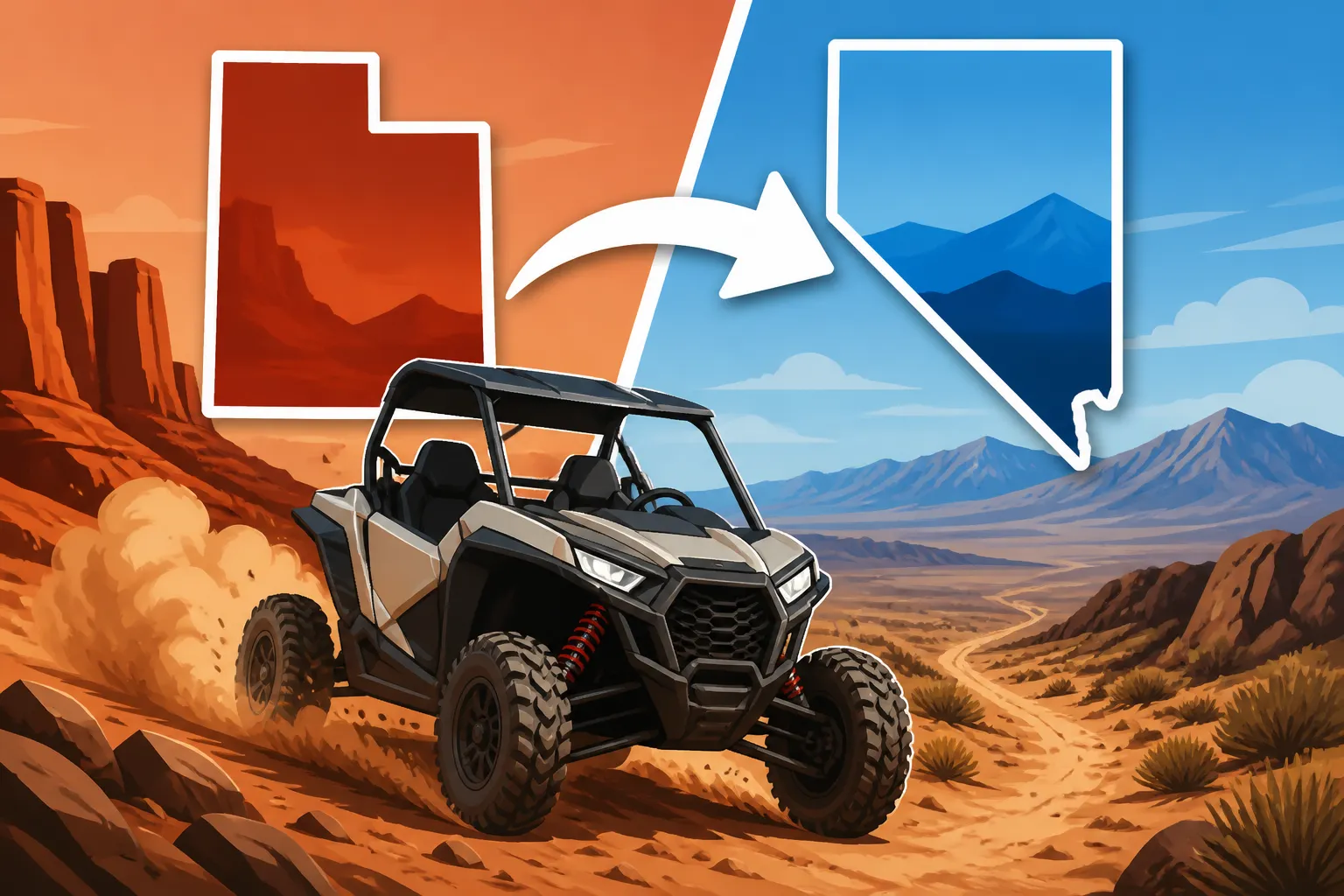
If you are a Utah resident visiting Nevada with an off-highway vehicle that is properly registered in Utah, Nevada may allow you to ride under its nonresident exemption for a limited period. Nevada’s exemption is generally described as a 15-day window. It is not a permanent substitute for Nevada registration, and it does not automatically apply to every rider or every machine.
The practical answer is: bring proof that the machine’s Utah registration is valid, make sure the registration applies to that specific machine, and confirm Nevada’s current exemption rules before you travel. If your stay or use falls outside the exemption, you may need a Nevada OHV decal instead. The details of reciprocity are covered in Nevada Reciprocity With Utah and Nevada’s 15-Day Window for Out-of-State Machines.
A Utah sticker by itself is not a universal permission slip. It may help establish that your machine is registered in Utah, but you still need to satisfy Nevada’s conditions. Your residency, the machine’s status, and the length of time it is operated in Nevada can all matter.
Keep these distinctions in mind:
- A Utah registration is evidence of registration in Utah. It does not prove that the rider qualifies for Nevada’s visitor exemption.
- The visitor exemption is limited. A machine staying in Nevada longer than the allowed period may need Nevada registration.
- Registration does not make every route legal. It does not open a closed trail, authorize cross-country travel where it is prohibited, or make an off-road machine legal for general road use.
- A rental or borrowed machine is a different situation. Ask the owner or rental company what paperwork applies rather than assuming your personal Utah registration covers it.
Nevada’s OHV decal serves as registration and a riding permit for machines that must be registered there. That is why it helps to distinguish a Nevada decal from a separate trail pass. Learn what the decal does and does not establish in What a Nevada OHV Decal Actually Proves.
If you are a Nevada resident, do not assume you can keep using a Utah registration to avoid Nevada’s requirements. The nonresident exemption is intended for qualifying visitors, not as a workaround for a resident’s registration obligation. If your residency or ownership situation is complicated, check with the Nevada OHV program before riding.
Check that the machine and rider qualify
Before counting on reciprocity, verify both sides of the arrangement: the Utah registration must be valid for the machine, and you must fit Nevada’s nonresident rules.
Confirm the Utah paperwork is current
Check the registration document and the machine’s registration decal. The information should match the vehicle you are bringing, including identifying details such as the VIN or serial number where those appear. A decal that is faded, damaged, expired, or attached to a different machine can create questions during a roadside check.
Carry the registration card or official document, not just a photo of the sticker. A photograph can be useful as a backup, but it may not replace the original paperwork if an officer needs to inspect it. Also bring proof of ownership, such as a title or bill of sale, if you have it. That can help resolve a mismatch, a recent purchase, or a question about who is authorized to operate the machine.
If you recently bought the ATV or UTV, check that the registration has actually been transferred or issued for you. A seller’s old paperwork may not establish that the machine is currently registered to the new owner. When the title or ownership documents are incomplete, see Nevada OHV Registration and Proof of Ownership for the broader paperwork issues.
Confirm your nonresident status
The exemption is for eligible nonresidents. If you live in Nevada, recently moved there, or maintain more than one residence, do not rely on a Utah plate or sticker alone to establish that you qualify as a visitor. A machine’s registration state and its owner’s residency are related facts, but they are not necessarily the same thing.
A person may also be borrowing a Utah-registered machine while living in Nevada. In that situation, the owner’s Utah registration does not automatically settle whether the operator or machine is eligible for the exemption. Check the rules for your particular arrangement before using the machine on Nevada public land.
For people who have moved from Utah to Nevada, this is a transition issue rather than a visitor issue. Nevada may require you to register the machine locally after you establish residency or otherwise become subject to its requirements. The relevant process is explained in Nevada OHV Registration After Moving to the State.
Be careful with machines that are exempt or unusual in Utah
A Utah document may not mean what you think it means. Some machines may have different registration categories, limited-use status, or an exemption under Utah rules. If you are unsure whether the paperwork is a full registration recognized for the purpose of Nevada reciprocity, ask the issuing Utah authority and confirm Nevada’s requirements.
This matters especially for:
- A machine used only on private property in Utah
- A recently purchased machine with temporary or incomplete paperwork
- A homebuilt or modified vehicle
- A machine with a VIN or serial number that is missing, altered, or difficult to read
- A machine registered under a category that differs from ordinary OHV registration
Do not assume that a Utah sticker, a dealer document, or proof of a purchase is interchangeable with a valid registration. If the paperwork does not clearly identify the machine as currently registered, resolve that before your trip.
Know how the 15-day window affects your trip
The 15-day window is the point visitors most often overlook. It is a limited exemption, not a season-long pass. If your trip is short, the Utah registration may be enough under Nevada’s visitor rules. If the machine will remain in Nevada or be operated there beyond the allowed period, plan ahead rather than waiting for a check to raise the issue.
A practical way to think about the exemption is:
| Your situation | What to check |
|---|---|
| Short visit from Utah | Confirm the Utah registration is current and that you qualify as a nonresident under Nevada’s rules. |
| Extended stay or repeated riding | Confirm how Nevada counts the allowed days and whether you need a Nevada decal once the exemption no longer applies. |
| Move to Nevada | Treat this as a residency and registration question, not simply a visitor trip. |
| Machine recently purchased | Verify that the registration and ownership documents match the new owner and machine. |
| Borrowed or rented machine | Ask the owner or rental company what registration and operating documents must accompany it. |
| Riding on roads | Check road-use rules separately; OHV registration alone does not make an ATV or UTV street legal. |
Do not guess at when the days start, whether separate visits combine, or whether leaving Nevada resets the count. Those are the kinds of details that can depend on the current rule and the facts of your trip. Confirm them with the Nevada OHV program before you rely on a particular interpretation. When a Visitor’s 15 Days Start Counting and What a Visitor Does After 15 Days in Nevada address those timing questions.
It is sensible to record your arrival date and keep travel records if you expect to be near the limit. That is not a substitute for meeting the rule, but it can help you explain your timeline. If you know in advance that your trip may run long, ask about Nevada registration before departure. Do not treat a grace period as automatic unless the official rule specifically provides one for your situation.
Visitors sometimes plan several separate riding weekends and assume each one starts a fresh clock. Do not build your plan around that assumption. Ask how Nevada counts the time and whether the exemption is tied to consecutive days, total days, or another measure. The safe approach is to get the answer for your exact schedule and keep a record.
The exemption also should not be confused with the cost or process of obtaining a Nevada decal. If you need a Nevada permit, check current requirements and figures with the official source; fees and procedures can change. Nevada Nonresident ATV Permit Cost explains the cost question, while Nevada OHV Registration Paperwork Checklist can help you organize the documents for an application.
Carry useful documents and keep the ride within its rules
A roadside check is easier when your documents are organized and readable. Keep the registration paperwork where you can reach it without unloading gear or digging through a dusty storage compartment.
A useful document set includes:
- Current Utah registration documentation. Carry the official document for the machine, not only a picture of its decal.
- Proof of ownership or permission to use it. A title, bill of sale, or written authorization can help if the registered owner is not riding.
- Identification. Keep your driver’s license or other appropriate identification with you.
- Insurance information, where applicable. Off-road registration and road-use insurance are separate questions. If you intend to use roads, check the insurance rules for that use.
- A backup copy. A clear phone photo or scan can help if the paper copy gets wet or damaged, but treat it as a backup rather than a guaranteed replacement.
A small waterproof document pouch can keep paper from becoming wet, sandy, or unreadable. If you shop through Amazon or another retailer, check the pouch’s seal and size rather than relying on a product description alone. Amazon listings can also be useful for comparing phone mounts or compact storage options, but confirm that a mount fits your machine and will stay secure over rough terrain. A phone should not be your only copy of registration paperwork.
Store a backup image somewhere accessible offline. Cell service can disappear quickly outside town, and cloud storage is not much help if you cannot connect. If your machine has a lockable compartment, use it, but avoid leaving originals exposed where they can blow out or get soaked.
Before setting out, check the route and land-management rules. A valid Utah registration does not grant access to every public road, trail, dune, or open area. Federal, state, county, and local land managers may have different route designations, seasonal closures, and travel restrictions. Review Nevada Rules for Riding Federal Land and consult the current map or land manager for the specific place you plan to visit.
Keep the machine on routes open to OHVs, obey closures, and do not assume that a visible track is an authorized trail. Desert routes can cross private land, protected habitat, or areas closed to motorized use. Registration is one part of a legal ride; route choice is another.
Registration and road use are not the same
A Nevada OHV decal or Utah registration does not automatically make an ATV or UTV legal for ordinary road travel. Rules for riding county roads, crossing a highway, or traveling on paved surfaces are separate. A machine may need specific equipment, insurance, a qualifying vehicle configuration, or a road-use decal, depending on where and how it is operated.
If your plan includes a road segment, check the rules for that specific road and machine before you ride. Do not rely on a trail map to prove road access, and do not assume that an out-of-state plate or registration overrides Nevada road restrictions. Start with Are ATVs Street Legal in Nevada? and the applicable county or local guidance.
This separation matters even when the ride seems brief. A legal crossing, a short route on an approved county road, and riding along a highway shoulder are not necessarily treated alike. Confirm the rule before planning a route that connects a staging area to a trail by road.
If your Utah registration is not enough
If you discover that the Utah registration has expired, does not apply to your machine, or does not cover your Nevada stay, pause and confirm the next step before riding. The right fix depends on whether you are a visitor, a new Nevada resident, an owner with a title problem, or someone using a machine owned by another person.
For a visitor who expects to stay beyond Nevada’s exemption, ask the Nevada OHV program what registration is required and what documents it will accept. Do not assume that a Utah registration can simply be extended or that a Nevada decal will be issued without ownership paperwork. If the machine has no Nevada title, the procedure may depend on its history and documentation; Nevada OHV Registration Without a Title explains why that situation needs separate attention.
If the problem is a recent purchase, gather the bill of sale, title, registration record, and any available VIN documentation. Make sure the numbers on the machine and paperwork agree. A discrepancy is easier to address before the vehicle is in the field than during a roadside inspection or registration application.
If the paperwork is incomplete, avoid trying to solve the issue by borrowing another machine’s decal or keeping an old sticker on the vehicle. The decal and registration documents should correspond to the machine being operated. A mismatch can create enforcement and ownership problems even if you bought the machine in good faith.
For a machine that is staying in Nevada long term, get the current requirements directly from the appropriate state office. The application process may involve proof of ownership, a VIN check, or other documentation, depending on the machine and its history. Requirements and fees can change, so use the current official instructions rather than an old checklist from a seller or online forum.
Before leaving home, run through this final checklist:
- Is the Utah registration current?
- Does it identify the exact machine you are bringing?
- Are you a nonresident who qualifies for Nevada’s exemption?
- Have you confirmed how the limited period is counted for your travel dates?
- Will the machine remain or be ridden in Nevada beyond that period?
- Do you have the official registration document and useful ownership paperwork?
- Have you checked the rules for the routes and land you plan to ride?
- If you plan to ride any road, have you checked road legality separately?
If any answer is uncertain, confirm it before the trip. A quick paperwork check at home is far less disruptive than arriving at a trailhead and discovering that the machine cannot legally be operated there.
Disclaimer
This article is for general informational purposes only and does not constitute professional advice. Laws, prices and regulations vary by location and change over time. Consult a qualified professional for guidance on your specific situation.