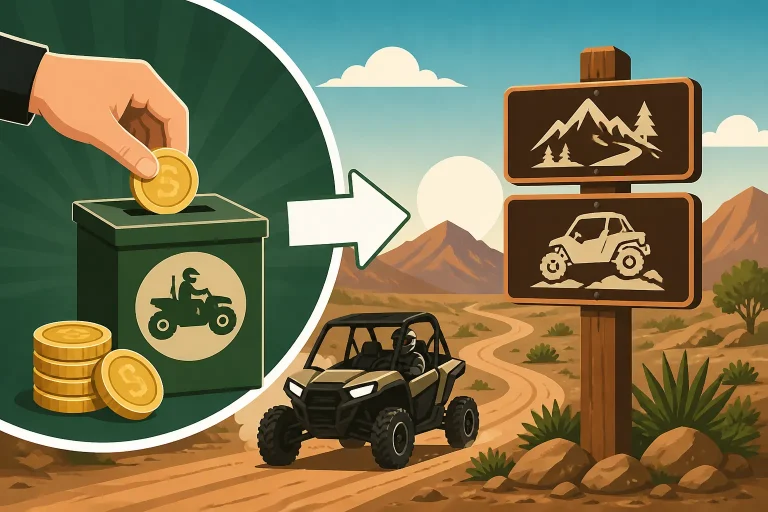
Grants That Built the Logandale Facilities
Logandale Trails is known for its broad riding area and desert scenery, but useful facilities such as restrooms and trailhead improvements also need funding. Nevada OHV grants help turn rider registration revenue into projects on the ground. Here’s how that funding works, what it can support at Logandale, and how riders can distinguish a grant’s contribution from the full cost of a facility.
How Nevada OHV grants support places like Logandale
Nevada’s OHV grant program directs funding toward projects that improve off-highway vehicle recreation. The Nevada Commission on Off-Highway Vehicles reviews and awards grants, while applicants may include public agencies and other eligible organizations. A project can address practical needs such as signs, facilities, access improvements, or trail work.
The money comes from Nevada OHV registration revenue. Riders can follow the connection from registration to grant funding through Where Nevada OHV Registration Money Goes and Nevada OHV Grant Program Explained. The key point is that registration supports more than an individual machine’s paperwork: a portion of the system helps fund recreation projects.
At Logandale, developed facilities are a visible example of what this funding can help provide. Restrooms, for instance, serve riders who spend time at the area and make a day trip more practical. The broader setting is described in Logandale Trails Outside Las Vegas, while Where Logandale’s Restrooms Came From focuses on the restroom project itself.
A grant award does not necessarily mean that a single grant paid every cost associated with a facility. A project may involve planning, construction, installation, upkeep, or other work funded through different sources. Awards can also be combined with local contributions or other public funding. Without the project’s award record, it is safer to say that a grant supported a facility than to assume it covered the whole project.
| Part of the funding picture | What it means for riders |
|---|---|
| OHV registration revenue | Helps support the state’s grant program and recreation projects |
| Grant award | Provides funding for an approved project, which may cover only part of its total cost |
| Applicant or project partner | May carry out the work and contribute staff, services, funds, or other support |
| Facility maintenance | May require separate planning and funding after construction |
| Rider use | Benefits from facilities, signs, and improvements, but does not determine where every grant dollar goes |
This is one reason grant descriptions can sound different from what a rider sees on the ground. A state award may support a particular phase or component, while a local partner handles other work. The final facility is the result of a project, not necessarily a direct one-to-one purchase from registration dollars.
For a wider view of how the Commission allocates program funds, see Why the Commission Spends What the DMV Collects. For the connection between decal revenue and trail improvements, Decal Money and Trail Maintenance explains why some funding supports projects beyond the registration counter.
What a grant can pay for—and what it does not promise
OHV grants are intended for projects that serve off-highway recreation, but the details depend on the proposal and award. A project might improve a trailhead, add or upgrade visitor facilities, provide signs, or support work that helps riders use an area responsibly. At Logandale, restrooms are an especially easy improvement to notice because they serve riders directly.
That does not mean every useful amenity at a riding area is grant-funded, or that grant money covers every expense from planning through long-term upkeep. A facility may have separate costs for design, construction, site preparation, access, installation, and maintenance. Different partners may contribute to different stages.
It also helps to separate a grant award from a general promise that an area will receive ongoing funding. An award is associated with an approved project and its scope. Routine cleaning, repairs, replacement, or future upgrades may require a different budget or a new funding decision. A restroom can be built with grant support and still need regular care afterward.
How to read a project description
When you encounter a statement that a grant “built” or “funded” a facility, look for the details behind that summary:
- Identify the project and location. Check whether the record names Logandale, the specific site, or a particular facility. Similar-sounding projects can involve different places or work.
- Find the applicant and partners. The organization receiving or administering an award may not be the only contributor. Partners can provide labor, services, land access, or other support.
- Check the project scope. An award may pay for construction, planning, signs, or another defined part of the work. It may not cover the complete facility.
- Separate the award from total project cost. If the record lists both, treat them as different figures. A grant award is not automatically the full cost.
- Look for completion and maintenance information. Funding approval, construction, and long-term upkeep are separate stages.
These checks matter because short summaries often compress a more complicated funding history. A grant can be an important reason a facility exists without being its only source of support. The project record is the best way to confirm what the award was meant to accomplish.
The same distinction applies to other public improvements. A registration decal does not itself guarantee that a particular trail or restroom will be built. Revenue is distributed through a program, and awards go to projects that meet its requirements. What Trail Money Comes Out of a Decal Sale gives more context on the path from a decal sale to recreation spending.
What Logandale’s grant-funded facilities mean for a ride
For a rider, the clearest benefit is practical: a developed facility can make an outing more comfortable and help a busy recreation area serve visitors. Restrooms and other site improvements can support longer stays and make the experience easier for families and groups. Signs and trailhead improvements can also help riders orient themselves and understand how to use an area.
But facilities do not replace trip planning. Logandale is a desert riding area, and access to a restroom should not be mistaken for access to drinking water, fuel, cell service, or full visitor services. Check current local information before leaving, bring enough water for your group, and plan for conditions to change. Logandale Trails Camping Spots and Nevada OHV Areas With Vault Toilets can help with related planning questions.
Grant-funded improvements also do not change the basic rules for operating a machine. Riders still need to use routes that are open, respect signs and closures, and follow applicable registration requirements. Nevada’s registration decal serves as the state’s OHV permit for covered machines; a facility grant is not a separate riding permit. For more on that connection, see Nevada’s Registration Decal as Your Permit and Nevada Permits for Riding BLM Land.
Visitors bringing an out-of-state machine should check whether their existing registration qualifies under Nevada’s rules and how long any exemption applies. A restroom or trailhead project does not change reciprocity requirements. Nevada OHV Reciprocity With Other States and Nevada’s 15-Day Window for Out-of-State Machines cover those separate questions.
A useful way to think about the grant is as support for the shared recreation setting, not as a promise about an individual ride. Registration revenue enters a public funding system; the Commission awards grants for eligible projects; and applicants and partners carry out the approved work. Riders benefit when those projects improve access or facilities, while still needing to verify current conditions and plan for what the site does not provide.
If you want to understand the project beyond a short description, look for the award record or project summary and compare its scope with the facility on site. That can clarify whether the grant supported construction, a particular upgrade, or another part of the work. It also prevents overreading a headline as proof that one grant paid for every feature or all future maintenance.
Disclaimer
This article is for general informational purposes only and does not constitute professional advice. Laws, prices and regulations vary by location and change over time. Consult a qualified professional for guidance on your specific situation.