Which Online ATV Safety Course Nevada Recommends
If you are looking for an online ATV safety course before riding in Nevada, the main question is whether the state requires a particular certificate. Nevada does not designate one statewide course as mandatory. For voluntary training, match the course to your machine: an ATV course for a quad, or a UTV course for a side-by-side. A certificate can support safer riding, but it does not replace registration or permission to ride.
Does Nevada Recommend or Require an Online Course?
Nevada does not require every ATV or UTV rider to complete a statewide safety course, and it does not designate one online course that all riders must take. So if you are asking which course Nevada officially requires, the practical answer is that there is no single state-mandated online course.
That does not make training unnecessary. A course can help new riders understand controls, terrain, protective gear, and how to avoid common crashes. It can also give parents and supervising adults a useful way to talk through riding decisions before a child or beginner gets on a machine. The distinction is that voluntary education is not the same thing as a legal requirement.
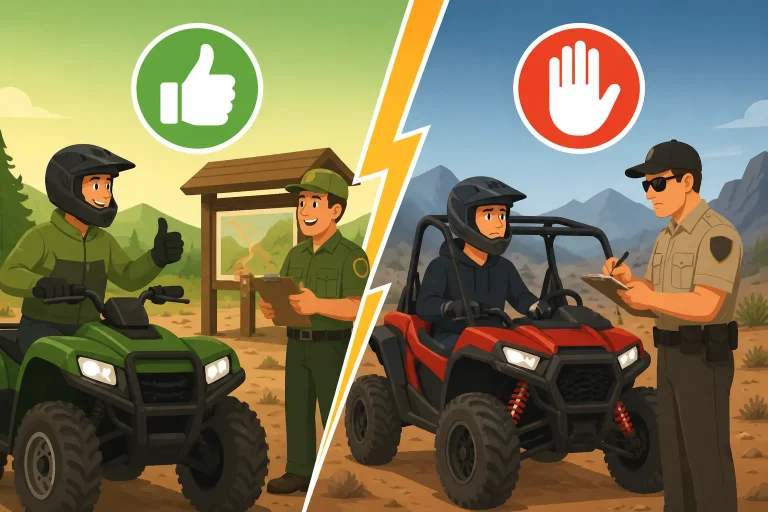
Do not treat a course certificate as a permit to ride. Completing a class does not by itself register a machine, authorize access to a trail, or satisfy every rule that might apply to a specific site or event. Nevada’s OHV decal and out-of-state registration rules are separate from rider education. For the registration side, see Nevada’s Registration Decal as Your Permit and Riding Nevada With an Out-of-State Registration.
A course provider may describe its program as recognized, approved, or suitable for riders in a particular setting. Read those statements carefully. A provider’s own course description is not proof that Nevada requires or endorses its program. If a school, employer, organized ride, rental company, or event asks for training, ask that organization which course it accepts and what documentation it needs.
For a broader look at the state’s training rules, see Nevada Has No Mandatory Safety Course. If you are choosing a course for a young rider, also check Nevada ATV Safety Certificate for Minors and Nevada Safety Courses and Nevada Riders for related considerations. Requirements can depend on the rider, activity, and location, so verify the rule that applies to your actual ride rather than relying on a course advertisement.
Which Course Fits Your Machine?
A good starting point is to choose training made for the type of vehicle you plan to ride. ATVs and UTVs are both off-highway vehicles, but they have different controls, seating, handling, and passenger considerations. A course that addresses one machine may not cover the other in enough detail.
| Machine or rider need | Course type to look for | What it should cover |
|---|---|---|
| ATV or quad | ATV-focused course, such as the ATV Safety Institute e-course | Rider position, throttle and braking, turning, hills, obstacles, and protective equipment |
| Side-by-side or UTV | UTV or recreational off-highway vehicle course, such as a ROHVA course | Seat belts, handholds, passenger behavior, rollover awareness, and terrain choices |
| Young or first-time rider | Course appropriate to the rider’s age, paired with adult supervision and practice | Basic controls, riding limits, protective gear, and when to stop |
| Rider planning a specific event or program | The course named or accepted by the organizer | The organizer’s documentation and any activity-specific topics |
The ATV Safety Institute, commonly called ASI, offers ATV safety education, including online learning. For a quad, look for training that is clearly designed for ATV operation rather than assuming a general outdoor safety class covers the same skills. A course should discuss how rider movement affects balance and turning, because an ATV is controlled differently from a car or a side-by-side.
For a UTV, look for training aimed at recreational off-highway vehicles. The Recreational Off-Highway Vehicle Association, or ROHVA, provides UTV-focused safety education. A UTV course should address how occupants use seat belts and handholds, how passengers should sit, and why a driver should adjust speed to the surface and slope. A certificate from an ATV-only course may not cover those details.
The names above are useful places to begin, not a claim that Nevada requires either provider. Course offerings and completion documents can change, so check the provider’s current course description before enrolling. Make sure the course is online if that matters to you, that it covers your machine, and that you understand what certificate or record it issues.
Some courses are designed mainly to teach foundational safety concepts. They cannot show whether a rider can control a machine on a steep, loose, or uneven trail. Online learning is best treated as preparation for practical instruction, not as a substitute for supervised practice. The distinction matters especially for first-time riders and children.
If you are riding a rental machine, ask the rental company what orientation it provides and whether it expects any prior training. A company’s rules may be more specific than Nevada’s general statewide training requirements. See Nevada Rules for Renting a Machine for the separate questions that can apply to rentals.
What an Online Course Can and Cannot Do
A useful online course gives riders time to learn basic concepts before they are managing a moving machine. It can explain safe habits in a structured way, make unfamiliar terms easier to understand, and help a family agree on simple rules. But a course cannot assess your ability to handle a particular ATV or UTV, and it cannot account for every trail condition you may encounter.
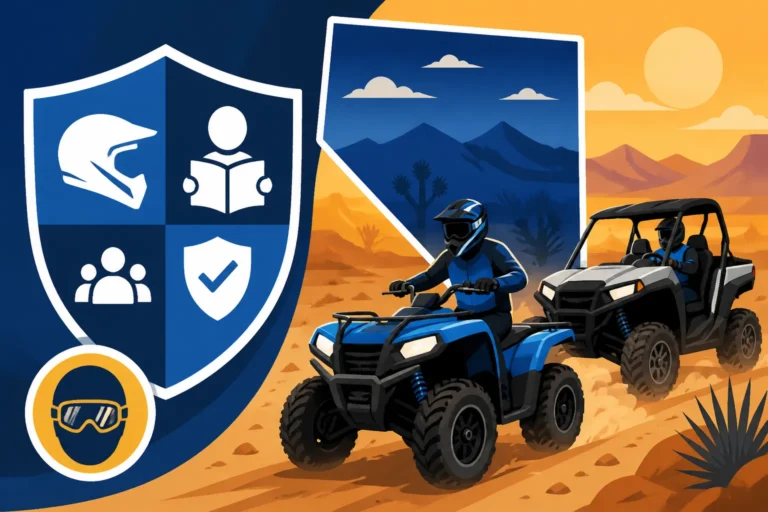
Look for a course that does more than list rules. Strong training should explain why a practice matters and give examples of how a rider might use it. For example, it should connect speed to visibility and stopping distance, explain how passengers affect a UTV, and describe how to respond when terrain becomes steeper or looser than expected. It should also encourage riders to stop, turn around, or choose another route when conditions exceed their skill.
Before enrolling, check these points:
- Vehicle match: Confirm whether the material is for an ATV, a UTV, or both. Do not assume the word “off-road” means it covers every kind of machine.
- Rider level: Check whether the material is suitable for a first-time rider or whether it assumes previous experience.
- Core subjects: Look for instruction on protective gear, pre-ride checks, controls, terrain, passengers, and responsible riding.
- Completion record: Find out whether the provider issues a certificate or other record, and what information it includes.
- Acceptance: If a school, group, company, or event requires proof, ask whether it accepts that specific course before you take it.
- Practice: Plan a supervised riding session in a suitable area. Reading about a maneuver is not the same as performing it safely.
A certificate can be useful as a record that a rider completed a course. It should not be presented as a Nevada registration document, a trail permit, or proof that a particular route is open. Those are separate questions. A registered machine may still be barred from a closed route, and a trained rider still needs to follow land-use rules. For related planning, see Nevada Rules for Riding Federal Land and Nevada Rules for Riding a Closed Route.
The same caution applies to a course marketed for minors. An online certificate does not automatically establish that a child is old enough to ride a specific machine, has adequate supervision, or may operate on a particular public route. Check the applicable youth rules and the machine manufacturer’s age and size guidance. A child who has completed a course still needs an adult to make a realistic judgment about their coordination, attention, and ability to follow instructions.
Online learning also has limits in Nevada’s varied riding conditions. A course can explain general hazards, but riders still need to plan for the place and day: loose sand, rocks, dust, heat, changing weather, and limited services can affect a ride. Training does not make a route suitable for a beginner. Use local maps and current land information, and choose terrain that fits the least experienced person in the group.
How to Use the Course Before a Nevada Ride
Treat the course as one part of preparation. First, confirm that your machine is allowed where you plan to ride and that its paperwork is in order. Nevada’s registration decal, a valid out-of-state registration, and site-specific access rules are not interchangeable with a safety certificate. Visitors can start with Nonresident Riders in Nevada and Nevada OHV Reciprocity With Other States to understand the separate registration questions.
Next, set aside time to practice in a legal, low-pressure area. Begin with the controls and basic starts and stops, then work on turning and managing speed on forgiving ground. Keep the practice area free of traffic and obstacles, and follow the vehicle maker’s instructions. For a UTV, have everyone use the available occupant restraints and stay seated as intended. For an ATV, do not carry passengers unless the machine is designed for them and the manufacturer allows it.
Before setting out, review the route with the group. Agree on a turnaround point, a pace that suits the least experienced rider, and a way to regroup if the group becomes separated. A beginner should not be pressured to follow faster riders into difficult terrain. If the machine, surface, or route feels beyond the rider’s current ability, stopping or choosing an easier route is a sound safety decision.
A practical preparation sequence is:
- Choose an ATV or UTV course that matches the machine.
- Complete the online material and save the completion record if one is provided.
- Check whether the school, organizer, rental company, or event accepts that course if it has requested training proof.
- Review the machine’s manual and inspect the vehicle before riding.
- Practice basic control under appropriate supervision.
- Confirm registration, access, route conditions, and any site-specific rules.
- Reassess the plan if weather, visibility, fatigue, or terrain changes.
If you are taking a child, use the course to begin a conversation rather than treating it as a pass/fail test that settles the matter. Ask the rider to explain key safety choices in their own words, then observe how they respond during practice. A child who can repeat a rule may still need time to develop the judgment and coordination to apply it while riding.
The main takeaway is simple: Nevada does not name one compulsory online ATV safety course for all riders. For voluntary training, choose an ATV-focused course for a quad or a UTV-focused course for a side-by-side, and confirm any separate requirements with the organization or location involved. Then pair the online material with hands-on practice and a route that fits the rider’s experience.
Disclaimer
This article is for general informational purposes only and does not constitute professional advice. Laws, prices and regulations vary by location and change over time. Consult a qualified professional for guidance on your specific situation.