Nevada Rules for Opening and Closing Gates
A gate on a Nevada trail can look like a minor obstacle, but it may be controlling livestock, protecting private property or marking a route boundary. For ATV and UTV riders, the safe approach is to check whether travel is allowed, follow any posted instructions, and leave the gate in the condition required by the owner or land manager. Here’s how to make that decision without guessing.
First, confirm the route is open to you
A gate is not, by itself, proof that a road or trail is open to public riding. An unlocked gate does not grant permission to cross private property, and an open gate does not cancel a posted closure. Before opening anything, confirm that your route allows motorized travel and that you are not crossing a boundary you do not have permission to cross.
This matters in Nevada, where a ride may pass from one kind of land to another. A route can run across public land, private parcels, state trust land or a mixture of them. Access rules may change at a boundary, even when the road looks continuous. A gate, fence, sign or map notation may be the only obvious clue that you need to pause and check.
Before the ride, review the route map and current land-manager information. A Reading a BLM Travel Management Map can help you understand which routes are designated for motorized use, while Calling a BLM Field Office Before a Ride can help resolve questions about a particular route or temporary restriction. If the route crosses private land, get permission rather than treating a gate or track as an invitation. See Nevada Rules for Crossing Private Land and Nevada Trespass Rules for Riders for related access issues.
Watch for signs that describe the gate or route. Follow posted directions about access, closures, seasonal restrictions and gate position. If instructions are missing or unclear, do not assume the gate should be opened. Stop in a safe place and check the route with the landowner or responsible land manager. If you cannot confirm that you are allowed to continue, turn around rather than testing the boundary.
| What you find | Practical response |
|---|---|
| A sign says the route is closed or motorized travel is prohibited | Do not pass, even if the gate is open or unlocked |
| A sign gives specific instructions for the gate | Follow those instructions, unless doing so would create an immediate safety problem |
| A gate is closed but the route is confirmed open | Open it only if you are authorized to pass, then close it as directed or leave it as found |
| A gate is open and the route is confirmed open | Pass carefully; do not assume the gate should be closed behind you |
| A gate is locked, chained or marked private | Do not bypass or tamper with it; use an authorized alternate route |
| The access status is uncertain | Stop and verify before proceeding |
The same caution applies to ranch roads and routes near grazing areas. A road that appears to be a familiar trail may serve a landowner, leaseholder or livestock operation rather than public recreation. Nevada Rules for Riding a Ranch Road You Do Not Own covers that distinction, and Nevada Rules for Riding State Trust Land is useful when a route crosses land with separate access requirements.
Opening and closing a gate without causing trouble
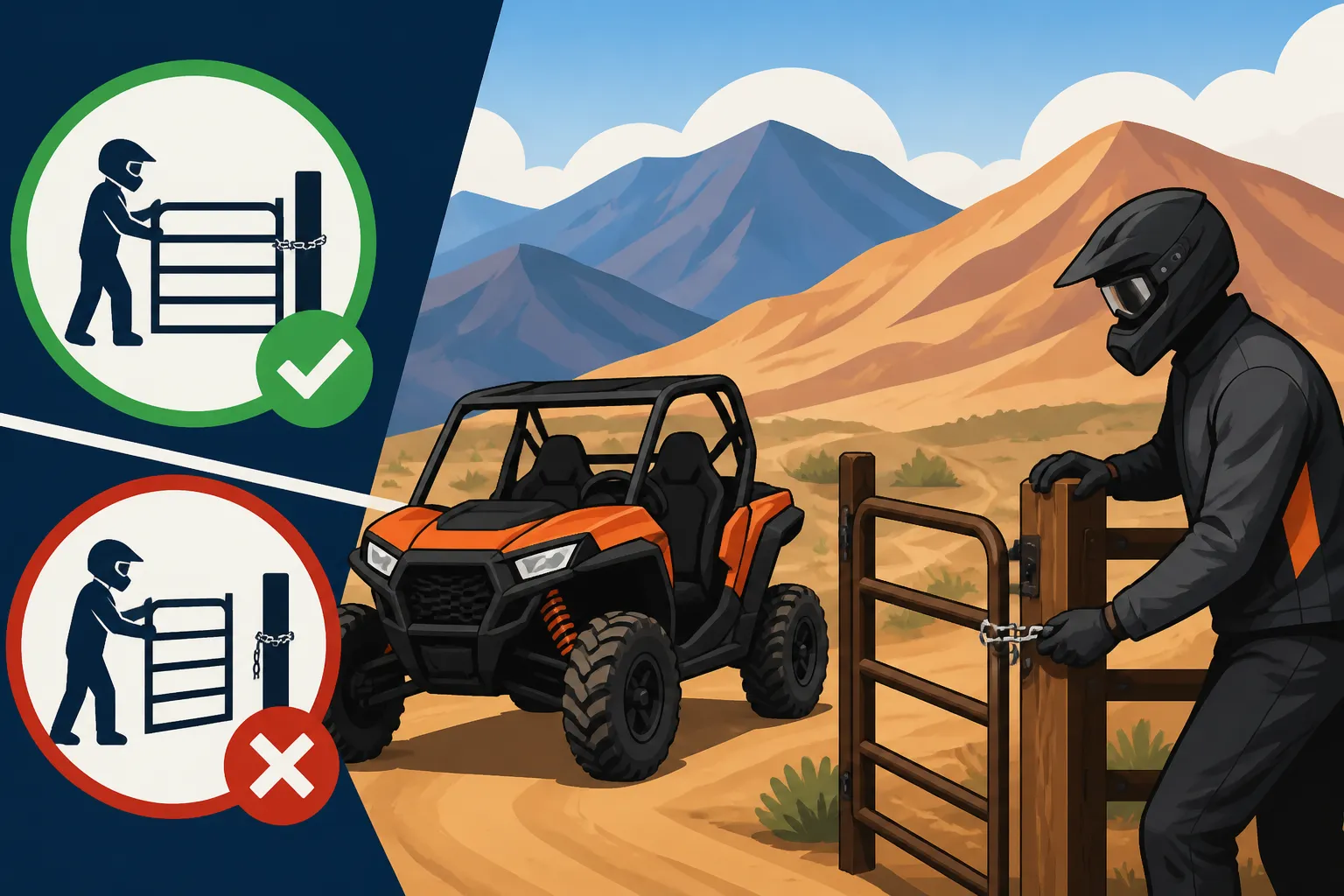
Once you have confirmed that you may pass, use the gate’s posted directions first. If no instructions are posted, the usual practical approach is to leave the gate in the same position you found it: closed when you arrived, closed after you pass; open when you arrived, open after you pass. This is a useful convention, not a substitute for instructions from the landowner or land manager.
A gate may be open temporarily because someone is moving livestock, vehicles or equipment. Closing it without checking could interfere with that work. Leaving a closed gate open could let animals wander onto a road or into a neighboring pasture. When the reason for the gate’s position is not clear, look for signs, ask the owner or follow the route manager’s instructions.
Use a careful, controlled sequence:
- Stop before the gate and move your ATV or UTV out of the path of other traffic.
- Check for signs, locks, chains, livestock and other riders or vehicles approaching from either direction.
- Shut off the engine if the gate is close to animals or the noise is likely to spook them.
- Open the gate only as far as needed to pass. Avoid swinging it into a fence, a vehicle or an animal.
- Move the machine through slowly, keeping clear of hinges, latches and pinch points.
- Close and secure the gate if required. Check that the latch has caught without forcing or damaging it.
- Make sure the whole group has passed and that the gate is in the required position before continuing.
Never climb over a fence, squeeze a machine through a gap that could damage it, cut a wire, loosen a fence fitting or force a lock. If the gate will not open normally, do not use the ATV or UTV to push it. Stop, take a photo of the gate and any signs if it is safe to do so, then contact the responsible party or turn back.
Do not leave a gate swinging freely. Wind can move it, and the gate may strike a person, machine or animal. If it is damaged, jammed or impossible to latch, avoid trying to repair it unless you have permission and know how to do so safely. Report the problem to the landowner or agency.
Livestock, groups and common mistakes
Gates often exist to manage livestock, so treat animals as a reason to slow down, not as an obstacle to rush past. Cattle, horses and other animals can react unpredictably to engine noise, sudden movement or a group of machines. Keep a generous distance, avoid revving the engine, and give animals time and space to move away from the gate.
If animals are gathered around the opening, do not try to push through them. Wait until the route is clear. If they block the gate or appear distressed, turn around if that is safe and contact the owner or land manager. Do not chase animals away, separate them from the herd or drive between a young animal and an adult.
Groups need a simple plan before reaching a gate. Pick one person to operate it while the others wait clear of the opening. Pass one machine at a time, and make sure the last rider knows whether the gate must be left open or closed. In a large group, do not let riders continue out of sight while the gate is unattended. A gate left open by the first machine can undo the effort of the final rider who closes it, so communicate the instruction clearly.
Common mistakes include:
- Assuming an open gate means public access. The gate may have been left open for ranch work or by another authorized user.
- Leaving a gate open because it was inconvenient to close. If the gate was closed and the route is open to you, leaving it open can release livestock or create a hazard.
- Closing a gate that was open without checking. The open position may be intentional, and a sign or landowner instruction should determine what happens.
- Riding around a locked gate. Going around a gate or fence can damage property and may put you on a closed or unauthorized route. See Nevada Rules for Riding a Closed Route.
- Driving through a gate as a group without checking behind. The gate can swing, animals can move into the route, and the final rider may be left with an unclear instruction.
- Treating a gate as a place to stop in the travel lane. Pull over safely so other authorized users can see and pass you.
If a gate appears to block a designated route, that still does not automatically mean you may go around it. The route may be temporarily closed, the gate may be a control point, or the map and signs may no longer match what you expected. Check before proceeding. For broader public-land access considerations, see Nevada Rules for Riding Federal Land and Nevada Rules for Riding Near Livestock.
A simple decision rule before you ride through
Before touching a gate, answer two questions: Am I authorized to travel this route, and what position should the gate be in after I pass? If either answer is unclear, stop and verify. A short delay is better than trespassing, damaging a fence or letting livestock escape.
Keep a route map available offline and note where you cross between different land types. Carry a phone or another reliable way to contact the landowner or managing office when possible, but do not rely on cell service in remote areas. If the access status cannot be confirmed from signs, maps or a responsible contact, choose a route you know is open.
For a ride that crosses state lines, do not confuse registration or permit reciprocity with land access. Having valid machine paperwork does not grant permission to cross a closed road or private parcel. Check the requirements for the machine and the land separately, including Nevada OHV Reciprocity With Other States when you are visiting with an out-of-state registration.
A careful gate crossing is usually simple: verify access, follow the posted direction, protect the fence and animals, and leave the gate as instructed. When the instructions or access rights are uncertain, do not guess.
Disclaimer
This article is for general informational purposes only and does not constitute professional advice. Laws, prices and regulations vary by location and change over time. Consult a qualified professional for guidance on your specific situation.