The 40 Miles of Winnemucca Sand
Finding the Winnemucca Sand Dunes can feel straightforward until the pavement ends, the route gets sandy, and you realize the area is bigger than it looked on a map. This guide explains what to expect from the dunes, how to plan an ATV or UTV ride, and how to prepare for access, changing sand, and limited services.
What to expect at the Winnemucca Sand Dunes
Why riders talk about the area’s 40 miles of sand
The Winnemucca Sand Dunes are known for an extensive dune field, often described as stretching for about 40 miles. That doesn’t mean every part of the sand is one continuous, equally rideable playground. Wind, terrain, vegetation, and the shape of the dune field can make one section feel very different from another.
For riders, the scale is part of the appeal. You can find open sandy areas, rolling dunes, and routes that connect across a broad landscape. It also means it’s easy to underestimate how far you’ve gone. A short ride from camp can turn into a longer loop when the terrain keeps inviting you onward, so decide on a turnaround point before heading out.
The dunes sit in a remote part of Nevada near Winnemucca, and the surrounding setting feels much more open than a developed recreation site. Don’t expect a staffed entrance, a shop at the trailhead, or services immediately nearby. Planning for the area’s size and isolation is just as important as choosing a machine suited to sand. For a closer look at the area’s setting and access, see [Winnemucca Dunes Along Nevada's US 95].
How the terrain can change your ride
Sand is not a single, predictable surface. A firm track can transition into soft, churned-up sand, while wind can reshape exposed areas between visits. The same route may feel noticeably different after weather or heavy riding. A vehicle that handles a packed approach comfortably may need more momentum and careful throttle control once it reaches deeper sand.
Riders new to dunes often focus on steep climbs, but the smaller transitions deserve attention too. A crest can conceal traffic on the other side, and a broad open slope can still have soft patches that slow a machine abruptly. Leave room between vehicles, look over a crest before crossing it, and avoid following another rider so closely that you have no time to react.
The dunes’ scale and changing surface are why a route that looks simple on a screen shouldn’t be treated as a guaranteed track. [Low Dunes and Why They Ride Differently] offers useful context for understanding how dune shapes affect the way a ride feels. Think of your route as a flexible plan, not a promise that every visible patch of sand will be easy or suitable for your machine.
Planning access and navigation
Check the approach before you leave town
The drive to a remote riding area can be the part that catches people off guard. Before departing, check the approach route and road conditions, and make sure your vehicle and trailer are appropriate for the surfaces you expect to encounter. A route description from another rider may not reflect recent weather, maintenance, or changes in access.
Bring a map that works when cell service does not. onX Offroad can be one tool for viewing your planned route and keeping track of where you are, but it should not be your only navigation source. Compare your plan with current land-management information and carry a backup, such as an offline map or a paper map that covers the area. [Nevada Trail Maps Worth Downloading] is a useful starting point for thinking about map options before a remote ride.
A simple pre-trip routine helps: mark your intended access point, note the route back to the highway, and identify a place to stop if conditions become unsuitable. Share your plan with someone who is staying behind, including when you expect to return. If the approach looks rougher than expected, turning around is a sensible decision—not a failed trip.
Build navigation into the ride itself
Once you’re on the sand, it can be harder to judge distance and direction than it was on the road. Dunes can block sightlines, and a familiar-looking ridge may be difficult to distinguish from another one on the return. Save your starting point and check your position periodically rather than waiting until you’re unsure where you are.
onX Offroad can help you keep a reference to your route, especially if you prepare for offline use where that feature is available. Still, map lines and displayed boundaries need to be interpreted carefully. A mapped track does not automatically mean a route is open, appropriate for your machine, or safe under current conditions. Use land-management information to confirm access and stay attentive to signs, barriers, and on-the-ground restrictions.
| Planning choice | Why it matters | A practical approach |
|---|---|---|
| Access route | Remote roads can be rough or affected by weather | Check conditions before towing in |
| Navigation | Dunes can make landmarks look alike | Save the starting point and carry a backup map |
| Ride distance | The dune field can tempt you to keep exploring | Set a turnaround time or boundary |
| Fuel and water | Services may be far from the riding area | Carry more than the immediate ride seems to require |
| Group spacing | Crests and soft sand reduce reaction time | Leave room and regroup at visible, safe locations |
Preparing your ATV or UTV and your group
Fuel, water, and recovery planning
Don’t plan fuel only around the distance from town to the dunes. Riding in sand can use fuel differently from cruising on a firm road, and detours, recovery efforts, or a longer-than-planned loop can add time. Start with a full tank where practical, know your machine’s limits, and bring a safe way to carry additional fuel if your trip calls for it. For more detailed preparation, read [Water and Fuel Planning in Nevada].
Water matters even on a cooler day. Wind, dry air, physical effort, and sun exposure can catch riders by surprise, especially if someone is helping recover a stuck machine. Pack enough drinking water for the group and keep it accessible rather than buried beneath gear. Add food, basic first aid, eye protection, and layers for changing conditions.
Recovery planning is easier before anyone is stuck. Travel with another capable vehicle when possible, carry suitable recovery equipment, and make sure the group knows how to use it safely. Avoid standing in the path of a tensioned strap or making a rushed pull with an uncertain attachment point. If you’re riding alone, choose conservative terrain, tell someone your route, and avoid situations where a minor problem could leave you stranded.
Match the machine and riding style to the sand
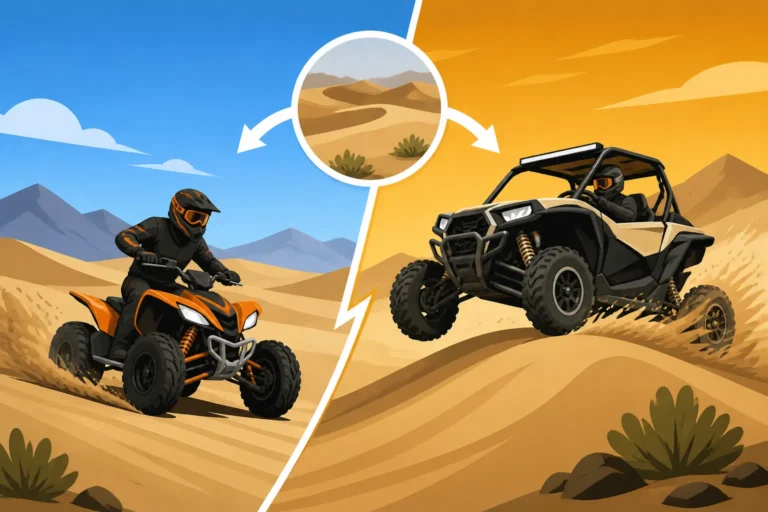
A heavier UTV and a lighter ATV can respond differently in soft terrain, and tire setup, load, and rider experience all matter. Before the trip, check the manufacturer’s guidance for your machine and tires. Secure loose cargo, inspect the vehicle, and confirm that the cooling system and other basic components are ready for sustained riding.
If someone in the group is new to sand, begin on easier terrain and let them get comfortable with steering and throttle before taking on steeper or softer sections. Keep the pace manageable, avoid sudden turns at speed, and take breaks before fatigue leads to poor decisions. A first dune outing does not need to involve the tallest climb; building confidence and reading the terrain are better measures of a successful day.
Make paperwork part of your pre-ride check, too. Nevada OHV registration requirements can depend on the machine and circumstances, so confirm what applies before setting out. A side-by-side has its own registration considerations; see [Nevada OHV Registration for a Side-by-Side] for a related guide. Keep required documents protected from dust and easy to reach if needed.
Riding responsibly and making the trip work
Share the dunes and protect the route
An open-looking landscape can still have sensitive areas, private land, or routes where travel is restricted. Stay on routes that are open to your type of use, watch for signs and closures, and don’t assume that a broad patch of undeveloped land is permission to ride anywhere. If you’re uncertain about a boundary, pause and check rather than guessing.
Dune riding also means sharing sightlines and space. Slow near camps, access roads, and places where vehicles may cross your path. Avoid stopping just beyond a crest, where another rider may not see you in time. Keep noise reasonable, pack out litter, and give wildlife room to move away. These habits make the area safer for other visitors and reduce the chance of avoidable damage.
Before leaving home, check applicable land-management information for current access guidance and restrictions. Use onX Offroad as a navigation aid if it helps you stay oriented, not as a replacement for official closure information or posted signs. For more on considerate riding practices, see [Nevada Trail Etiquette on Shared Dunes].
Decide whether to make it an overnight trip
The wide dune field can make an overnight visit appealing, particularly if you want time to explore without rushing back toward town. But an overnight plan needs more than a tent and a full tank. Think through where camping is allowed, what facilities are available, how you’ll manage waste, and how you’ll keep equipment secure. Don’t count on water, fuel, or other services at the dunes unless you have confirmed them.
For a day trip, set a departure time that leaves enough daylight for the ride and the drive back. For an overnight, tell someone where you plan to camp, check weather and access conditions, and bring supplies for the entire stay rather than relying on a nearby service stop. [Winnemucca Dunes for an Overnight] can help you think through that style of visit.
The best trip plan leaves room for changing conditions. If the wind picks up, a route becomes difficult, or the group is tired, shorten the ride. If you want a comparison with another Nevada dune destination, [Sand Mountain: Nevada's Great Basin Dune] provides a useful reference point. The goal is not to cover the most miles; it’s to return with everyone and every machine in good shape.
Disclaimer
This article is for general informational purposes only and does not constitute professional advice. Laws, prices and regulations vary by location and change over time. Consult a qualified professional for guidance on your specific situation.