The 14-Day Camping Limit on Nevada BLM Ground
A long Nevada ride can turn into a paperwork-and-campground headache if you assume every BLM site lets you stay indefinitely. The usual dispersed-camping limit is 14 days, but what counts as a move, where you can camp beside an OHV, and whether a particular riding area allows overnight stays all matter. This guide explains how to plan a compliant stay without disrupting your trip.
How Nevada’s 14-day BLM camping limit works
The standard stay and the 28-day window
On many Bureau of Land Management areas, dispersed camping is limited to 14 days within a 28-day period. The limit is intended to prevent one campsite from becoming a semi-permanent home and to give vegetation, soil, and other visitors a chance to recover. It can apply even when you are camping on open public land without a reservation or campground fee.
The rule is not necessarily a simple reset every time you move your tent a short distance. Under the commonly used BLM rule, after reaching the stay limit, campers must relocate at least 25 miles from the original location and cannot return to that location for 28 days. Local rules may add restrictions or define the boundaries differently, so check the applicable field office’s information before relying on a particular interpretation.
For example, imagine you set up a camp outside a Nevada OHV area on the first day of a trip. Moving your trailer to a nearby pullout may not be enough to start a new stay if that pullout is still within the area covered by the restriction. The practical takeaway is to plan a genuinely different destination, not just a different patch of dirt nearby.
What counts as your campsite
A campsite is not always just the spot where your tent sits. Your vehicle, trailer, gear, and the area you are using can all help show that you are occupying a place. Leaving equipment behind while riding elsewhere does not necessarily make the campsite unoccupied, and moving your camp a few hundred yards may not satisfy a relocation requirement.
This can catch riders who treat a large desert riding area as one continuous camp. A group might park at one trailhead, ride for the day, and then shift to a pullout down the same access road. That may feel like a new spot, but it may not meet the rule’s purpose or a local restriction. If you are close to the limit, verify the required distance and location rules with the managing office instead of guessing.
Keep a simple record of your arrival date and where you camped. That is especially useful when a trip includes several stops, a rental return, a weather delay, or a change in plans. The broader guide [Nevada Dispersed Camping Rules for Riders] can help you think through the other practical rules that may apply when your machine and camp are both on public land.
Where you can and cannot camp near Nevada riding areas
Dispersed camping is not allowed everywhere
“BLM land” does not mean “camp anywhere.” Some public lands allow dispersed camping, while other locations have designated sites, seasonal closures, stay limits shorter than the general rule, or no camping at all. A riding area may also have a day-use boundary that is separate from nearby land where overnight camping is permitted.
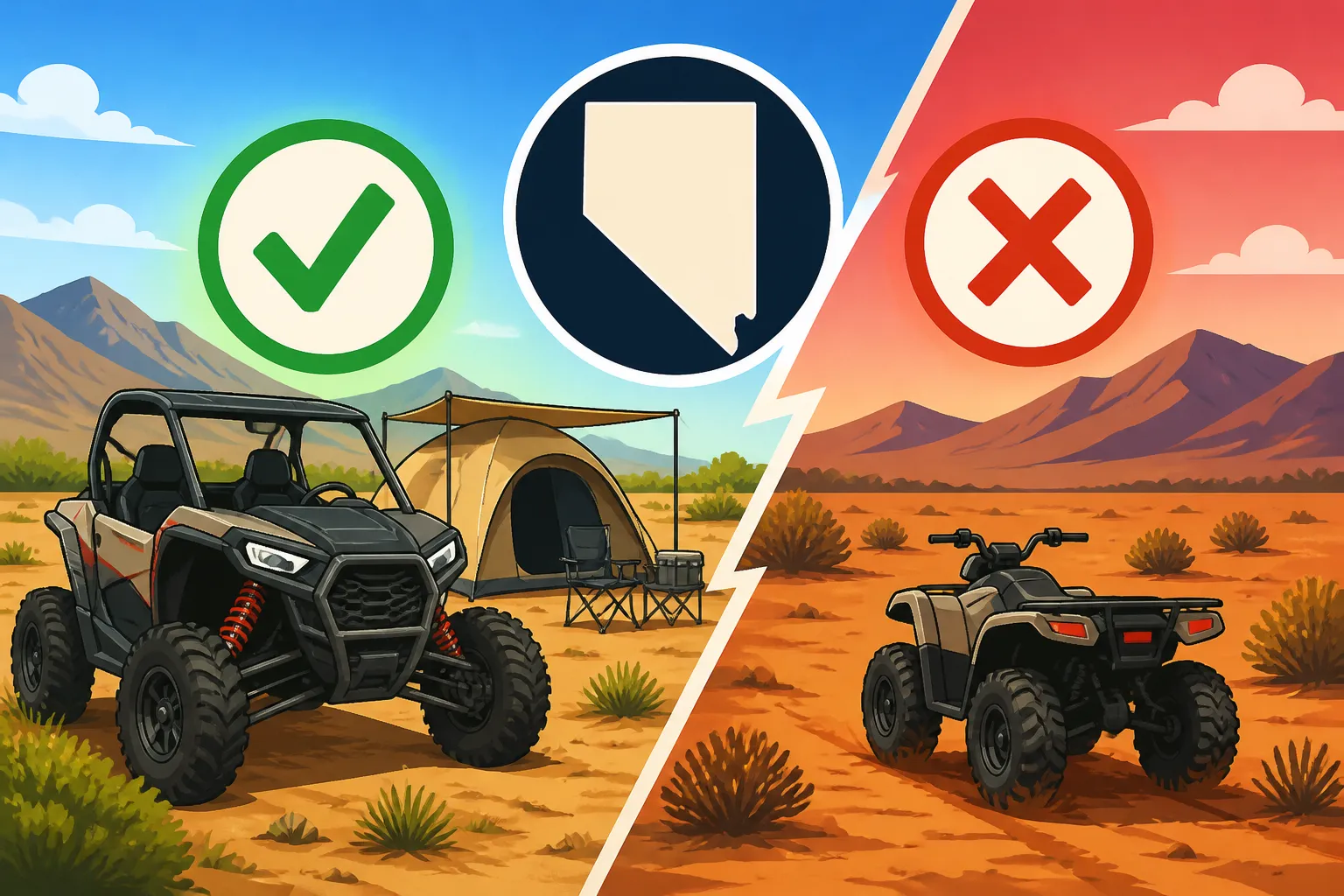
Nellis Dunes is a useful example of why it pays to check the specific place rather than assume. The area is known for riding, but camping is not allowed there. Riders planning an overnight stay need to identify a separate, legal place to camp and account for the drive or tow between camp and the dunes. See [Why Nellis Dunes Bans Camping] before building an overnight plan around that riding area.
At Sand Mountain, Logandale, and other popular destinations, facilities and camping arrangements can differ. A developed campground, a designated staging area, and a dispersed site on nearby BLM ground are not interchangeable. The site’s own rules may govern where a trailer can go, how long it can stay, and whether you can camp next to your machine. [Camping at Nevada OHV Areas] is a useful starting point when comparing possible bases.
Check the exact boundary and local rules
A map can show roads, trails, and public-land boundaries, but it may not answer every camping question. Local closures, seasonal restrictions, designated recreation sites, private inholdings, and land managed by another agency can complicate a route that looks straightforward on a screen. A road that reaches public land does not automatically mean the surrounding ground is open for camping.
Before setting out, identify the managing office for the area and look for current alerts, travel maps, and recreation-area rules. When a boundary or restriction is unclear, call the appropriate BLM field office and describe the location you have in mind. [Calling a BLM Field Office Before a Ride] can help you prepare useful questions rather than making a vague call from the trailhead after you have already unloaded.
Digital maps can be handy for comparing possible access routes and spotting nearby public-land boundaries. onX Offroad may help you orient yourself while planning, but treat it as a planning aid rather than permission to camp. Confirm important boundaries and closures against official maps or directly with the land manager. If your route crosses several kinds of land, the guide [Reading a BLM Travel Management Map] can help you understand why a mapped road or trail does not always settle the camping question.
| Camping situation | What to check before you settle in | A practical planning note |
|---|---|---|
| Dispersed camping on BLM land | The 14-day rule, local restrictions, and the land boundary | Record your arrival date and exact general location |
| Developed campground | Site-specific stay, reservation, and vehicle rules | Do not assume the dispersed-camping rule replaces campground rules |
| Riding area with day-use limits | Whether overnight camping is permitted at all | Arrange a separate camp if the riding area is day-use only |
| Camp near a trailhead | Whether camping and parking are both allowed | A legal place to park is not automatically a legal campsite |
| Multi-stop trip | How far you must move after reaching the stay limit | A short move nearby may not reset the clock |
Planning a ride and campsite together
Choose your overnight base before unloading
When a trip is built around riding, it is tempting to find the trailhead first and figure out camp later. That can leave you searching for an acceptable overnight spot after dark, with a trailer in tow and tired riders in the vehicle. A better approach is to choose a legal camp area first, then check how you will reach the riding area from there.
Compare the distance between camp and the trailhead, the condition of the access road, and whether your vehicle and trailer can turn around safely. A spot that appears close on a map may be separated from the trailhead by a wash, a closed route, private land, or a road unsuitable for a large trailer. If you are considering a camp near Logandale, for instance, check the available sites and restrictions before treating the riding area as your overnight base. [Logandale Trails Camping Spots] offers a more location-specific place to continue that research.
Use onX Offroad or another mapping tool to sketch out the route and identify questions, not to make assumptions about permission. Then verify the area with the relevant official map or office. This two-step habit is particularly helpful when a camp plan depends on a narrow access road, a boundary crossing, or a route that might be closed seasonally.
Plan for the full length of your stay
A “two-week trip” can be longer than 14 days once you count the day you arrive and any days spent waiting out a storm, making repairs, or taking a rest. Mark the arrival date on a calendar and decide early what you will do if the trip runs long. Waiting until the last day can turn a simple move into a stressful search for fuel, water, and a second campsite.
Build a realistic relocation plan. Identify a second area that is far enough away under the applicable rules, check whether it allows camping, and make sure you can get there with your trailer. A destination that is technically far enough away but has no accessible camping, poor road conditions, or no room for your group is not a useful backup.
If you are riding with friends, agree on how the group will handle the limit before arriving. One person may assume the group can shift camp down the road, while another expects to travel to a different recreation area. Agreeing on dates, equipment, and a backup location avoids pressure to leave gear behind or make a rushed decision. For additional ideas on coordinating camp and machine rules, see [Nevada Rules for Camping Beside Your Machine].
Staying responsibly on public land
Keep your camp small and leave the site clean
A legal stay can still cause problems if a camp spreads into fragile ground or blocks access for other people. Keep vehicles and trailers on durable surfaces or in established areas, avoid creating new tracks, and do not expand a campsite simply because the surrounding ground looks empty. Desert plants may take a long time to recover from tire damage, and a small disturbance can become a broad scar when multiple groups follow the same route.
Pack out trash, food scraps, and repair materials. Secure loose items before riding so that wind does not scatter them, and avoid leaving gear behind while you explore. If you use a portable toilet or fire equipment, follow the site’s rules and any fire restrictions in effect. Do not assume that a practice allowed at one campground is permitted at a dispersed site nearby.
Think about the next visitor when choosing where to park. Leave room for trailers to turn around, keep access roads clear, and avoid setting up across routes or in a way that funnels riders through a camp. A respectful camp is safer for your group, easier for other visitors to pass, and less likely to attract a complaint that could end your stay early.
Keep records and be ready to relocate
Carry a basic record of your camp dates, location, and the relevant local guidance. If an enforcement officer or land manager asks how long you have been there, a clear answer is easier than trying to reconstruct the dates from memory. Keep important documents protected from dust and moisture, particularly if you are riding far from your tow vehicle.
If you are told that a site is closed or that your stay must end, ask calmly what location or rule applies and what options are available. Do not assume that a disagreement about a map gives you permission to remain. If a closure or boundary is unclear, document the information and contact the managing office for clarification rather than moving only a short distance and hoping that solves the issue.
A planning app can help keep potential camps and riding routes organized, and onX Offroad may be useful for reviewing the broader area before departure. Still, save official maps and contact details separately so you are not relying on a single device or signal. For practical route-planning context, [What the Trail Finder Site Shows You] and [Riding BLM Land in Nevada] can help you prepare for the land-access questions that come with an OHV trip.
A practical checklist before a Nevada BLM camping trip
Confirm the rules, dates, and access
Before leaving home, check that camping is permitted at your intended location. Confirm whether the site is dispersed or developed, whether it has a local stay limit, and whether any closures affect the camp or the route to it. If the area is managed by more than one agency, make sure you know which office controls the location where you plan to sleep.
Count your stay conservatively, including the arrival date, and note the 14-day limit where it applies. If you may need to move, identify a real second destination that meets the relocation requirement and allows camping. Consider the access road, trailer size, fuel range, water supply, and the distance back to your riding area. A backup plan is only useful if you can actually reach it.
Check maps for routes and boundaries, but verify anything important through official information. onX Offroad can be one tool for organizing your route, while the land manager remains the authority on current closures and camping permissions. Keep a phone number or office contact available in case a sign on the ground conflicts with what you saw during planning.
Prepare for desert conditions and trip changes
Nevada’s open country can make a campsite look simple on a map but demanding in practice. Carry enough water for camp and riding, plus a reserve for unexpected delays. Plan fuel stops before you reach remote stretches, and do not count on cell service at a trailhead or dispersed site. If a storm, breakdown, or heat issue changes your schedule, you may need to use the backup location you identified in advance.
Secure the camp before leaving for a ride. Store food and trash properly, tie down loose items, and make sure your trailer and tow vehicle are parked where they will not block an access route. Tell someone outside the riding group where you expect to be and when you plan to check in, especially if your camp is remote.
Most importantly, do not treat the 14-day limit as the only rule to check. The location may prohibit camping entirely, require you to use a designated area, or have additional restrictions. A few minutes spent confirming the specific site can prevent a much bigger problem after you have driven hours into the desert. The best plan leaves room for a compliant move, a safe ride, and a clean campsite for the people who arrive after you.
Disclaimer
This article is for general informational purposes only and does not constitute professional advice. Laws, prices and regulations vary by location and change over time. Consult a qualified professional for guidance on your specific situation.