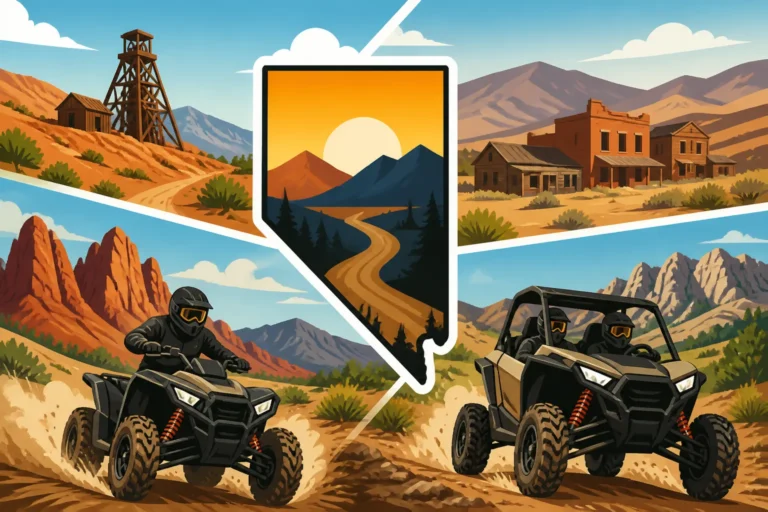
Nevada’s Dune Riding Areas Compared
Nevada’s dune areas can look deceptively similar on a map, but the ride can feel completely different once you arrive: one place may be built around a towering open dune, while another mixes sand with marked trails, rocky ground, or busy day-use traffic. This guide compares the main options so you can match a riding area to your machine, experience, and trip plans.
Nevada dune riding areas at a glance
| Riding area | What stands out | Best fit | What to plan for |
|---|---|---|---|
| Sand Mountain Recreation Area | A prominent dune and an extensive riding area near Fallon | Riders seeking a classic dune-focused trip | Sand conditions, busy weekends, recreation-area rules, and limited services |
| Logandale Trails | A large network of routes among red rock and desert scenery | Riders who want varied terrain and a trail-based day | Route finding, changing terrain, and staying on appropriate routes |
| Nellis Dunes | Convenient access from the Las Vegas area | A shorter outing or a quick ride close to town | Dust, traffic, and the lack of camping at the riding area |
| Amargosa Big Dune | A dramatic dune near Beatty | Experienced riders planning around a distinct dune feature | Access conditions, dune steepness, and checking for land-use restrictions |
| Winnemucca Dunes | A broad sand-riding destination near Winnemucca | Riders looking for a northern Nevada sand trip | Distance, remote-area preparation, and confirming current access details |
Treat this table as a starting point, not a substitute for checking the route and land-management information for your exact destination. Conditions, access, and closures can change. For an overview of other destinations, see [Nevada's Dune Riding Areas Compared] and [Best Places to Ride an ATV in Nevada].
What makes one dune area different from another
The word “dunes” can make every destination sound like the same kind of ride. In practice, the experience depends on the shape and size of the sand, how much riding area surrounds the main dune, what terrain connects the routes, and how easy it is to reach the site. A place with one striking dune can feel very different from an area where sand is only one part of a larger trail network.
The riding surface matters, too. Loose, deep sand demands steady throttle and good momentum, while firmer sand and mixed terrain can feel more forgiving. A route that crosses sand, gravel, and rock may be a better match for a rider who wants variety than for someone who came specifically to climb and descend dunes. Before traveling, look beyond a destination name and find out what the actual riding area includes.
Your day can also be shaped by practical details: drive time, parking and unloading, camping rules, available facilities, and how crowded the riding area tends to feel. Those details are especially important if you are bringing children, riding in a group with mixed experience, or towing a trailer. A great destination on paper can become a frustrating one if the conditions do not fit your crew.
A quick way to narrow your choices
Start by deciding what you want the ride to feel like. If you picture a major dune as the centerpiece, Sand Mountain or Amargosa Big Dune may be worth researching first. If you would rather follow a mix of routes through desert scenery, Logandale Trails may suit your plans better. If you have only a short window near Las Vegas, Nellis Dunes may be the more practical choice.
Next, consider the people and machines in your group. A skilled sand rider on an appropriate machine may be comfortable seeking out steeper terrain, while a first-time rider may enjoy a less demanding route with room to stop, watch, and practice. A large side-by-side also needs more space to turn and pass than a small quad. “Beginner friendly” does not mean risk-free; it means the group has manageable routes and a realistic way to avoid terrain beyond its ability.
Finally, compare the drive and logistics with the actual riding time you expect to get. A remote destination can make sense for a weekend, but feel like too much effort for a brief afternoon. Think about fuel, food, water, trailer parking, and the return drive. If you are weighing a short outing against a longer trip, [Nevada's Dune Riding Areas Compared] can help frame the choice around the character of each area rather than just its distance from town.
Sand Mountain Recreation Area
What the ride is known for
Sand Mountain is one of Nevada’s best-known sand destinations, located near Fallon. Its large dune is the defining feature, and the area offers room to ride beyond a single slope. The dune’s scale can be exciting to look at from the base, but it can also make the place feel intimidating to someone who has only ridden hard-packed trails or small sandy patches before.
The main dune is not the only consideration when planning a ride. Sand Mountain includes marked routes and surrounding riding terrain, so a visitor does not have to treat the steepest face as the only worthwhile option. Riders can spend time getting comfortable, explore according to their ability, and take breaks to watch how other machines move through the sand. For route context, see [Sand Mountain's 23 Miles of Marked Trail].
Sand Mountain is a recreation-area destination, not simply a convenient patch of open sand. Check the managing agency’s current information before your trip for access, day-use details, camping conditions, and any restrictions. The area is also known for sensitive habitat and managed riding zones, so staying on permitted routes is part of protecting the place and avoiding a ride-ending mistake. [Sand Mountain's 4,795 Acres] offers another useful point of reference when comparing the scale of the riding area.
Who may enjoy Sand Mountain most
Sand Mountain can be a strong choice for riders who want the dune to be the main event. It can suit experienced riders interested in climbing and descending, as well as mixed groups who are content to take the outing at different paces. A confident rider might spend more time on the dune, while a newer rider can practice on terrain that feels manageable and gradually decide whether to try more.
It is not necessary to prove anything by taking on the steepest line. If you are new to dunes, watch the traffic first and choose an area that leaves you room to stop or turn away. Sand can change how a machine responds, and a slope that looks approachable from below may feel much steeper once you are committed. Agree with your group beforehand that anyone can opt out of a climb without pressure.
Sand Mountain is also a practical place to research for a dedicated trip if you are prepared to bring what you need. Do not assume you can count on nearby services at the riding area. Plan water, fuel, food, recovery equipment, and sun protection in advance. For a more specific first-trip perspective, [Sand Mountain for a First Dune Trip] can help you think through the learning curve and preparation.
Logandale Trails
Why Logandale feels different from a pure dune trip
Logandale Trails, near the town of Logandale and the Valley of Fire region, is better understood as a large trail-riding area with varied desert terrain than as one continuous field of open dunes. Sand may be part of the experience, but the surrounding scenery and route network are a major reason people choose it. Riders can encounter red rock formations, sandy stretches, and other desert surfaces during the same outing.
That variety can be a welcome change for people who do not want to spend an entire day on one dune face. It also means route planning matters. Different lines can bring different levels of challenge, and a trail that looks simple on a map may feel different in a wider machine, especially when there are turns, uneven surfaces, or other riders nearby. [Logandale's 45,000 Acres] gives a sense of the area’s broad scale, but size alone does not tell you which routes fit your group.
Stay on routes that are open and appropriate for your machine. The surrounding landscape can make it tempting to leave a track to get a better view or explore an inviting wash, but open-looking terrain is not automatically open to cross-country travel. Use current maps and management information, and keep habitat and route restrictions in mind. For official route planning, [Which BLM Roads Around Logandale Stay Open] is a useful topic to review.
When Logandale is a good match
Logandale may suit a group that wants a scenic ride with more route variation than a single-dune destination. It can also work well for riders who enjoy stopping to take in the landscape instead of treating the trip as a continuous high-speed run. Families and mixed-skill groups may appreciate having a range of possible routes, provided everyone chooses trails that match the least experienced rider and the machines in the group.
The area’s size can be both an advantage and a challenge. More terrain gives you options, but it can also make it easy to underestimate how far you have traveled or how long it takes to return to the trailer. Set a turnaround point, keep the group together, and carry a map that remains usable if cell reception is poor. If riders split into different paces, decide on a clear regrouping plan before leaving the staging area.
Logandale is not automatically the better choice simply because it has varied terrain. Someone whose main goal is steep, open dune riding may prefer Sand Mountain. Someone seeking a close-in outing near Las Vegas may find Nellis Dunes more convenient. Logandale makes the most sense when its mix of scenery and trails is part of the appeal, and when your group is ready to navigate a larger riding area rather than follow one obvious feature.
Nellis Dunes
The appeal of a ride near Las Vegas
Nellis Dunes is a convenient option for riders based in or visiting the Las Vegas area who want to get out on sand without building a longer trip around a distant destination. Its proximity can make it appealing for a shorter outing, especially when the group has limited time or wants to avoid a long tow. Convenience, however, does not remove the need to plan carefully.
The area can feel busy, particularly when many riders are using the same access and riding zones. Dust, moving machines, and changing lines of sight make awareness essential. Give other riders room, avoid stopping in places where approaching machines may not see you, and keep children close. If visibility drops because of dust, reduce speed and leave extra space rather than trying to keep up with a machine you can barely see.
Do not assume that easy access means the area has everything you need once you arrive. Nellis Dunes is known as a day-use riding destination, and camping is not permitted there. Plan your overnight stay elsewhere and confirm current access information before heading out. For a practical comparison with other southern Nevada sites, [Nellis Dunes, Nevada's Free Dune Ride] and [Why You Cannot Camp at Nellis Dunes] are relevant planning reads.
Making a short Nellis Dunes outing work
A shorter trip can still be a good ride if you prepare as though you will be away from town. Bring enough water, basic tools, protective gear, and a way to deal with a minor breakdown. A quick outing often encourages people to pack lightly, but heat, dust, and mechanical trouble do not care whether you planned to be gone for two hours or all day.
Choose your riding zone with the group’s experience in mind, and take a moment to observe traffic before unloading or setting out. If the area feels crowded, pick a conservative route and keep the ride controlled. It is easy to mistake a familiar area near a city for a low-risk outing; the same hazards remain, including blind rises, loose sand, and riders approaching from directions you do not expect.
Nellis Dunes is most compelling when convenience is a priority. It may not deliver the same feel as a remote weekend at Sand Mountain, nor the same scenic route variety as Logandale. But a close destination can be exactly right for a limited schedule. Check parking and access details, make sure the group agrees on a meeting point, and do not let the short drive lead to a rushed departure.
Amargosa Big Dune
The character of the Big Dune ride
Amargosa Big Dune, near Beatty, is a distinctive destination centered on a prominent dune. Its shape and height are part of the appeal, and the setting can feel more remote than a quick ride near Las Vegas. For some riders, that sense of scale and distance is precisely what makes the trip memorable. For others, it is a reason to be more cautious about preparation and route choices.
A large dune should not be confused with an invitation for every rider to climb it. Steep faces, loose sand, and limited visibility over a crest can create hazards even for people with substantial experience. Look at the terrain from a safe vantage point, watch how other riders approach, and choose lines that leave a margin for error. Never follow another machine onto a slope simply because it made the climb.
Before traveling, verify the current access and riding rules for the area. Land-use restrictions and sensitive natural features can affect where riding is allowed, and what appears to be an open route on an older map may not reflect current conditions. If you are also planning a Sand Mountain trip, [The 600-Foot Dune Near Fallon, Nevada] provides a useful comparison point for thinking about dune scale and the sort of ride you want.
Planning for a more remote destination
A trip to Amargosa Big Dune calls for deliberate preparation. Carry enough water for the group, include extra for unexpected delays, and bring fuel appropriate to your route and machine. Have basic recovery equipment and a plan for what to do if a vehicle becomes stuck or disabled. In remote areas, a small mechanical issue can take much longer to resolve than it would close to town.
Tell someone who is not on the ride where you are going and when you expect to return. Keep your group together and establish a simple communication plan before setting out. If phones lose signal, a digital map that depends entirely on a live connection may be less useful than expected. Save maps for offline use when possible and carry a backup navigation option that suits your trip.
The Big Dune can be a rewarding choice for a planned outing, but it may be less suitable for riders who want an easy, spontaneous stop with nearby services. Consider your towing route, daylight, fuel range, and the experience of everyone in the group. If the outing includes first-time dune riders, plan a conservative day around learning and observation rather than making the tallest climb the measure of success.
Winnemucca Dunes
What to expect from northern Nevada sand riding
Winnemucca Dunes offers a northern Nevada option for riders interested in a broad sand-riding area. Compared with sites closer to Las Vegas, its appeal may be as much about building a trip around a different part of the state as it is about the dunes themselves. The open landscape can be inviting, but a wide riding area also makes it important to know where you are and how you will return.
Sand conditions and the overall feel of the terrain may differ from what a rider expects after visiting another dune destination. Do not assume that experience at Sand Mountain or Nellis Dunes transfers perfectly to a new area. Give yourself time to read the surface, observe how the machine handles, and adjust your speed. If you are unfamiliar with the site, begin with a conservative route and expand the ride only when everyone is comfortable.
Research current access and land-management guidance before you go. Look at where the riding area begins, which routes are open, and whether there are conditions or closures that affect your plan. [Winnemucca Dunes Along Nevada's US 95] is a useful starting point for considering the location, while [The 40 Miles of Winnemucca Sand] offers a more focused way to think about the area’s scale.
Who should consider Winnemucca Dunes
Winnemucca Dunes may appeal to riders who are already in northern Nevada or who want a destination beyond the better-known southern Nevada riding areas. It can make sense as part of a longer regional trip, particularly if your group enjoys traveling to new terrain rather than repeating a familiar local ride. Build the trip around realistic drive time, and avoid assuming that a remote ride can be squeezed into a tight schedule without tradeoffs.
If your group includes people with different experience levels, discuss what each person expects from the day. One rider may be eager to explore the open sand, while another may want a short, low-pressure ride. Agree on routes and regrouping points in advance. A large area can create a false sense of security: if riders spread out without a plan, it can be harder to find one another or respond quickly to a problem.
The destination may be less appealing if your trip depends on a full set of nearby services or if you have not planned for self-sufficiency. Confirm what you can and cannot rely on before departure. As with any dune area, prepare for dust, sun, and changes in traction, and carry the essentials even if the ride is intended to be brief. A well-planned first visit is more enjoyable than trying to improvise after arrival.
Choosing the right dune area for your group
Match the destination to the kind of ride you want
Use the character of each area as your first filter. Sand Mountain is a natural candidate for a dune-centered outing. Logandale is a better fit when varied routes and desert scenery matter as much as sand. Nellis Dunes can be practical when you want a shorter ride near Las Vegas. Amargosa Big Dune and Winnemucca Dunes may suit riders who are planning around a more specific destination and have accounted for the drive and preparation.
Then consider the group’s comfort level. A place can offer routes for different abilities without being equally suitable for every rider in every condition. A beginner who is comfortable on flat ground may still feel overwhelmed on a steep, loose dune. An experienced rider may also need time to adjust to unfamiliar sand, traffic, or visibility. Choose the destination based on the least experienced member, not just the most capable person in the group.
Think about what would make the day feel successful. If the goal is to practice, a slower ride with room to stop may be better than a long list of landmarks. If the goal is scenery, a route network may be more satisfying than repeated dune climbs. If the goal is a family outing, breaks and clear meeting points may matter more than the number of miles covered. A good match is one where everyone can participate without feeling pushed into terrain they do not want to ride.
Compare practical details before setting out
Travel time is only one part of the calculation. Check where you can unload, how far you are from fuel and supplies, what camping options are allowed, and whether the riding area has services you are counting on. Sand Mountain and Nellis Dunes, for example, offer very different trip-planning considerations, even though both are popular southern Nevada riding destinations. For camping-focused planning, [Nevada ATV Camping Spots] can help you explore the broader options.
Look at the route and riding-area information before you leave, not only when you reach the staging area. A map can help you understand the relationship between the access road, permitted trails, and places where riding is restricted. Tools such as onX Offroad can help riders review mapped routes and save trip information for use when reception is limited. Treat any mapping app as a planning aid, not as permission to ride a route; confirm access with the relevant land manager.
Also check the machine itself against the plan. A quad, a two-seat side-by-side, and a larger four-seat UTV have different turning needs, loading requirements, and ways of moving through deep sand. Tire condition, belt condition, cooling, and fuel range can matter as much as the destination. If the machine is unfamiliar or has been sitting, address maintenance before the trip rather than discovering a problem at the trailhead.
Preparing for a safe and enjoyable dune ride
Set up the ride before the machines start moving
Before anyone rides, agree on the route, the group order, and the plan for regrouping. Pick an experienced lead and a sweep rider who can help ensure no one is left behind. Keep the pace appropriate to the newest rider and avoid pressure to follow a line or climb that someone has already declined. A clear group plan prevents the common confusion of one machine turning off while others continue ahead.
Wear protective equipment suitable for the machine and conditions, including a helmet and eye protection. Sand and dust can irritate eyes and lungs, while exposed skin can take a beating from sun and wind. Bring layers that work for changing temperatures and enough drinking water for the expected ride, with extra in case the trip runs long. For practical preparation beyond the dunes, see [Nevada Desert Riding in Summer Heat] and [Water and Fuel Planning in Nevada].
Check the machine before unloading. Look over tires, controls, lights, fuel, and anything that could affect safe operation. Carry a basic tool kit and equipment appropriate for a stuck machine, but do not attempt a recovery that exceeds your group’s ability. If a machine is disabled, move people to a safe location away from active riding lines and make a plan before trying to tow or winch it.
Ride sand with patience and space
Sand can respond differently from packed dirt. A machine may need steady momentum to cross a soft section, but “more speed” is not a universal answer. New riders should learn how the machine responds on manageable terrain before attempting steep climbs or unfamiliar lines. If the front end feels light, the machine bogs, or the rider loses control, continuing to add throttle can make a poor situation worse.
Give other machines room, especially near the base and crest of dunes. A crest can hide people or vehicles on the other side, so do not cross it blindly. Approach in a way that lets you see where you are going, and avoid stopping where another rider may be committed to a line. In busy areas, expect traffic from more than one direction and keep children and spectators well away from active routes.
Know when to turn back. Wind can reduce visibility, weather can change, and fatigue can make ordinary decisions harder. A steep face that seemed manageable early in the day may not be a sensible choice after several hours of riding. If the group is tired, the route is unclear, or conditions no longer feel comfortable, shorten the ride and return by a known route. The goal is to finish with everyone and every machine accounted for, not to check off a particular climb.
Rules, access, and trip planning
Confirm registration and riding permissions
Nevada’s OHV registration and decal requirements depend on the machine and the rider’s circumstances. Do not assume that a machine’s registration from another state automatically answers every Nevada question, or that a destination’s easy access means no paperwork is needed. Review the state rules that apply to your machine and visit the relevant official guidance before the trip. [Nevada OHV Permits Explained] provides background on how Nevada’s system works.
If you are visiting from another state, check whether an exemption or reciprocity rule applies to your circumstances and how long it applies. The rules can depend on details such as where the machine is registered and how long it has been in Nevada. Read [Nevada's Nonresident Exemption in NRS 490.082] and [Nevada's 15-Day Window for Out-of-State Machines] before relying on an assumption based on a previous visit.
Registration is not the same thing as permission to ride every open-looking stretch of land. A valid decal does not override a closure, private-property boundary, habitat restriction, or land-manager route rule. Confirm both the paperwork requirements and the access conditions for the specific area. Carry required documentation in a secure, dry place, and make sure your group knows how to show it if asked.
Check conditions close to departure
Dune conditions can change with wind, weather, traffic, and land-management decisions. Before leaving, check the current information for access roads, closures, fire restrictions, and any site-specific rules. A route that was open during a previous trip may be affected by new conditions. This is especially important for destinations where the drive is long enough that discovering an access issue at the trailhead would waste much of the day.
Review maps with more than one goal in mind: finding the route in, understanding where the riding area begins and ends, and identifying a safe way back. Save maps offline if possible, keep track of landmarks, and do not depend on cell service for navigation or emergency communication. For a wider guide to map-based trip preparation, see [Nevada Trail Maps Worth Downloading] and [Calling a BLM Field Office Before a Ride].
Finally, leave room in your itinerary for the real pace of an off-road day. Unloading, checking equipment, helping a newer rider, and taking breaks all take time. Set a turnaround time that gives you daylight to return, especially if the route is unfamiliar. A little planning helps preserve the best part of dune riding: being able to enjoy the landscape without constantly worrying about what you forgot, where the trail goes, or how far it is back to the truck.
Disclaimer
This article is for general informational purposes only and does not constitute professional advice. Laws, prices and regulations vary by location and change over time. Consult a qualified professional for guidance on your specific situation.