Sand Mountain’s Six Vault Toilets
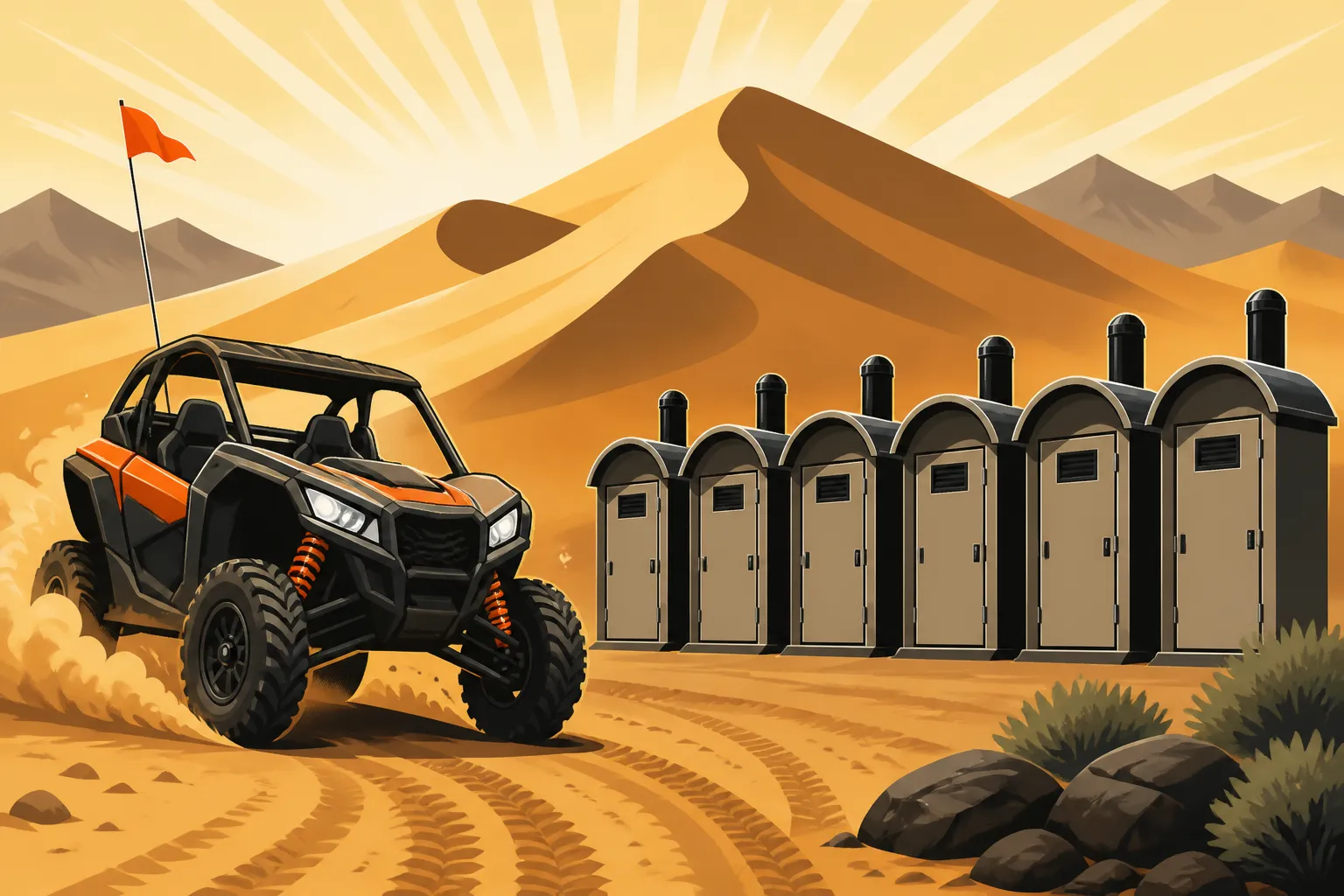
A day at Sand Mountain can turn uncomfortable quickly when riders assume restroom facilities are close to every trail or overlook how remote the dunes feel once they leave the staging area. Sand Mountain has six vault toilets, but knowing that number is only part of planning well. This guide covers what to expect, what to bring, and how to make restroom stops easier for your group.
What to know about Sand Mountain’s six vault toilets
Vault toilets are basic facilities, not full-service restrooms
Vault toilets provide a place to use the restroom, but they are not the same as flush restrooms at a visitor center or campground. At Sand Mountain, riders should plan for simple facilities and bring the personal supplies they may need. Don’t count on running water, soap, paper supplies, or a handwashing sink being available when you arrive.
That distinction matters after a dusty ride. A toilet stop may be available, but you may still need to clean your hands with sanitizer or use water you brought yourself. Pack supplies before leaving town rather than expecting to find them at the recreation area. Fallon is a common staging point for a Sand Mountain trip, so it makes sense to make a final restroom stop and pick up essentials there.
The six toilets also don’t mean that every riding area has a nearby facility. Sand Mountain is a large recreation area, and riders can spread out across the dunes and marked routes. Before setting off, make sure everyone in your group knows where the facilities are in relation to your parking or staging area. If you use onX Offroad or another mapping tool to plan routes, treat it as a navigation aid—not a guarantee that a restroom is beside the route you choose.
Six facilities still require a little planning
A number like six can sound generous, but the practical question is how those facilities fit into your day. Your group may arrive during a busy period, stop at a different part of the area, or spend hours riding away from the main staging locations. Don’t assume a toilet will be immediately available wherever you happen to pull over.
Before unloading, take a moment to identify the restroom location or locations you can reasonably reach from your starting point. If you’re coordinating several vehicles, tell everyone where the group plans to meet if someone needs a break. A simple plan can prevent a rider from wandering around looking for the rest of the group—or setting off alone to find a facility.
This is especially helpful when riding with children, older adults, or anyone who needs more frequent breaks. Build restroom stops into the day instead of waiting until someone is uncomfortable. If your group is heading out for a longer ride, agree on a return time or check-in point. The goal is not to make the day rigid; it’s to avoid the familiar desert-trip problem of discovering that the nearest convenient stop is farther away than expected.
How to plan restroom stops around your ride
Use your starting point as the anchor
A practical Sand Mountain day often begins with a trailer, a support vehicle, or a campsite as the group’s base. Before riding out, note which facilities are convenient from that base and how long it may take to return. If riders split into smaller groups, make sure each one understands the plan rather than relying on one person to remember.
If you are using a navigation app, check that you have the map information you need before heading out. Cell coverage can vary in remote areas, and a screen that works in town may not be useful everywhere on the dunes. onX Offroad can help with route orientation and saved map planning, but carry a paper map or another backup if your group depends on navigation. A toilet location is only helpful if you can find your way back to it.
For a broader look at the area’s basic facilities, see [Sand Mountain's Six Vault Toilets] and [Vault Toilets and No Water at Sand Mountain]. If your trip involves camping, also plan around the fact that basic restroom facilities do not mean drinking water is available. Review [Camping at Sand Mountain Without Water] before packing for an overnight stay.
Match the plan to the people riding
A group of experienced adults may be comfortable with longer stretches between stops. A family with young children may need a more flexible schedule. A good plan accounts for the least comfortable person in the group, not just the rider who is happiest to stay out all day.
Before unloading, ask whether anyone wants to use the restroom, refill water, or organize personal gear. Then make another quick stop before the group commits to a longer route. This is easier than trying to solve a problem once vehicles are separated, someone is already riding, and the dunes make it harder to communicate.
For a family trip, explain the plan in plain language: where the restroom is, who to tell if a break is needed, and what to do if the group gets separated. Keep children with a responsible adult during stops, and avoid letting a young rider head off alone to look for a facility. A little coordination at the start can keep a minor inconvenience from becoming the main event of the day.
| Planning question | Why it matters | A practical step |
|---|---|---|
| Where is the nearest facility to our staging point? | The six toilets may not be close to every riding area. | Identify the facility before unloading. |
| Does anyone need water or hand-cleaning supplies? | Vault toilets may not have sinks or running water. | Pack drinking water and sanitizer. |
| Will our group split up? | Riders may not share the same route or return time. | Set a meeting point and check-in plan. |
| Are we camping overnight? | A day-use assumption may not suit a longer stay. | Pack supplies for the full trip and check local conditions. |
| Is our map available offline? | Remote coverage may be unreliable. | Save maps in advance and carry a backup. |
What to bring and how to use the facilities responsibly
Pack for a restroom stop without assuming supplies are provided
Bring a small personal kit that stays easy to reach in your vehicle or riding gear. Useful items include hand sanitizer, tissues or toilet paper, a sealable bag for used personal items, and drinking water. If someone in your group has specific medical or hygiene needs, pack those items rather than relying on whatever may be present at the site.
Keep clean supplies separate from dusty riding gear. A simple zip bag or small dry pouch can help, especially when vehicles are open to wind and sand. For a family, it can be useful to have a second kit in the support vehicle so the group isn’t dependent on one person remembering to carry everything.
Pack drinking water for the ride itself, too. Water for drinking is not interchangeable with the water you might use for cleaning up, and a desert outing can make people underestimate how quickly they go through both. Review [Carrying Water for a Desert Ride] and [Water and Fuel Planning in Nevada] when preparing for a longer day. If you are deciding where to stay, [Sand Mountain Day Use Hours] and [The 14-Day Camping Limit on Nevada BLM Ground] are useful related reading for understanding the broader recreation-area context.
Leave the facility usable for the next person
A vault toilet is a shared facility, and a few basic habits make the stop better for everyone. Use the toilet as intended, keep trash out of the facility, and take personal items with you when you leave. If the site has posted instructions, follow them. Don’t leave wipes, packaging, or hygiene products behind just because they seem small; they can create maintenance problems and make an already basic facility unpleasant for the next visitor.
Keep children supervised, particularly around vehicles and riding areas. A restroom stop can be busy, with trailers, machines, and people moving between parking and the dunes. Ask riders to slow down near shared facilities and watch for people on foot. If your group is gathering outside the restroom, make sure you are not blocking access or creating a traffic pinch point.
If a facility appears damaged, full, or otherwise unusable, don’t try to fix or empty it yourself. Use another available facility if possible and report a maintenance concern through the appropriate land-management contact when you can. Conditions can change, so a facility count is not a promise that every toilet will be available on every visit. Check for local notices before departure and keep a backup plan.
Making the restroom plan part of a safer Sand Mountain day
Think beyond the toilet stop
Restroom planning connects to the rest of your preparation. A group that has enough water, fuel, navigation, and communication is less likely to make rushed decisions when someone needs a break or when the route takes longer than expected. Decide where you’ll regroup, make sure riders know how to get back, and avoid sending one person off alone to search for a facility.
Sand conditions and traffic can affect the pace of a ride. A route that looks short on a map may take longer in practice, particularly if the group includes new riders or makes frequent stops. Use onX Offroad or another offline mapping option to prepare your route, but leave room in the schedule for breaks and unexpected delays. Plan conservatively if you’re riding with children, a mixed-experience group, or anyone who may need help getting back to the staging area.
You can also make the day easier by choosing a route that fits the group rather than trying to cover as much ground as possible. If you want a first-visit overview, [Sand Mountain for a First Dune Trip] is a useful companion. For guidance on marked routes and sensitive areas, read [Sand Mountain's 23 Miles of Marked Trail] and [Staying on Sand Mountain's Marked Trails]. Staying oriented and following the established riding areas helps make facilities and regrouping points easier to use as part of a larger plan.
Prepare for the possibility that plans change
A restroom may be occupied, closed, or farther away than expected. Someone may need an unplanned stop, or your group may decide to stay longer than intended. Carry enough personal supplies to handle a delay without leaving trash behind or improvising in a way that harms the recreation area.
For a multi-vehicle group, agree on a basic communication plan before riding. Decide whether you will regroup at the starting point, return to a planned meeting location, or use a designated check-in time. Make sure every driver knows the plan. Don’t assume that everyone can call or message from every part of the area.
Finally, keep your expectations realistic: Sand Mountain is a recreation area, not a resort with staffed restroom buildings and full amenities. Its six vault toilets are useful, but they’re one part of a self-supported desert trip. Bring water, personal supplies, offline navigation, and patience; then you can spend less time troubleshooting basic needs and more time enjoying the dunes.
Disclaimer
This article is for general informational purposes only and does not constitute professional advice. Laws, prices and regulations vary by location and change over time. Consult a qualified professional for guidance on your specific situation.