Nevada Trail Rides for a Long Weekend
A long weekend in Nevada can turn into a scramble if you pick a trail before checking the distance, camping options, fuel stops, and access rules. This guide compares three practical trip styles—from dunes near Fallon to a multi-day route through eastern Nevada—and lays out how to plan each day so you spend more time riding and less time backtracking.
Choose a Nevada long-weekend ride that fits your group
Nevada’s riding areas are spread across a huge landscape, so “nearby” can still mean a substantial drive. For a three- or four-day trip, it helps to choose one base area rather than trying to connect distant destinations. Think about your group’s experience, machine range, towing setup, and appetite for camping before settling on a route.
| Trip style | Good fit for | Possible base | Planning consideration |
|---|---|---|---|
| Dunes and marked routes | Riders who want a focused riding area | Sand Mountain near Fallon | Check recreation-area access, camping conditions, and dune rules |
| Desert trails and scenery | Groups wanting varied terrain and a nearby town | Logandale near Overton | Review route maps and stay on routes open to OHVs |
| Point-to-point route | Experienced groups with careful logistics | Silver State Trail corridor | Plan fuel, overnight stops, navigation, and vehicle shuttles |
Sand Mountain for a focused dune weekend
Sand Mountain Recreation Area, near Fallon, makes sense when the riding itself is the main event. The large dune field and marked trails offer a concentrated destination, which can make planning simpler than a point-to-point trip. It is especially appealing to groups who want to unload once, establish a camp or lodging base, and spend the weekend exploring the same general area.
That convenience does not mean you can arrive without a plan. Confirm the area’s current access and recreation requirements before leaving, and make sure everyone understands the dune environment. Sand can change how a machine handles, and a route that looks straightforward from the parking area may feel very different once you are climbing or crossing soft terrain. If your group includes newer riders, start conservatively and agree on a meeting point before anyone heads onto the dunes.
Sand Mountain is not a place to assume water or services will be close at hand. Carry what your group needs for the day, plan fuel around your actual machine and riding style, and have a way to contact the group if riders become separated. For practical details on the site, see [Sand Mountain for a First Dune Trip] and [Camping at Sand Mountain Without Water]. To compare the area with other destinations, [Nevada's Dune Riding Areas Compared] can help narrow down your choice.
Logandale for desert routes and dramatic scenery
Logandale Trails, outside Overton, offers a different kind of weekend from a dune-only trip. The broad trail area and surrounding red-rock scenery make it a good candidate for groups who want to explore desert routes rather than spend every ride session on a dune face. It can also work well for a day trip or a longer stay when you want to combine riding with time in the surrounding region.
The key is treating the area as a network of routes, not as a place where every visible track is automatically open. Choose routes that match your machine and group’s ability, and check for closures or land-use restrictions before you go. Keep your planned route handy offline, because cell service can be unreliable once you are away from town. A navigation app such as onX Offroad can help you review routes and keep your group oriented, but use it alongside official land-management information rather than as the sole authority on whether a route is open.
If the group is new to the area, resist the urge to cover as much ground as possible on the first day. A shorter loop gives everyone time to learn the terrain, spot hazards, and settle into a riding rhythm. For more trip-specific ideas, read [Logandale Trails for a Day Trip], [Logandale Trails Difficulty Ratings], and [Logandale Trails Camping Spots].
Silver State Trail for a point-to-point adventure
The Silver State Trail is a more ambitious option for riders who enjoy covering distance and organizing a multi-day route. It is often discussed as a long corridor through central and eastern Nevada, with connections to communities and state parks. That scale is part of the appeal—but it also makes this a different kind of trip from choosing one riding area and returning to the same campsite each night.
Before committing, decide whether your group has the time, range, equipment, and logistical support for a route-based journey. A point-to-point ride may require vehicle shuttles or careful arrangements for where machines and support vehicles will be at the end of each day. Fuel, food, water, lodging or camping, and weather all need to be planned around the route rather than handled spontaneously.
Use detailed maps and confirm the route’s current status before departure. onX Offroad can be useful for reviewing a planned line and saving navigation information for offline use, especially when riders are moving between communities. Still, route availability and land rules should be checked with the relevant land manager. Start with [Silver State Trail in Three Days], then look at [Fuel Stops Along the Silver State Trail] and [Camping Along the Silver State Trail] to think through the practical pieces.
Build a realistic three-day itinerary
A long weekend feels much more enjoyable when the ride plan leaves room for loading, fueling, rest, and the unexpected. Don’t schedule every daylight hour as riding time. A late start, a flat tire, a slow section, or a group member who needs a break can quickly push an overpacked itinerary off course.
A three-day Sand Mountain plan
Day one: arrive and get oriented. Aim to reach the area with enough daylight to unload, check the machines, and set up camp or lodging. If there is time, take a short introductory ride rather than heading straight for a full-day loop. Confirm that each machine is ready, review the group’s turnaround time, and agree on a simple plan for regrouping.
Day two: make this the main ride day. Leave with full fuel, water, basic recovery equipment, and a route or riding zone everyone understands. Keep the first section within the group’s comfort level, especially if not everyone has experience in soft sand. Build in breaks and do not let the most confident rider set a pace that leaves newer riders struggling to keep up.
Day three: ride close to camp, then pack out. Choose a shorter outing that leaves time to return, load machines, and handle any cleanup before the drive home. A final ride that runs late can make the end of the weekend stressful, particularly if you are towing a trailer or traveling a long distance.
The same outline works for many destination weekends: arrive and settle in, use the middle day for the biggest ride, and keep the final day flexible. Review [Sand Mountain Day Use Hours] and [Sand Mountain on a Holiday Weekend] when choosing dates and planning arrival.
A three-day Logandale plan
Day one: explore a manageable loop. After arriving near the area, use a shorter route to get familiar with the terrain and check how your group handles the trail conditions. Pick a clear destination or turnaround point. If your group has mixed experience, keep the first outing easy enough that everyone can finish comfortably.
Day two: extend the ride without overreaching. Plan a longer route after you have a better sense of travel time, terrain, and group pace. Mark a few decision points where you can shorten the ride if conditions change. Stay on routes you have confirmed are open, and avoid assuming that a trail shown in one map source is necessarily authorized for OHV use.
Day three: choose a short scenic ride or skip riding. A relaxed final morning can be a better choice than squeezing in one more long loop. You may want time to visit the area, have a meal, or simply pack without rushing. The trip is more likely to feel like a break if every day does not end with a late return and a hurried trailer load.
For a first visit, use a map to identify likely routes before you arrive, then verify them against current official information. onX Offroad can help with route planning, saved map access, and keeping a group oriented, while local land-management information helps you make the final call about closures and permitted travel.
Plan the details that make or break the trip
The best destination is not necessarily the one with the most dramatic terrain. It is the one your group can reach, ride responsibly, and enjoy without running short on fuel, water, daylight, or patience. A little preparation also helps avoid the familiar long-weekend frustration: arriving tired, discovering a key item is missing, and spending the first morning fixing preventable problems.
Check access, registration, and route rules
Before you load the trailer, confirm that each machine has the registration or permit documentation required for the kind of riding you plan to do. Nevada’s OHV requirements can depend on the machine and the rider’s circumstances, and an out-of-state registration does not automatically answer every question. Review [Nevada OHV Permits Explained] and [Riding Nevada With an Out-of-State Registration] if you are bringing a machine from elsewhere.
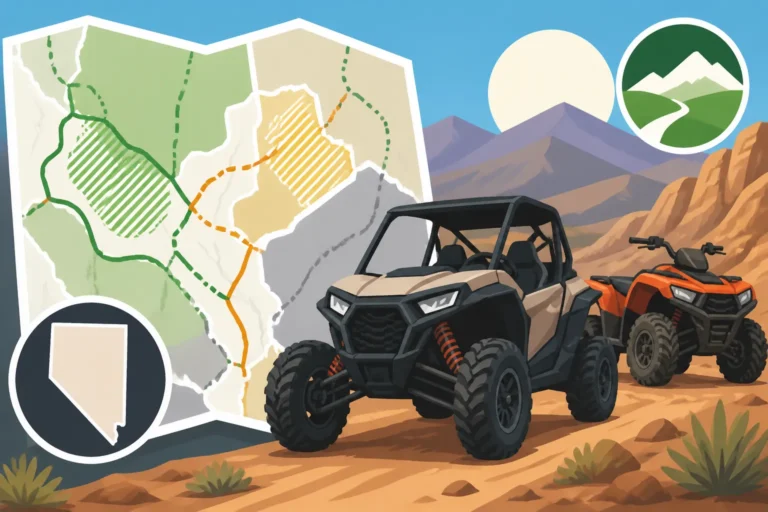
Check land access as carefully as registration. Nevada riding areas can include federal, state, and private lands, and an open-looking track may cross a closed route or a boundary where riding is not permitted. Save maps before leaving cell coverage and confirm any seasonal or temporary closures with the relevant agency. Keep your group on designated or otherwise authorized routes, and do not assume a trail is legal just because another vehicle has used it.
Carry your registration information and any relevant documents in a dust-resistant pouch or other protected place. It can also be helpful to keep secure phone photos as a backup, but don’t rely on a phone alone if the battery dies or the device is damaged. [Nevada Trail Closures to Check Before You Go] and [Carrying Documents in a Dry Bag] offer useful preparation reminders.
Match your supplies to Nevada conditions
Desert riding puts a premium on water, fuel planning, and heat management. Bring more water than you expect to need, and make sure everyone—including passengers—has access to it during the ride, not just at camp. In hot conditions, schedule the longest riding period earlier in the day, take breaks in shade where possible, and be willing to shorten a route if someone is becoming overheated.
Fuel range is not a fixed number. Sand, climbing, machine load, speed, and repeated stops can all affect consumption. Estimate range conservatively, identify fuel options before the trip, and avoid planning a route that depends on reaching a station at the edge of a machine’s expected range. Carry only the fuel and equipment you can transport safely, and follow applicable rules for fuel containers and storage.
Pack for ordinary problems as well as emergencies: a first-aid kit, basic tools, tire-repair supplies suitable for your machine, recovery gear, protective riding equipment, and a communication plan. A satellite messenger may be worth considering for remote rides where cell service is uncertain. For more detail, see [Water and Fuel Planning in Nevada], [Nevada Desert Riding in Summer Heat], and [Cell Coverage on Nevada Trails].
Keep the group together and the plan flexible
A weekend group can include different machines, skill levels, and comfort with distance. Before setting off, agree on the lead and sweep riders, the route, the planned stops, and what to do if someone has a mechanical issue. Set a pace that works for the least experienced rider, not just the person most eager to reach the next landmark.
Use regrouping points rather than expecting everyone to ride bumper-to-bumper. Dust and terrain can stretch a group out, and a rider who stops unexpectedly may be difficult to see. If someone falls behind, the group should have a clear procedure for waiting and checking in. Keep children and inexperienced riders within a level of supervision appropriate to the terrain and the machine.
Finally, treat the itinerary as a framework, not a promise. Wind, heat, a closed route, a mechanical problem, or slower-than-expected progress may call for a shorter ride. That is not a failed weekend; it is sound judgment. A route you finish safely and enjoy is better than a demanding plan that leaves everyone exhausted or forces a rushed return after dark.
Disclaimer
This article is for general informational purposes only and does not constitute professional advice. Laws, prices and regulations vary by location and change over time. Consult a qualified professional for guidance on your specific situation.