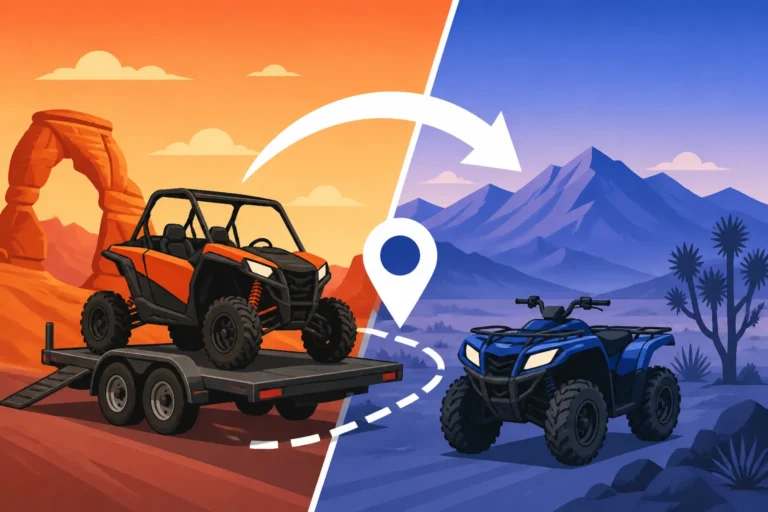
A Nevada Machine That Only Rides Private Land
It's a common head-scratcher for many off-highway vehicle (OHV) enthusiasts in Nevada: "My ATV or UTV never leaves my private property, so why would I need to bother with registration?" You've invested in a machine for your ranch, your expansive property in rural Nevada, or even just for riding around your own land in a subdivision that borders the open desert. The idea of navigating DMV bureaucracy for something that feels entirely yours and entirely off-limits to public trails can feel frustratingly unnecessary. This guide is here to clarify the specific rules and exceptions for OHVs used exclusively on private land in Nevada, helping you understand when you can skip the state decal and when you still need to get your paperwork in order.
Understanding Nevada's OHV Registration Laws
Nevada's off-highway vehicle registration laws can feel a bit like a maze, especially when you're trying to figure out if your specific riding scenario fits an exemption. At its core, the law generally requires any OHV that will be operated on public lands, trails, or roads designated for OHV use to be registered with the state. This means carrying a valid registration decal and card. The key phrase here is "public lands."
The state's primary interest in registering OHVs is to fund trail maintenance, law enforcement, and safety programs that benefit everyone who rides on public property. When you pay for your registration decal, a portion of that money goes directly back into improving the places you love to ride. However, if your machine genuinely never touches a public trail, a county road, or even a public access point, the logic behind registration changes dramatically.
It’s easy to get caught up thinking about just the major riding areas like Sand Mountain or Logandale Trails, but "public land" in Nevada also encompasses Bureau of Land Management (BLM) property, U.S. Forest Service lands, state parks where OHVs are permitted, and many county-maintained dirt roads that connect these areas. If your machine is destined for any of these, registration is a must. You can find more details about what machines need to be registered in Nevada by looking into [Registering an ATV in Nevada] and checking out the list of [Machines Nevada Exempts From Registration].
The distinction between a machine kept at home and a machine ridden on public land is paramount. Many owners keep their OHVs garaged or trailered for transport to public riding areas, which clearly requires registration. But what about the folks whose machines only ever see the dust of their own vast backyard or sprawling ranch? This is where the specific exemption for private land use comes into play, offering a reprieve from the typical registration requirements, provided you meet certain strict conditions.
What Constitutes "Public Land" in Nevada?
When we talk about public land in Nevada, it's not just the vast, open desert administered by the Bureau of Land Management (BLM) or the scenic national forests. It's a much broader definition that captures almost any ground that isn't privately owned and explicitly restricted. This includes unpaved county roads, state lands, and even certain paved roads in unincorporated areas that haven't been expressly closed to OHV use by local ordinance, although riding paved roads often comes with its own set of strict limitations, as covered in [Riding County Roads Legally in Nevada].
The moment your tire crosses from your private property line onto any of these public domains, even for a short distance, your machine becomes subject to Nevada's OHV registration laws. This can be a tricky line to navigate, especially for properties that border vast stretches of BLM land or have easements that cross public thoroughfares. It's not enough to simply intend to stay on private land; your riding habits must reflect it entirely.
Consider a rancher whose property extends for miles, bordering a county-maintained dirt road. If that rancher uses their quad to check fences or herd cattle only within the boundaries of their private property, they likely wouldn't need to register it. However, if they take that same quad out onto the county road to access a different parcel of their ranch, or to ride to a nearby town for supplies, then that machine suddenly needs to be registered. The definition is clear: if it touches publicly accessible land, it needs to be street legal or registered for off-highway use, depending on the specific road or trail.
The General Rule for Private Land OHVs
The general rule for OHVs used exclusively on private land in Nevada is straightforward: if your machine never operates on public land, trails, or roads, it does not need to be registered with the Nevada Department of Motor Vehicles (DMV). This is a significant exemption that can save owners the time, effort, and fees associated with registration. However, "never" is a powerful word here, and it leaves very little room for ambiguity.
This exemption is often a relief for landowners who primarily use their ATVs or UTVs for work or recreation strictly within their property boundaries. Think about a vineyard owner in Pahrump using a utility UTV to transport equipment between rows, or a family with a large tract of land near Lovelock enjoying weekend rides on their own trails. In these scenarios, as long as the machine remains confined to their property, state registration isn't required.
It's also important to distinguish registration from titling. While registration might be exempt for private land use, ownership documentation is still critical. You should still have a clear [Titling an Off-Highway Vehicle in Nevada] and proof of ownership, such as a bill of sale or manufacturer's statement of origin, even if you don't pursue a state title for an older machine. This paperwork is crucial for proving legal ownership, which is essential if your machine is ever stolen, needs to be sold, or if there's any dispute over who it belongs to.
When Your Private Land Use Might Still Require Registration
While the exemption for private land use sounds simple, the reality often has nuances that can quickly pull an OHV into the registration requirement. It's not always as clear-cut as "my property line" versus "the vast unknown." There are several scenarios where a machine predominantly used on private land might still fall under the state's registration mandate. Understanding these gray areas is crucial to avoid an unexpected citation.
One common scenario involves properties that have public easements or shared access roads. Imagine your property is accessed via a dirt road that also serves as a public right-of-way, even if it's mostly used by you and your neighbors. If you ride your OHV on that shared road, even if it feels like part of your private domain, you're technically on public land. Similarly, if you need to cross a short stretch of county road to get from one part of your property to another, that brief journey constitutes operation on public land and would necessitate registration.
Another less obvious situation might involve organized events. While your primary use might be private, perhaps you occasionally participate in a local poker run or a charity ride that starts or ends on private land but utilizes public roads or trails along the route. The moment your wheels touch those public segments, even as part of an organized event, your machine needs to be properly registered. The spirit of the law prioritizes public safety and trail funding, and these events, even with a private land component, tap into those public resources.
Crossing a Public Road to Access Another Private Parcel
This is probably one of the trickiest situations for many rural landowners. You might own two parcels of land, both private, but separated by a short stretch of public road—perhaps a county-maintained dirt road or even a quiet paved road. It seems logical to just hop on your ATV or UTV and drive the short distance between your properties. After all, it's your land you're accessing.
However, in the eyes of Nevada law, the moment your machine operates on that public road, even if only for a hundred feet, it loses its "private land only" exemption. At that point, it needs to be registered. This can be particularly frustrating for ranchers or those with expansive landholdings in areas like Lincoln County or Elko County, where properties are vast and often bisected by public access routes. You might feel like you're just moving your equipment around, but legally, you're operating on a public thoroughfare.
If your machine is primarily for [The Husbandry Exemption for Nevada Ranches], you still need to be mindful of this. While husbandry machines may have specific exemptions, these often apply to their use on the ranch, not necessarily their transit across public roads, unless those roads are explicitly part of the working ranch and closed to general public access. It's a fine line, but one that could lead to a citation if overlooked. Many find it simpler to register their machines if there's any chance of them touching a public road, even briefly, to avoid potential fines or legal issues.
Incidental Use and the "Any Public Land" Rule
The concept of "incidental use" often trips up OHV owners. They might think, "Oh, I only ride on public land for a few minutes to get to my hunting spot," or "I just use a small piece of BLM land as a shortcut to my back forty." Unfortunately, Nevada's OHV laws don't typically make allowances for "incidental" or "minimal" public land use when it comes to registration. The rule is generally quite broad: if you operate on any public land, registration is required.
This means that even a quick jaunt across a BLM-managed wash that borders your property, or a detour onto a county road to avoid a private land obstruction, can put you squarely into the category of needing registration. The law isn't concerned with the duration or frequency of your public land use, but rather the simple fact of it occurring. This ensures that all users who benefit from public trails and land contribute to their maintenance and regulation.
For owners who live in areas where private and public lands are intricately mingled, such as properties bordering the vast stretches of desert near Searchlight or Sandy Valley, it can be incredibly difficult to guarantee that their OHV never, ever touches public ground. It requires a meticulous understanding of property lines and a strict adherence to them. Otherwise, even a seemingly innocuous ride could lead to a problem. This is why, for many, if there's even a slight chance of their OHV leaving private property, getting the decal is a practical decision.
Essential Paperwork for Private Land OHV Ownership
Even if your ATV or UTV never leaves your private property and therefore doesn't require state registration, having clear, comprehensive ownership documentation is absolutely non-negotiable. Think of it as your machine's birth certificate and deed rolled into one. Without proper paperwork, you could face significant headaches if you ever decide to sell the machine, if it's stolen, or if there's a dispute over who actually owns it. The absence of official state registration makes these private documents even more critical.
The foundation of ownership proof typically starts with the manufacturer's statement of origin (MSO) or manufacturer's certificate of origin (MCO) when the machine is new. This document establishes the vehicle's initial ownership directly from the factory. When a machine is sold, a bill of sale becomes the crucial link in the chain of ownership. This isn't just a scribble on a napkin; it needs to be a detailed document outlining the buyer, seller, sale price, date, and most importantly, the machine's full Vehicle Identification Number (VIN). Services like LawDepot can provide templates for robust bills of sale, ensuring all the necessary legal information is included, even for private transactions.
For older machines, or those purchased years ago, the original MSO/MCO might be lost. In such cases, a series of comprehensive bills of sale tracing back to the original owner becomes your primary proof. It's also vital to understand [Titling an Off-Highway Vehicle in Nevada], even if you choose not to pursue a title immediately for a private-land machine. A state-issued title is the clearest form of ownership proof, recognized universally. While not legally required for unregistered private-land machines, it can simplify future transactions immensely.
The Importance of a Robust Bill of Sale
A bill of sale for an ATV or UTV, especially one that won't be state-registered, is not just a formality; it's a legal safeguard. This document formally transfers ownership from the seller to the buyer and provides critical details about the transaction. Without it, proving you legally own the machine can be incredibly difficult, particularly if you're buying a used ATV privately in Nevada and there's no state title involved, which sometimes happens with older machines or those sold without complete paperwork.
A good bill of sale should include:
- The full names and addresses of both the buyer and the seller.
- The date of the sale.
- The purchase price.
- A clear description of the OHV, including make, model, year, and engine size.
- The most crucial piece of information: the complete and accurate Vehicle Identification Number (VIN). This is how your specific machine is identified.
- Signatures of both the buyer and the seller.
Having a professionally drafted bill of sale, perhaps using a template from resources like LawDepot, can make a huge difference. It minimizes ambiguity and provides a clear record that can be invaluable in case of theft, an accident on your property, or a future resale. Always insist on a clear, signed bill of sale when you acquire an OHV, even if it's just for private land use, and make sure to keep a copy for your records indefinitely. You might also want to consult [What a Nevada ATV Bill of Sale Should Carry] for more specific details on what information should be included.
What an OHV Title Proves, Even for Private Use
Even if your ATV or UTV is never going to see public land, understanding [What an OHV Title Looks Like] and what it represents is fundamentally important. An OHV title issued by the state of Nevada is the ultimate proof of legal ownership. It acts as a secure, official document that legally identifies the owner of a specific off-highway vehicle, much like a title for a car. For machines used solely on private land, while not mandatory for operation, having a title provides undeniable legal protection and simplifies future transactions.
Think about it this way: a bill of sale proves you bought the machine, but a title proves you own it, free and clear, according to state records. If you ever decide to sell your machine, a clean title makes the process smoother and more transparent for potential buyers. It gives them confidence that they are purchasing from the legitimate owner, without any outstanding liens or ownership disputes. Without a title, especially for a machine that was never registered, future buyers might be hesitant or demand a lower price due to the increased risk and potential hassle.
Furthermore, in the unfortunate event of theft, a state title significantly aids law enforcement in identifying and recovering your stolen property. Without a title, and if the machine was never registered, proving ownership to the police can become a protracted and difficult process, relying solely on bills of sale and other less formal documents. Investing the time and paying the [Cost to Title an ATV in Nevada], even for a private-land machine, can provide invaluable peace of mind and long-term security. Even if you're not planning to register, obtaining a title is a smart move for any OHV owner. You can learn more about [Nevada OHV Registration and Proof of Ownership] to understand the nuances of these documents.
The Role of VIN Inspections
Even if your OHV never touches public land and you're not planning to register it, a Vehicle Identification Number (VIN) inspection can still play an important role, especially if you're trying to obtain a state title for the first time or if there's any ambiguity about the machine's identity. While the Nevada DMV will not perform a VIN inspection themselves, as detailed in [The VIN Inspection Nevada DMV Will Not Do], it doesn't diminish the importance of verifying your VIN.
A VIN inspection typically involves a licensed dealer or a sworn law enforcement officer physically inspecting the VIN on your machine to ensure it matches the paperwork (like the MSO or bill of sale) and that the number hasn't been tampered with. This process is primarily designed to prevent theft and the sale of stolen machines. If you're acquiring a machine, especially a used one, getting a VIN inspection even without the intent to register immediately is a wise precautionary step. It helps confirm the machine's legitimacy and can prevent you from inadvertently purchasing stolen property. You can learn more about this process in [Nevada OHV VIN Inspection Requirements].
If you plan to eventually title your private-land machine, a VIN inspection will likely be a mandatory step in that process. While the DMV won't do it, they accept inspections performed by licensed Nevada OHV dealers or by law enforcement. Knowing [Which Dealers Can Inspect a VIN in Nevada] or [Asking a Sworn Officer to Verify a VIN] can save you a lot of time and effort down the road. Even if you only ride on your ranch, ensuring your machine's VIN is clean and correctly documented is a fundamental aspect of responsible ownership.
Deciding What's Right for Your Machine
Navigating the rules for off-highway vehicles in Nevada, especially when it comes to private land use, can feel like a lot. On one hand, the exemption for machines strictly confined to private property offers a clear path to avoiding state registration. This can be a huge relief for ranchers, large property owners, or anyone who simply enjoys their ATV or UTV within their own boundaries without ever venturing onto public trails or roads. It saves you the time, fees, and administrative hassle associated with getting a state decal.
However, the definition of "private land" needs to be taken absolutely literally. The moment a single wheel touches any public land—be it a county road, a BLM access point, or even a shared easement that's publicly accessible—your machine technically falls under the state's registration requirements. This is where many owners unintentionally find themselves non-compliant, often without even realizing they've crossed that invisible line. The best advice here is if there's even a slight chance your machine will ever, for any reason, operate on public ground, registering it is the safest and most compliant option.
Beyond registration, ensuring you have clear proof of ownership is paramount, regardless of where you ride. A robust bill of sale, potentially drafted with the help of resources like LawDepot, and ideally a state-issued title, will protect you from theft, disputes, and make future sales much smoother. Knowing your machine's VIN is clean and verified through an inspection is also a smart move. Ultimately, the decision boils down to your specific riding habits and your willingness to strictly adhere to the "private land only" rule. For peace of mind and full compliance, many find that registering their OHV, even if they mostly ride privately, is the simplest way to go.
| Aspect of Ownership | Exclusively Private Land (No Public Use) | Any Public Land Use (Even Incidental) |
|---|---|---|
| State Registration Decal | Not required (exempt) | Required by Nevada law |
| State Title | Highly recommended for proof of ownership, not strictly required for operation | Required for registration; proof of ownership |
| Bill of Sale | Crucial for proving purchase and ownership; keep indefinitely | Essential for transferring ownership, even with a title |
| VIN Inspection | Recommended for title acquisition or verifying legitimacy | Required for title acquisition and initial registration |
| Financial Cost | Minimal (title fee optional) | Registration fee, title fee, potential late fees if applicable |
| Legal Risk | Low, if strictly adhering to private land use | Low, if registered and compliant; high if unregistered on public land |
| Ease of Resale | Potentially more challenging without title/registration history | Smoother with clear title and registration history |
Disclaimer
This article is for general informational purposes only and does not constitute professional advice. Laws, prices and regulations vary by location and change over time. Consult a qualified professional for guidance on your specific situation.