Nevada’s 15-Day Window for Out-of-State Machines
If you’re bringing an ATV or UTV into Nevada for a visit, the 15-day rule can be easy to misread. It is a limited exemption for qualifying out-of-state machines—not a general grace period for every visitor, and not permission to ride wherever you like. Here’s how to think about the time limit, what to carry, and what to do if your trip runs longer.
What Nevada’s 15-day window means
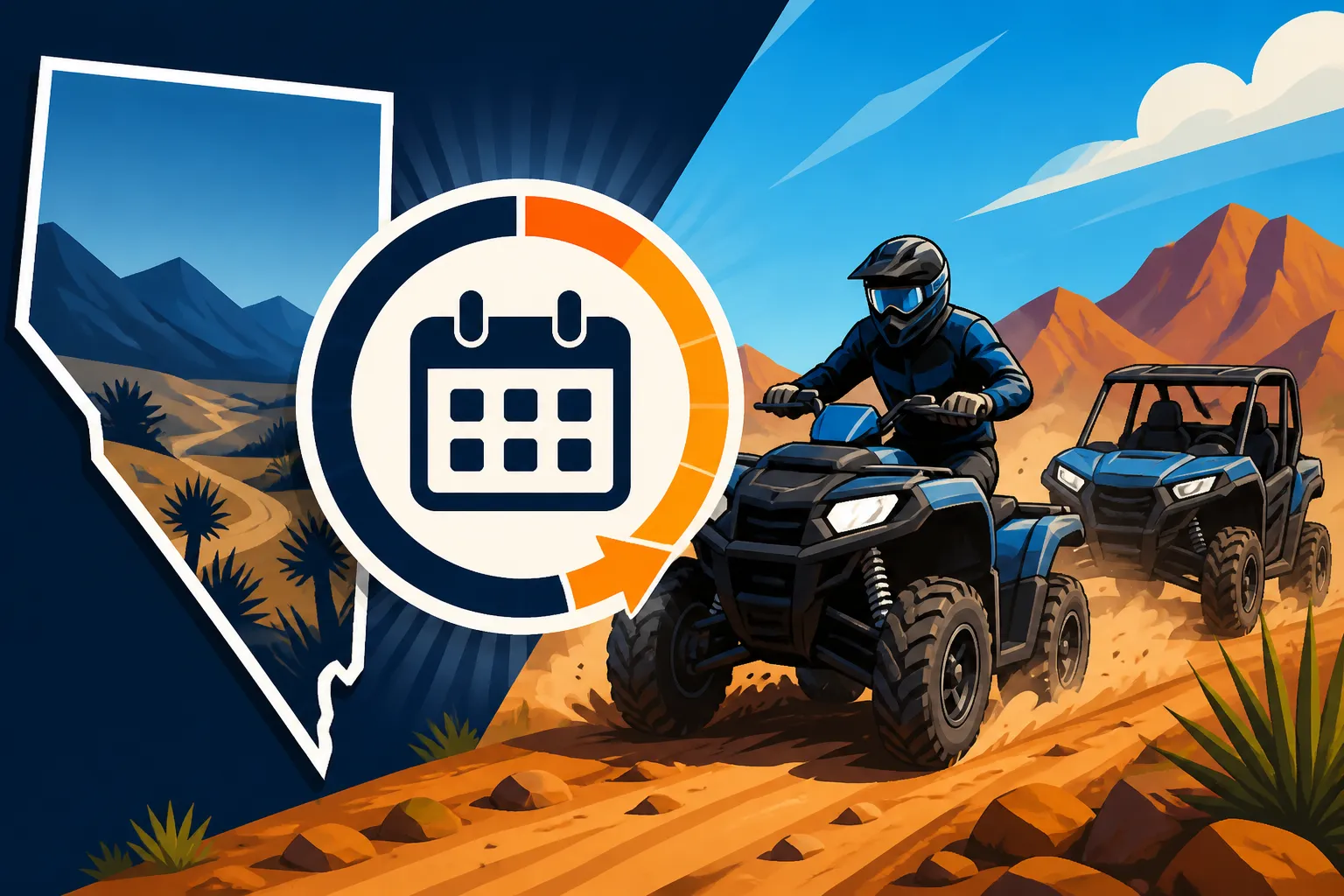
Nevada allows some qualifying machines owned by nonresidents to operate without a Nevada OHV decal for up to 15 days in a calendar year. The exemption is commonly referred to under Nevada law as the nonresident exemption. Its details and eligibility conditions matter: being from out of state, by itself, does not settle whether your machine qualifies.
The key distinction is that this is a limited exemption from Nevada OHV registration, not an automatic 15-day grace period after you cross the state line or buy a machine. It also does not make an ATV or UTV street legal. The Nevada OHV decal and road-use rules are separate issues.
For a careful overview of who may qualify, see Nevada’s Nonresident Exemption in NRS 490.082. If you are unsure whether the exemption applies to your machine, check the current Nevada requirements before riding rather than relying on another rider’s interpretation.
Think of it as a yearly use limit
The 15-day allowance is tied to a calendar year. That is different from counting 15 consecutive days from the date you arrive. A visitor who rides on several separate trips may use days from the same yearly allowance on each trip. The allowance does not necessarily restart just because the machine leaves Nevada and comes back.
For practical planning, keep your own record of every calendar day the machine is operated in Nevada. Don’t assume that a short ride counts as only part of a day, or that transporting the machine out of state resets the count. If you are close to the limit, confirm how the rule applies to your exact circumstances with the state’s OHV registration authority. The article When a Visitor’s 15 Days Start Counting discusses the day-count question in more detail.
Eligibility is not the same as residency
The exemption is for qualifying nonresidents and machines. It is not simply a rule that says any machine with an out-of-state sticker gets 15 free days. The owner’s residency, the machine’s status under the home state’s rules, and the documents available to prove that status may all matter.
That is why riders should not treat these situations as interchangeable:
- A visitor bringing a machine they own from their home state.
- A visitor borrowing a machine registered to someone else.
- A Nevada resident riding a machine with an out-of-state decal.
- A person who has recently moved to Nevada but has not updated their paperwork.
- A machine from a state that does not issue the same kind of registration document Nevada uses.
Each may call for a different answer. For general visitor questions, see Do Nonresidents Need a Nevada OHV Decal?. If your move is permanent or you are no longer clearly a visitor, look into Nevada registration rather than assuming the visitor exemption still fits.
How the 15-day allowance works in real trip planning
The safest approach is to plan around the limit before unloading the machine. Write down the dates you expect to ride, confirm the machine’s out-of-state status, and decide what you will do if the schedule changes.
| Situation | Practical way to handle it |
|---|---|
| One short Nevada visit | Confirm the machine qualifies, carry its current documents, and track each day it is operated. |
| Several visits in one calendar year | Keep a running total across trips; do not assume each visit starts a new allowance. |
| A trip that may exceed the limit | Check Nevada registration requirements before riding beyond the qualifying period. |
| A machine borrowed from another owner | Confirm that the owner’s documents and residency meet the exemption conditions, and carry permission to use it. |
| A recent move to Nevada | Treat this as a residency and registration question, not simply a visitor trip. |
| A machine with unclear or expired paperwork | Resolve its registration and ownership documentation before relying on an exemption. |
Track days conservatively
A simple trip log can prevent a misunderstanding later. Record the date, where you rode, and which machine you used. If more than one person rides the same machine, the exemption should not be treated as a separate allowance for each rider unless the official rule specifically says so. The limit concerns the machine’s eligibility and use, not a personal punch card for each person in the group.
A note on your phone may be enough, but paper is useful when a device battery is dead or there is no signal. You can also keep a small note with the machine’s documents. If you prefer a dedicated organizer, Amazon and outdoor retailers carry compact document pouches; choose one that closes securely and can tolerate dust and moisture.
Keep the log factual. You do not need to write an essay after every ride. A date and a short note such as “machine operated in Nevada” is more useful than trying to reconstruct the schedule months later.
Do not confuse arrival, unloading, and riding
The phrase “15-day window” can sound like a countdown that begins the moment the trailer enters Nevada. The useful planning question is not simply when you crossed the border, though. It is how the exemption’s day limit applies to your machine and its operation under current Nevada requirements.
If you are transporting a machine through Nevada without using it, do not guess how that affects the count. Likewise, don’t assume that riding for only a short time on a particular date avoids counting that date. When timing matters, ask the Nevada OHV registration office to clarify the rule before the trip.
The related article What a Visitor Does After 15 Days in Nevada covers the next step when a visitor’s Nevada use goes beyond the exemption.
Documents and checks to make before you ride
Even when a visitor believes the machine is exempt from Nevada registration, having clear paperwork makes it easier to explain why. Carry the documents that establish who owns the machine, where it is registered or otherwise recognized, and that the displayed out-of-state credential is current and belongs to that machine.
Build a simple paperwork kit
Before leaving home, check that you can produce:
- The machine’s current home-state registration or other relevant credential, if one is issued or required.
- Proof of ownership, such as a title or other ownership document where applicable.
- Identification showing the owner’s nonresident status.
- Written permission if the rider is using someone else’s machine.
- Any documents required by the home state for the machine to be operated there.
- A record of Nevada operating days if the machine has already been used in the state during the calendar year.
The exact documents can vary with the machine and the home state. A state may use a registration card, decal, permit, title, or a combination. Nevada’s acceptance of an out-of-state document depends on the applicable rule; do not assume that a document with “registration” printed on it automatically satisfies every condition. For the broader comparison, read Nevada OHV Reciprocity With Other States and Riding Nevada With an Out-of-State Registration.
Check names and identifying numbers before you leave. A document in the seller’s name, an expired registration, or a VIN that does not match the machine can turn a straightforward roadside question into a difficult one. If the machine is new to you and its paperwork is incomplete, resolve that before treating it as an eligible visitor machine.
Make the paperwork usable in the desert
Desert riding is rough on loose papers. Dust, sweat, water, and a sudden stop can scatter or damage documents. Keep originals secure and make a backup copy, but don’t rely on a phone photo as a substitute for a document the law requires you to carry.
A clear, waterproof document sleeve or small dry pouch helps keep papers together. Amazon sells basic organizers of this type, as do outdoor and motorsports shops. Look for a closure that stays shut in a dusty vehicle, and keep the pouch somewhere accessible rather than buried beneath recovery gear.
You can also save a photo or scan to your phone as a backup. Label files clearly, such as “UTV registration” or “proof of ownership,” and make them available offline. A backup helps if a paper gets damaged, but it is still only a backup. If you are unsure whether a digital copy is acceptable for a particular document, carry the paper version.
What to do if your trip may go beyond the limit
If your plans change and you expect to exceed the 15-day allowance, do not wait until the last planned ride to start figuring out registration. Nevada’s process may involve more than buying a decal: ownership records, a title, an application, a VIN inspection, or other documentation can be relevant depending on how the machine was acquired and where it came from.
Start by confirming that you are counting days correctly and that the machine actually qualifies for the visitor exemption. Then ask the Nevada OHV registration authority what steps apply to your situation. The requirements for an out-of-state machine are explained in Registering an Out-of-State Machine in Nevada, and Nevada OHV Registration Paperwork Checklist can help you organize what to ask about.
Do not assume a home-state sticker solves every Nevada issue
A valid credential from your home state may be important, but it does not automatically answer every question. The credential must relate to the machine, be current where required, and fit the conditions of the Nevada exemption. Reciprocity rules can also differ between states, so a rider’s experience in another state is not necessarily a reliable guide to Nevada.
If your home state does not register a particular kind of off-highway machine, ask Nevada what document or status is required for a nonresident machine from that state. Keep any official response with your trip records, but follow the current Nevada procedure rather than treating an informal conversation as a permanent rule.
A recent move is a different problem
A person who has made Nevada their home should not assume the nonresident allowance is a substitute for registering a machine. The 15-day visitor exemption is not a way to postpone residency-related obligations indefinitely. If you recently moved, are spending an extended period in Nevada, or keep the machine in the state for much of the year, describe those facts when asking about registration.
The answer may depend on the owner’s circumstances, the machine’s previous registration, and the paperwork available. If registration is required, sort it out before the next ride. You may also need to address title transfer or VIN verification separately; the visitor exemption should not be treated as proof of ownership.
The 15-day exemption does not grant trail access or road privileges
Registration and access are related, but they are not the same thing. A machine may qualify for a registration exemption and still be restricted from a particular trail, land area, road, or route. You remain responsible for obeying land-manager closures, local rules, and the equipment requirements that apply to the place you ride.
A registration exemption is not a street-use permit
An OHV registration decal—or an exemption from displaying one—does not by itself make an ATV or UTV legal on public roads. Nevada has separate rules for road use, and they depend on the kind of machine, the road, the route, and required equipment. Do not ride from a trailhead into town simply because the machine is registered somewhere or falls within the nonresident window.
Before any road segment, check whether it is legally open to the machine and whether the machine and operator meet the applicable requirements. A home-state plate or sticker should not be treated as a blanket authorization to ride on Nevada streets.
Public-land access has its own conditions
A visitor may also need to check the rules for the specific land and riding area. Federal land managers can close routes or restrict cross-country travel. Private property requires permission. A recreational-area fee or pass, where one applies, is separate from the Nevada OHV registration question.
Nevada does not have a separate general trail sticker that replaces its OHV registration system; see Why Nevada Has No Separate Trail Permit. But that does not mean every public riding area is free of site-specific rules or charges. Check the current access information for your destination, and do not assume that an out-of-state decal grants access to a particular riding area.
A practical checklist for visitors
Use this quick check before putting the machine on a Nevada trail:
- Confirm who owns the machine and where they reside. The exemption is not simply based on who is driving.
- Check that the machine’s home-state status is current. Confirm what registration or credential applies to that machine in its home state.
- Verify that the Nevada nonresident exemption fits. Do not rely only on a sticker or another rider’s account.
- Track Nevada operating days across the calendar year. Keep a simple record for separate trips as well as longer visits.
- Carry useful ownership and registration documents. Include written permission if someone else owns the machine.
- Plan ahead if the trip might exceed the allowance. Ask about Nevada registration before riding beyond the limit.
- Check access rules for each destination. A registration exemption does not override closures, road restrictions, or landowner permission.
- Keep documents protected and backups available. A dry pouch and offline phone copies are helpful, but a digital backup may not replace required originals.
For storing papers with your machine’s other trip documents, a small waterproof organizer from Amazon can be a practical option. Keep it secured in the vehicle and make sure you can reach it without unloading the machine. The goal is not to carry a pile of paperwork; it is to be able to show the relevant documents and explain your day count without guessing.
The simplest way to avoid trouble is to resolve eligibility before the trip, maintain a conservative day log, and treat any uncertain point as a question to confirm—not as permission to ride. If the machine’s ownership, home-state status, or residency situation is complicated, get specific guidance before using the 15-day exemption.
Disclaimer
This article is for general informational purposes only and does not constitute professional advice. Laws, prices and regulations vary by location and change over time. Consult a qualified professional for guidance on your specific situation.