Why There Is No Nevada Trail Sticker to Buy
Nevada riders often look for a separate trail permit or sticker after hearing they need paperwork to ride. The confusing part is that Nevada generally uses its off-highway vehicle registration decal for that purpose, rather than selling a second, statewide trail sticker. Here’s what that decal covers, when another pass may still be needed, and what visitors should check before riding.
Nevada uses one OHV decal instead of a separate trail sticker
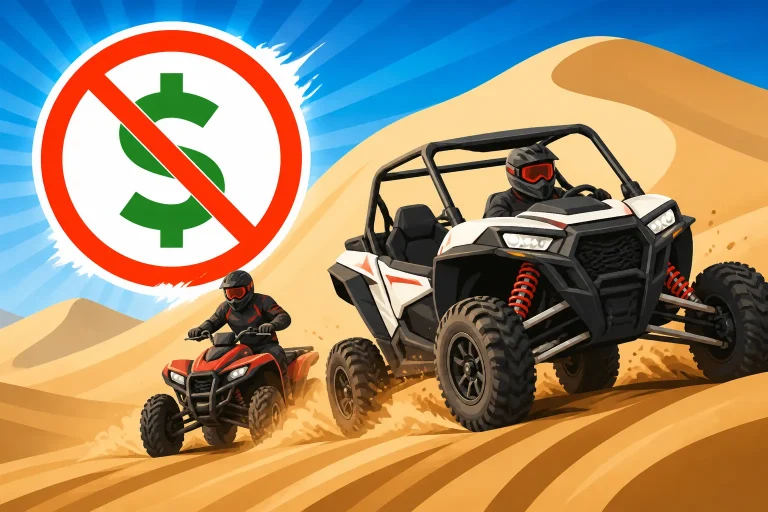
For many Nevada OHV owners, the registration decal is the key state credential for riding off-highway vehicles on public land. You do not normally buy a second Nevada-wide trail sticker on top of the registration decal just to ride a trail.
That distinction can be easy to miss because people use “registration,” “permit” and “trail sticker” interchangeably. They are not quite the same thing:
- Registration is the state’s process for recording an eligible off-highway vehicle and its ownership information.
- The decal is the visible proof associated with that registration.
- A trail permit is often another state’s term for permission to ride, or a separate product sold for a particular site.
- A site pass or recreation fee may be required at a particular riding area, even when the machine has its Nevada decal.
Nevada combines parts of the first three functions in its OHV registration system. That does not mean the decal opens every gate, replaces every site fee, or grants permission to ride wherever you find a track. It means there is generally not an additional, statewide Nevada trail decal for a Nevada machine to buy after it has met the state OHV registration requirements.
For a fuller overview of how the system fits together, see Nevada OHV Permits Explained and Nevada’s Registration Decal as Your Permit. Those topics help separate the state’s OHV decal from local fees and land-manager rules.
What the decal does and does not do
A decal helps show that the machine has met Nevada’s applicable OHV registration requirements. It is not a map, a trail reservation, or permission to cross private property. Nor does it automatically authorize riding on roads that are closed to OHVs.
The decal also does not turn an off-highway machine into a street-legal vehicle. Road use has separate rules, which may depend on the machine, the road, the county and the equipment fitted to the vehicle. A rider considering county-road use should look into the separate requirements for a large ATV or road-legal UTV instead of assuming the OHV decal is enough.
A useful way to think about it is:
| What you need to do | What may apply |
|---|---|
| Register an eligible Nevada OHV | Nevada OHV registration and its decal |
| Ride a specific managed recreation site | The site’s rules, and possibly a separate pass or fee |
| Join an organized event | Event or land-manager requirements may apply |
| Ride a public road | Separate road-use rules and equipment requirements |
| Ride private land | The landowner’s permission, even if the machine is registered |
The state decal is one layer of permission and identification. The location you plan to ride is another.
Why Nevada does not sell a second statewide trail sticker
A separate trail sticker is common in some places, so visitors may expect Nevada to offer one. Nevada’s system instead uses OHV registration and a decal, with fees tied to that system. The state does not generally make riders buy an additional universal trail sticker for everyday OHV use across Nevada.
There is a practical reason for keeping the system consolidated: the registration program can identify machines and support OHV administration without creating a second statewide permit that duplicates the first. Nevada’s registration decal is intended to serve as the state-level proof riders need for eligible machines, subject to the applicable rules and exemptions.
That does not mean all riding is free. A specific recreation area may charge for access, camping or another service. Those charges belong to the site or land manager, not to a second Nevada-wide trail sticker. For example, a riding area may have a day-use or camping fee, while other open public-land areas may not charge an individual rider at the trailhead. Rules and fees can differ between sites, so check the official information for the place you’re visiting.
This is why the question “Do I need a trail sticker?” needs a location attached to it. The answer may be “no separate Nevada statewide sticker,” but a particular site could still require a pass. Similarly, an event organizer may need a permit even though individual machines already carry the required registration.
The decal is not a substitute for permission to ride
Having a decal does not authorize riding in a closed area, crossing a wilderness boundary, using an unauthorized route, or entering private land. Public land is not automatically open to cross-country travel. Land managers can designate routes, close areas for resource protection or hazards, and impose temporary restrictions.
Before leaving the trailer, confirm that your intended route is open and appropriate for your machine. A track on a phone map, an old paper map or a line visible on the ground is not proof that riding is allowed there. The rules for public land are explained further in Nevada Rules for Riding Federal Land, and current route restrictions are worth checking through Nevada Trail Closures to Check Before You Go.
The same caution applies to trails close to communities, recreation sites and roads. A route that looks like a short connection may cross private property or a closed segment. Registration does not resolve that issue.
Do not confuse OHV registration with road-use credentials
The state OHV decal is for the OHV registration system. It should not be treated as a license plate or as proof that an ATV or UTV is legal on every public road. Nevada has separate rules for certain large ATVs and for machines operating on qualifying roads. Those rules can involve equipment, insurance, driver qualifications and local road access.
If the purpose of your trip is to ride a county road to reach a trailhead, check the road-use rules before assuming your OHV registration covers the trip. A decal may be necessary for the machine’s off-highway use while still being insufficient for the road segment.
Who needs the Nevada decal and what visitors should check
Nevada residents generally need to follow Nevada’s OHV registration requirements for eligible machines they operate, unless a specific exemption applies. The answer can depend on details such as the machine’s size, age, use and ownership. Don’t assume that a machine is exempt simply because it stays on a ranch, is small, is used by a child or rarely leaves private property. Each exemption has its own conditions.
If you are unsure whether a specific vehicle needs registration, start with Nevada’s Registration Decal as Your Permit and check the official state information for the machine’s circumstances. A dealer or the state OHV office may also be able to help identify the correct application route. The registration decal does not replace proof of ownership; keep the required paperwork with the machine’s records. Nevada OHV Registration and Proof of Ownership explains why those are separate issues.
Visitors with an out-of-state machine
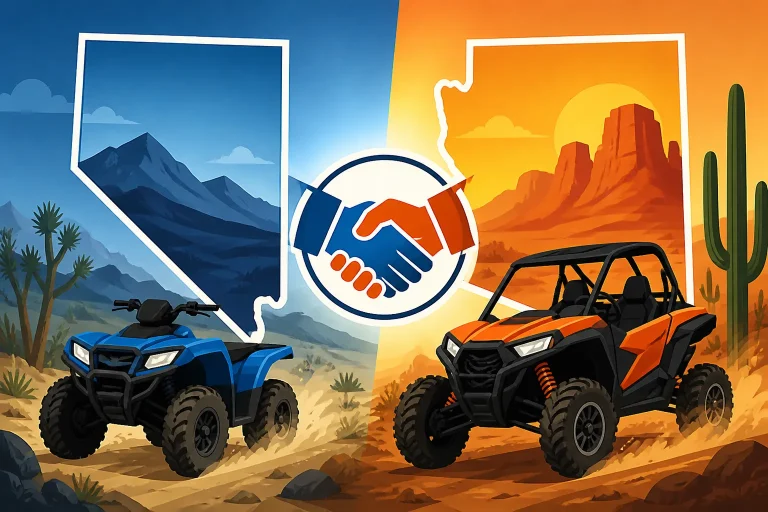
A visitor may not need to buy a Nevada decal immediately just because they cross the state line with an ATV or UTV. Nevada has rules for nonresident machines and out-of-state credentials, but the exemption is conditional. It may depend on where the machine is registered or permitted, the rider’s residency, how long the machine is operated in Nevada and other details.
Do not assume that a sticker issued by another state is automatically accepted for an unlimited stay. Reciprocity is not the same as a blanket promise that every out-of-state decal works in Nevada in every situation. Start with Nonresident Riders in Nevada and Nevada’s Nonresident Exemption in NRS 490.082. If your trip may extend beyond the applicable visitor period, check Nevada’s 15-Day Window for Out-of-State Machines and confirm the current rule with the official state source before you ride.
A few practical questions to answer before your trip:
- Is the machine registered, permitted or otherwise documented in the state where it is normally kept?
- Does the rider qualify as a nonresident under Nevada’s rules?
- How does Nevada count the time the machine is operated in the state?
- Does the planned trip go beyond the temporary exemption?
- Does the specific recreation site require a separate pass or fee?
- Is the route open to OHVs, and are any separate road-use rules involved?
If the answer to any of these is unclear, resolve it before arriving at the riding area. A visitor who does not qualify for an exemption may need to arrange Nevada registration rather than look for a separate trail sticker.
Reciprocity is a rule, not just a sticker match
A physical sticker can look familiar without proving that it meets Nevada’s requirements. What matters is whether the machine’s out-of-state status qualifies under Nevada’s current rules, not whether its decal looks similar to Nevada’s.
The same is true in reverse when Nevada riders travel elsewhere. Nevada’s decal does not automatically satisfy every other state’s permit rules. A state may recognize Nevada registration, require its own permit, or apply conditions based on the machine and the visitor’s trip. Check both the destination’s official requirements and any rules for the route to get there.
For California visitors, Nevada Reciprocity With California is a useful starting point. But the general lesson applies to riders from any state: check the current rule for the state you are entering and do not rely solely on a friend’s previous trip or an old online discussion.
Exemptions are specific, not a shortcut
Some machines or uses may fall under an exemption. That does not create a general “private land only” or “farm use” exception that every rider can claim. The facts matter, and a machine that appears to qualify may still need documentation to support the claim.
For example, an exemption might depend on a defined machine category, a particular use or the vehicle’s age. If you believe an exemption applies, confirm the conditions and what proof to carry. Do not buy a generic trail sticker as a substitute for registration, and do not treat the absence of a decal as proof that a machine is exempt.
Separate passes, fees and permits that may still apply
“No separate statewide trail sticker” does not mean “no other costs or permissions anywhere in Nevada.” It means the Nevada OHV registration decal is not normally duplicated by a second statewide trail permit. A particular site, activity or land manager can have its own requirements.
Recreation-site fees
Some OHV areas charge a site-specific use fee or offer passes for day use, camping or repeated visits. The charge may be collected by the land manager or an operator responsible for the recreation area. It is separate from Nevada OHV registration, and paying it does not register the machine.
Check the current official site information before travelling. Confirm:
- whether a fee applies to the machine, the vehicle transporting it, the campsite or the people in the group;
- how payment is collected and whether advance purchase is available;
- whether the pass covers riding, camping or both;
- whether the pass is valid for the date and area you plan to use; and
- whether seasonal closures or restrictions affect access.
Do not assume that a Nevada registration decal pays a recreation-site fee. Likewise, a site pass does not replace state registration when registration is required.
Organized rides, races and commercial activities
A regular personal ride and an organized event are not always treated the same way. A club ride, competition, guided commercial trip or activity that uses public land in a managed or organized way may involve permits, insurance or advance coordination. These requirements usually relate to the event or business activity, not to an extra personal trail sticker that every rider must purchase.
If you are joining an organized ride, ask the organizer what paperwork it handles and what you need to bring. If you are organizing the event, contact the relevant land manager early enough to establish the correct process. A Nevada decal on each machine does not automatically authorize an event on public land.
Renters should also distinguish the machine’s paperwork from their own obligations. A rental company may handle registration for its fleet, but that does not necessarily cover site fees, route restrictions or the renter’s responsibilities under the agreement. Ask the rental provider what documents and access costs are included before setting out.
Roads, private property and restricted land
A decal does not grant permission to ride on private property, and it does not override posted closures. It also does not settle whether a road is open to OHVs. For a road connection, verify the route’s legal status and any required equipment or other conditions.
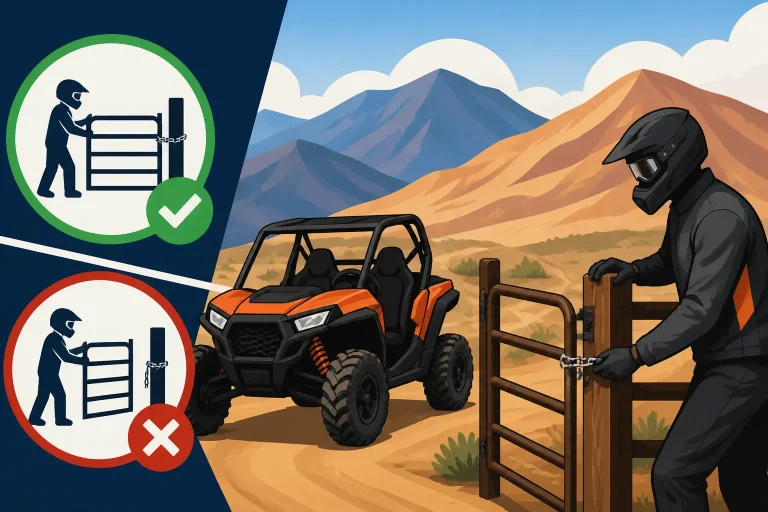
Similarly, a rider may need to stay on designated routes even when travelling on public land. A route that appears unmarked or lightly used can still be closed to motor vehicles. Respect gates and signs, and do not rely on tire tracks as evidence of legal access.
Buying the right thing and carrying useful proof
If you are a Nevada resident and your machine is subject to registration, focus on the state’s OHV registration process rather than searching for a separate statewide trail sticker. Make sure you select the correct application for your situation, assemble proof of ownership and complete any required inspection or verification steps. The paperwork can vary with how you acquired the machine, so use the state’s instructions rather than assuming all purchases follow the same path.
If you are visiting, check whether the machine qualifies for Nevada’s nonresident rules and whether your out-of-state documentation is current. If it does not qualify, ask the appropriate state office how to register it. If you are going to a managed area, check its rules separately for a site pass or fee.
A practical pre-ride checklist
Before the trip, confirm each of these:
- Machine status: Is it registered in Nevada, or does it qualify for a visitor exemption?
- Proof: Do you have the registration card or other documents the rules call for?
- Decal: Is the decal attached where required and readable?
- Ownership: Can you show the paperwork connecting you to the machine if needed?
- Route: Is the intended trail open to your type of vehicle?
- Site access: Does the riding area charge a separate fee or require a pass?
- Road segments: Will you use any public road, and do you meet separate road-use requirements?
- Trip length: If visiting from outside Nevada, have you checked how the nonresident period applies to your trip?
- Current restrictions: Have you checked for temporary closures, fire restrictions or other changes?
Keep the registration card and ownership records protected from dust and water. A small waterproof document pouch can be useful; you might find one at an outdoor shop or on Amazon. If you buy supplies on Amazon, choose a pouch that closes securely and is easy to open with dusty or gloved hands. The point is to protect your documents, not to attach an unofficial sticker to the machine.
A digital photo of paperwork can be a helpful backup, but do not assume it replaces any physical document the rules require. Keep original paperwork secure and accessible, and check what proof officials accept. Some riders store a copy in a protected pouch in the vehicle and keep a second copy with their travel documents. A basic organizer bought locally or through Amazon can help keep registration, insurance and site-pass information together, but it does not change what documents are legally required.
Avoid buying a look-alike decal
A generic sticker, club decal or product sold online is not a Nevada registration decal. It cannot substitute for state registration, and an unofficial sticker should never be placed where it could be mistaken for the official decal. Before purchasing anything described as a “Nevada trail sticker,” check what it actually is: a state registration item, a site-specific pass, a club membership decal or simply a decorative product.
This matters especially when an online listing uses broad language such as “trail pass” without explaining which land or program it covers. A listing on Amazon or another marketplace may be for a holder, accessory or non-government decal, not the official Nevada OHV credential. Verify registration procedures and fees with the official source, and check a recreation area’s official site for any separate access pass.
The short answer before you load the trailer
Nevada does not generally sell a separate statewide trail sticker for riders to buy in addition to the state OHV registration decal. For eligible Nevada machines, the OHV registration system and its decal serve the state-level function people often expect a trail permit to perform.
The important qualifications are that the decal is not universal permission to ride anywhere, a specific recreation site may charge its own fee, organized activities can have separate permit requirements, and road use is governed by different rules. Visitors also need to confirm whether their out-of-state machine qualifies under Nevada’s nonresident provisions and how long that exemption applies.
So before buying anything, identify the exact need. If it is state OHV registration, follow Nevada’s registration process. If it is a pass for a particular riding area, buy or arrange that site’s pass. If the question is whether your machine can use an out-of-state decal, verify the reciprocity and visitor rules. And if you are unsure, check with the relevant official agency or land manager before riding.
Disclaimer
This article is for general informational purposes only and does not constitute professional advice. Laws, prices and regulations vary by location and change over time. Consult a qualified professional for guidance on your specific situation.