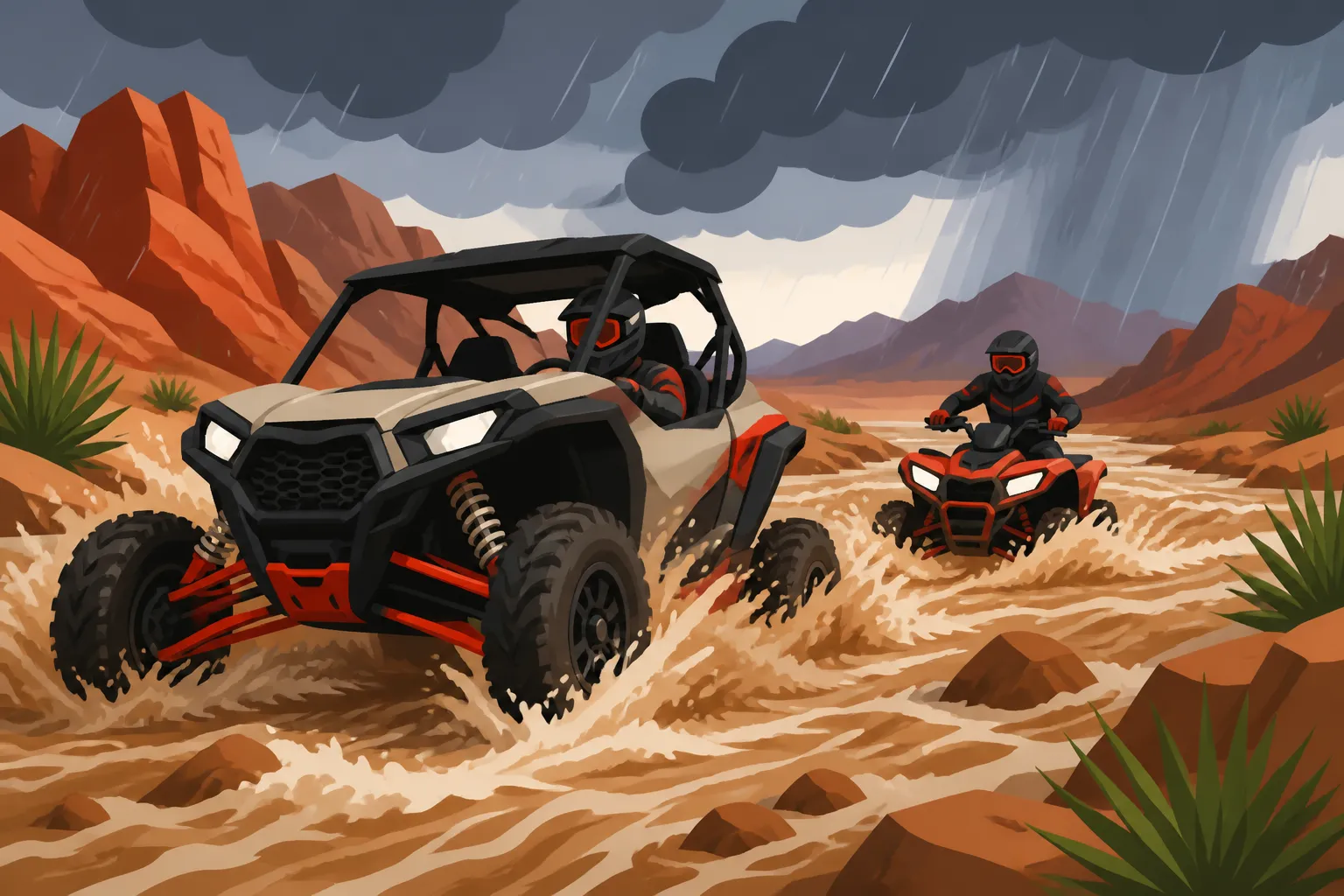
Flash Flood Season in the Desert
A Nevada ride can begin under clear skies and turn dangerous when a storm miles away sends water rushing through a dry wash. Flash floods can arrive quickly, carry rocks and debris, and cut off the route back to your truck. This guide explains how to plan around desert storms, recognize flood hazards, and make safer decisions on an ATV or UTV.
Why flash floods are a serious desert riding hazard
A dry wash can become a flood channel
In Nevada, a wash that looks like a convenient, flat trail may be a natural channel for runoff. Water from a storm can collect across a broad area and funnel into that channel, even when rain is not falling where you are riding. The sky above your group may still look clear while water is moving toward you from higher ground.
That is why “it’s only a little water” is a risky way to assess a crossing. A shallow-looking flow can conceal a soft bottom, shifting gravel, or a sudden drop. Water can also carry branches, rocks, and sediment that make it difficult to keep a vehicle upright or steer predictably. A UTV’s weight and four-wheel drive do not make a flooded crossing safe.
Washes around the Las Vegas Valley, near Pahrump, and across more remote desert country can be dry for long stretches and still carry sudden runoff. Treat a wash as a potential flood path, not as proof that a route is safe because it was dry earlier in the day. For practical terrain precautions, read Riding a Desert Wash Safely.
Storms can affect you from far away
A common mistake is to judge the danger only by looking at the clouds directly overhead. Storms can form over distant hills or mountains, where rain runs downhill into drainages and washes. You may encounter the resulting water well away from the rainfall itself.
Desert terrain can make it hard to see what is happening upstream. A bend, canyon wall, ridge, or low spot may block your view. By the time you hear rushing water or see a muddy surge, the safe decision may already be to move away from the channel rather than try to outrun it.
Dry lake beds and broad, flat-looking areas can be hazardous too. They may hold water or become soft after rain, making a route impassable or leaving a vehicle bogged down. Before planning a crossing or shortcut over a low area, review Dry Lake Beds and When They Are Not Dry.
The risk changes with the terrain and the trip
A familiar route is not automatically a safe route in storm conditions. A trail that was firm and easy to follow on a dry weekend can be cut by runoff, covered in loose debris, or damaged by water. Narrow canyons, steep-sided washes, culverts, low crossings, and routes with limited exits deserve extra caution.
The stakes are higher when your group is far from a paved road, cell coverage is unreliable, or daylight is running short. If one machine gets stuck or damaged, other riders may be tempted to help by entering the same hazardous area. Agree in advance that no one will attempt a flooded crossing to recover a vehicle. Protecting people comes before retrieving equipment.
Plan your ride around weather and terrain
Check the forecast for the whole route
Before leaving, check weather conditions for the riding area, not just the town where you are staying. If your plan includes travel from Las Vegas toward Logandale or from Fallon toward Sand Mountain, check conditions along the route and around the riding area. Storms can be localized, and a forecast for one community may not describe conditions in another drainage.
Pay attention to thunderstorm and flood alerts, but do not treat the absence of an alert as a guarantee that every wash is safe. Forecasts help you make a plan; they cannot tell you exactly when or where water will rise in a specific channel. Check again before you unload and keep monitoring conditions during the ride when you can.
A map can help you understand the route, but it does not replace weather judgment. Some riders use onX Offroad to review their planned route and nearby terrain before a trip. You can also use a printed map or another mapping tool. Whatever you choose, understand where your route follows low ground, crosses drainages, or enters terrain with limited ways out. For broader trip preparation, see Nevada Trail Maps Worth Downloading and Nevada Trail Closures to Check Before You Go.
Choose a route with safe alternatives
A good storm plan includes more than a destination. Identify high ground, exit routes, and places where your group can turn around without entering a wash. If a route has only one narrow way out, or if your planned ride depends on crossing a low-water area, reconsider it when storms are possible.
Before setting out, agree on a turnaround rule. For example, the group might turn back if thunder begins, rain starts over nearby higher terrain, a wash shows new runoff, or the route becomes difficult to read. Make the rule simple enough that everyone can follow it without arguing at a stressful moment.
Use a current travel map to check whether your route is open and where designated trails or roads run. onX Offroad can be one option for reviewing a route before departure, but don’t assume a mapped line confirms that a trail is open, passable, or safe after a storm. Check land-manager information where available, and be ready to change plans. Reading a BLM Travel Management Map can help you think through the difference between a mapped route and permission to travel it.
Pack for delays and changing conditions
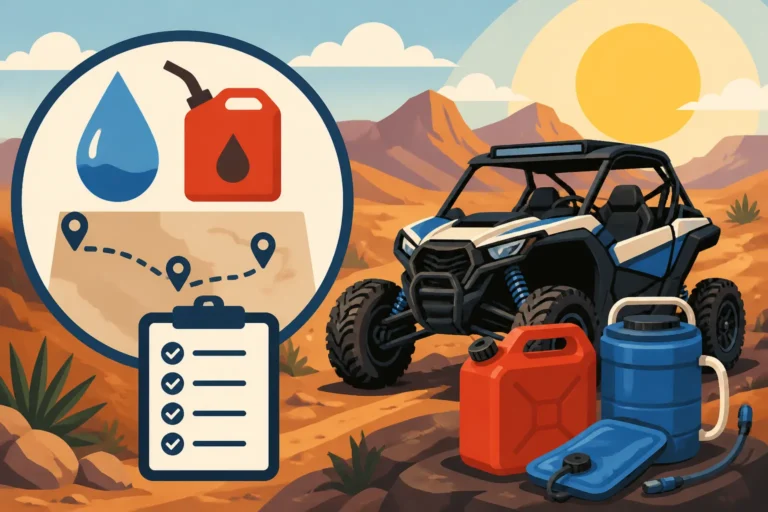
A storm can turn a short ride into a long wait. Bring more water than you expect to need, along with food, basic first-aid supplies, a charged phone, and appropriate clothing for a delay. Carrying water matters in Nevada even when rain is in the forecast; storms can bring a sudden temperature change, but they do not remove the risks of heat, exertion, or getting stranded. See Water and Fuel Planning in Nevada and Carrying Water for a Desert Ride.
A paper map or downloaded map can be useful if your phone loses signal or power. Keep essential items secured so they do not disappear in dust, wind, or a hurried retreat from a low area. Tell someone who is not riding where you plan to go and when you expect to return.
| Before the ride | What to check or prepare | Why it matters |
|---|---|---|
| Weather | Forecasts and alerts for the riding area and nearby higher terrain | Rain upstream can affect a wash below |
| Route | Drainages, low crossings, narrow canyons, and alternate exits | Some routes become difficult to leave quickly |
| Maps | Current route information and an offline or paper backup | Signal may be limited, and routes can change |
| Group plan | Turnaround conditions and a meeting point | Clear decisions help prevent risky disagreement |
| Supplies | Water, food, first aid, charged communication devices | A delay can make a short outing much longer |
What to do when storms or runoff appear
Leave low ground early
If you hear thunder, see rain over nearby hills, or notice runoff beginning, move away from washes and other low ground while there is still time. Head for higher, stable terrain that is not exposed to lightning, and do not wait beside a channel to see whether the water will rise. A route that feels manageable at the first sign of rain can become blocked quickly.
Avoid driving down a wash to “get out before the water comes.” That instinct can put the vehicle directly in the path of runoff. Instead, use a safe route away from the drainage if one is available. If no safe route is clear, stop making forward progress into the hazard, get to higher ground, and contact emergency services when needed and possible.
Do not assume that a small trickle is harmless or that a crossing is safe because another vehicle made it through. Water depth, speed, bottom conditions, and debris can change from one moment to the next. A vehicle can be swept, stalled, or left in an unstable position before its driver has time to react.
Never enter moving floodwater
If water is moving across a trail or road, do not ride through it. Do not try to judge the depth by the visible surface, and do not follow tire tracks from another vehicle. The flow may conceal a washed-out edge, loose rocks, a deep rut, or a sudden change in traction.
Turn around and find a safer route, or wait on high ground until conditions are safe. If the water blocks the only apparent way back, do not make a crossing just because your truck or campsite is on the other side. Seek help and share your location as clearly as possible. A machine can be replaced; a rider caught in a flash flood may have very little time to escape.
If someone is already in danger, do not enter the water to reach them. Call emergency services and look for a safer way to assist from stable ground. Follow dispatcher instructions and give clear details about your location, the direction the water is moving, and any visible landmarks.
If your machine becomes trapped or the route is cut off
If runoff reaches your vehicle or you cannot safely continue, stop trying to force the route. Move away from the channel and climb to higher ground on foot if that is the safer option. Do not stay beside a machine because you are worried about losing it, and do not climb into a low ditch, culvert, or narrow ravine for shelter.
Keep your group together when possible, but do not let regrouping delay someone’s move to safety. Once everyone is out of immediate danger, take stock of injuries and contact emergency services if needed. If you have a phone or satellite messenger, send a concise location and situation update. A tool such as onX Offroad may help you identify your position if you have prepared for use in limited-service areas, but do not rely on a device alone for rescue. Review Satellite Messengers for Desert Riding as part of your communication planning.
If the storm passes, do not assume the trail is ready to ride again. Runoff can leave hidden holes, loose rock, slick sediment, damaged trail edges, and debris. Wait for conditions to stabilize and use official closure information where available. If you cannot confirm that the route is safe and open, choose another ride or head back by a known safe route.
Make a safer decision before the first mile
Use a simple go-or-no-go check
Before unloading, pause and consider the whole outing rather than focusing on the first section of trail. Check for storm conditions nearby, identify whether the route crosses washes, and ask whether the group can get to high ground without crossing a drainage. If the plan depends on guessing how much rain a wash can handle, it is a poor plan for a stormy day.
A practical decision table can help keep the discussion grounded:
| Situation | Safer choice |
|---|---|
| Thunderstorms are forecast near the riding area | Choose a different day or a route with clear exits and no wash crossings |
| Rain is falling over nearby hills or mountains | Stay out of drainages and move toward safe higher ground |
| Water is moving across a trail | Do not cross; turn around or wait in a safe location |
| The route is damaged or its condition is uncertain | Stop and confirm the route is open and passable before continuing |
| Your group cannot agree on a safe exit plan | Do not start the ride |
This is not about being overly cautious or spoiling a trip. It is about avoiding the moment when a group feels committed to a route simply because it has already driven a long way to get there. A flexible plan gives you room to switch from a ride near Logandale to another activity, or to postpone a remote trip from Fallon when storms threaten.
Keep the group’s expectations realistic
Talk through the plan with everyone before starting, including less-experienced riders. Make sure each person knows not to follow a lead rider into moving water, and that turning around is an acceptable outcome. Families riding with children should be especially clear about staying together and not approaching a wash to watch the water.
A storm may leave you with a shorter ride than you hoped for. That can be frustrating, especially after arranging time off, loading machines, and driving across the state. But there is no need to “make the trip count” by pushing ahead when conditions are deteriorating. The safest day may be the one where the group decides to turn back before a hazard becomes an emergency.
After a storm, share any route damage or unsafe conditions with the appropriate land manager when possible. Avoid riding around a closure or creating a new track to bypass damaged sections. Returning when the route is confirmed safe helps protect both riders and the desert terrain.
Disclaimer
This article is for general informational purposes only and does not constitute professional advice. Laws, prices and regulations vary by location and change over time. Consult a qualified professional for guidance on your specific situation.