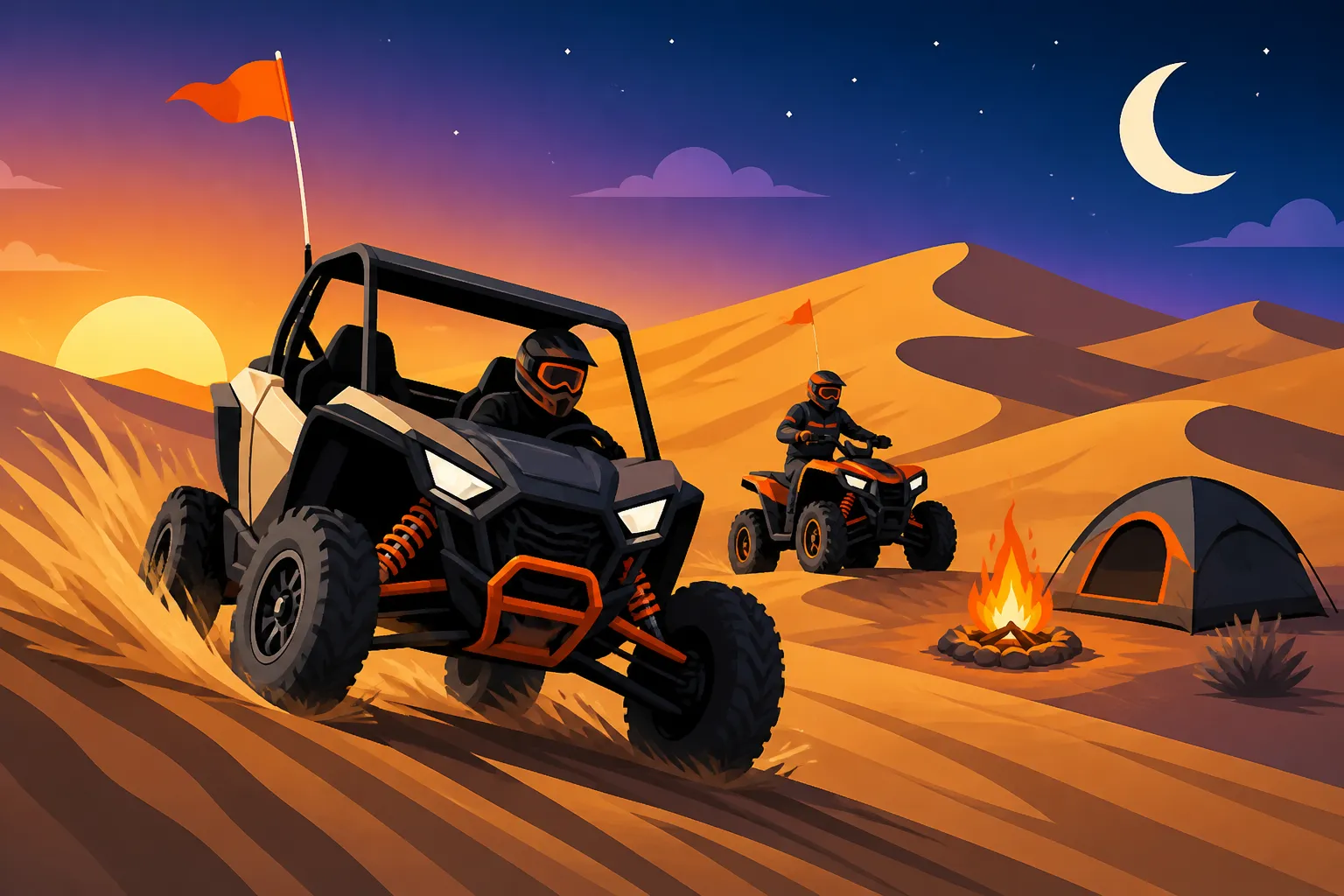
Winnemucca Dunes for an Overnight
An overnight ride at Winnemucca Dunes can sound simple: tow in, set up camp, and head for the sand. The hard parts are often less obvious—finding a suitable place to camp, carrying enough water and fuel, and avoiding a late-day breakdown far from help. This guide covers practical planning for a safer, more comfortable overnight trip.
Plan your overnight visit before you leave
Winnemucca Dunes is a popular sand-riding area near Winnemucca, Nevada, and its open terrain can make it feel more remote than the map suggests. A day trip and an overnight stay call for different preparation: you need a plan for camp, supplies, navigation, and what to do if a machine or vehicle has trouble.
Choose a base camp that fits your group
Before you pack, decide whether you want to camp close to the riding area or stay in town and drive out for the day. Camping near the dunes can make it easier to start early and avoid repeated trips, but it also means bringing everything you need and being prepared for limited services. A room or campground in Winnemucca offers more access to supplies and facilities, though it means you will be driving between town and the riding area.
If you plan to camp on public land, identify a spot where camping is allowed and where your tow vehicle and trailer can be parked without blocking access or damaging sensitive ground. Do not assume that every flat, open-looking patch is available for camping. Land boundaries, route designations, seasonal restrictions, fire rules, and closures can affect where you may travel or stay. Check the relevant land manager’s information before leaving, and follow posted signs when you arrive.
Think about the practical layout of camp, too. A spot that looks convenient at noon may be exposed to wind later, close to traffic, or difficult to find again after dark. Agree on a meeting point with your group, keep camp gear away from active riding lines, and avoid setting up where vehicles need room to pass. For more background on the area, see [Winnemucca Dunes Along Nevada's US 95] and [The 40 Miles of Winnemucca Sand].
Check access, conditions, and closures
A mapped route does not guarantee that it is open, passable, or suitable for your vehicle on the day you arrive. Recent weather can change the approach, and soft sand can make a short stretch unexpectedly demanding for a tow vehicle or trailer. Check road and land-management updates before setting out, then reassess conditions at the trailhead rather than pushing ahead because you have already driven a long way.
Download maps before you lose cell service. An offline map can help you locate your camp, understand nearby roads, and retrace your route if dust or changing light makes landmarks hard to recognize. onX Offroad can be one mapping option for viewing routes and saving map information for offline use; check the app’s current features and map coverage before relying on it. Carry a second navigation option as well, such as a paper map or a separate device, and make sure at least one person in the group knows how to use it.
Check for current closures and restrictions, especially if your plans include routes beyond the main dunes. A route that appears open on an older map may have changed, and riding outside designated or permitted areas can create safety and access problems. Use [Nevada Trail Closures to Check Before You Go] and [Nevada Trail Maps Worth Downloading] as starting points for building a more reliable plan.
Prepare machines and people for sand riding
Dunes are not just another surface. Sand can affect traction, visibility, cooling, fuel use, and how quickly a rider becomes tired. A group that is comfortable on hard-packed roads may need a different pace and more frequent check-ins in soft terrain.
Make a machine and recovery check
Before unloading, inspect each ATV or UTV for obvious problems: tire condition and pressure, brakes, throttle response, steering, fluid levels, lights, and any loose straps or cargo. Use the machine manufacturer’s guidance for setup and operation in sand. There is no single tire-pressure or riding setup that works for every machine, tire, load, and rider, so avoid copying a number from someone else’s setup without checking whether it suits your equipment.
Pack recovery gear appropriate to your machines and know how to use it before you need it. A tow strap, shovel, tire repair supplies, basic tools, and a way to communicate with the group can help with common problems, but recovery should never become an improvised tug-of-war. Keep people clear of tensioned straps, use designated recovery points, and do not stand in a likely line of pull. If a machine is stuck in a way that makes recovery unsafe, stop and reassess rather than adding more power.
Sand can also make routine riding more tiring than expected. Take breaks before riders become overheated or frustrated, and agree on simple group rules: who leads, who follows, where to regroup, and what to do if someone cannot keep up. For an overview of how terrain can affect a ride, [Low Dunes and Why They Ride Differently] offers useful context.
Set a pace that leaves room for changing conditions
Visibility can change quickly when several machines are moving over loose sand. Leave enough space to see the rider ahead and avoid following so closely that dust or a sudden stop takes away your reaction time. Use a route and speed that match the least experienced rider, not the most confident one. If a rider is uncomfortable, stop somewhere safe and talk through the next section before continuing.
Keep children and newer riders in terrain they can handle, and make sure everyone understands the limits of their machine. Avoid cresting a dune blindly: another rider, a drop, or an obstacle may be hidden on the other side. Ride in control, stay within the routes and areas open to your vehicle, and do not treat a visible track as proof that cross-country travel is allowed.
Plan your riding day around daylight. It is easy to lose track of time when the group is having fun, but a late return across unfamiliar sand can increase the chance of getting separated or missing a hazard. Set a turnaround time and let someone outside the group know where you expect to be and when you plan to check in. If you are deciding what to bring for a broader Nevada trip, [Nevada Trail Etiquette on Shared Dunes] and [Nevada Trail Difficulty for Beginners] can help set expectations.
Pack for an overnight stay without nearby services
A comfortable overnight trip depends less on elaborate gear than on having the essentials covered. At a remote riding area, a forgotten water container or a dead phone can be more than an inconvenience.
Carry water, food, fuel, and a backup plan
Bring more drinking water than you expect to need, accounting for riding effort, warm conditions, meals, and the possibility of a delay. Keep some water accessible during the ride instead of storing every container in camp. Do not count on finding potable water at the dunes. For trip-specific preparation, use [Water and Fuel Planning in Nevada] and [Nevada OHV Areas With Drinking Water] to shape your checklist, then confirm what is actually available at your chosen location.
Fuel planning should include the tow vehicle and the OHV, not just the ride itself. Estimate the round trip, include time spent exploring, and leave a reserve rather than assuming you can refuel nearby. Secure fuel containers appropriately and follow applicable fire-safety rules. If your machine’s fuel range is unfamiliar, make a shorter first loop and check consumption before committing to a longer ride.
Pack meals and snacks that can handle heat, wind, and dust. Bring a first-aid kit, sun protection, warm layers for after sunset, and a light source for camp. A charged phone is useful, but it is not a dependable emergency plan where coverage is limited. Consider a suitable emergency communication device for remote travel, and make sure the group knows how to use it.
Make camp resilient to wind, dust, and temperature swings
Desert conditions can shift between hot sun, cool evenings, and gusty wind. Choose shelter and storage that can be secured, and keep lightweight items from blowing away. Dust can work into food, sleeping gear, electronics, and machine components, so use closed containers and keep clean bedding protected until bedtime.
Set up camp with enough room to park and turn around without driving over vegetation or creating a new route. Keep cooking and fuel storage organized, and follow current restrictions for fires and stoves. Never assume a fire is permitted because another group has one. If conditions are windy or restrictions are unclear, choose a safer cooking option and check the posted rules.
Respect other visitors’ space and keep noise and lights considerate after dark. Pack out trash, food scraps, and any repair materials. If you are comparing dispersed camping with developed options elsewhere, [Camping at Nevada OHV Areas] and [Nevada Dispersed Camping Rules for Riders] can help you think through the differences and the responsibilities that come with camping on public land.
| Trip need | What to plan for | Why it matters |
|---|---|---|
| Water | Drinking water for camp and riding, plus a reserve | Delays and exertion can increase water needs |
| Fuel | A conservative estimate for the OHV and tow vehicle | Sand conditions and extra exploring can affect consumption |
| Navigation | Offline maps and a backup method | Cell coverage may be limited or unavailable |
| Recovery | Suitable strap, shovel, tools, and recovery knowledge | A stuck machine can become a group problem |
| Camp | Permitted location, secure shelter, and closed storage | Wind, dust, and access rules affect where and how you stay |
| Communication | A check-in plan and appropriate emergency device | A phone alone may not work in a remote area |
Make the trip safer and more enjoyable
An overnight stay works best when the group has made decisions before fatigue, darkness, or a mechanical problem puts pressure on everyone. A few simple habits can prevent small issues from turning into a difficult night.
Use a clear group plan
Before riding, identify the lead and sweep riders and agree on a regrouping point. Make sure everyone knows the plan if the group gets separated: stop in a safe place, avoid continuing alone, and use the agreed communication method. Riders should know the camp location and be able to describe it without relying on one person’s phone.
Use a map to orient yourself, but do not make navigation dependent on a single app. If you use onX Offroad or another mapping tool, download the relevant information in advance and check that you can access it with your device offline. Carry a battery pack, keep the phone protected from dust, and preserve enough power for emergencies. onX Offroad may help with route planning, but it should complement—not replace—current land-management information and sound judgment.
Tell a trusted person where you are going, who is in the group, and when you expect to return or check in. Choose a plan for what happens if you miss that check-in. A useful plan is specific: it names the expected route or area, gives a realistic return window, and identifies whom to contact if the group does not check in.
Know when to change the plan
Turn around if weather, visibility, machine trouble, rider fatigue, or access conditions make the planned route unsafe. A group may feel pressure to continue because camp is set up or the drive was long, but changing plans is often the sensible choice. You can shorten the ride, stay closer to camp, or spend the evening resting and attempt the route another time.
If someone becomes overheated, confused, unusually weak, or unwell, stop riding and respond promptly. Move them out of direct sun where possible, offer water if they are alert and able to drink, and seek appropriate emergency help. Do not assume a person will recover just because they want to continue. The same practical caution applies to a machine that is overheating, losing power, or behaving unpredictably.
Finally, leave the area in good condition. Use established access where allowed, avoid disturbing wildlife or vegetation, secure trash, and do not leave broken parts or camp equipment behind. For a second mapping reference while planning, onX Offroad can help you review route context and save information before departure; confirm current access and restrictions separately. A good overnight trip is not only one where the group gets a full day of riding—it is one where everyone returns safely and the site is left ready for the next visitor.
Disclaimer
This article is for general informational purposes only and does not constitute professional advice. Laws, prices and regulations vary by location and change over time. Consult a qualified professional for guidance on your specific situation.