Ditch Riding Versus Shoulder Riding
It's a common scenario out here in the vast expanses of Nevada: you're out riding your ATV or UTV, cruising along a dirt path, and suddenly you hit a paved road. It can be incredibly frustrating trying to figure out if you can simply hop over to the shoulder, or dip into the ditch, to connect to the next section of trail without getting in trouble or, worse, putting yourself in danger. This guide aims to clear up the confusion surrounding ditch riding versus shoulder riding for off-highway vehicles in Nevada, outlining what's permissible, what's risky, and what's downright illegal.
Understanding the Roadside: Shoulders, Ditches, and Rights-of-Way
Before we can even talk about riding them, we need to properly define what a "shoulder" and a "ditch" are in the context of a public roadway. Many riders assume these areas are fair game because they aren't the main driving lanes, but the legal definitions in Nevada are often far broader than you might expect, encompassing much more than just the asphalt or concrete itself.
What Exactly is a Road Shoulder?
The shoulder of a road is generally understood as the paved or unpaved area immediately adjacent to the travel lanes. It's designed primarily for emergency stops, disabled vehicles, or sometimes for slower traffic on multi-lane roads. In Nevada, shoulders are still considered part of the highway right-of-way. They are not intended for regular OHV travel, even if they appear to be a convenient bypass around traffic or a short cut to the next dirt path. Many people see a wide, clear shoulder and think it's just an extension of the dirt trail, especially if it's unpaved, but legally, it's typically still part of the road system and subject to those rules.
For example, imagine you're riding your UTV near Cold Springs north of Reno, and you come to a paved county road with a wide gravel shoulder. It might seem harmless to just continue along that gravel shoulder for a few hundred feet to reach another dirt access road. However, this shoulder is still legally part of the road. Riding on it without meeting specific street-legal requirements for "large ATVs" can lead to a citation. The ground might look like a natural extension of your off-road adventure, but the law sees it as adjacent to a highway.
Understanding the Roadside Ditch
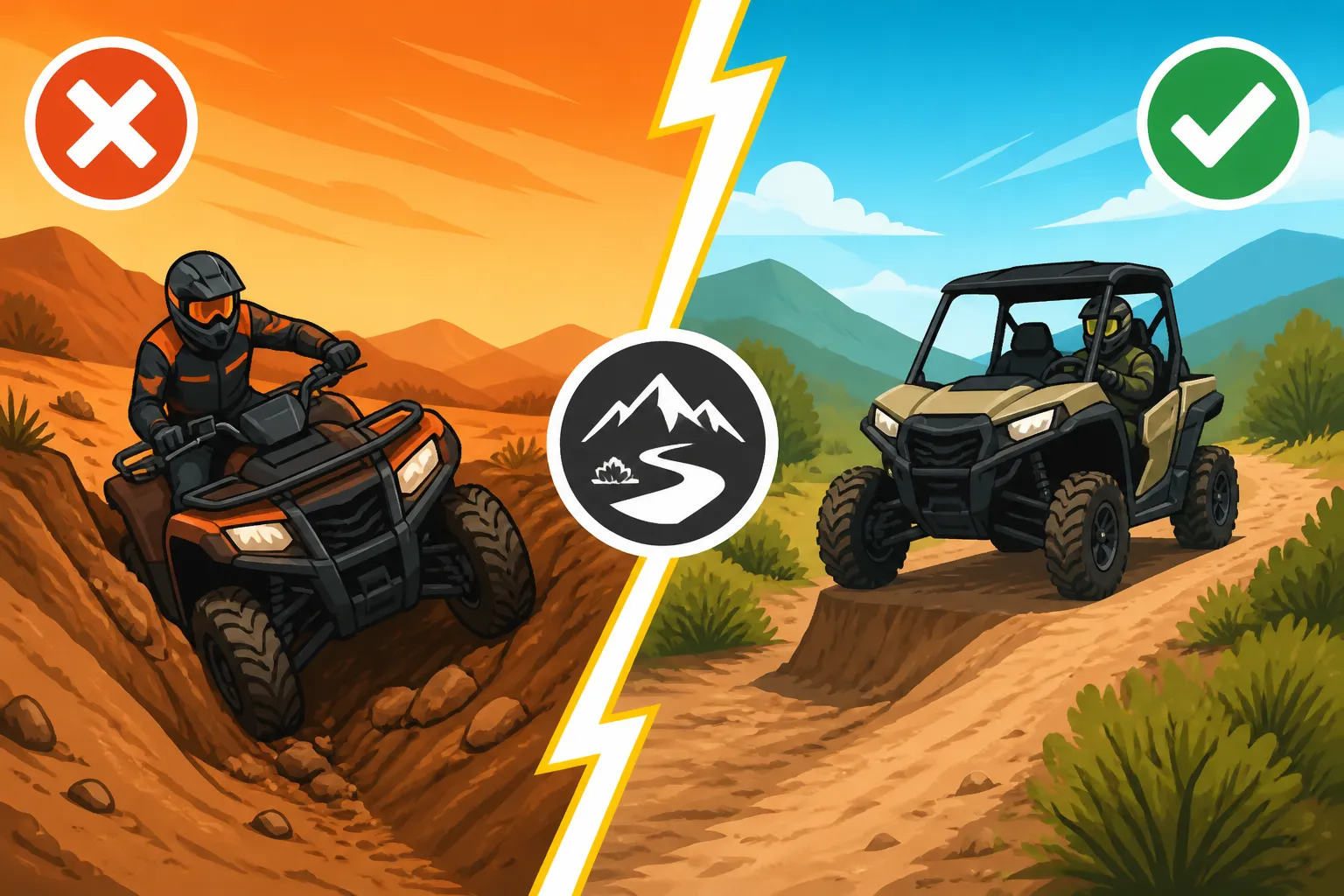
A ditch, in contrast to a shoulder, is typically a depression or channel running alongside a road, designed to collect and drain water away from the roadway. Ditches can vary widely in depth, width, and terrain, from shallow grassy swales to deep, rocky ravines. While a ditch might seem even further removed from the "road" than a shoulder, they often fall within the highway right-of-way as well. Furthermore, ditches often have culverts, hidden obstacles, and steep sides, making them incredibly dangerous for OHV travel.
Think about the irrigation ditches that run alongside many rural roads near Fallon or Fernley. These might look like fun, challenging terrain for your ATV. You might even see a local farmer using one for very specific agricultural purposes. However, for recreational OHV use, traversing these ditches is often illegal and dangerous. They can be private property, part of the state's drainage system, or simply too hazardous due to hidden rocks, soft mud, or unexpected drops. A deputy patrolling rural areas in Churchill County would likely view recreational ditch riding as just as problematic, if not more so, than shoulder riding, due to both the legal implications and the inherent safety risks.
Nevada's Stance on Riding Along Roadsides
Nevada law, specifically NRS Chapter 490, is quite clear about where off-highway vehicles can and cannot operate. The general rule is that OHVs are for off-road use, and using them on paved public roads, or the areas immediately adjacent to them, is highly restricted. There are some specific exceptions, but they are often misunderstood and do not apply to casual ditch or shoulder riding for most standard ATVs and UTVs.
Nevada's Stance on Paved Highway Riding
Generally, OHVs are prohibited from operating on paved highways in Nevada. This includes the main travel lanes, turn lanes, and, crucially, the shoulders. The rationale is simple: OHVs are designed differently than street-legal vehicles, often lacking the necessary safety equipment (like turn signals, proper mirrors, or DOT-approved tires) and stability for high-speed, multi-traffic environments. [Are ATVs Street Legal in Nevada?] delves deeper into this, but the short answer is usually "no," especially for standard ATVs and UTVs.
Nevada does have provisions for what it calls "large all-terrain vehicles" (LATVs), which are typically larger UTVs that meet specific criteria (four seats or a truck bed, among other things). These machines can be made street-legal for use on certain minor county roads, and in some designated areas, if they acquire a special [Nevada's Large All-Terrain Vehicle Decal] and are equipped with specific safety features. However, even with this decal, they are not permitted on state highways or interstates, and they are still subject to many of the same rules as other motor vehicles. Riding a standard quad on a shoulder is almost universally prohibited.
The "2-Mile Limit" and How It Applies (or Doesn't)
One of the most common misconceptions revolves around the "2-mile limit." Many riders believe they can ride their OHV on a paved road, or its shoulder, for up to two miles to connect trails. This is a partial truth, and a very dangerous one if misunderstood. Nevada law, under specific conditions, allows a properly equipped large all-terrain vehicle to travel for a maximum of [Nevada's 2-Mile Limit on Paved Highway] on designated minor county roads to connect to an OHV trail. This is a very specific exemption and comes with a host of requirements.
First, your machine must qualify as a "large ATV" and be properly registered and permitted for road use. Second, it must be on a minor county road, not a state highway, and often not within the city limits of larger municipalities. Third, it's for connection, not just general travel. This means you can't just cruise down the shoulder of Highway 95 for two miles to get to the next gas station. You would need to check [Which Nevada County Roads Qualify for ORVs] and ensure your vehicle meets all the criteria. For the vast majority of standard ATVs and smaller UTVs, and on most major roads, this 2-mile exception does not apply.
County Roads and Local Ordinances
While state law provides the overarching framework, individual counties in Nevada have the authority to enact their own ordinances regarding OHV use on county roads. This means that what might be permissible in one county, however limited, could be strictly prohibited in another. For instance, some rural counties might have more permissive rules for [Riding County Roads Legally in Nevada] for certain types of OHVs, while others, particularly those with higher populations or specific environmental concerns, might have strict bans.
Take Washoe County, for example. [Washoe County Ordinance 1507] has specific regulations that may differ from, say, Lincoln County, where populations are sparse and OHV use might be more common on less-trafficked county roads. It's absolutely vital to research the local ordinances for any area you plan to ride in, especially if you anticipate needing to use any portion of a county road. Ignorance of local law is rarely an excuse that will save you from a citation from [What a Nevada Trooper Looks For on a County Road]. Even when allowed, you typically cannot ride in the ditch; that often implies trespass or an unsafe operation.
Practical Considerations and Safety for Riding Near Roads
Beyond the legalities, there are immense practical and safety concerns that should make riders think twice about using road shoulders or ditches for OHV travel. These areas present unique hazards that are entirely different from designated off-road trails.
Visibility and Traffic Hazards
Riding an OHV on a road shoulder places you in direct proximity to fast-moving vehicle traffic. Cars and trucks are not expecting an OHV on the shoulder, and your machine's lower profile and different operating characteristics make you incredibly difficult to see, especially at speed or in dusty conditions. Ditches often have even worse visibility, as you might be obscured by roadside vegetation or the contour of the land itself. Drivers may not see you until it's too late, and the risk of a collision is exponentially higher than on a designated trail.
Imagine trying to navigate a narrow ditch alongside a busy road near Mesquite, while cars are whizzing by at 65 mph. The noise, the dust, and the sheer speed difference create a recipe for disaster. Even if you're riding a UTV with a full roll cage, an impact with a passenger car or a semi-truck at highway speeds is almost certainly catastrophic. Using your high-visibility flags, and ensuring your machine's lights are functioning properly (perhaps with upgraded LED lights from a company like SuperATV) can help, but they are no substitute for staying off the road entirely when you're not legally permitted.
Terrain Differences and Machine Stress
The terrain on a road shoulder, and especially in a ditch, is very different from a prepared off-road trail. Shoulders might be gravel, loose dirt, or even paved, but they often have uneven edges, potholes, or debris flung from the main road. Ditches, as discussed, can hide culverts, sharp rocks, deep ruts, or soft, muddy spots that can easily trap or overturn an OHV. These conditions put immense stress on your machine's suspension, tires, and steering components, potentially leading to breakdowns or loss of control.
Consider a ditch that has been eroding over years – it might look like a gentle slope, but beneath the surface, there could be exposed irrigation pipes, jagged rocks, or areas of washboard that will severely test your suspension. A well-built UTV from Polaris or Can-Am, perhaps even with aftermarket upgrades from SuperATV, is designed for rugged off-road use, but not necessarily for the unpredictable and often treacherous conditions found in roadside ditches. You could blow a tire, bend an axle, or even roll your machine, all far from help and in a potentially high-traffic area.
Equipment and Preparedness
If, under specific and rare circumstances, you are operating a legal "large ATV" on a minor county road, your machine must be equipped to meet street-legal standards. This includes working headlights, taillights, brake lights, mirrors, a horn, and often turn signals. Your machine will also need to comply with [Nevada Equipment List for Road-Legal UTVs]. For instance, a vehicle like a Polaris RZR XP 4 1000, if it has four seats, could potentially qualify as a large ATV, but it would still need all the required safety equipment, which often means adding aftermarket kits.
Beyond the machine itself, you, as the operator, also need to be prepared. This includes having a valid [Nevada Driver's License Rules for UTV Road Use], appropriate liability insurance (which is mandatory for road use), and often wearing a helmet, even if you're over 18. [Nevada Helmet Rules on Nevada Roads] are specific. Your standard off-road helmet might be fine, but always ensure it's properly fastened. Carrying [Insurance Nevada Requires for Road Use] is non-negotiable for road-legal operation. For casual ditch or shoulder riding, these requirements are almost never met, further compounding the legal risks.
Consequences of Illegal Riding and Enforcement
Riding your OHV illegally on shoulders or in ditches in Nevada carries significant consequences, ranging from costly fines to vehicle impoundment and even criminal charges in severe cases. Law enforcement across the state, from Nevada Highway Patrol to county sheriff's deputies and BLM rangers, are increasingly vigilant about OHV laws.
Fines and Penalties
Operating an OHV on a prohibited public road, shoulder, or within the right-of-way can result in substantial fines. These are not minor infractions. A ticket for operating an unregistered OHV or one not equipped for road use can easily set you back hundreds of dollars. If you don't have the proper [Nevada's Large All-Terrain Vehicle Decal] when attempting to use a minor county road, you could face [Nevada Fines for No Large ATV Decal]. These penalties are designed to deter unsafe and illegal operation and help fund the state's OHV program and trail maintenance.
Consider a scenario where you're riding your Can-Am Maverick in a ditch beside a rural road near Pioche. A Lincoln County Sheriff's Deputy spots you. You might receive multiple citations: one for operating an OHV on a restricted roadway, another for not having the appropriate registration or decal for road use, and potentially one for unsafe operation. These fines accumulate quickly, and the cost can easily overshadow any perceived convenience of "ditch riding" to save a few minutes.
The Risk to Your Machine and Insurance
Beyond fines, there's the very real risk to your machine. If you're involved in an accident while riding illegally on a shoulder or in a ditch, your insurance coverage might be null and void. Most off-road insurance policies have exclusions for accidents that occur during illegal operation or on public roads where the vehicle is not legally permitted. This means you could be on the hook for not only the damage to your own machine (which can be substantial for a modern UTV), but also for any property damage or injuries to others that you might cause.
Furthermore, illegal operation can lead to your machine being impounded. If law enforcement determines you are operating dangerously or without proper registration, they have the authority to seize your vehicle. The costs associated with impoundment – towing fees, storage fees, and administrative penalties – can be astronomical. Getting your machine back can be a long, drawn-out, and expensive process, often requiring you to rectify the original violation (like getting proper registration) before it's released. It's a significant headache that can easily ruin a planned riding trip or even your ownership experience.
| Feature | Road Shoulder Riding | Roadside Ditch Riding |
|---|---|---|
| Legal Status | Generally Illegal for OHVs; Part of road right-of-way; Rare exceptions for "Large ATVs" on specific county roads for 2 miles if fully compliant. | Generally Illegal; Often private property or within road right-of-way; High risk of trespass. |
| Safety Concerns | High risk of collision with vehicle traffic; Poor visibility for drivers; Debris from road; Uneven surfaces. | Extreme terrain hazards (culverts, rocks, mud, steep banks); Very poor visibility for OHV operator and other drivers; Risk of rollovers or getting stuck. |
| Terrain | Can be paved, gravel, or dirt; Often uneven, but generally flatter than ditches. | Highly varied; Can be soft mud, deep ruts, jagged rocks, steep slopes; Designed for water drainage, not vehicle travel. |
| Required Equipment | If legally permitted (e.g., "Large ATV"), must meet street-legal standards (lights, mirrors, horn, etc.). | No specific equipment allows for ditch riding. |
| Operator Requirements | If legally permitted, must have valid driver's license, insurance, and appropriate registration/decal. | No specific requirements, as generally prohibited. |
| Enforcement Risk | High; Visible to law enforcement; High potential for fines and impoundment. | High; Can be considered trespass or unsafe operation; High potential for fines and impoundment. |
| Primary Purpose | Emergency stops, disabled vehicles (for street-legal vehicles). | Water drainage, sometimes utility access. |
Riding off-highway vehicles in Nevada offers incredible opportunities for adventure, but it's crucial to understand and respect the laws and safety guidelines, especially when near paved roads. While the idea of cutting across a shoulder or dipping into a ditch might seem convenient, the legal and safety risks far outweigh any perceived benefit. Always prioritize designated trails, know the local ordinances, and ensure your machine and your riding practices are compliant with Nevada law to keep yourself and others safe.
Disclaimer
This article is for general informational purposes only and does not constitute professional advice. Laws, prices and regulations vary by location and change over time. Consult a qualified professional for guidance on your specific situation.