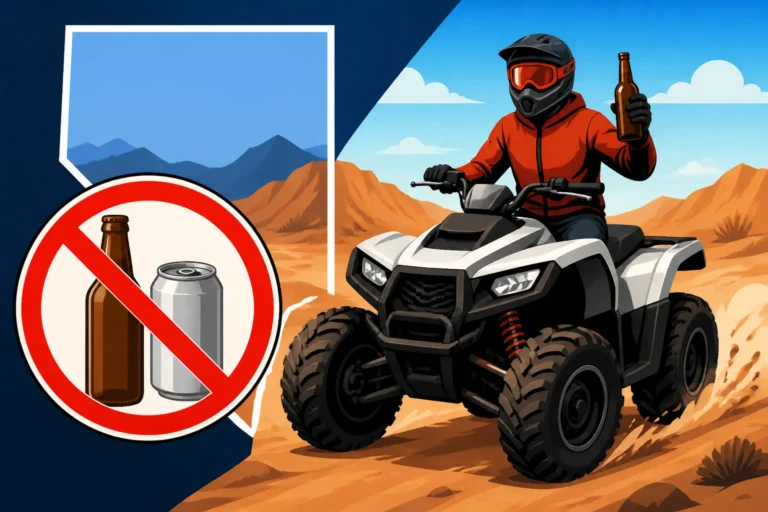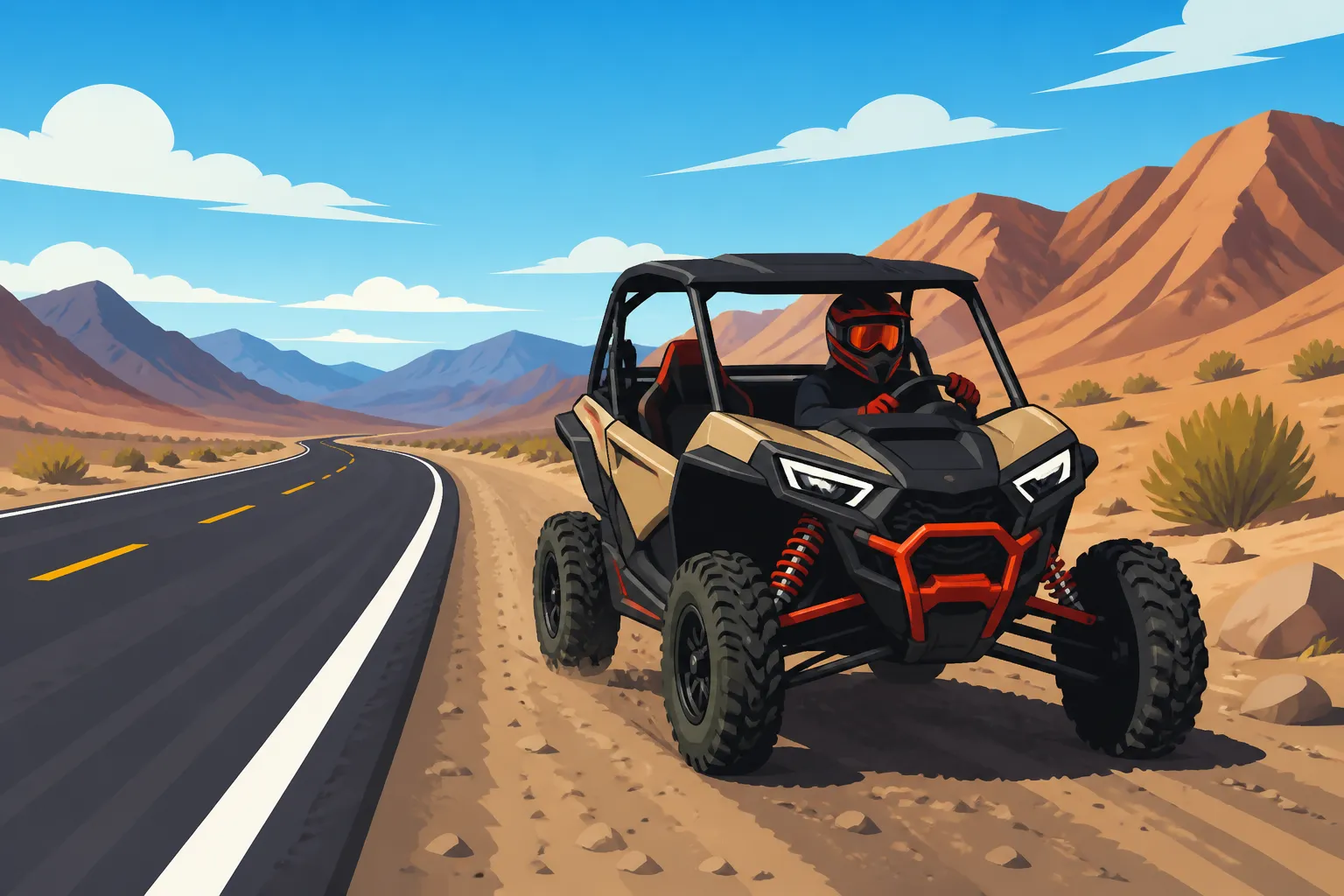
Riding a Nevada Highway Shoulder
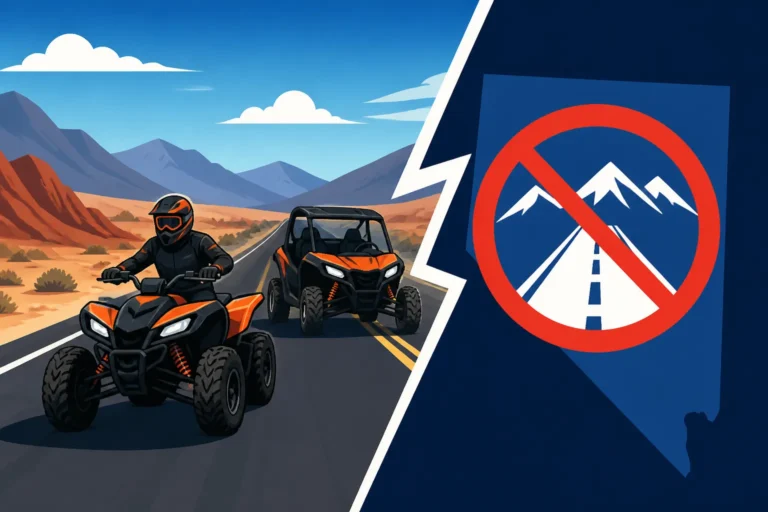
It's a common scenario for many of us who love hitting the Nevada trails: you're out exploring, having an incredible time, but then you hit a patch of pavement. Maybe it's a short hop between two trail sections, or perhaps you need to get from your campsite to the nearest gas station for fuel or a quick snack. The paved road stretches out, and right there, invitingly, is the shoulder – seemingly clear, separated from the main traffic, and just begging you to use it for that quick connection. It feels like a convenient, even safe, solution, doesn't it? But before you roll your ATV or UTV onto that shoulder, it’s absolutely critical to understand Nevada's specific regulations. This guide will clarify the rules around riding a Nevada highway shoulder, helping you stay legal and safe while enjoying our amazing state.
The Lure of the Shoulder: Why It's So Tempting (and Dangerous)
Let's be honest, the convenience of using a road shoulder when you're on an off-highway vehicle (OHV) can be incredibly appealing. We’ve all been there, faced with a short stretch of pavement that stands between us and the next dirt adventure or a necessary resupply stop. It just seems like the most logical path.
Connecting the Dots (and Trails)
Imagine you're at a popular riding area, perhaps camping just off a county road. You’ve got your UTV all loaded up, ready for a day of exploring, but the nearest trailhead is a mile down a paved road. Or maybe you've been riding for hours, and that fuel gauge is starting to look a little low, and the gas station is just a quarter-mile up the highway from the trail exit. In these moments, the thought of loading your machine back onto a trailer just for a quick jaunt feels like a colossal waste of time and effort. Using the shoulder seems like a perfect shortcut, a way to efficiently connect your off-road fun with the necessities of the paved world. It allows you to maximize your riding time and minimize the hassle, which is exactly what we all want.
The Illusion of Safety
Many riders perceive the shoulder as a relatively safe zone. It’s physically separated from the main flow of traffic, often by a solid white line, and it gives the impression that you’re out of harm’s way, away from fast-moving cars and trucks. You might think, "I'll just go slow, stick to the edge, and I'll be fine." This perception of safety is often reinforced by seeing emergency vehicles or disabled cars using the shoulder. You might even assume that since you’re not in the traffic lane, you’re not really on the highway. Unfortunately, this can be a dangerous illusion, as shoulders are not designed for regular OHV travel and present their own unique set of hazards that many riders simply don't consider until it's too late.
Nevada's General Highway Riding Rules
Before we dive specifically into shoulders, it's important to remember that Nevada has clear, albeit sometimes complex, rules about where and how OHVs can operate on paved roads in general. While many of us primarily associate our ATVs and UTVs with dirt, dunes, and open desert, there are specific provisions that allow for limited road use, especially for "large ATVs" – which typically refers to side-by-sides. These rules usually involve designated routes, speed limits, and strict equipment requirements. The core principle is that off-highway vehicles are just that – off-highway – and their presence on paved roads is tightly controlled. Understanding these broader regulations is the foundation for grasping why shoulder riding has its own set of limitations. For a deeper dive into the general rules, check out [Riding County Roads Legally in Nevada].
Nevada's Specific Stance on Shoulder Riding
Nevada's legal framework for OHVs on roads is quite precise, and while it does offer some pathways for limited paved road use, riding on the shoulder is often a grey area that can quickly lead to trouble if you're not fully informed. It's not as simple as "if it's paved, you can't ride it," but it's also not a free-for-all.
The 2-Mile Rule and Designated Routes
Nevada law includes a provision that allows OHVs to travel up to two miles on a paved highway shoulder to connect trail segments or access services, but this is usually interpreted within the context of designated routes. The catch? This isn't a blanket permission to ride any shoulder. The primary intent of Nevada's OHV legislation for road use is to allow machines to cross highways or to use specifically designated "minor county roads" to link trails. The key here is "designated." Simply because a road has a shoulder does not automatically make it a legal route for your OHV. Many highway shoulders are not part of any official OHV route system. If you're on a major state or federal highway, even if it feels like you're just "on the shoulder," you're likely on a road where OHV travel is strictly prohibited, regardless of how close you hug the white line. For more on the distance limits, see [How Far You Can Ride Pavement in Nevada].
The Difference Between a Shoulder and a Ditch
It’s easy to confuse a shoulder with a ditch, especially in the vast open spaces of Nevada where dirt often borders the pavement. Some riders might think, "Well, I'm technically off the paved surface if I'm just in the dirt alongside it." However, legally and practically, there's a significant difference. A shoulder is typically paved or graveled and is considered part of the improved roadway. A ditch, or the unimproved area beyond the shoulder, is usually natural terrain. While riding in an actual ditch adjacent to a road might technically keep you off the "roadway," it introduces a whole new set of safety concerns, like steep drop-offs, culverts, and hidden obstacles. Moreover, a law enforcement officer isn't going to spend time debating the fine line between a shoulder and a ditch when they pull you over. Their priority is public safety and adherence to the clear rules for OHV operation. What a deputy really looks for is whether your machine is being operated safely and legally, regardless of the nuanced terrain. Understanding this distinction can save you a lot of headache, and a good resource to review is [Ditch Riding Versus Shoulder Riding].
Implications for "Street Legal" Machines
Even if your UTV or larger ATV qualifies as a "large ATV" under Nevada law and proudly displays a [Nevada Large ATV Decal], riding on a highway shoulder still falls under the general rules for road use. That decal permits you to operate on certain county roads and designated routes, not necessarily all shoulders. Just because your machine meets the equipment requirements and has the special decal doesn't grant you carte blanche to ride anywhere a car can't. The decal is about what kind of machine is allowed, not where it's allowed. It’s a common misconception that having the decal means you’re essentially "street legal" everywhere. While it does enable more road access than a non-decaled machine, it doesn't override restrictions on specific highways or non-designated shoulders.
When Is Shoulder Riding Potentially Permitted (and Under What Conditions)?
While the general rule of thumb is to avoid highway shoulders unless explicitly permitted, there are a few very specific situations and conditions under which OHV use near or on paved roads is allowed in Nevada. It's crucial to understand these distinctions to avoid unintentional violations.
Crossing a Highway
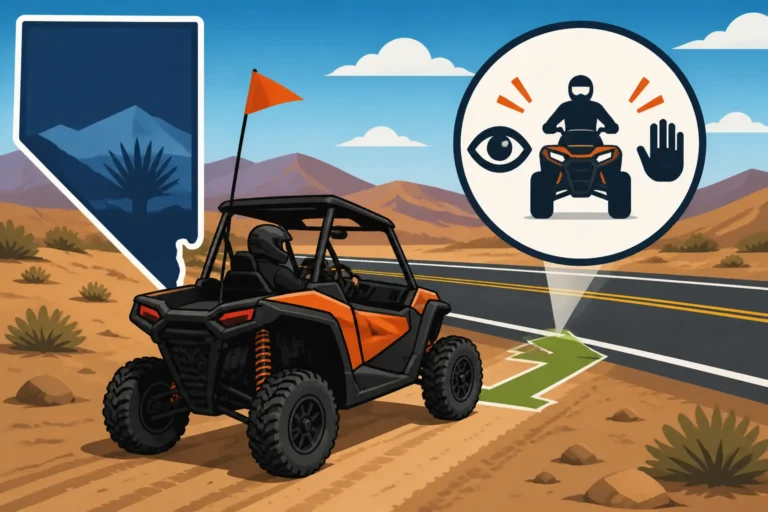
The most common and explicitly permitted scenario for an OHV on a paved road, including crossing over parts of a highway, is when you need to get from one side of a road to the other to continue on an approved trail. Nevada law generally allows for OHVs to cross a highway, provided they do so at a right angle (perpendicular to the flow of traffic), do it safely, and yield to all oncoming traffic. This is a very different action than riding along a shoulder for an extended distance. When you cross, your goal is to minimize time on the pavement and re-enter the off-road environment as quickly and safely as possible. It's not about using the shoulder as a travel lane, but as a brief, necessary transition point. For precise guidance on this, consult [Crossing a Highway on an ATV in Nevada].
Limited Exceptions and Local Ordinances
There are rare instances where a specific county or municipality might have an ordinance that designates certain road shoulders as part of an approved OHV route. These are almost always on minor county roads, not major highways. For example, some smaller towns might allow OHV travel on specific shoulders to access local businesses or trailheads. However, these are exceptions, not the rule, and they are usually very clearly marked or communicated by local authorities. You absolutely cannot assume that such an ordinance exists unless you have verified it with the local jurisdiction. Relying on hearsay or observation of others could lead to a ticket. Always check local ordinances and maps, such as those you might find on the [Nevada Trail Finder], before assuming a shoulder is fair game. This is particularly relevant in areas where cities have designated specific OHV routes. If you're riding through a town like Mesquite, for instance, there might be specific, limited routes, but these usually won't include major highway shoulders. To understand the local decision-making power, read up on [Nevada Cities That Require Designated OHV Routes].
Equipment Requirements for Any Road Use
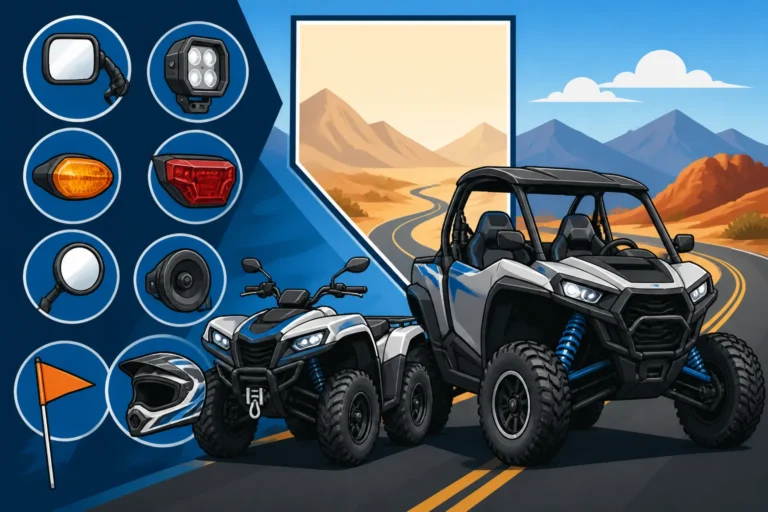
Even if you manage to find that rare, legally designated shoulder or are making a permitted highway crossing, your OHV still needs to meet specific equipment requirements to be on any paved surface. This isn't just a suggestion; it's a legal mandate to ensure your machine is visible and controllable. You'll need at least one headlamp that can illuminate 500 feet ahead, and a tail lamp visible for 500 feet to the rear. A stop lamp is also required, along with at least one mirror that provides a clear view of at least 200 feet to the rear. A horn is also mandatory. Many riders find that upgrading their stock equipment with aftermarket parts from companies like SuperATV can significantly improve safety and ensure compliance. They offer a wide range of lights, mirrors, and other accessories designed to meet these kinds of road-use standards, making your machine safer and legal for those permitted stretches. Beyond just lighting, a spark arrester is also required, whether on or off-road, to prevent fires. For details on these requirements, check out [Nevada Headlight Requirements for Road Use] and [Nevada Mirror Requirements for a Road UTV].
The Risks and Consequences of Illegal Shoulder Riding
The temptation to use a highway shoulder might be strong for convenience, but the dangers and legal repercussions of doing so illegally far outweigh any perceived benefit. It's not just about avoiding a ticket; it's about your safety and the safety of others.
Safety Hazards: Collisions, Debris, and Sudden Stops
Riding a highway shoulder, even at low speeds, exposes you to significant and often unseen hazards. First, drivers of cars and trucks typically do not expect an OHV to be traveling on the shoulder. This lack of expectation dramatically increases the risk of a collision, especially if you need to merge, cross, or if a vehicle is pulling over. Drivers might not see you, might misjudge your speed, or might simply not be paying attention to the shoulder.
Beyond other vehicles, shoulders are often littered with debris that cars have kicked off the main roadway – nails, glass, sharp metal, or even larger objects like shredded tires. These can cause immediate damage to your tires and suspension, leading to a loss of control. The shoulder itself might also be uneven, have sudden drop-offs, or be poorly maintained, creating unexpected obstacles. What looks like a smooth, clear path from a distance can quickly become a minefield. Imagine hitting a pothole or a patch of loose gravel at speed and losing control – the consequences could be catastrophic, especially with fast-moving traffic just feet away.
Penalties and Citations
Nevada law enforcement takes OHV rules seriously, particularly when it comes to road use. Operating your ATV or UTV illegally on a highway shoulder can result in a significant citation. Fines for unregistered operation, operating in prohibited areas, or lacking required equipment can quickly add up. Beyond just the monetary penalty, your machine could be impounded, leaving you stranded and incurring additional towing and storage fees. This isn't just a slap on the wrist; it's a genuine disruption to your day, your wallet, and potentially your driving record. It’s far more hassle than the few minutes saved by illegally riding the shoulder. To avoid these unwanted encounters, it's wise to review [Nevada Tickets for Riding Where You Should Not].
Insurance Implications
An often-overlooked consequence of illegal shoulder riding is the impact it can have on your insurance coverage. While many OHV riders carry insurance for their machines, these policies typically have specific clauses regarding where and how the vehicle is being operated. If you are involved in an accident while riding illegally on a highway shoulder, your insurance provider might deny coverage for damages to your machine, medical expenses, or liability claims. This is because operating outside of legal parameters can be considered a breach of your policy's terms. This means you could be personally responsible for thousands, or even tens of thousands, of dollars in damages and injuries, which is a financial risk no one wants to take. Always ensure you understand your policy's limitations, and remember that adherence to the law is often a prerequisite for your coverage to be valid. You can learn more about insurance requirements in [Insurance and Nevada OHV Registration].
Permitted vs. Prohibited Shoulder Use in Nevada
To make it a little clearer, here's a quick overview of when shoulder use might be permissible and when it's definitely not.
| Scenario | Legality in Nevada | Conditions/Considerations |
|---|---|---|
| Crossing a Highway | Generally Permitted | Must be perpendicular, safely, yielding to traffic, and minimizing time on pavement. |
| Designated OHV Routes | Permitted if explicitly part of route | Rare for highway shoulders. Only on minor county roads with clear local ordinances/signage. Verify locally. |
| Accessing Services (Short) | Usually Prohibited on major highways. Limited on minor roads | Only if on a designated route, or for very short, critical access where no alternative exists, and still subject to deputy discretion. |
| Connecting Trail Segments | Usually Prohibited on major highways. Limited on minor roads | Only if on a designated route, or if a very short distance on a minor county road and within a 2-mile limit, often for "large ATVs". |
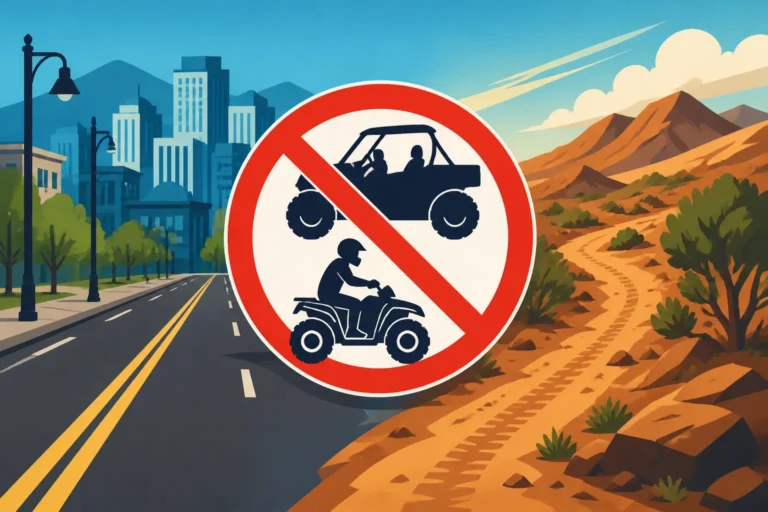
| General Travel Along Highway | Strictly Prohibited | OHVs are not allowed to travel long distances on major highway shoulders as a regular thoroughfare. |
| Emergency Use | Permitted (as with any vehicle) | If your OHV breaks down or for actual emergencies, temporary shoulder use for safety is generally accepted. |
Conclusion
The allure of riding a Nevada highway shoulder to connect trails or grab a quick bite can be powerful, but the reality is that it's a highly restricted and often dangerous activity. While Nevada law does provide some limited avenues for OHV use on paved roads, particularly for designated "large ATVs" and for short distances, it's critical to understand that these usually do not extend to general travel along major highway shoulders. The safety risks from unexpected debris, unaware drivers, and uneven surfaces are substantial, and the legal consequences, including fines, impoundment, and insurance issues, are not worth the shortcut.
Instead of risking it, always prioritize safety and legality. Utilize the incredible network of designated off-highway trails our state offers, and plan your routes carefully. Use tools like the [Nevada Trail Finder] to identify approved paths and connections. When you absolutely must traverse a short paved section, ensure it's a legally designated route or a permitted highway crossing, and that your machine meets all necessary equipment requirements. Ultimately, responsible riding means knowing the rules and sticking to them, ensuring you can continue to enjoy Nevada's vast and beautiful backcountry for years to come.
Disclaimer
This article is for general informational purposes only and does not constitute professional advice. Laws, prices and regulations vary by location and change over time. Consult a qualified professional for guidance on your specific situation.