What a Nevada Trooper Looks For on a County Road
There's nothing quite like hitting Nevada's wide-open spaces on your ATV or UTV, but sometimes, the trail requires you to use a county road to connect to the next adventure. This can be a nerve-wracking experience for many riders, unsure if their machine is truly legal for pavement and what a Nevada Highway Patrol Trooper might be looking for during a roadside stop. This guide will walk you through the specifics of what makes an off-highway vehicle (OHV) legal on Nevada county roads and exactly what law enforcement will be checking to ensure you're riding safely and within the law.
Understanding Nevada's "Large ATV" Designation
Before you even think about putting tires on pavement, it's absolutely crucial to understand Nevada's specific classification for OHVs allowed on certain public roads. The state doesn't just let any ATV or UTV roam free on county routes; there's a very particular definition you need to meet. Ignorance of this definition is a common reason riders find themselves pulled over or worse, issued a citation, so let's break it down.
What Nevada's NRS 490.043 Counts as a Large ATV
Nevada Revised Statute (NRS) 490.043 is the key here. It defines a "large all-terrain vehicle" as an off-highway vehicle that is 50 inches or less in width, has an unladen weight of 1,200 pounds or less, and has seating for two or fewer riders. Wait, that's the original ATV definition. For road use, Nevada actually uses a different, broader definition for what qualifies as a "large ATV" that can obtain a special decal for county road use. The definition for street-legal purposes is far more generous and applies mostly to side-by-sides (UTVs).
When a trooper pulls you over, they aren't just looking at your off-road registration; they're looking to see if your machine fits the legal definition for road use. For an OHV to be considered a "large all-terrain vehicle" eligible for limited road access, it must meet one of the following criteria:
- It has four or more wheels and an unladen weight of 3,500 pounds or less. This covers the vast majority of UTVs on the market today, from compact two-seaters to larger four-seat machines and even some utility models with truck beds.
- It has a truck-like or utility bed in the rear, designed for carrying cargo. This often applies to utility UTVs like a Polaris Ranger, Can-Am Defender, or similar work-focused machines. A trooper will quickly eyeball the back of your side-by-side to see if it has this feature.
- It has seating for four or more occupants. This is where many popular recreational four-seat UTVs, like a RZR XP 4 1000 or Can-Am Maverick X3 MAX, fit the bill.
If your machine fits any one of these descriptions, you're on the right track to potentially obtaining the specific "Large ATV" decal needed for limited county road travel. This is a separate decal from your standard OHV registration, and it's what truly signals to a trooper that your machine might be legal for the pavement you're on.
Why a Two-Seat Sport Quad Fails Nevada's Test
This is a really common point of confusion and one that often leads to disappointment for riders. If you're riding a traditional two-seat sport quad – think a Yamaha YFZ450R or even a larger utility quad like a Polaris Scrambler XP 1000 – it's highly unlikely it will qualify for the "Large ATV" designation required for county road use. Why? Because these machines typically do not have an unladen weight over 3,500 pounds, a truck bed, or seating for four or more.
The law was specifically written to allow larger, more stable side-by-sides to connect trails, not traditional ATVs. Many riders assume that if they meet the general OHV registration requirements, they're good for short stretches of county road. Unfortunately, that's not the case for most ATVs. A trooper knows these distinctions well. They're trained to quickly assess the type of machine you're on. If it's a quad, chances are high you'll be getting pulled over, and the conversation will quickly turn to why you're on a paved county road with an unregistered or improperly designated machine. It's a key piece of information for any ATV owner to know before attempting to ride on Nevada's paved roads. For a deeper dive into these classifications, check out [What Nevada's NRS 490.043 Counts as a Large ATV].
Nevada's General and Minor County Roads
Even if your OHV qualifies as a "large ATV," you can't just ride anywhere. Nevada has very strict rules about where these machines can be ridden on pavement. A trooper isn't just looking at your machine; they're looking at where you're riding it. The law specifically limits these machines to "general" or "minor" county roads. What does that mean?
Generally, these are lower-speed, less-trafficked paved county roads, often found connecting rural areas or leading to trailheads. They are not state highways (like US 93 or SR 169), interstates, or typically city streets unless a city has specifically designated a route by ordinance. For instance, while some areas like Mesquite might have a reputation for open streets, you still need to know the specific local ordinances. A patrol officer in Carson City or Reno will be far less forgiving on main thoroughfares than a deputy in a smaller, rural county.
Furthermore, even on qualifying county roads, there are often limits. [Nevada's 2-Mile Limit on Paved Highway] is a critical rule to remember. You're generally allowed to operate for no more than two miles on a paved highway or county road to connect to another trail, or to access fuel or services. This isn't a free pass to cruise through town. Troopers are especially vigilant for machines that appear to be using these roads for general transportation rather than trail access. If you're spotted going to the grocery store or just joyriding through a residential area, you're almost certainly going to attract attention.
Some counties may also have specific ordinances that either open or close certain county roads to OHV traffic entirely, so it's essential to check local regulations before you go. [Nevada Cities That Require Designated OHV Routes] can provide more context on how local jurisdictions manage this.
Essential Equipment for Road-Legal OHVs
So, your side-by-side meets the "large ATV" definition for Nevada roads. Great! But that's only half the battle. Your machine also needs to be equipped with a specific set of safety features and accessories to be compliant with road-use laws. This is often where a trooper's inspection begins, as these items are readily visible and crucial for safe operation on shared roadways.
Lighting and Visibility: Headlights, Taillights, and Reflectors
When you're sharing the road with cars, trucks, and even larger vehicles, visibility is paramount. Nevada law is clear about the lighting requirements for a "large ATV" on county roads:
- Headlights: Your machine must have at least one headlight (and often two for most UTVs) that is capable of projecting a white light visible from a distance of 500 feet to the front. This isn't just about seeing where you're going; it's about being seen. A trooper will check if your headlights are functional and if they meet the visibility standard. If you've got aftermarket lights, make sure they aren't blindingly bright to oncoming traffic, which can also draw unwanted attention.
- Taillights and Stop Lamps: Just as important as headlights are taillights. You need at least one red taillight, visible from 500 feet to the rear. Critically, you also need a separate stop lamp (or a taillight that functions as one) that illuminates when you apply the brakes. This is non-negotiable for road safety. If your brake lights aren't working, you're an immediate hazard and a target for a citation.
- Reflectors: In addition to active lighting, passive reflectors are required. You'll need a red reflector on the rear of the machine, visible from 200 feet, and amber reflectors on both sides of the machine, visible from 200 feet. Many modern UTVs come with some of these, but it's crucial to verify their presence and condition. Some riders upgrade their UTVs with kits from companies like SuperATV, which offer robust lighting solutions and mirrors that help ensure compliance and enhance safety.
A trooper isn't just looking for any lights; they're looking for lights that meet the specific distance and color requirements. If your lights are dim, broken, or improperly installed, you'll be facing a problem. [Nevada Headlight Requirements for Road Use] and [Nevada Taillight and Reflector Rules] detail these expectations.
Audible Warnings and Mirrors: Horns and Rear-View Mirrors
These are two commonly overlooked items that are absolutely essential for road use and will be checked by a trooper.
- Horn: Your "large ATV" must be equipped with a horn. This isn't just a friendly "hello" to fellow riders on the trail; it's a critical safety device for alerting other drivers or pedestrians on the road. It needs to be audible from at least 200 feet away. If your machine didn't come with one, installing an aftermarket horn is a simple and inexpensive way to comply. A quick honk is often part of a trooper's routine check.
- Rear-View Mirrors: Just like any other road-going vehicle, you need to be able to see what's behind you. Nevada law requires at least one rear-view mirror. Many UTVs come with a single center-mounted mirror, which typically suffices. However, if you're riding a machine with a windshield or cab, you might find side mirrors to be more practical and offer better visibility. Brands like SuperATV offer a wide range of mirrors, from roll cage mounted side mirrors to convex rearview mirrors, making it easy to add this critical safety feature. A trooper will always confirm you have at least one functional mirror to ensure you can safely change lanes or be aware of traffic approaching from behind.
Safety Gear: Seat Belts, Helmets, and Spark Arresters
While some of these rules apply off-road too, their enforcement can be particularly strict on county roads where public safety concerns are heightened.
- Seat Belts: If your "large ATV" is equipped with seat belts (which almost all modern UTVs are), they must be worn by all occupants while the vehicle is in operation on a county road. Troopers are very keen on this, as it's a primary safety device. They will be looking to see if everyone is buckled up.
- Helmets: This is another area of frequent misunderstanding. While Nevada has specific helmet rules for off-road riding, the requirements change when you're on a paved county road. If you're operating a "large ATV" on a paved county road, a helmet is not required for adults 18 and older, unless the vehicle is not equipped with a roll cage or occupant retention system (like a windshield and seat belts). However, it's always recommended for safety, and for riders under 18, a helmet is mandatory, regardless of the vehicle type or road. A trooper will confirm age and helmet use for minors. For a comprehensive overview, consult [Nevada Helmet Law for Road Riding].
- Spark Arresters: While primarily an off-road and fire prevention requirement, a functional spark arrester is also required if you're riding on public lands, which includes connecting county roads that lead to or through such areas. Most factory-equipped OHVs come with a spark arrester, but if you've modified your exhaust system, ensure the replacement still includes this vital component. Troopers, especially in rural areas, are often well-versed in fire safety and will check for this.
- Mufflers: Your machine also needs an adequate muffler to prevent excessive noise. While there aren't explicit decibel limits on county roads specifically for OHVs, overly loud machines can attract negative attention and may still be cited under general noise ordinances if deemed excessive.
[Equipment a Nevada Road-Legal Machine Needs] offers a comprehensive list of all these requirements.
Driver, Passenger, and Age Rules on County Roads
It's not just about the machine; it's about who's driving it and who's riding along. A Nevada Trooper will absolutely be checking the credentials of the driver and ensuring that all passengers are compliant with state law, especially concerning age and supervision. These rules are in place for everyone's safety and are strictly enforced on public roads.
Driver's License and Age Requirements
This is a fundamental check for any vehicle on a public road, and OHVs are no exception when operating on designated county roads.
- Driver's License: Anyone operating a "large ATV" on a Nevada county road must possess a valid driver's license. This means a standard Class C driver's license, just like you'd need to drive a car or truck. A trooper will ask for your license, and if you don't have one, or if it's suspended or expired, you're looking at a serious citation, potentially even an arrest depending on the circumstances. This is a non-negotiable requirement.
- Minimum Age to Drive: The minimum age to operate a "large ATV" on a county road is 16 years old, and that 16-year-old must hold a valid driver's license. There's no provisional license exemption for OHVs on county roads; it's the full deal. If a trooper sees a younger driver, they will immediately question the situation. You can find more information on this at [Nevada Driver's License Rules for UTV Road Use].
It's easy to forget your wallet or license when you're geared up for a trail ride, but when you transition to a county road, those details become critical. Always carry your physical driver's license with you, just as you would in your car.
Passenger Rules and Child Safety
Nevada has specific rules about who can ride as a passenger and where they can sit in a "large ATV" on county roads.
- Designated Seating: All passengers must ride in a seat designed for occupancy, and the number of passengers cannot exceed the manufacturer's designated seating capacity. This means no riding in the bed, no standing, and no piling more people in than there are seat belts. A trooper will count heads and confirm everyone is properly seated and buckled.
- Child Passengers: If you have children as passengers, they must meet specific requirements. Generally, a child needs to be able to place their feet on the floorboards or footrests when seated. For very young children, appropriate child restraint systems should be used, similar to how they would be in a car, if available for the specific OHV. The primary concern is their safety and ability to stay securely seated. [Nevada Rules for a Child Passenger on a Road] provides more depth on this topic. It's about common sense and ensuring that the child is safe and not exposed to unnecessary risk while sharing the road with other traffic.
Supervising a Teenager on a County Road
If you have a rider under 16 who is learning or enjoying an OHV, their ability to ride on county roads is severely restricted.
- Under 16 Restriction: A person under 16 years of age is generally prohibited from operating an OHV on a public highway or county road, even if supervised. While there are provisions for young riders off-road (with proper supervision and potentially a safety certificate), these allowances typically do not extend to paved county roads. This is a crucial distinction.
- Trooper Scrutiny: A trooper spotting a clearly underage driver on a county road will almost certainly initiate a stop. The consequences can range from a citation for the supervising adult to the machine being impounded, depending on the severity and any prior offenses. It's always best to keep riders under 16 strictly on designated off-road trails.
Paperwork and Proof: What to Carry
Imagine being pulled over and not having the right documents. It's frustrating in a car, but for an OHV on a county road, it can be even more complicated due to the dual nature of registration (off-road vs. road-legal). A Nevada Trooper expects you to have specific paperwork in order, and being unprepared is a quick way to turn a brief stop into a time-consuming hassle or a costly ticket.
The Large ATV Decal: Your Road Permit
This is perhaps the most critical piece of visual proof a trooper will look for, besides the machine itself.
- More Than Off-Road Registration: Your standard Nevada OHV registration decal, while mandatory for public land riding, is not what permits you to ride on county roads. For that, you need the specific "Large ATV" decal. This decal signifies that your machine has met the structural and equipment requirements to be operated on limited paved roads.
- Placement and Visibility: The "Large ATV" decal is usually a distinct color or design compared to the standard OHV decal, making it easily identifiable by law enforcement. It must be clearly affixed to your machine in a visible location, typically on the left side or rear. A trooper will look for this decal immediately. If you have your off-road decal but lack the "Large ATV" decal, you're essentially riding an unregistered vehicle on the road as far as the law is concerned. The process for getting this decal involves an application and often a VIN inspection by a qualified dealer to confirm the machine meets the criteria. [Applying for a Nevada Large ATV Decal] details this process.
Registration, Title, and Insurance Proof
Beyond the "Large ATV" decal, you need to carry the underlying documents that prove ownership and responsibility.
- OHV Registration Card: Just like your off-road adventures, you need your current Nevada OHV registration card. This card proves that your machine is properly registered with the state. A trooper will verify the information on the card matches your machine's VIN and current decal.
- Proof of Ownership/Title: While you generally don't need to carry your physical title document, it's wise to have some proof of ownership, especially if you're riding a machine that's newly purchased or still has a lien on it. The registration card typically serves as primary proof, but in complex situations, a bill of sale or a copy of the title can be helpful.
- Liability Insurance: This is absolutely non-negotiable for road use. Just like a car, if you're operating a "large ATV" on a paved county road, you must have liability insurance. [Liability Insurance Nevada Requires Under NRS 485.185] clearly states this. A trooper will ask for proof of insurance, usually an insurance card. Driving without it is a serious offense that can lead to significant fines, impoundment, and suspension of your driving privileges. Make sure your insurance specifically covers your OHV for road use, as some off-road policies do not extend to paved roads.
Driver's License and Vehicle Identification
As mentioned before, your driver's license is paramount, but a trooper will also confirm the machine's identity.
- Your Driver's License: Keep your valid driver's license on you at all times when riding on county roads. A trooper will ask for it to verify your identity and driving privileges.
- VIN Verification: The Vehicle Identification Number (VIN) on your OHV is its unique identifier. A trooper may visually check the VIN on your machine against the registration card to ensure they match and that the vehicle is not stolen. If the VIN is obscured, damaged, or doesn't match, it will raise red flags and lead to further investigation.
- Keeping Paperwork Dry: Nevada's desert climate can be dusty, and unexpected rain can happen. Invest in a waterproof bag or container for your essential documents to keep them legible and protected. There's nothing worse than presenting a soggy, unreadable insurance card to a trooper.
| Document/Item | Trooper's Check | Why It Matters |
|---|---|---|
| Large ATV Decal | Color/design, visible placement, validity. | Confirms eligibility for road use, separate from OHV decal. |
| Driver's License | Validity, age, restrictions. | Legal requirement for operating any vehicle on public roads. |
| OHV Registration Card | Current date, VIN match, owner info. | Proof of state registration. |
| Proof of Insurance | Current policy, OHV coverage for road use. | Mandatory liability protection for road operations. |
| Headlights | Functional, white light, 500 ft visibility. | Crucial for being seen and seeing, especially at dusk/night. |
| Taillight/Stop Lamp | Functional, red light, 500 ft visibility, brake-act. | Alerts rear traffic, indicates braking. |
| Reflectors | Rear red, side amber, 200 ft visibility. | Passive safety for visibility. |
| Horn | Functional, audible from 200 ft. | Warning device for other road users. |
| Rear-View Mirror | At least one functional mirror. | Essential for situational awareness on roads. |
| Seat Belts | Present, functional, worn by all occupants. | Primary safety restraint, especially for UTVs. |
| Spark Arrester | Present, functional. | Fire prevention, generally required on public land access. |
| VIN | Match to registration, legible, not tampered. | Machine identification, anti-theft check. |
| Seating/Occupancy | Number of occupants vs. designated seats. | Safety, prevents overcrowding/unsafe riding. |
| Road Type/Location | On designated general/minor county road, 2-mile rule. | Ensures compliance with where OHVs are permitted. |
| Underage Riders | Age of driver/passengers, supervision if applicable. | Adherence to age and licensing laws for road operation. |
Common Violations and What Troopers Enforce
Even with all the right equipment and paperwork, there are still ways to run afoul of the law when operating your OHV on a Nevada county road. Troopers are looking for specific behaviors and situations that indicate a violation, ranging from where you're riding to how you're driving. Knowing these common pitfalls can help you avoid a citation and keep your ride enjoyable.
Riding Where You Shouldn't: Restricted Roads and Cities
This is arguably the most common reason OHV riders get pulled over on paved roads. Many assume that "county road" means any road outside of a state highway, but that's not always the case.
- The 2-Mile Limit: As discussed, [Nevada's 2-Mile Limit on Paved Highway] is a critical enforcement point. If a trooper observes you riding significantly further than two miles, or repeatedly using a paved road for general travel rather than trail access, you're likely to be stopped. They're looking for machines that are clearly "connecting the dots" versus those treating county roads like a personal freeway.
- Prohibited Highways and Interstates: Riding on state highways (like US 95, US 50, or SR 160) or interstates (I-15, I-80) is strictly forbidden for OHVs. Troopers will not hesitate to pull you over for this. Even a brief crossing or riding the shoulder is generally not permitted unless explicitly designated.
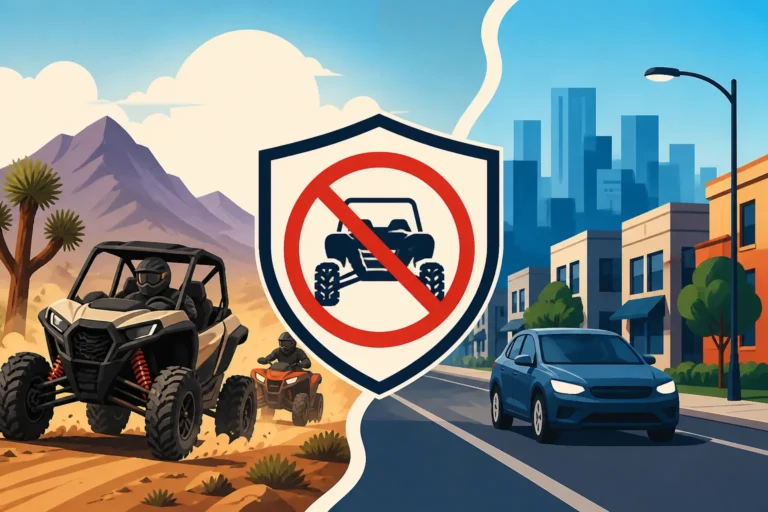
- City Limits and Designated Routes: Many incorporated cities in Nevada (Las Vegas, Reno, Henderson, Sparks) have ordinances that prohibit OHVs from their streets entirely, or restrict them to very specific, designated routes. Just because a road is "county" and then transitions into a city street doesn't mean your privileges extend. Troopers and local police are particularly vigilant in urban and suburban areas. If you're riding through a subdivision to get to the desert, you might be breaking local laws. Always check municipal ordinances. [Nevada Cities That Keep OHVs Off the Street] provides more detail.
- Shoulder and Ditch Riding: While it might seem safer or more considerate to ride the shoulder or ditch, these areas are generally considered part of the highway/road right-of-way and fall under the same restrictions. A trooper will treat riding the shoulder the same as riding in the lane if OHVs are prohibited on that particular road.
Expired Decals and Missing Equipment
These are low-hanging fruit for law enforcement, easy to spot and easy to ticket.
- Expired "Large ATV" Decal: If your "Large ATV" decal is expired, it's essentially the same as riding an unregistered vehicle on the road. A trooper will check the date on your decal. [Nevada Fines for No Large ATV Decal] can be substantial, so stay on top of your renewals.
- Missing or Non-Functional Equipment: As detailed in the previous section, if any of your required equipment – headlights, taillights, brake lights, horn, mirror – is missing, broken, or not properly working, a trooper will notice. This can lead to a citation for each deficiency. This is where investing in quality, durable components, perhaps from SuperATV's extensive lineup of lighting and accessory options, can save you a headache and a fine. They're built to withstand tough off-road conditions, but also ensure you're compliant for those short road stretches.
- Improper Seating/Passengers: Overloading your machine or having passengers riding in unsafe positions (e.g., in the bed without designated seating, or children standing) is a clear violation. Troopers prioritize safety, and this is a quick way to get stopped.
- No Safety Flag on Dunes: While not directly related to county roads, if you are transiting a county road to or from a dune area like Sand Mountain, a trooper might also be looking to see if you have your safety flag and whip, especially if they know you're headed to or coming from such a location. While the flag isn't usually required on the county road itself, its absence might signal a general disregard for safety rules, which could lead to closer scrutiny.
Impaired Driving and Other Safety Concerns
Beyond the specific OHV laws, general traffic laws apply. A trooper is also watching for more serious violations.
- Driving Under the Influence (DUI): This is paramount. Operating an OHV on a county road while under the influence of alcohol or drugs carries the exact same penalties as a DUI in a car. Troopers are trained to spot impaired driving, and if they suspect it, you're facing severe consequences, including arrest and loss of driving privileges.
- Reckless Operation: Speeding, weaving, doing "donuts," or generally driving in a dangerous or reckless manner on a county road will absolutely attract law enforcement attention. These machines are not designed for high-speed road use, and reckless behavior endangers everyone.
- Lack of Due Care: Even if not outright reckless, a trooper may pull you over if you appear to be driving without due care and attention, perhaps distracted or not properly controlling the machine for road conditions.
When riding your "large ATV" on a Nevada county road, remember that you are sharing the space with other motorists. Adhering to all traffic laws, exercising caution, and ensuring your machine and documentation are in order are your best defenses against a roadside stop turning into a negative experience. Being prepared and informed means you can enjoy the vast beauty of Nevada's trails and safely connect them via the appropriate county roads.
Disclaimer
This article is for general informational purposes only and does not constitute professional advice. Laws, prices and regulations vary by location and change over time. Consult a qualified professional for guidance on your specific situation.