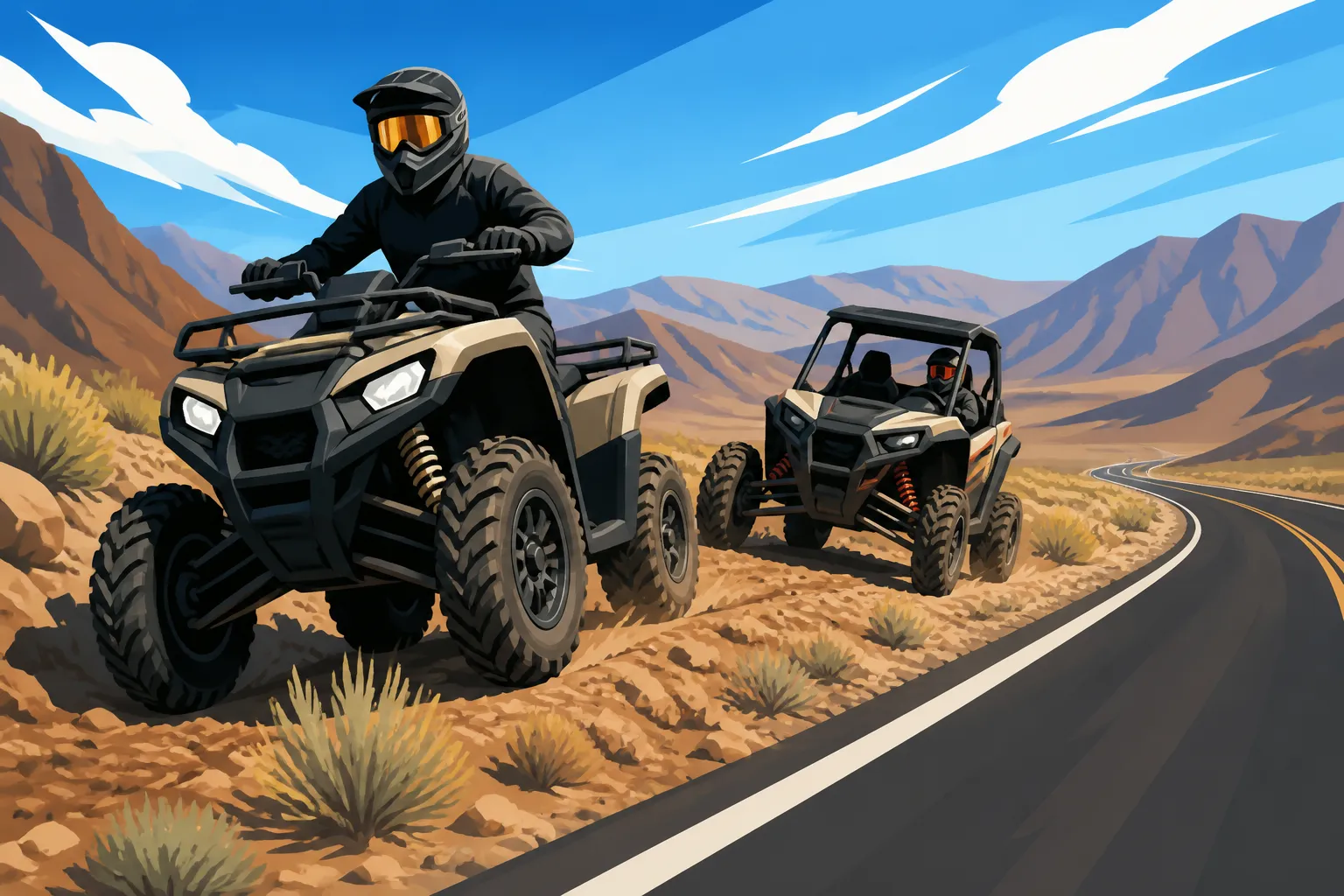
Riding Nevada Shoulders and Ditches
We've all been there: out on the trails, enjoying the vast Nevada landscape, only to find our favorite riding area separated by a short stretch of paved road. Or maybe you're just a stone's throw from that gas station or diner you're craving. The temptation to "just hop on the shoulder" or "take the ditch" for a quick connection is incredibly strong. It feels harmless, a minor detour from the dirt. But in Nevada, the rules for off-highway vehicles (OHVs) and public roads are far more strict and nuanced than many riders realize. This guide will walk you through exactly what Nevada law says about riding shoulders, ditches, and other parts of the public roadway, helping you stay legal and safe.
The Lure of the Shoulder and Ditch – Why We Even Consider It
It’s completely understandable why the idea of riding the shoulder or a ditch adjacent to a paved road crops up in a rider's mind. The open desert often gives way to a paved ribbon, and sometimes, that ribbon is the only thing standing between you and more epic riding, or simply a much-needed refuel.
Bridging the Gaps Between Trails
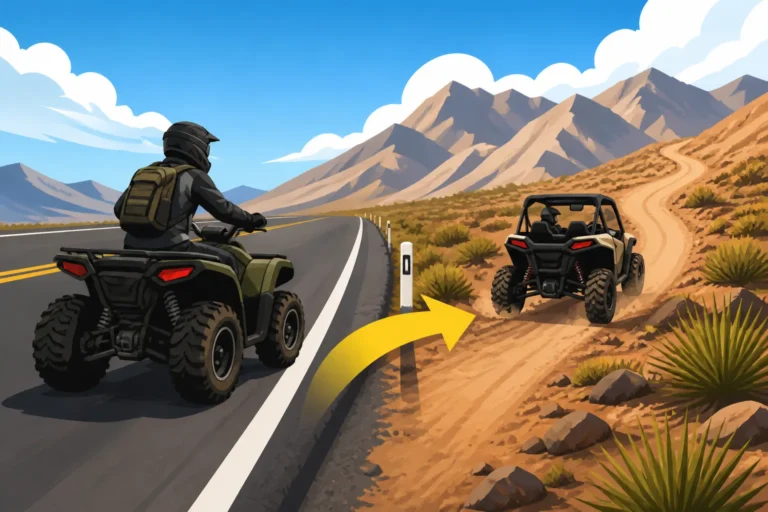
Picture this: you've just finished a fantastic section of trail, dusty and exhilarated, only to see the next marked OHV route on the other side of a two-lane county road. Or perhaps your mapping app shows a tantalizing network of trails just a short, unpaved ditch away. It’s tempting to think, "It's just a quick hop!" Loading your machine back onto the trailer, driving a quarter-mile, and then unloading again feels like an unnecessary hassle and a real momentum killer. We’re out there to ride, after all, not to play logistical chess with our rigs. This frustration is a common experience, leading many to eye that seemingly innocent stretch of dirt or gravel next to the asphalt as a convenient, albeit potentially illegal, shortcut.
Accessing Amenities and Services
There’s nothing quite like the feeling of hitting a dirt trail that leads directly to a burger joint, a gas station, or a small town market. But more often than not, those amenities are right alongside a paved road. When you’re miles from civilization, running low on fuel, or just dreaming of a cold drink, pulling over to the shoulder or riding the dirt apron of a highway to get to a service station seems like the most logical thing in the world. Who wants to trailer up just to get a gallon of gas? This desire for quick access to necessities without the burden of re-trailering is a significant driver behind riders considering temporary use of road shoulders or even paved sections. It's about convenience, sure, but it's also about the very practical needs that arise during a long day of riding.
Misconceptions and Local Interpretations
A lot of the confusion around riding shoulders and ditches stems from a mix of anecdotal evidence and varying local enforcement. You might hear from another rider, "Oh, they never bother you on the shoulder out there," or see someone else doing it. In some remote areas, enforcement might indeed be less frequent, leading to a false sense of security that it's permissible. There’s also a common misconception that if it’s not on the asphalt, it’s not really the road. Riders might feel that a gravel shoulder or a dirt ditch is functionally the same as the trail they just left. However, Nevada law often views the entire right-of-way, including shoulders and ditches, as part of the public highway or roadway, subjecting it to the same OHV restrictions as the paved surface itself. This gap between common perception and legal definition is where many riders inadvertently run into trouble.
Nevada Law and the Strict Definition of "Road"
Nevada takes the operation of off-highway vehicles on public roadways seriously, and their laws are surprisingly comprehensive. While it might seem like a simple dirt path next to the pavement, the legal definition of what constitutes a "road" or "highway" is much broader than many people assume. Understanding this is crucial to avoiding an unexpected citation.
The Letter of the Law – What Nevada Statutes Say
Nevada Revised Statutes (NRS) lay out very specific definitions for highways and roadways, and they don't leave much wiggle room for OHVs. The core idea is that an off-highway vehicle is, by its very nature, intended for off-highway use. When you venture onto public lands managed by the Bureau of Land Management (BLM) or within designated OHV recreation areas like Logandale Trails or Sand Mountain, you're generally on legal ground for your machine. However, the moment you touch a public road, even the shoulder, you're entering a different legal landscape. It’s not just about the blacktop; the law often considers the entire public right-of-way as part of the "highway," and that includes those enticing shoulders and ditches. This is why "Riding Nevada Shoulders and Ditches" is a topic that requires such careful attention – it's a specific legal gray area for many, but often quite black and white in the eyes of the law.
Understanding "Highway" and "Roadway" Boundaries
For the purpose of OHV regulations, Nevada's definition of a "highway" or "roadway" is expansive. It typically includes the entire width between the boundary lines of every way or place open to the use of the public for purposes of vehicular traffic, whether maintained by the state, county, or any other public authority. This means the paved lanes, the unpaved shoulders, and often the adjacent ditches and median strips are all considered part of the "highway" system.
Think of it this way: when you're driving your truck on the highway, you wouldn't expect to see a vehicle legally operating in the ditch or on the shoulder for an extended period, even if it's a short stretch. The same principle largely applies to OHVs. The intent is to keep faster-moving, non-OHV traffic separate from slower, less visible, and differently-equipped off-highway vehicles. So, while you might think you're just on the "edge" of the road, legally speaking, you're still on the road. Navigating these boundaries correctly is vital, especially when you consider [Nevada Rules for Crossing a State Route], which have their own strict parameters.
Sidewalks and Median Strips – Even More Restricted
If shoulders and ditches are generally off-limits for continuous travel, sidewalks and median strips are absolutely out of the question. These areas are specifically designed for pedestrians or for landscaping and traffic management, not for any type of vehicular traffic, least of all OHVs. Attempting to navigate these spaces on your ATV or UTV is not only highly illegal but incredibly dangerous. Sidewalks are for foot traffic, and median strips are often home to signs, landscaping, or simply act as a buffer. Using them for OHV travel could easily result in severe injury to pedestrians or yourself, not to mention significant fines and other legal repercussions. For clarity, the answer to [Can You Ride a Quad on a Nevada Sidewalk?] is a resounding no. Even in areas where a county road might allow limited OHV access, sidewalks and medians remain strictly forbidden.
The 2-Mile Rule and Designated Routes – Where You Can Ride Pavement
While Nevada law is generally strict about OHV use on paved roads, there are very specific exceptions designed to allow riders to connect trails or access limited services. However, these exceptions come with their own set of rules and limitations, and they are frequently misunderstood.
The Limited 2-Mile Exception
This is one of the most talked-about and often misinterpreted rules for Nevada OHV riders. Nevada Revised Statutes allow for a very specific, limited use of county roads. An OHV can be operated on a paved county road for a maximum distance of two miles, but only under specific circumstances: to connect two OHV trails, to access fuel or food, or to get to your staging area or lodging. This is not a blanket permission to cruise down any paved road for two miles. It's a logistical allowance, a way to bridge short gaps when trailering isn't practical. Crucially, this rule applies only to county roads, not state highways or city streets, and counties can even opt out of this provision by local ordinance. So, while it's nice to know you might have this option, you need to be absolutely sure of the specific road type and any local restrictions before you rely on it. Understanding [Nevada's 2-Mile Limit on Paved Highway] and [How Far You Can Ride Pavement in Nevada] is key here.
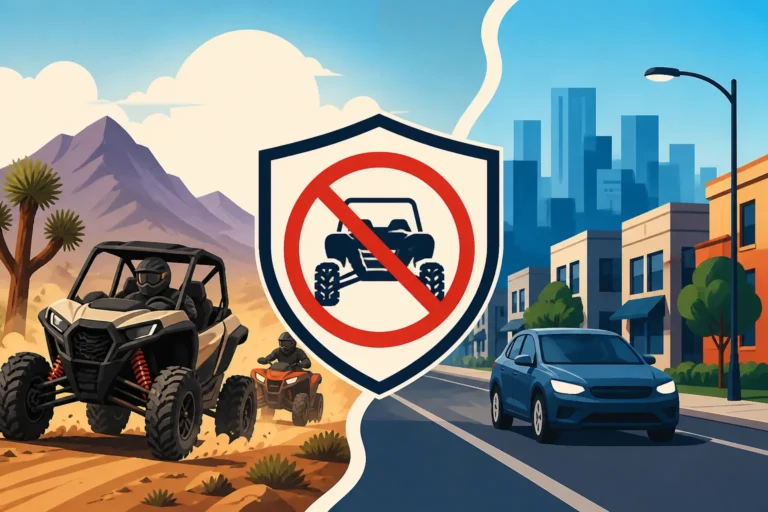
County Roads vs. State Highways vs. City Streets
This distinction is perhaps the most critical for any rider considering a paved road. The 2-mile rule? It's for minor county roads only. These are generally the smaller, less-traveled paved roads that crisscross rural areas, often connecting to BLM lands or state parks.
- State Highways (e.g., US 95, SR 169): These are almost universally off-limits for OHV travel, even for a short distance. They are high-speed thoroughfares with significant traffic, and OHVs are considered too slow and vulnerable to safely share these roads. Crossing a state route is generally permitted at intersections, but riding along it, even the shoulder, is prohibited.
- City Streets: Within incorporated cities, OHVs are typically banned unless a specific ordinance designates a route. Cities are generally concerned with noise, safety, and traffic flow in dense areas, and they prefer OHVs to stick to designated trail systems. For example, [Nevada Cities That Require Designated OHV Routes] will have very specific rules.
- Minor County Roads: These are your best bet for the limited 2-mile exception. However, it's not a guarantee. Some counties have taken advantage of the "opt-out" clause in the state law, meaning even some county roads might be off-limits. Knowing [Which Nevada County Roads Qualify for ORVs] involves checking local regulations or looking for posted signage. Always verify before you ride.
Designated Routes and Local Ordinances
Beyond the 2-mile rule for county roads, some specific cities or counties have gone through the process of creating "designated OHV routes" within their limits. These are typically signed roads or portions of roads where OHV travel is explicitly permitted. A great example often cited is Mesquite, Nevada, which has a reputation for being more OHV-friendly within its city limits, allowing riders to reach businesses or trailheads via specific routes. This is a very different scenario than simply deciding to ride a shoulder or ditch.
However, these designated routes are the exception, not the rule. You cannot assume that because one town has them, another does. For instance, [Mesquite and Its Reputation for Open Streets] is a localized phenomenon. Other areas, like Washoe County, might have very different ordinances, such as [Washoe County Ordinance 1507], which could restrict OHVs more severely. Always look for clear signage indicating a designated OHV route. If you don't see signs explicitly permitting OHV use, assume it's prohibited. Relying on "what someone told me" or "I saw someone else do it" is a risky strategy and could lead to a citation.
Consequences and Enforcement – What's at Stake
Riding your OHV where it's not permitted, even for a seemingly innocuous short stretch on a shoulder or in a ditch, carries real consequences. These aren't just minor inconveniences; they can impact your wallet, your machine, and even the future of OHV access for everyone.
Citations, Fines, and Impoundment
The most immediate and tangible consequence of riding illegally on a Nevada road is a citation from law enforcement. Whether it's a Sheriff's Deputy, an NHP Trooper, or a park ranger, they are generally well-versed in OHV laws. Fines for operating an OHV on a restricted roadway can vary, but they are rarely cheap. These aren't just "slap on the wrist" tickets; they can be substantial, often in the hundreds of dollars.
Beyond the financial penalty, there's also the very real possibility of your machine being impounded. If an officer determines you are operating your OHV illegally and unsafely on a public roadway, they have the authority to have it towed and impounded. This means not only paying the fine but also incurring towing and storage fees, which can quickly add up and turn a fun day of riding into a very expensive headache. Getting your machine back can be a complicated process, and it usually involves resolving the underlying citation first. So, what might seem like a quick, harmless shortcut could actually lead to significant financial and logistical stress. [Nevada Tickets for Riding Where You Should Not] are a real possibility for those who disregard these rules.
Safety Hazards and Liability
Legal consequences aside, the primary reason for these restrictions is safety. OHVs are designed for off-road terrain, not for interacting with highway traffic. They are typically slower, less visible, and handle very differently on pavement compared to a street-legal vehicle.
- Visibility: OHVs are lower to the ground, often dusty, and lack the comprehensive lighting and reflective elements of street vehicles. This makes them incredibly hard to see, especially at dawn, dusk, or in bright sunlight. A vehicle traveling at 55 mph needs significant time to react to a slower, less visible OHV on the shoulder.
- Handling: Knobby tires, high centers of gravity, and short wheelbases mean OHVs handle poorly on pavement, especially when sudden braking or evasive maneuvers are required. Swerving to avoid debris or another vehicle could easily lead to a rollover.
- Driver Awareness: Drivers of street vehicles simply do not expect to encounter OHVs on shoulders or ditches. This lack of expectation significantly increases the risk of collision.
Should an accident occur while you are operating your OHV illegally on a public road, the liability implications can be severe. Your standard OHV insurance policy might not cover incidents that happen during illegal operation, leaving you personally responsible for damages, medical bills, and legal fees. While [Insurance and Nevada OHV Registration] is a good start, it often doesn't protect you from the consequences of breaking the law. The risk to your personal safety and financial well-being far outweighs the perceived convenience of a shortcut.
Impact on OHV Access and Public Perception
Every time an OHV is seen operating illegally on a shoulder, ditch, or any other unauthorized public road, it paints a negative picture for the entire OHV community. These incidents, whether they result in accidents or just complaints, fuel public perception that OHV riders are reckless and disregard laws.
This negative perception can have far-reaching consequences:
- Stricter Regulations: Increased complaints and incidents can lead to local governments enacting stricter ordinances, closing previously accessible routes, or even banning OHVs from entire areas.
- Loss of Public Support: When the public views OHV riders as a nuisance or a danger, it becomes harder to advocate for trail maintenance, new riding areas, or for keeping existing areas open.
- Enforcement Focus: More illegal activity can prompt law enforcement to dedicate more resources to patrolling OHV areas and roads, increasing the likelihood of citations for all riders, even those trying to follow the rules.
Responsible riding isn't just about avoiding a ticket; it's about being a good ambassador for the sport. Adhering to road rules, even when inconvenient, helps maintain a positive image for OHV enthusiasts and safeguards future access to the amazing riding opportunities Nevada offers.
Equipping Your Machine for Legal Road Use (if applicable) and Best Practices
While most OHV use on paved roads is prohibited, Nevada does offer a path for certain machines to become "street legal" for specific types of roads and limited travel under the "Large ATV" designation. If you intend to utilize any of Nevada's legal road-riding options, whether the 2-mile rule or the Large ATV designation, proper equipment and a strong understanding of best practices are essential.
The "Large ATV" Designation and Required Equipment
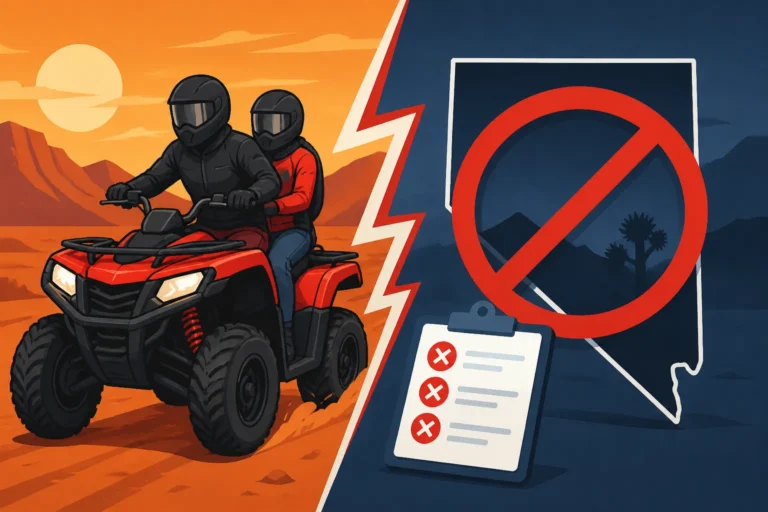
Nevada's "Large ATV" designation is the only way to legally operate some OHVs, primarily UTVs (side-by-sides), on specific public roads. This isn't for every machine; it generally applies to UTVs that meet certain criteria, like having four or more wheels, a roll cage, and sometimes a truck bed or specific seating capacity. [What Nevada's NRS 490.043 Counts as a Large ATV] clarifies these specifics. Smaller, sport-oriented ATVs generally do not qualify. [Can a Two-Seat Quad Get a Nevada Road Decal?] The short answer is almost certainly no, as they usually fail the seating or bed capacity test.
To qualify for a "Large ATV" decal and operate legally on designated county roads or the 2-mile connections, your machine must be equipped with a comprehensive list of safety features designed to make it more visible and controllable in traffic. This list includes:
- Headlights: Capable of illuminating persons and vehicles at a safe distance.
- Taillights: Visible from 500 feet to the rear.
- Stop Lamps: Functioning brake lights.
- Reflectors: Often integrated into taillights, but sometimes separate.
- Horn: An audible warning device.
- Mirrors: Typically one on each side, offering a clear view to the rear.
- Spark Arrester: To prevent wildfires, always a requirement for off-road use, but specifically on roads too.
Many aftermarket companies, like SuperATV, offer a wide range of accessories designed to meet these requirements. From full street-legal kits that include turn signals, horns, and mirrors, to individual lighting upgrades, SuperATV provides options that can help bring your UTV into compliance for the "Large ATV" designation. They also offer mirrors and other visibility enhancements that are crucial for safely sharing any paved road. Knowing [Nevada Street Legal UTV Requirements] and having the right gear from brands like SuperATV is paramount. Check out [Nevada Equipment List for Road-Legal UTVs] for the full details.
Safe Practices for Approved Road Sections
Even when you're legally operating your OHV on an approved section of road, whether it's the 2-mile connection or a designated "Large ATV" route, safety remains your top priority. You are sharing the road with vehicles that are larger, faster, and expecting traditional cars, not OHVs.
- Be Highly Visible: Always run your headlights and taillights, even in broad daylight. Consider adding a safety flag or reflective elements to your machine and gear.
- Stay Alert and Predictable: Constantly scan your surroundings for other vehicles, road hazards, and pedestrians. Use hand signals if your machine doesn't have turn signals. Maintain a predictable path and speed. Avoid sudden movements.
- Wear Appropriate Gear: Even if you're an adult and the helmet law for adults on paved county roads isn't as strict as off-road, wearing a helmet is always recommended for maximum protection. [Nevada Helmet Law for Road Riding] outlines the specifics, but safety dictates more than just the minimum. Eye protection and sturdy clothing are also wise.
- Keep to the Right: If there's a shoulder, utilize it, but remember the laws about continuous travel on shoulders. If you're on the main paved surface, stay as far to the right as safely possible without impeding traffic or risking a ditch departure.
- Mind Your Speed: While your UTV might be capable of higher speeds, slow down on paved roads. Your machine handles differently, and slower speeds give you more time to react.
Planning Your Route to Avoid Illegal Sections
The best strategy for avoiding illegal road use, and the citations and dangers that come with it, is meticulous route planning. Don't leave it to chance or rely on outdated information.
- Utilize Mapping Tools: Apps and websites like the [Using the Nevada Trail Finder] are invaluable resources. They often highlight legal OHV trails, designated routes, and areas where OHVs are restricted. Pre-plan your entire trip, identifying where paved sections intervene and how you'll manage them.
- Trailer Up for Longer Paved Stretches: If a paved road section is longer than the 2-mile limit, or if it's a state highway or city street, biting the bullet and trailering your machine is the safest and most legal option. Consider staging your ride to minimize necessary road travel. [Trailering Versus Riding the Road There] is often a better option for peace of mind.
- Consult Local Resources: Before you head out, check with local land management agencies (like the BLM field office in the area you plan to ride), county sheriff's departments, or the Nevada Commission on Off-Highway Vehicles for the latest information on local ordinances and road access. Conditions and rules can change.
- Look for Bypass Trails: Sometimes, what appears to be a necessary road section actually has a parallel dirt trail or lesser-known route that allows OHVs to bypass the pavement entirely. A little research can save you a lot of trouble.
By being informed, equipped, and proactive in your planning, you can ensure your Nevada OHV adventures remain both thrilling and compliant with the law.
| Usage Type | Allowed On | Equipment Needed | Key Restrictions | Risks & Penalties |
|---|---|---|---|---|
| Shoulder/Ditch Riding (Illegal) | None (generally considered part of roadway) | Standard OHV (no street legal gear) | Prohibited for continuous travel | Fines, Impoundment, High Accident Risk |
| 2-Mile County Road Rule | Minor County Roads (if county allows) | Standard OHV, highly visible | Max 2 miles, for specific purposes (connect trails, access fuel/food) | Fines if outside parameters, safety risk |
| Large ATV Designated Use | Designated County Roads (specific UTVs only) | Full Street-Legal Gear (lights, horn, mirrors, etc.) | Machine must qualify as "Large ATV," specific designated routes, county ordinances apply | Fines if not compliant, safety risk |
Disclaimer
This article is for general informational purposes only and does not constitute professional advice. Laws, prices and regulations vary by location and change over time. Consult a qualified professional for guidance on your specific situation.