Out-of-State Plating Services and Nevada Law
It's incredibly frustrating when you just want to ride your ATV or UTV and navigate the confusing web of street legal laws, especially here in Nevada. Many riders look for creative solutions to get their off-highway vehicles on paved roads, and out-of-state plating services often pop up as a tempting shortcut. This guide is going to cut through the noise and explain why relying on an out-of-state plate might not actually make your machine street legal in the Silver State, and what Nevada law truly expects.
The Allure of Out-of-State Plating Services
Let's be honest, the idea of making your off-highway vehicle street legal sounds fantastic. Imagine being able to ride from your house directly to the trailhead, or cruise into town for a quick bite after a long day on the dirt. The freedom and convenience are incredibly appealing, and it's easy to see why so many riders are eager to find a way to make it happen.
Why Riders Seek Alternatives
Nevada's laws regarding street-legal ATVs and UTVs can feel pretty restrictive. If you've spent any time researching it, you'll quickly realize that getting a standard quad or even a sport UTV approved for public roads here is a tough nut to crack. The specific vehicle definitions, equipment requirements, and designated road restrictions can leave many riders feeling like they're hitting a brick wall. This frustration naturally leads people to search for workarounds, hoping there's a loophole or an easier path.
That's where the promise of out-of-state plating services comes in. They often market themselves as the ultimate solution, suggesting that by registering your machine in another state, you can bypass all the local headaches. The thought of avoiding complex inspections, specific equipment upgrades, and the general red tape of Nevada's DMV processes is incredibly enticing. It feels like a golden ticket to full street legality, regardless of where you actually live or ride.
How These Services Often Work
Typically, these services facilitate the registration of your ATV or UTV in a state known for more lenient street-legal OHV laws, such as South Dakota or Montana. The process often involves setting up a Limited Liability Company (LLC) in that state or using a registered agent's address. The idea is that your machine then "belongs" to this out-of-state entity, allowing it to be registered and plated under those state's rules.
These services often highlight benefits like avoiding local sales tax on the purchase of a new machine (though this varies and is not universally true or legally sound for Nevada residents), or the absence of rigorous vehicle inspections that might be required in your home state. They provide the paperwork, handle the filing, and before you know it, you receive a license plate and registration for your ATV or UTV. On the surface, it seems like a straightforward and legitimate way to achieve street legality, offering the convenience you've been dreaming of.
Nevada's Stance on Out-of-State Registrations
While it's easy to get caught up in the excitement of a new plate for your UTV, it's crucial to understand how Nevada views these out-of-state registrations, especially when it comes to riding on public roads. The reality isn't always as simple as a plate from another state automatically granting you full privileges here.
Reciprocity and Its Limits
Nevada generally extends reciprocity to valid out-of-state registrations for off-highway vehicles. This means if you're visiting from California with a [Riding Nevada on a California Green Sticker], or from Arizona with an [Riding Nevada on an Arizona Decal], your machine is typically considered legally registered for off-road use in Nevada for a certain period, usually 15 days for recreational purposes. The same applies to those visiting from [Riding Nevada on a Utah Registration]. This reciprocity is designed to allow visitors to enjoy our fantastic trails and dunes without having to re-register their machines for off-road purposes every time they cross the border.
However, this is where the critical distinction lies: reciprocity for off-road use does not equate to reciprocity for street-legal status. Nevada's laws about operating an OHV on public roads are distinct and apply to all vehicles on those roads, regardless of where they were registered. A plate from South Dakota or Montana, while valid in those states, doesn't automatically override Nevada's specific statutory definitions and equipment requirements for what constitutes a "street-legal" OHV on its paved surfaces. It's a common misconception that a plate from another state makes your machine street-legal everywhere.
Nevada's Specific Street Legal Requirements
Nevada has very specific criteria for what an off-highway vehicle must be to qualify for limited street use. The key here is the classification of a "Large ATV" under NRS 490.043. This isn't just a casual term; it's a legal definition that outlines what characteristics a machine must possess to even be considered for a Nevada road decal. Essentially, to be deemed a Large ATV, your machine needs to have either four seats or a truck bed. This immediately excludes the vast majority of traditional ATVs, which only have one or two seats, and many popular sport UTVs, which might have two seats but lack a truck bed.
This definition is critical because it's the fundamental starting point for street legality in Nevada. If your machine doesn't meet this basic structural requirement, no amount of additional equipment or out-of-state plating will make it compliant with Nevada's road-use laws. It's not about how many lights you've added or whether you have a horn; it's about the core design of the vehicle itself. Understanding [What Nevada's NRS 490.043 Counts as a Large ATV] is the first step to knowing if your machine has any chance of legally hitting paved roads here.
The Pitfalls of Relying on Out-of-State Plates in Nevada
While the idea of an out-of-state plate might seem like a clever hack, the reality on Nevada roads can be quite different and potentially costly. It's not uncommon for riders who've gone this route to find themselves in a tough spot when encountering law enforcement.
Enforcement on Nevada Roads
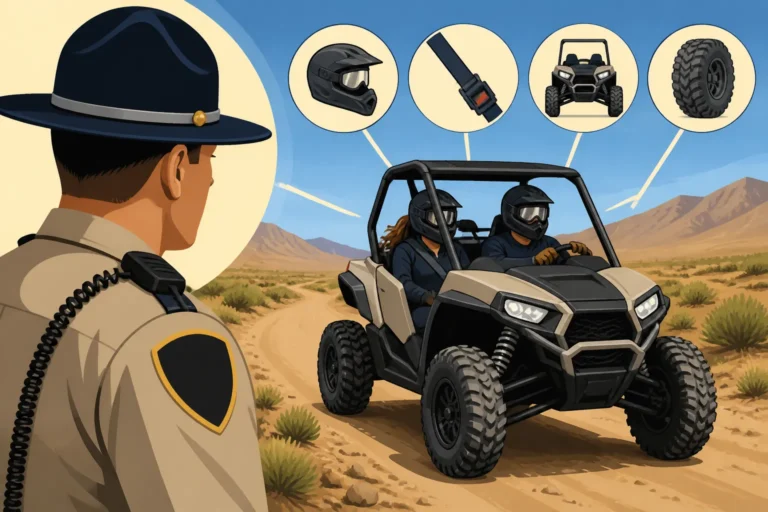
Nevada law enforcement officers are well-versed in the state's vehicle codes, especially when it comes to off-highway vehicles. They understand the nuances of what is and isn't allowed on public roads. When a deputy or highway patrol officer sees an ATV or UTV with an out-of-state plate, they're not just looking at the plate itself; they're looking at the vehicle's characteristics and comparing them to Nevada's specific "Large ATV" definition and other street-legal requirements.
If your machine, despite its out-of-state plate, doesn't meet Nevada's criteria for a Large ATV—meaning it lacks four seats or a truck bed—or if it's missing other mandatory equipment, you could still be cited for operating an unregistered or illegal vehicle on a public roadway. The out-of-state plate does not grant immunity from local statutes. Officers might ask for your driver's license, proof of insurance, and then assess whether your vehicle is truly compliant with Nevada law for road use. [What a Nevada Trooper Looks For on a County Road] often involves checking these fundamental aspects. A citation can lead to significant fines, and in some cases, your machine could even be impounded until it's properly registered or moved.
Insurance and Liability Concerns
Beyond the immediate risk of a citation, there's a more serious and often overlooked issue: insurance and liability. When you purchase an insurance policy for a "street-legal" UTV or ATV, whether through an out-of-state registration service or independently, that policy is underwritten based on the assumption that your vehicle is legally operating on public roads. If Nevada law does not recognize your machine as street-legal despite its out-of-state plate, your insurance company might deny coverage in the event of an accident on a public road.
Imagine you're riding on a county road with your out-of-state plated UTV, and an accident occurs. If it's determined that your vehicle was not legally street-legal in Nevada at the time of the incident, your insurance policy could be null and void for that particular claim. This leaves you personally exposed to all the financial fallout, including property damage, medical bills, and potential lawsuits. It's a significant risk that many riders don't fully consider. [Insurance Nevada Requires for Road Use] is there to protect you, but that protection hinges on your machine meeting the state's legal definitions. It's always best to be upfront with your insurance provider about your vehicle's exact legal status in Nevada.
Understanding Nevada's "Large ATV" Provision
So, if out-of-state plating isn't the magic bullet, what does Nevada consider street-legal for limited road use? It all comes down to the "Large ATV" provision, which is very specific and designed to differentiate certain utility-focused side-by-sides from recreational machines.
What Truly Qualifies for a Nevada Road Decal
As mentioned, the core of Nevada's street-legal provision for OHVs rests on the "Large ATV" definition: a machine must have either four seats or a truck bed. This is not a suggestion; it's a hard and fast rule. This means that utility UTVs like a Polaris Ranger, a Can-Am Defender, or certain models of multi-passenger side-by-sides with a bed often fit the bill. These machines are typically designed with a more utilitarian purpose in mind, often resembling a small truck, which aligns with the intent of the Large ATV classification.
For instance, a two-seat sport quad, no matter how many modifications you make, will simply not qualify because it lacks both four seats and a truck bed. The same goes for many two-seat sport UTVs, like a Polaris RZR or a Can-Am Maverick, unless they specifically come in a four-seat configuration and meet all other requirements. When it comes to aftermarket parts, companies like SuperATV offer a wide range of accessories such as windshields, mirrors, and turn signal kits that are crucial for meeting equipment requirements. However, no aftermarket part can change the fundamental design of your machine from a two-seater to a four-seater, or magically add a truck bed where there isn't one. The foundation of qualification is the vehicle's factory design. If your machine meets the four-seat or truck bed criteria, then you can start looking into [Applying for a Nevada Large ATV Decal].
Equipment and Operational Rules
Once your machine qualifies as a Large ATV by definition, you still have a list of mandatory equipment it must possess to be ridden on specific public roads. This includes:
- Headlights and Taillights: These must be visible from 500 feet.
- Stop Lamp: A working brake light is essential.
- Horn: A functional horn is required.
- Mirrors: You need at least one rearview mirror, typically two for better visibility.
- Spark Arrester: A properly functioning spark arrester is crucial for fire prevention, both on and off-road.
- Muffler: The machine must have an adequate muffler to prevent excessive noise.
- Tires: DOT-approved tires are generally expected for road use.
- Seatbelts/Restraints: If your UTV has seatbelts, they must be used.
Beyond the equipment, there are strict operational rules. You need a valid driver's license, and you must carry liability insurance that meets Nevada's minimum requirements. The riding itself is limited to minor county roads, and you can only cross major highways or state routes at designated intersections. There's also the famous [Nevada's 2-Mile Limit on Paved Highway] rule, which restricts how far you can travel on certain paved roads to access an off-road area. Your machine must also adhere to posted speed limits and all other rules of the road. It’s a comprehensive set of regulations, and you can find a lot of these details under [Nevada Equipment List for Road-Legal UTVs].
The Legal and Practical Reality for Nevada Riders
Ultimately, the goal is to enjoy your machine safely and legally. Trying to skirt the rules with an out-of-state plate might seem like a clever hack, but it often leads to more headaches than it's worth. Understanding and complying with Nevada's specific regulations is the most responsible and practical approach.
Avoiding Costly Misunderstandings
When it comes to vehicle registration and road use, ignorance of the law is rarely an excuse that holds up. If you're pulled over with an out-of-state plate on a machine that doesn't meet Nevada's Large ATV definition, explaining that you thought it was legal because of the plate simply won't cut it. The cost of a citation, including potential fines and court fees, can quickly outweigh any perceived savings or convenience of an out-of-state registration service. Imagine having to pay [Nevada Fines for No Large ATV Decal] – it's definitely not the kind of expense you want on your books.
Furthermore, the time and stress involved in dealing with legal challenges, appearing in court, or getting your vehicle out of impound can be a massive drain. It's far less complicated and ultimately more enjoyable to simply understand the rules from the start. This allows you to make informed decisions about how and where you operate your machine, ensuring peace of mind rather than constant worry about whether you'll be stopped.
Safe and Legal Riding in Nevada
Nevada offers an incredible amount of terrain for off-highway vehicle enthusiasts. From the vast open deserts to mountain trails, there are countless places to explore without needing to put your machine on a paved road. Many experienced riders choose to trailer their ATVs and UTVs to designated riding areas, bypassing the complexities of street legality altogether. This approach ensures you're always riding legally and safely in the environment your machine was designed for.
Focusing on the incredible off-road opportunities, like those found in [Best Places to Ride an ATV in Nevada], allows you to fully enjoy your machine without the constant concern of violating road-use laws. Whether it's the expansive dunes of Sand Mountain or the technical trails of Logandale, Nevada's public lands are a treasure trove for off-road adventure. Companies like SuperATV also offer a huge selection of off-road specific accessories, from lift kits to winches, that enhance your trail experience without confusing street legality issues. By understanding the rules and embracing the vast off-road landscape, you can ensure your Nevada riding experience is both thrilling and compliant.
| Feature / Requirement | Nevada Large ATV Decal (Local) | Out-of-State Plated (Hypothetical) |
|---|---|---|
| Primary Definition | 4 seats OR a truck bed required | Based on specific out-of-state law |
| Legal Basis in NV | NRS 490.043 defines "Large ATV" | Reciprocity for off-road use only |
| Equipment Check | Nevada-specific items (lights, horn, mirrors, etc.) | May or may not meet NV requirements |
| Roads Allowed | Minor county roads, specific crossings, 2-mile rule | Only roads permitted by NV law for "Large ATVs" |
| Enforcement Risk | Low, if compliant | High, if vehicle doesn't meet NV definition |
| Insurance Validity | High, if NV-compliant insurance secured | Potentially void if not NV-compliant for road use |
| Compliance Certainty | High, if all NV laws are met | Low, depends on NV law interpretation |
Disclaimer
This article is for general informational purposes only and does not constitute professional advice. Laws, prices and regulations vary by location and change over time. Consult a qualified professional for guidance on your specific situation.