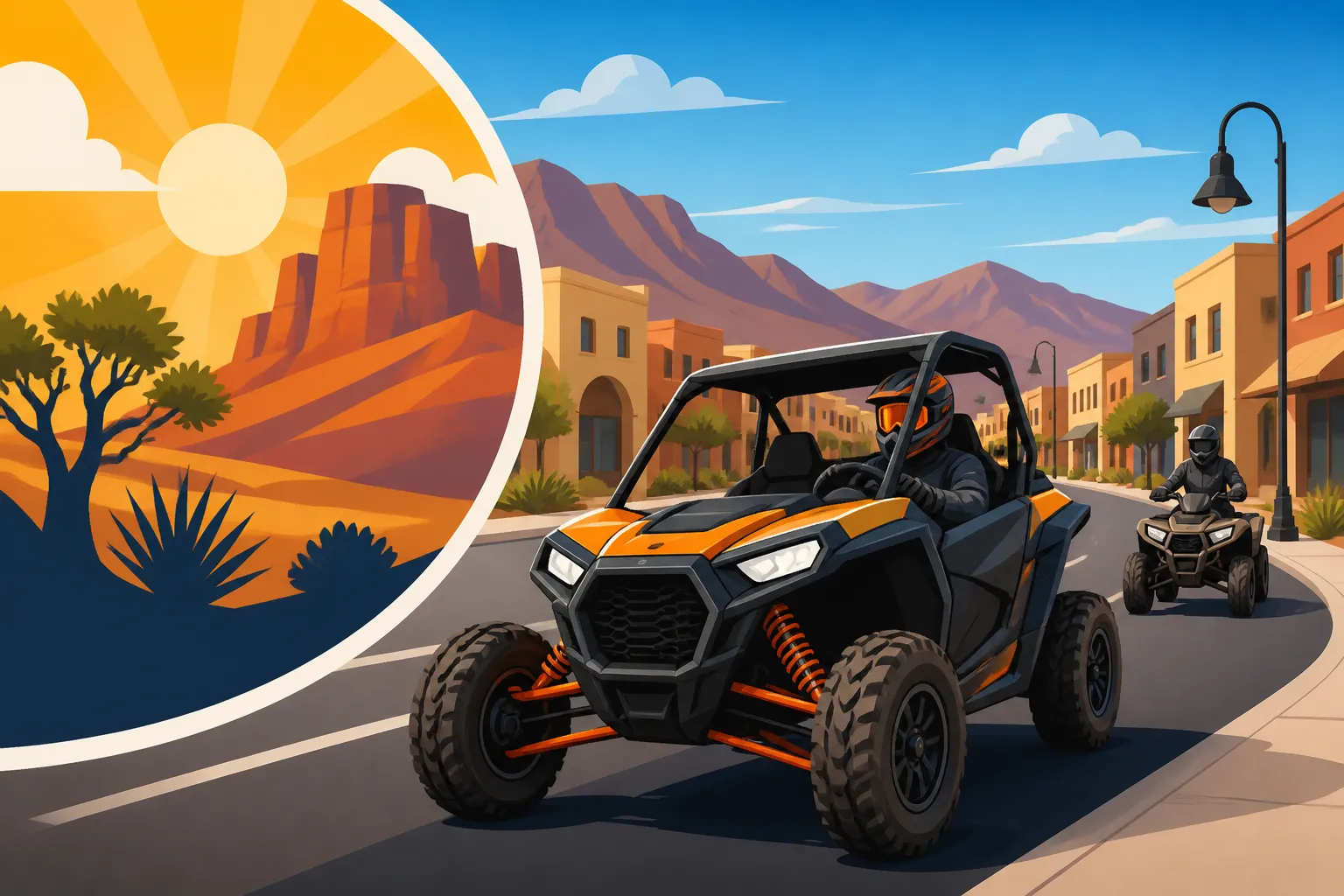
Mesquite and Its Reputation for Open Streets
It's incredibly frustrating when you're looking to enjoy the vast off-road terrain Nevada has to offer, but you constantly bump up against confusing rules about where you can and can't ride your ATV or UTV on public roads. Many riders hear whispers of towns like Mesquite being more "open" to off-highway vehicles, leaving them wondering what the real deal is and if they can truly cruise through town to get to the trails. This guide is here to untangle the nuances of riding your OHV on Nevada's streets, with a special focus on Mesquite's reputation and how it compares to the broader state laws.
The Allure of Mesquite's Open Streets for OHV Riders
Mesquite, nestled in the scenic Virgin River Valley, has earned a bit of a legendary status among off-highway vehicle enthusiasts. While many Nevada towns and cities have strict bans or very limited access for ATVs and UTVs on their paved streets, Mesquite stands out for its more accommodating approach. This reputation often draws riders from all over, eager to experience a place where their machines aren't confined solely to dirt trails. It’s a welcome change for those tired of trailering their rig everywhere, only to have to unload it a mile from where they want to eat or get gas.
What Makes Mesquite Different?
The difference in Mesquite largely comes down to local ordinance. While state law [Nevada's 2-Mile Limit on Paved Highway] sets a general framework for OHV use on certain public roads, it also grants individual counties and cities the power to designate specific routes or implement stricter controls. Mesquite, through its city council, has historically adopted a more OHV-friendly stance compared to larger metropolitan areas like Las Vegas or Reno. This means that within certain areas and under specific conditions, you can actually ride your UTV or ATV on designated city streets to access trailheads, fuel stations, or local businesses. This local flexibility is what creates the buzz and makes Mesquite a destination for many riders.
However, "open" doesn't mean "anything goes." Riders still need to adhere to specific rules and common-sense etiquette. The machine itself needs to meet certain equipment standards to be considered street-legal for these designated routes, and riders must have the appropriate licenses and insurance. It's not a free-for-all, but rather a more integrated approach that recognizes the importance of OHV recreation to the local economy and culture. This balance is what makes [Mesquite Riders and the 2-Mile Rule] a practical reality rather than just a theory.
The Local Buzz and What It Means for You
The local buzz about Mesquite being OHV-friendly isn't just talk; it translates into a noticeable rider presence on the streets, especially during peak riding seasons. You'll see side-by-sides pulling up to restaurants, quads getting gas, and families in their UTVs heading out of town towards the extensive trail systems that surround the city. This creates a vibrant, welcoming atmosphere for off-roaders, a stark contrast to the often-tense feeling of trying to navigate OHV restrictions elsewhere.
For you, this means a significant convenience factor. Instead of having to load your machine onto a trailer every time you want to move from your hotel to the trailhead, or make a quick run for supplies, you can often simply ride it. This seamless transition from pavement to dirt enhances the overall riding experience, making trips less about logistics and more about enjoyment. Many local businesses in Mesquite also cater to the OHV crowd, understanding that these visitors contribute significantly to the local economy. From rental shops like Polaris Adventures in Mesquite to gear suppliers, the infrastructure is there to support an OHV-centric experience. Just remember, even with this relaxed atmosphere, obeying traffic laws and understanding which streets are designated for OHVs is paramount to avoiding any issues.
Understanding Nevada's General Street Legal Framework
While Mesquite might offer a more liberal riding experience, it's crucial to understand the statewide regulations that govern street-legal OHVs in Nevada. Nevada has specific laws concerning what types of off-highway vehicles can be ridden on public roads, and under what conditions. Ignorance of these laws, even in a friendly town like Mesquite, won't save you from a citation if you're caught riding improperly. The state provides a framework, and then local jurisdictions can either adopt those rules or add further restrictions.
Nevada's "Large ATV" Classification
One of the most critical aspects of Nevada's street-legal framework is the concept of a "Large All-Terrain Vehicle" (Large ATV). Under [What Qualifies as a Large ATV in Nevada], only OHVs that meet a specific set of criteria can even be considered for limited street use. Generally, this refers to machines that are wider than 50 inches, weigh more than 900 pounds, and have a non-straddle seating position. Think most modern side-by-sides or UTVs with multiple seats and a steering wheel, rather than the traditional straddle-seat ATV. A typical two-seat sport quad, for example, would not qualify under this definition, making [Why a Two-Seat Sport Quad Fails Nevada's Test] a common frustration for many quad owners.
If your machine fits the "Large ATV" definition, you can apply for a special "Large ATV Decal" from the Nevada DMV. This decal indicates that your vehicle has met the basic state requirements to operate on specific public roads. It's not a license plate, and it doesn't mean your UTV is suddenly a car, but it's the gateway to legal street use. Understanding this classification is the first step in determining if your machine can participate in Mesquite's "open street" policy or any other limited road use across the state. [Nevada Large ATV Decal Cost] is something to factor into your budget if you're planning on going this route.
The 2-Mile Rule and Designated Routes
Beyond the "Large ATV" classification, Nevada law, specifically NRS 490.047, outlines how these approved machines can actually use public roads. The famous "2-mile limit" is a key component of this. It generally states that a Large ATV can travel up to two miles on a paved highway or county road to connect two off-highway routes or to access fuel, food, or lodging. This is where [How Far You Can Ride Pavement in Nevada] comes into play. It's meant for transit, not for joyriding through town.
Additionally, state law allows counties and cities to designate specific routes where OHVs can legally operate. These are typically minor county roads or city streets that are deemed safe for shared use and provide access to popular riding areas. This designation is critical, as it allows for more extensive use than the 2-mile rule alone. Mesquite has leaned into this provision, designating a network of streets where OHVs are permitted, making it much more accommodating than other areas. However, it’s imperative to note that the state also allows cities to create ordinances that ban OHV use on city streets entirely, even if the county has designated routes. This is why [Nevada Cities That Require Designated OHV Routes] exist, and why it's so important to check local ordinances wherever you plan to ride. Always look for signage or consult local government websites to confirm permissible routes.
Navigating County Ordinances Beyond Mesquite
While Mesquite shines as an OHV-friendly haven, it's not the norm across the entire state of Nevada. Understanding how different counties and cities approach OHV road use is vital for any rider looking to explore beyond one specific area. Each jurisdiction has the power to enact its own ordinances, creating a patchwork of rules that can be confusing and lead to unintended violations if you're not careful.
How Other Counties Handle OHV Road Use
Many counties across Nevada do allow for limited OHV use on certain minor county roads, often in line with the state's 2-mile rule for connecting trails or accessing services. Rural counties, especially those with extensive public lands, tend to be more permissive, recognizing the role OHVs play in recreation and local economies. For example, parts of Lincoln County might have more leniency on remote dirt roads that are technically county routes, but this doesn't extend to major state highways or bustling town centers. It’s always about specific designations. [Nevada County Roads Open to UTVs] are usually the less-traveled, lower-speed routes that lead to trailheads rather than the main arteries.
Some counties, however, might have stricter interpretations or simply choose not to designate any county roads for OHV use, effectively limiting riders to off-highway trails entirely. It's a localized decision, often influenced by population density, traffic concerns, and public safety considerations. Before heading out, especially to a new area, it's a smart move to consult the county sheriff's office or local government website for their specific OHV ordinances. This proactive approach can save you a lot of headache and potential fines.
Cities That Strictly Restrict OHVs
In stark contrast to Mesquite, many of Nevada's more populated cities and towns have enacted strict ordinances that prohibit OHV use on almost all city streets. Las Vegas, Henderson, Reno, and Sparks, for example, generally do not allow OHVs on their paved roads, except in very specific, often emergency-related, circumstances. These municipalities prioritize pedestrian safety, traffic flow, and noise regulations, leading to comprehensive bans. Attempting to ride your UTV through downtown Las Vegas, even if it has a Large ATV Decal, would almost certainly result in a ticket.
This is a critical point of difference for riders coming from out of state or those unfamiliar with Nevada's nuanced laws. The state's 2-mile rule often doesn't override these specific city bans. So, while you might be able to ride a short distance on a county road outside a city's limits, the moment you cross into city boundaries, those privileges often disappear. Always assume city streets are closed to OHVs unless explicitly marked otherwise or if you have verified a specific local ordinance allowing it. Ignoring these city-specific rules can lead to significant fines under [Nevada Tickets for Riding Where You Should Not].
Essential Equipment for Nevada Road Riding
If you're planning on taking your OHV onto any public road in Nevada, even in OHV-friendly Mesquite, your machine must meet certain equipment requirements. These aren't just suggestions; they're legal mandates designed to ensure the safety of both the OHV operator and other road users. Simply having a Large ATV Decal isn't enough if your rig isn't properly equipped. Many riders turn to aftermarket solutions to get their machines up to snuff.
Lighting and Visibility Requirements
Visibility is paramount when sharing roads with traditional vehicles. For a Large ATV to be considered road-legal in Nevada, it needs to be equipped with proper lighting that is functional and clearly visible. This typically includes:
- Headlights: Your OHV must have at least one headlight (and ideally two, as most UTVs do) that can emit a white light visible from a distance of 500 feet during darkness or inclement weather. Ensure they are properly aimed and working correctly.
- Taillights and Stop Lamp: A red taillight visible from 500 feet to the rear is essential. Crucially, you also need a separate stop lamp (brake light) that illuminates when you apply the brakes. This is a common add-on for many off-the-shelf UTVs that might not come with a dedicated brake light from the factory. Aftermarket companies like SuperATV offer kits that can easily integrate these components. [Nevada Taillight and Reflector Rules] specifies these distances.
- Reflectors: Red reflectors are required on the rear of the machine, positioned to reflect light from other vehicles. Sometimes, a well-placed taillight assembly can serve this purpose if it incorporates reflectors.
- Mirrors: You must have at least one rearview mirror, and ideally two (one on each side), to provide a clear view of traffic approaching from the rear. This is another area where many stock OHVs fall short and require an aftermarket addition.
- Horn: A working horn capable of emitting sound audible from 200 feet is also required. This is for signaling other drivers or pedestrians and is crucial for road safety.
It's wise to consider a comprehensive [Nevada Equipment List for Road-Legal UTVs] before you even think about hitting the pavement.
Safety Gear and Other Essentials
Beyond lighting, other safety and operational requirements are in place for OHV road use:
- Muffler and Spark Arrester: All OHVs operating on public lands or roads in Nevada must be equipped with a muffler to prevent excessive noise and a U.S. Forest Service-approved spark arrester to prevent wildfires. These are typically standard on new machines but should always be checked, especially if you've made exhaust modifications. [Nevada Spark Arrester Requirement] is not just for trails; it applies to roads too.
- Seat Belts: If your Large ATV is equipped with seat belts, they must be worn by all occupants while operating on the road. This is standard for UTVs. [Nevada Seat Belt Rules in a Side-by-Side] is non-negotiable.
- Helmets: While not always required for adults off-road, Nevada's helmet law becomes stricter when operating on a public road. Drivers and passengers under the age of 18 are generally required to wear an approved helmet. Even for adults, it's always a good idea to wear one. Consult [Nevada Helmet Law for Road Riding] for the specifics, but safety first!
- Driver's License and Insurance: You must possess a valid driver's license (not just an OHV safety certificate) to operate a Large ATV on a public road. Additionally, liability insurance is required, just like for any other motor vehicle. Always carry proof of both. [Nevada Driver's License Rules for UTV Road Use] are clear on this point.
- Tires: While not always explicitly detailed for OHVs, road use generally implies tires suitable for paved surfaces. Some knobby off-road tires can be DOT-approved, while others might wear excessively or handle poorly on pavement.
To make your machine fully compliant for road riding, you might find yourself browsing the extensive catalog of an aftermarket provider like SuperATV, which offers everything from mirrors and horns to full street-legal kits designed to meet these exact specifications.
| Requirement | General Nevada Law (Large ATV) | Mesquite Specifics (Designated Routes) |
|---|---|---|
| Vehicle Type | Must meet "Large ATV" definition (wider, heavier, non-straddle) | Same as general Nevada law |
| Decal/License | Nevada Large ATV Decal required, valid driver's license | Same as general Nevada law |
| Insurance | Liability insurance required | Same as general Nevada law |
| Headlights | White, visible 500 ft | Same as general Nevada law |
| Taillights | Red, visible 500 ft | Same as general Nevada law |
| Stop Lamp | Required (brake light) | Same as general Nevada law |
| Reflectors | Required on rear | Same as general Nevada law |
| Mirrors | At least one rearview mirror required | Same as general Nevada law |
| Horn | Audible 200 ft required | Same as general Nevada law |
| Muffler/Arrester | Required | Required |
| Helmet (Under 18) | Required | Required |
| Road Use Limit | Generally 2-mile limit to connect trails/access services | Designated city streets allow more extensive use for access |
| Passenger Rules | Follow vehicle seating capacity, passenger rules | Follow vehicle seating capacity, passenger rules |
The Pitfalls and Practicalities of Riding on Pavement
Even with Mesquite's reputation and your machine fully equipped and legal, riding an OHV on paved roads comes with its own set of challenges and practical considerations. It's not the same as riding your dirt bike or UTV on a wide-open trail, and understanding these differences is key to a safe and enjoyable experience.
The Realities of Paved Road Riding
First and foremost, the dynamics of an OHV on pavement are different from a car or even a motorcycle. ATVs and UTVs are designed for off-road traction, not high-speed cornering on asphalt. Their suspension, tire type (even DOT-approved ones), and steering characteristics can make them feel less stable on paved surfaces, especially at higher speeds or when encountering imperfections in the road. You'll likely experience more vibration, louder road noise, and a generally rougher ride than in a passenger car.
Traffic is another major reality. While Mesquite's designated routes aim to guide you on less-congested streets, you will still be sharing the road with cars, trucks, and other vehicles that are often traveling at higher speeds. This requires heightened awareness and defensive driving. Drivers of larger vehicles might not expect an OHV on the road, or they might underestimate its speed and braking capabilities. Always assume other drivers don't see you, and be prepared to react quickly. Maintaining appropriate speed limits, signaling turns, and keeping a safe following distance are more critical than ever. Remember, the goal of [Nevada Rules on Riding Into Town for Fuel] is convenience, not to replace your daily driver.
Enforcement and Avoiding Unwanted Tickets
Even in Mesquite, local law enforcement officers are still on duty, and they will enforce OHV laws. Just because the city is known for its open streets doesn't mean you can disregard traffic laws or venture off designated routes. If your machine isn't properly equipped, if you don't have the correct decal or driver's license, or if you're riding where OHVs aren't permitted, you could easily receive a ticket. [Nevada Fines for No Large ATV Decal] can be costly, not to mention the potential inconvenience of having your ride cut short.
To avoid unwanted tickets, always:
- Know the designated routes: Obtain a map or verify with local authorities exactly which streets are open to OHVs in Mesquite or any other area. Stick to these routes religiously.
- Ensure compliance: Double-check that all your lights, horn, mirrors, and other safety equipment are functional before every ride on pavement. Make sure your Large ATV Decal is properly displayed.
- Carry proper documentation: Always have your driver's license, OHV registration card, and proof of insurance with you. Keep them in a waterproof bag to protect them from dust and the elements.
- Follow all traffic laws: Speed limits, stop signs, traffic lights, and right-of-way rules apply to OHVs just as they do to cars. Do not weave through traffic or operate your OHV erratically.
- Be courteous: Share the road respectfully. A positive public image for OHV riders helps maintain friendly policies in communities like Mesquite.
Riding your OHV on Mesquite's streets can be a fantastic convenience and a great way to link up with some incredible trails. However, it requires preparation, adherence to rules, and a keen sense of awareness to ensure a safe and legal experience for everyone.
Disclaimer
This article is for general informational purposes only and does not constitute professional advice. Laws, prices and regulations vary by location and change over time. Consult a qualified professional for guidance on your specific situation.