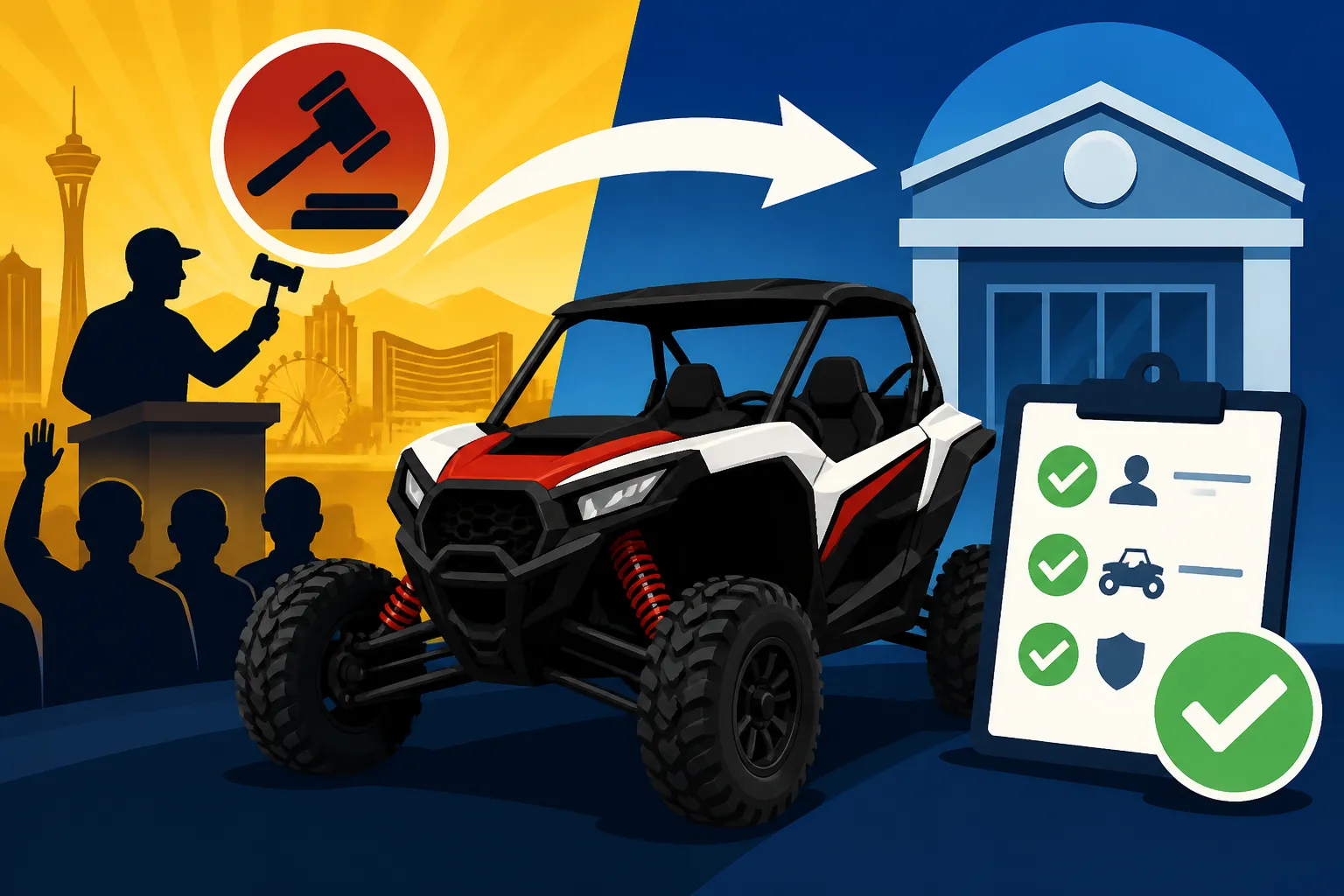
Registering a Machine Bought at a Las Vegas Auction
You just scored a fantastic deal on an off-highway vehicle (OHV) at a Las Vegas auction, and that buzz of excitement is probably still tingling! But now that the adrenaline has worn off, you're likely staring at a pile of paperwork (or maybe even a lack thereof), wondering how on earth you're going to get your new-to-you quad or side-by-side legally registered to hit those incredible Nevada trails. This guide is going to walk you through the often-confusing process of registering an OHV bought from an auction in Nevada, helping you navigate the paperwork and get that decal on your machine.
The Unique Challenges of Auction OHV Purchases
Buying an OHV at an auction, especially a public one in a bustling city like Las Vegas, can be a thrilling experience. The prices can be hard to beat, and you might find a machine you never expected. However, the process of transferring ownership and getting it street-legal (or, in Nevada's case, trail-legal) can throw a few curveballs your way that you wouldn't typically encounter with a private party or dealer purchase. It's not always as simple as signing a title and heading to the DMV.
One of the biggest frustrations buyers face is the variability in documentation. Some auctions are incredibly professional, providing clear bills of sale and even titles. Others, particularly smaller or more informal events, might offer little more than a receipt. When you're dealing with a state agency like the Nevada DMV, robust documentation is your best friend. Without it, you might find yourself in a bureaucratic maze, trying to prove that the shiny new machine sitting in your garage is actually yours. This initial hurdle can be daunting, but it's far from insurmountable if you know the steps to take.
Establishing Proof of Ownership After the Gavel Drops
After the excitement of winning your bid, the very first thing you need to focus on is establishing clear proof of ownership. This is your foundation for everything that follows. Ideally, the auction house will provide you with a detailed bill of sale or a certificate of auction that clearly lists:
- The full name and address of the auction house (the seller).
- Your full name and address (the buyer).
- The date of sale.
- A comprehensive description of the OHV, including its make, model, year, and crucially, its Vehicle Identification Number (VIN).
- The final sale price.
Sometimes, you might get a generic receipt that doesn't have all this detail. If that's the case, try to work with the auction house to get a more robust document. You can even consider creating a supplementary bill of sale yourself using a service like LawDepot, where you fill in the missing details and have both you and a representative from the auction house (if they're willing) sign it. The more official-looking and comprehensive your initial paperwork, the smoother your journey to registration will be. Remember, the DMV needs to see a clear chain of custody.
The Elephant in the Room: Missing Titles
It's an unfortunate reality that many OHVs sold at auction, particularly those from impound lots, repossessions, or estate sales, might not come with a traditional title. This is probably the single biggest headache for an auction buyer. Nevada, like most states, relies heavily on a clean title to prove ownership. Without it, you're essentially trying to register a machine that, on paper, doesn't have a clear owner.
The absence of a title doesn't mean your machine can't be registered, but it does mean you'll have extra hoops to jump through. The Nevada DMV has provisions for these situations, but they require additional affidavits, declarations, and sometimes even a bonded title process. This can add significant time and effort to what you might have expected to be a straightforward registration. It's a common frustration that can make you feel like you're going in circles, but understanding the options available can save you a lot of grief. Don't be discouraged; many people successfully navigate this. [Nevada OHV Registration Without a Title] is a common path for many auction buyers.
Navigating the Nevada DMV OHV Section
Once you have your best possible proof of ownership, your next step is to tackle the Nevada Department of Motor Vehicles (DMV). This is where the rubber meets the road, or more accurately, where the paper meets the stamp. The Nevada DMV OHV section handles all registrations and titling for off-highway vehicles, and they have specific procedures for machines acquired through less traditional means like auctions. While it can feel overwhelming, approaching the process systematically can help.
Remember that patience is key when dealing with government agencies. Having all your ducks in a row before you go to the DMV can save you multiple trips and a lot of frustration. It’s always a good idea to call ahead or check the official DMV website for the most current forms and requirements, as these can sometimes change. They often have dedicated agents who specialize in OHV transactions, and knowing when to go to avoid peak hours can also make a significant difference in your experience.
The All-Important VIN Verification
Before you can title or register your auction-bought OHV, you'll almost certainly need a VIN inspection. This is a critical step, especially if your machine didn't come with a title, was purchased out-of-state, or if there's any question about its origin. The VIN verification process confirms that the vehicle identification number on your paperwork matches the physical VIN on the machine, and that the VIN hasn't been tampered with or stolen.
While the Nevada DMV itself will not perform a VIN inspection for OHVs, they do authorize specific entities to do so. Your best bet is usually a licensed Nevada OHV dealer. Many dealerships offer this service, sometimes for a nominal fee. You might also be able to get a VIN inspection done by a sworn law enforcement officer, such as a sheriff's deputy or state trooper. This can be a convenient option if you live in a rural area or have difficulty transporting your OHV to a dealership. Always ensure the individual performing the inspection fills out the correct Nevada DMV form (often the OHV-001 or a similar document) completely and accurately, as any errors will send you right back to square one. [Which Dealers Can Inspect a VIN in Nevada] and [Asking a Sworn Officer to Verify a VIN] are valuable resources here.
Applying for a Nevada Title and Registration
With your proof of ownership and a completed VIN verification form in hand, you're ready to submit your application to the Nevada DMV. This typically involves several forms, and the specific ones you need will depend on whether your OHV came with a title or if you're applying for an original title.
If you do have a title, you'll need the properly assigned title, your proof of purchase (bill of sale), and the VIN verification form. You'll then apply for a new Nevada title and registration decal. If, as is common with auction purchases, you don't have an existing title, you'll be submitting a much more comprehensive application package. This package often includes an application for an original title, your bill of sale, the VIN verification, and possibly affidavits explaining the circumstances of the purchase and the lack of a title. Nevada provides various forms for different scenarios, so make sure you pick the one that fits your situation. [Why Nevada Has Five Registration Applications] can help clarify which form is right for you. Be prepared to fill out every section clearly and legibly to avoid delays.
Overcoming the Lack of a Title with an Affidavit
Let's circle back to that missing title problem. If your auction-bought OHV genuinely doesn't have one and the auction house can't provide it, you're not out of luck. Nevada has procedures in place for establishing ownership through an affidavit process. This usually involves you signing a legal document, under penalty of perjury, stating how you acquired the machine and why a title isn't available. This affidavit acts as your sworn statement of ownership.
You might need to combine this with a certified bill of sale or other documentation you received from the auction. Services like LawDepot can be incredibly helpful for drafting a formal bill of sale or an affidavit of ownership that meets legal standards, even if it's supplemental to what the auction provided. This legally-sound documentation gives the DMV the assurance they need that you are, in fact, the rightful owner. In some cases, if the value of the OHV is high enough, or if there are lingering questions about its history, the DMV might even require you to obtain a bonded title. This means you purchase a surety bond that protects previous owners or lienholders in case your claim of ownership is later found to be fraudulent. It's a rare step for OHVs, but it's important to be aware of the possibility.
Understanding Fees and Deadlines for Registration
Alright, you've got your paperwork mostly sorted, the VIN is verified, and you're feeling good about finally getting that registration decal. But before you head to the DMV, it's crucial to understand the fees involved and, perhaps even more importantly, the strict deadlines. Missing these can lead to unnecessary expenses and delays, turning your auction score into a bigger financial commitment than you anticipated.
Nevada's system is designed to encourage timely registration, and penalties are put in place for those who drag their feet. It's not just about the cost; it's also about being able to legally enjoy your new ride. Imagine finally getting everything ready, only to find out you've incurred a late fee or, worse, can't ride because your paperwork isn't fully processed. A little planning goes a long way in avoiding these common frustrations.
The Cost of Getting Legally Registered in Nevada
Registering your OHV in Nevada involves a few different fees. First, there's the OHV registration fee itself. This is what you pay to get your decal, and it's typically an affordable amount, contributing to trail maintenance and other OHV-related programs. You usually have the option to register for one year or three years, with the three-year option often offering a slight savings over renewing annually. [Nevada OHV Registration Fee for One Year] and [Nevada OHV Registration Fee for Three Years] detail these options.
Beyond the registration, you'll also pay a title fee if you're applying for a new Nevada title, which is likely the case for an auction machine, especially if it didn't come with one. This is a separate charge from the registration decal itself. You might also encounter a small VIN assignment fee or other minor administrative charges. While the exact figures can vary and are subject to change, expect a combined cost for titling and registration that reflects these different components. It’s always best to check the current fee schedule on the Nevada DMV website before your visit. [Cost to Title an ATV in Nevada] provides a good overview.
The Critical 30-Day Clock and Avoiding Penalties
This is where many new OHV owners, especially those buying at auction, can get tripped up. Nevada law states that you generally have 30 days from the date of purchase to register your off-highway vehicle. This "30-day clock" is a strict deadline, and missing it can result in penalties. If you fail to register within this timeframe, the Nevada DMV will assess a late fee. While not exorbitant, it's still an unnecessary expense that you can easily avoid with prompt action. [Nevada's Thirty-Day Registration Deadline] explains this in detail.
The 30 days can fly by, especially when you're trying to gather auction documents, get a VIN inspection, and navigate the DMV process. It's a common source of frustration, feeling rushed while trying to complete complex paperwork. My advice? Treat the auction date as a countdown timer. As soon as you win that bid, start collecting your paperwork and scheduling your VIN inspection. Don't wait until week three to begin the process, or you might find yourself scrambling.
| Required Action | Timeline | Potential Issue | How to Avoid |
|---|---|---|---|
| Obtain Proof of Ownership | Immediately after sale | Incomplete/missing documents | Request detailed Bill of Sale, create one with LawDepot |
| Get VIN Inspection | Within 1-2 weeks | Can't find authorized inspector | Locate a Nevada OHV dealer or contact law enforcement early |
| Gather All DMV Forms | Within 2 weeks | Incorrect forms, missing information | Check Nevada DMV site, call for clarification |
| Submit Title & Registration | Within 30 days of sale | Late fees, rejection for missing docs | Prioritize, submit promptly, double-check all paperwork |
Common Pitfalls and How to Avoid Them
Even with the best intentions, the process of registering an auction-bought OHV can have its share of snags. From missing forms to unexpected hurdles, it's easy to get frustrated. Understanding these common pitfalls beforehand can help you sidestep them, saving you time, stress, and potentially money. The goal is to make your DMV visit as smooth as possible, allowing you to focus on enjoying your machine rather than battling bureaucracy.
Many people find the DMV process to be one of the less enjoyable parts of OHV ownership. However, by being prepared and proactive, you can turn a potentially trying experience into a manageable task. Think of it as part of the adventure – every challenge overcome brings you closer to the open trails!
The Frustration of Incomplete Paperwork
One of the most common reasons for a rejected application at the DMV is incomplete or incorrect paperwork. You might think you have everything, only to be told you're missing a signature, a date, or an entirely different form. This is especially prevalent with auction purchases where the initial documentation might have been sparse. The frustration of standing in line, waiting your turn, only to be sent home for a small oversight is a universal experience for many.
To avoid this, create a checklist of all required documents before you head to the DMV. This includes your bill of sale, VIN verification form, any affidavits of ownership, and the specific title and registration application forms. Double-check that every blank space is filled, every required signature is present, and all copies are clear. If you used a service like LawDepot to draft a supplementary bill of sale or affidavit, ensure it's properly notarized if required. When in doubt, call the Nevada DMV OHV section directly or visit their website for a detailed list of requirements for your specific situation. [Nevada OHV Registration Paperwork Checklist] can be your best friend here.
Proving Ownership Without a Traditional Title
As we've discussed, not having a title is a significant hurdle for many auction purchases. The DMV's primary concern is ensuring they are titling and registering the machine to its rightful owner. Without a clear paper trail from the manufacturer through previous owners to you, they're understandably cautious. This can lead to a feeling of being stuck in limbo, owning a machine you can't legally ride.
Your strategy here is to build the strongest possible case for ownership. This means your bill of sale from the auction must be as detailed as possible. If it's not, supplement it with a new bill of sale you create yourself with an online template from a service like LawDepot, signed by both parties if feasible. If the auction house can't or won't provide a title, prepare an affidavit of ownership explaining the circumstances. Be ready to provide any additional documentation that might help, such as photos of the machine from the auction, proof of payment, or even correspondence with the auction house. The more evidence you can provide, the more likely the DMV is to accept your claim and help you obtain a new Nevada title.
The "Too Good to Be True" Auction Deal
Finally, let's talk about those irresistible auction deals. While many are legitimate, sometimes an OHV might be sold at a price that seems almost too good to be true. In some rare cases, these machines might have underlying issues that complicate registration, such as being previously stolen or having a lien attached that wasn't properly discharged. While reputable auction houses do their due diligence, the onus ultimately falls on the buyer to verify the machine's history.
Before you even bid, if possible, try to perform a VIN check. There are online services that can run a VIN to see if the machine has been reported stolen or has any active liens. If the auction doesn't provide the VIN in advance, exercise caution. Buying a used ATV privately can be risky, and auctions sometimes heighten those risks. While you might not always be able to do an extensive background check on an auction floor, being aware of the potential for issues can prevent massive headaches down the road. It’s always better to walk away from a deal that feels questionable than to end up with a machine you can't legally register and ride. [Checking an ATV VIN Before You Buy] is a practice that applies equally, if not more, to auction purchases.
Disclaimer
This article is for general informational purposes only and does not constitute professional advice. Laws, prices and regulations vary by location and change over time. Consult a qualified professional for guidance on your specific situation.