Fines a Deputy Can Write at a Dune
A deputy’s citation at a Nevada dune can involve more than an expired sticker. The issue may be registration, where you rode, or whether your out-of-state paperwork qualifies. Knowing the common reasons for a stop—and what to do with a citation—helps you avoid preventable trouble and separate a state violation from a recreation-area fee.
What a deputy may cite at a Nevada dune
A deputy or other authorized officer may address violations under the laws and rules that apply where you are riding. At a dune area, that can mean Nevada OHV requirements, restrictions on a route or land area, or a separate safety or conduct rule. The details matter: the same machine may be subject to different requirements depending on its registration, the rider’s status, and the land manager’s rules.
A citation is not automatically the same thing as a fine paid on the spot. It may require a response to a court or other authority, and the consequences depend on the alleged violation and the process named on the paperwork. A warning, a citation, and a recreation-area fee are also different things.
| Issue during a dune ride | What an officer may be checking | What to do before riding |
|---|---|---|
| Nevada registration decal | Whether the machine has the required current registration and the decal is displayed as required | Check the decal’s validity and placement |
| Out-of-state paperwork | Whether the machine and rider qualify under Nevada’s visitor rules | Carry current home-state documents and confirm reciprocity |
| Closed area or route | Whether riding is allowed in that specific location | Check current land-manager maps and closures |
| Ownership or registration proof | Whether you can identify the machine and show its paperwork | Carry the registration card or other relevant documents |
| Conduct or safety concern | Whether a separate state or site rule applies | Review the rules for the location and ride within them |
Registration is a common reason for a stop. Nevada requires registration for many off-highway vehicles used on public land, although exemptions apply to some machines and situations. A missing, expired, or improperly displayed decal can create a problem even if the machine is otherwise in good condition. For the basics, see Nevada OHV Registration and Proof of Ownership and Nevada OHV Decal Placement Rules.
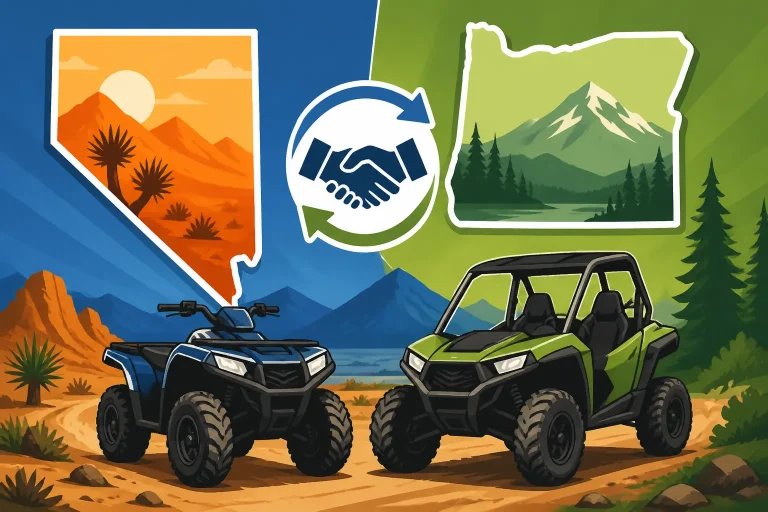
Visitors should not assume that a registration sticker from another state automatically settles the question. Nevada has rules for certain nonresident machines, and eligibility can depend on the machine’s home-state status and how long it is used in Nevada. The rules are not simply “out-of-state sticker means no Nevada requirements.” Review Nevada OHV Reciprocity With Other States and Nevada’s 15-Day Window for Out-of-State Machines before a longer stay. If the machine does not qualify for an exemption or reciprocity treatment, ask the Nevada OHV authority what registration is required.
A deputy may also respond to riding where access is prohibited. A route shown on an older map may have since closed, and a broad assumption that public land is open to cross-country travel can be wrong. Restrictions may protect habitat, separate motorized and nonmotorized areas, or reflect a temporary closure. Riding beyond a marked boundary can lead to enforcement even when the machine has valid registration. Check current maps and notices for the specific recreation area rather than relying only on a trail app or a map saved months ago.
Some issues involve more than one rule. For example, riding into a closed area might also involve trespass if the land is private, while a dispute over registration is separate from a day-use or recreation fee. An officer may address multiple alleged violations in one encounter, but each should be identified on the paperwork. Do not assume that paying a site fee resolves a registration citation or that displaying a decal gives permission to ride every nearby route.
Registration, reciprocity, and recreation fees are separate
Nevada’s OHV decal serves as the state’s registration and riding permit for machines that must be registered. That does not mean it replaces every other requirement at a riding area. A recreation site may have its own access, parking, camping, or organized-event rules, and an out-of-state machine may be subject to separate Nevada registration rules.
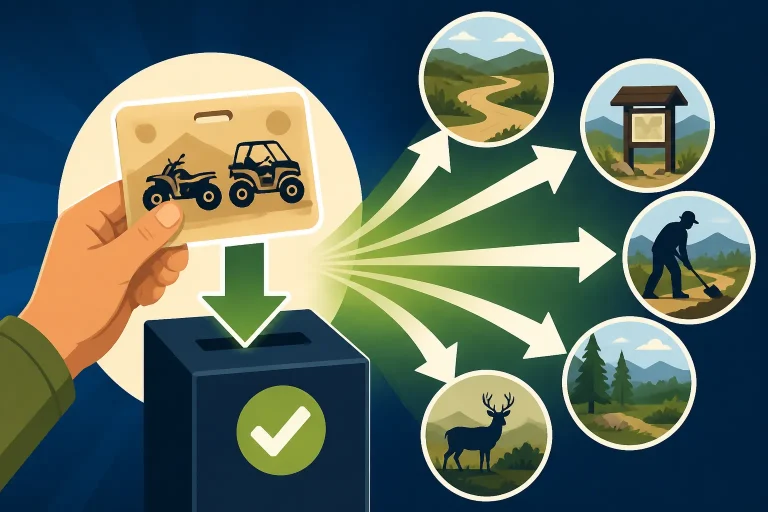
This distinction is particularly useful at dunes where visitors pay a site fee or buy a pass. A pass can cover access to a recreation area without proving that the machine is properly registered. Conversely, a valid registration decal does not necessarily pay a site fee or authorize riding in a closed zone. Check both sets of rules before unloading.
For a Nevada-registered machine, make sure the decal is current, attached in the required place, and readable. If the decal has peeled, faded, or been damaged, do not assume that carrying the registration card alone will eliminate the issue. Follow the replacement process and keep proof of registration with you. What a Nevada OHV Decal Actually Proves explains what the decal does and does not establish.
For a nonresident machine, carry the documents that show its current registration or permit in its home state. If the machine is exempt there, or if its paperwork is unusual, verify that Nevada recognizes the situation before riding. A border crossing or a short visit does not, by itself, prove that a machine falls within Nevada’s nonresident exception. Read Nonresident Riders in Nevada and confirm details with the official Nevada OHV source if the machine will remain in the state beyond a brief trip.
It is sensible to keep paperwork protected from dust and water, but accessible enough to produce during a stop. A clear photo on a phone can be a useful backup; it should not be treated as a guaranteed substitute for required original or physical documents. A dead phone, poor reception, or a screen that cannot be read can make a roadside check harder. See Carrying Documents in a Dry Bag for practical ways to protect the paperwork you need.
When you are unsure whether your home-state sticker counts, resolve that before the ride. Look up the state’s current reciprocity guidance, identify whether the machine is registered for off-highway use, and check any time limit or eligibility conditions. If the answer is unclear, contact the relevant Nevada office rather than relying on a seller, social-media comment, or an old forum post. Riding Nevada With an Out-of-State Registration is also useful when planning a visit.
Why the dune and land manager matter
Nevada dune areas are not all governed by identical site rules. The land manager, designated boundaries, and current closures can affect what is allowed. A deputy may enforce applicable state law, while a federal or other land-management officer may enforce rules tied to the land they manage. The authority involved can depend on where the stop happens and what conduct is alleged.
At Sand Mountain, for example, riders should check the recreation area’s current access information as well as Nevada registration requirements. A site pass or fee is a separate question from whether an OHV has the proper decal. The dune also has marked routes and sensitive areas where riding restrictions matter. See Sand Mountain’s 4,795 Acres and Staying on Sand Mountain’s Marked Trails when planning a trip.
At Nellis Dunes or Logandale Trails, do not assume that rules from one location carry over unchanged to another. Boundaries, access points, closures, and site conditions can differ. If you are uncertain whether a track leads into a closed or restricted area, stop and check the applicable map or sign rather than following tire marks. What the Trail Finder Site Shows You can help with planning, but confirm current local information before setting out.
Rules can also change temporarily because of habitat protection, fire conditions, weather, or other management needs. A route that was open on your last visit may not be open now. Check official notices before leaving and pay attention to signs at the trailhead and along the route. When a closure is posted, an old map or a navigation app should not be treated as permission to continue.
A location’s fee policy is another separate issue. Some places may charge for a pass or have specific camping and day-use requirements; other areas may not charge a direct entry fee. Not seeing a fee booth does not mean every activity is allowed, and paying for access does not override a closure. Confirm the site’s requirements directly, especially before a holiday or a multi-day trip.
What to do during and after a citation
If an officer stops you, stay in a safe place and follow clear instructions. Keep your hands visible, avoid sudden movements around the machine, and speak calmly. If asked for registration or ownership documents, provide what you have. If you do not understand the reason for the stop, ask politely what rule the officer believes was violated.
Do not argue about the legal conclusion beside the trail. You can make a note of your understanding and address a disputed citation through the process written on the citation. If you believe the officer has the wrong machine, route, or registration information, explain the relevant facts calmly, but do not interfere with the stop.
After receiving paperwork:
- Read the citation carefully, including the alleged violation, response instructions, and any deadline.
- Check whether it directs you to a court, an agency, or another office. Follow the instructions on the document rather than guessing where to respond.
- Keep the citation with relevant records, such as registration papers, photos of the decal, receipts, maps, and any site-pass information.
- Write down what happened while the details are fresh, including the location, signs you saw, and the route you took.
- Contact the listed court or authority if you need clarification about the response process. If the matter could carry significant consequences or you plan to contest it, consider speaking with a qualified attorney.
Do not ignore a citation because you think it was only a warning or because the machine has since been registered. Correcting a problem afterward may help prevent another stop, but it does not necessarily cancel an existing citation. The paperwork controls how and when you must respond.
Fines and other consequences depend on the specific violation, the applicable law, and the authority handling the case. Additional assessments or court costs may also apply. Because amounts and procedures can change, use the citation and the relevant official court or agency as the source for current requirements; do not rely on an old fine amount quoted online.
Before the next ride, fix any paperwork problem, confirm whether your out-of-state registration is accepted, and check the dune’s current maps and rules. Those steps cannot guarantee that you will never be stopped, but they can prevent common avoidable issues and help you respond more confidently if an officer asks to see your documents.
Disclaimer
This article is for general informational purposes only and does not constitute professional advice. Laws, prices and regulations vary by location and change over time. Consult a qualified professional for guidance on your specific situation.