Nevada Rules for Riding a Dry Lake Bed
A dry lake bed can look like an open, easy place to ride, but a flat surface does not automatically mean public access or unrestricted OHV use. In Nevada, the key questions are who manages the land, whether riding is allowed on that specific playa, and whether the ground is truly dry. Check those details before unloading.
Confirm that the lake bed is open to riding
A dry lake bed is a landform, not a permission slip. The playa may be on federal, state, tribal, or private land, and each area can have different access rules. Even where the surrounding desert is open to vehicles, the lake bed itself may be closed, restricted to designated routes, or subject to a temporary closure.
Start by identifying the exact place you plan to ride and the land manager responsible for it. A map pin, trail name, or local nickname may not tell you where the ownership boundary falls. Check current maps and notices from the responsible land manager, and contact the local field office if the route or boundary is unclear. General guidance about riding on public land is covered in Nevada Rules for Riding Federal Land and Riding Open BLM Land Versus Marked Trail.
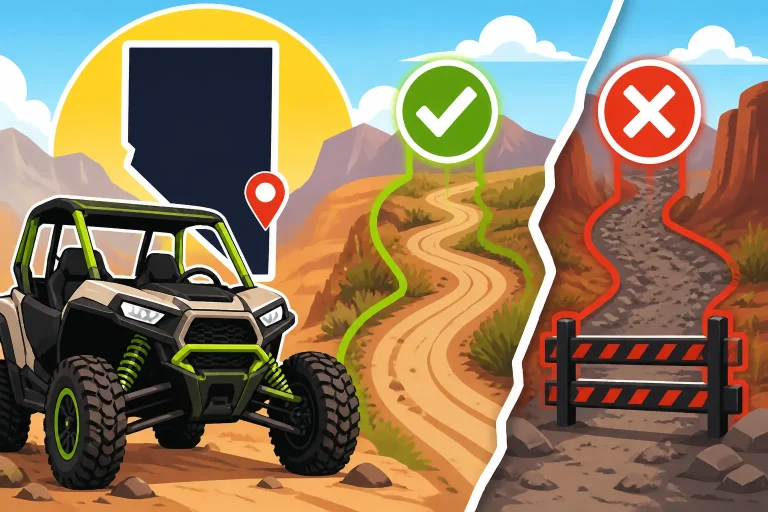
Do not assume that a broad area marked as public land is open to cross-country travel. A map may show a designated road or route across the playa while the rest of the basin is closed to vehicles. In some places, driving is allowed only on existing routes; in others, managers may designate specific areas for OHV use. Follow signs and route markers, and do not create a new track to get around a closure or reach a preferred riding spot. Reading a BLM Travel Management Map can help explain why route-level details matter.
Before setting out, check for:
- Posted signs at the access point, trailhead, or edge of the playa.
- Current land-manager maps showing open routes and closed areas.
- Temporary closures, fire restrictions, restoration areas, or event controls.
- Private-property boundaries and any access conditions.
- Seasonal or weather-related restrictions.
A route that was open on a previous visit may have changed. Closures can be put in place to protect sensitive habitat, respond to unsafe conditions, or manage damage. If the available information conflicts, take the more cautious approach and verify with the agency or landowner rather than treating the absence of a sign as permission.
Check the surface before driving onto it
A lake bed can look dry while remaining soft, wet, or unstable underneath. Rain may leave a thin crust over mud, and water can collect in low spots long after the surrounding ground appears firm. A vehicle that breaks through the surface can sink quickly, become difficult to recover, and leave deep ruts that remain after the site dries.
Do not use another rider’s tracks as proof that the ground is safe. The surface can vary over a short distance, and earlier tracks may have been made when conditions were different. Look for warning signs such as dark or glossy patches, standing water, soft edges, recent rainfall, or a crust that flexes or cracks underfoot. If you are not sure, stay off the playa and choose a route on firm, approved ground.
A practical rule is to avoid riding a lake bed after rain or when water is present, even if one section seems solid. Wait for conditions to dry thoroughly, then confirm that the land manager permits access. “Dry” in the name of the place does not guarantee that it is dry enough to support a vehicle.
Use a cautious approach if you have a clear, authorized route and conditions appear suitable:
- Stop at the edge and inspect the ground on foot from a safe, firm spot.
- Check for signs, route markers, standing water, soft patches, and fresh damage.
- Keep to the permitted route or riding area rather than testing unknown ground.
- Avoid sudden turns, hard acceleration, or repeated passes over a vulnerable surface.
- Turn back if the vehicle begins to sink, the crust breaks, or conditions change.
If a vehicle becomes stuck, avoid spinning the tires in an attempt to power out. Spinning can dig the machine deeper and widen the damaged area. Use recovery equipment only if it is safe to do so, and avoid walking into soft ground where you could also become stuck. Planning for remote travel is useful beyond lake beds; Riding a Desert Wash Safely explains why apparently simple desert terrain can change quickly.
Follow OHV paperwork and land-use rules
Land access and vehicle paperwork are separate issues. Permission to ride a particular route does not replace registration or decal requirements, and having a valid decal does not make a closed route legal to ride.
Nevada’s OHV registration and permit rules depend on the machine and the rider’s circumstances. Nevada-registered machines generally need the appropriate current decal unless an exemption applies. Visitors may have different requirements depending on the machine’s home-state registration and how long it is in Nevada. Confirm the current rules before traveling, especially if your vehicle is registered outside Nevada. Start with Nevada OHV Permits Explained and Nevada Reciprocity With California if you are bringing a California-registered machine.
A lake bed may also sit within a broader recreation area with separate conditions. The land manager may restrict where vehicles can travel, require riders to stay on marked routes, or close areas to protect resources. Check the rules for the specific location rather than relying on a general statement that “BLM land is open.” If the route crosses a boundary or connects with a different management area, check the rules on both sides.
Keep your paperwork accessible and protect it from dust and water. A phone photo can be a useful backup, but do not assume it will be accepted in place of required documents. Carry the documents that apply to your machine, and make sure the decal is current and displayed as required. Rules for exemptions and route access can be complicated; Nevada Rules for Riding a Closed Route and Nevada Rules for Riding State Trust Land cover situations where the land status changes what is allowed.
Ride with a plan for changing conditions
Even an authorized, dry lake bed can be a demanding place to ride. The flat surface can make distances difficult to judge, and there may be few landmarks or sheltered areas. Dust, heat, wind, and limited cell coverage can turn a short outing into a more serious situation if a vehicle breaks down or a rider becomes separated.
Before leaving the paved road, tell someone where you are going and when you expect to return. Check the forecast and any local alerts, and do not ride into a basin when storms are possible. Rain can make a playa impassable and may create flash-flood risks in nearby washes. Flash Flood Season in the Desert and Carrying Water for a Desert Ride offer useful planning advice for Nevada’s changing desert conditions.
Carry enough water for the group, basic tools, a first-aid kit, and a way to communicate if cell service is unavailable. A charged phone is helpful, but it is not a reliable substitute for a backup communication plan in remote terrain. Make sure everyone knows the route and agrees on a turnaround point. Ride at a speed that leaves room to react to soft ground, wildlife, other riders, or a sudden change in visibility.
Pay attention to the impact of each pass. A broad, open surface may seem resistant to damage, but vehicle tracks can persist, and wet or fragile ground is especially vulnerable. Avoid disturbing wildlife or vegetation at the playa’s edge, and pack out all trash. Do not drive through standing water or muddy areas just to maintain a straight line.
| Before riding | What to verify |
|---|---|
| Land access | Identify the land manager and confirm the playa or route is open to OHVs. |
| Route | Check current maps, signs, and any temporary closures. |
| Surface | Avoid wet, soft, cracked, or uncertain ground; do not treat old tracks as proof of safety. |
| Paperwork | Confirm the machine’s registration and decal requirements, including rules for visitors. |
| Conditions | Check weather, water availability, communications, and a safe turnaround plan. |
If access is unclear, conditions are questionable, or the playa is wet, choose another approved route. Turning back protects your machine, reduces damage to the land, and avoids the risk of needing a difficult recovery far from help.
Disclaimer
This article is for general informational purposes only and does not constitute professional advice. Laws, prices and regulations vary by location and change over time. Consult a qualified professional for guidance on your specific situation.