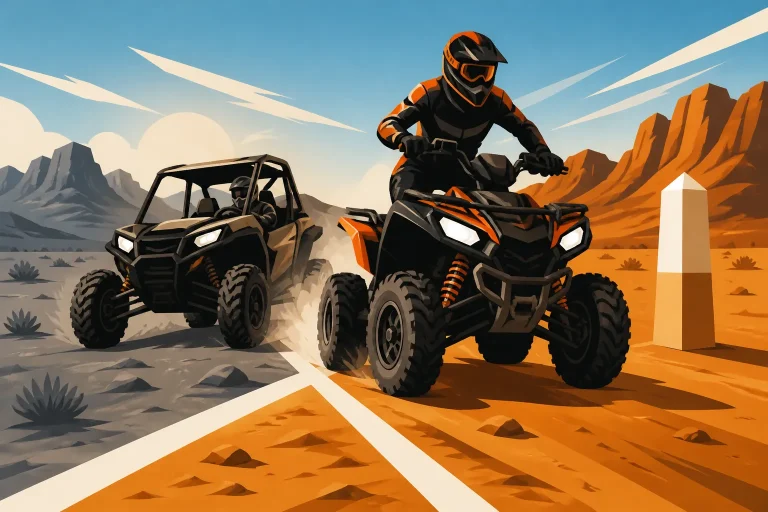
What Nevada Charges Visitors to Ride
If you’re bringing an ATV or UTV to Nevada, the cost depends less on being a visitor than on what registration your machine already has and where you plan to ride. Nevada generally does not sell a separate statewide trail permit for each ride. This guide explains when you may need a Nevada decal, what extra fees can apply, and how to check your situation before unloading.
The short answer: what a visitor may have to pay
There is no single fee every visitor pays. If your machine has valid registration from another state that Nevada recognizes, you may be able to ride without buying a Nevada decal. If it does not qualify for that exemption, you may need Nevada’s OHV decal. Some destinations also charge their own access or recreation fees, separate from registration.
Nevada’s standard OHV decal has commonly been listed at $20 for one year, but fees and eligibility rules can change. Confirm the current amount and the rule for your specific machine with Nevada’s official OHV registration information before you travel. The important point is that the decal is a registration document as well as Nevada’s general OHV riding permit; it is not normally an add-on pass that visitors buy just to ride public trails.
| Your situation | Likely Nevada cost | What to check |
|---|---|---|
| You have valid out-of-state OHV registration recognized by Nevada | Often no Nevada decal fee | Whether the registration is current and qualifies for Nevada reciprocity |
| Your state does not register your machine, or your paperwork does not qualify | A Nevada OHV decal may be required | Whether a nonresident exemption or limited window applies |
| You ride at a fee-charging area | A site-specific fee may apply in addition to any required registration | The area’s current pass, day-use and camping rules |
| You rent a machine or join a guided tour | The operator usually handles the machine’s paperwork; you pay the rental or tour charges | What the booking includes, and what it excludes |
| You plan to ride public roads | Possible separate road-use requirements and costs | Whether the machine and route qualify for road use |
This table is a planning guide, not a substitute for checking your paperwork. A machine’s state of registration, the kind of document it carries, how long it will be in Nevada and the exact location you intend to ride can all matter. For a broader overview of the permit system, see Nevada OHV Permits Explained.
When an out-of-state machine can ride without a Nevada decal
Visitors often assume there are only two choices: buy a Nevada decal or stay off the trails. That’s too simple. Nevada’s treatment of an out-of-state machine can depend on whether the machine has valid registration from its home state and whether that registration is recognized for use in Nevada.
A valid registration card, permit or sticker from another state may be enough for a qualifying machine. But don’t assume that any colored sticker on a fender proves registration. States use different systems: some issue a registration decal, some issue a permit, and others have categories for public-land use or for certain types of machines. Nevada’s reciprocity rules determine whether a particular credential counts.
The practical steps are:
- Identify the machine and the document it carries. Note whether it is an ATV, UTV, dirt bike or another off-highway vehicle, and read the registration paperwork rather than relying on the decal’s appearance.
- Check that the registration is current. An expired sticker or lapsed registration may not support an exemption.
- Confirm Nevada accepts that kind of registration. Reciprocity is not a blanket promise that every out-of-state label is enough. State rules and vehicle categories differ.
- Check how long the machine will remain in Nevada. Some visitor rules involve a limited period, so a short trip and an extended stay may be treated differently.
- Carry proof with the machine. Keep the registration document accessible and make sure the decal or sticker remains legible.
For a state-by-state overview, read Nevada OHV Reciprocity With Other States. If you’re arriving with a valid registration but aren’t sure whether it counts, Riding Nevada With an Out-of-State Registration is a useful next step.
The limited window is not a general free pass
Nevada has a limited nonresident rule associated with certain out-of-state machines. The details matter: it is not safe to treat the rule as “any visitor can ride free for a set number of days.” Eligibility can depend on the machine’s home-state registration requirements and the circumstances of its use.
Before relying on a short-term exemption, check the current language and how the time period is counted. The day you arrive with the machine may matter, and the rule may not apply to every visitor or every type of machine. The overview Nevada’s 15-Day Window for Out-of-State Machines explains why this detail deserves its own check.
If you’ll be in Nevada longer than the allowed period, or your paperwork does not fit the exemption, contact the Nevada OHV registration office before the trip. Don’t wait until you’re at a remote trailhead to discover that your machine needs a Nevada decal.
A state sticker is not proof of every kind of permission
Even when an out-of-state registration qualifies, it doesn’t automatically authorize riding on every road, trail or parcel of land. The registration question and the access question are separate:
- Registration concerns whether the machine is properly documented.
- Land access concerns whether riding is allowed in that specific place.
- Road use concerns whether the machine may operate on that road and meets the applicable requirements.
- Site fees concern charges imposed by a particular recreation area or operator.
A machine can be properly registered and still be on a closed route. It can be permitted on a trail but not legal on a nearby county road. Check the land manager’s map and restrictions for the exact route, not just the area name.
When you may need Nevada’s OHV decal
You may need to purchase a Nevada OHV decal if your machine is not covered by a qualifying out-of-state registration or an applicable exemption. That can include machines from places where the vehicle is not registered for the kind of riding you intend to do, as well as machines that have no current paperwork.
The decal is not merely a visitor’s day pass. It is part of Nevada’s OHV registration system, and the registration record and proof of ownership may also matter. Before applying, check what documentation is needed for your situation. A visitor with an out-of-state purchase, a machine with an incomplete title history and a machine already registered in Nevada may each face different paperwork steps.
Nevada’s standard decal has commonly been listed at $20 for one year. Verify the current fee through an official Nevada source before paying, especially if your trip is planned well in advance. You can read Nevada’s $20 Decal Is the Permit for an explanation of how the decal serves as Nevada’s general OHV permit.
What the decal does and does not cover
For ordinary OHV riding, Nevada does not generally require visitors to buy a second statewide “trail sticker” on top of the appropriate registration. The Nevada decal is the relevant state credential for machines that need Nevada registration. That does not mean the decal grants entry to every recreational area or covers every possible activity.
A decal does not:
- Open a closed route or allow riding outside designated areas.
- Replace a site-specific day-use, camping or recreation pass where one is required.
- Make a non-street-legal machine legal on public roads.
- Replace a title, bill of sale or other proof of ownership when those documents are needed.
- Automatically satisfy requirements imposed by another state if you cross the border.
Keep your registration card with the machine, and keep the decal visible and in good condition. If you need to show proof during a ride, a photo on your phone may be a helpful backup, but don’t assume it replaces documents an enforcement officer or land manager requires. For practical ways to carry paperwork, see Carrying Documents in a Dry Bag.
Buying a decal before you leave
If you determine that Nevada registration is required, give yourself time to sort out the paperwork. The right application can depend on how you acquired the machine and whether it has a title. Check the current forms and instructions before mailing anything or making a long drive to an office.
If the machine is a rental, a tour machine or a dealer demo, don’t assume you have to buy a personal decal. Ask the provider how the machine is registered and what documentation will be carried with it. Visitors who use an operator’s machine generally have a different paperwork problem from visitors transporting their own ATV or UTV.
Extra charges at specific riding areas
Nevada’s OHV registration and a recreation area’s access fee are separate costs. A visitor can have valid paperwork and still owe a day-use or pass fee at a particular destination. Conversely, a free-to-access area may still require a properly registered machine.
Sand Mountain is a well-known example of a Nevada riding area with its own recreation fees. Those charges are set for that destination and are not the same as the state OHV decal. The fee structure, pass options, included activities and exceptions can change, so verify them with the site’s official information before setting out. For context, see Nevada’s Only Pay-to-Ride Dune.
When comparing destinations, look for more than a headline “pass” price. Check whether the charge is per vehicle, per person, per day or for a longer period; whether camping is included; and whether the fee applies to the machine, tow vehicle or both. Do not assume that a pass for one recreation area works at another.
Other public lands may have no general entry charge for a casual ride, while still requiring compliance with registration and route rules. Organized group rides, races, commercial trips and special events can trigger different permit requirements. A personal day ride is not the same as an event that reserves space, advertises to the public or brings a large organized group onto public land.
Budget for the whole trip, not just the sticker
A sensible estimate includes more than the state credential. Depending on your plans, allow for:
- Any required Nevada decal or other registration cost.
- A site-specific riding or day-use fee.
- Camping fees, if you stay overnight.
- A fee for an organized event or commercial activity, if applicable.
- Fuel, towing and supplies.
- Any rental, guide or recovery charges if you do not bring your own machine.
Those are separate categories, and one payment rarely covers them all. Check each fee with the organization that collects it. For example, the state registration office can answer a decal question, while the recreation-area manager is the right source for an entrance or camping fee.
If you are picking up equipment for the trip, a waterproof document pouch can help keep registration papers protected from dust and water. If you shop on Amazon for one, check the size and closure carefully; a pouch that fits a phone may not fit folded vehicle documents. It is also worth keeping a second copy of essential paperwork somewhere separate from the machine.
Renting or joining a tour changes who handles the paperwork
If you rent an ATV or UTV, the rental company generally handles the machine’s registration and the paperwork associated with its use. That does not mean every cost is included in the rental quote. A rental agreement may separate the rental charge from a tour, transport, fuel, damage hold, cleaning or access charge. Read the terms and ask what you will pay before confirming.
Ask the operator:
- Is the machine properly registered for the planned ride?
- Are any recreation-area fees included, or paid separately at the site?
- Does the rental allow the type of terrain you plan to ride?
- Are there limits on where you may take the machine?
- What identification, driver qualifications or age rules apply?
- What happens if the machine needs recovery or is returned damaged?
A guided tour can make paperwork easier because the operator selects the route and supplies the machine, but it does not remove the need to follow the guide’s instructions or the area’s rules. A tour package might include entry to a riding area, or it might not. Don’t infer that from the word “tour”; ask directly.
If you buy goggles, gloves or a document pouch before renting, check the operator’s equipment rules first. Some businesses provide helmets or other protective gear, while others expect riders to bring particular items. On Amazon, descriptions and sizing can be easy to misread, so confirm that gear meets the needs of the ride rather than buying based only on a product photo.
Registration does not make every Nevada road legal
A common source of surprise is the difference between an OHV decal and authorization to ride on a road. Nevada’s standard OHV registration does not by itself make an ATV or UTV street legal. Road use can depend on the machine’s design, equipment, insurance, the rider’s qualifications and the specific road or route.
Some larger ATVs may qualify for a separate Nevada road-use decal under specific rules. A machine that qualifies for that route is not the same as a typical sport quad, and having an OHV decal alone does not satisfy the road requirements. Rules can also differ between state highways, county roads, local streets and designated routes.
Before planning to ride from a town to a trailhead, check:
- Whether that specific road is open to the type of vehicle.
- Whether the machine qualifies for the road-use category.
- What required equipment, insurance and driver credentials apply.
- Whether local restrictions close the route to OHVs.
- Whether crossing a highway is allowed at the place you intend to cross.
If your goal is only to ride off-road, avoid adding road use to the plan unless you’ve checked it carefully. A route that looks like a convenient connector on a map may be a public road with restrictions. A road-use decal, where available, is not permission to ride anywhere you choose.
A pre-trip checklist for visiting riders
A quick check before loading can prevent a wasted trip or an expensive change of plan. Work through these steps for each machine you intend to bring.
- Write down the machine’s make, model and vehicle type. The rules may differ for an ATV, side-by-side, dirt bike or other OHV.
- Find the current registration document. Check its expiration date and whether it identifies the machine clearly.
- Confirm the document’s status in Nevada. Do not rely on a seller’s assurance, an old sticker or a rule remembered from a previous trip. Use the current Nevada reciprocity information.
- Check whether a limited visitor exemption applies. Confirm who qualifies, what dates count and what happens if the machine stays longer.
- If Nevada registration is required, verify the current fee and application process. Check whether the machine needs a title or additional ownership documents.
- Choose the riding area and check its current rules. Confirm closures, route restrictions, site fees, camping conditions and any event requirements.
- Check the trip’s road segments separately. A legal trail route does not automatically make connecting roads legal for OHV travel.
- Pack proof of registration and ownership. Protect the documents and keep them accessible.
- For a rental, get fee details in writing. Confirm access charges, fuel terms, permitted terrain and damage or recovery conditions.
If your machine has no clear paperwork, resolve that before the trip. A bill of sale, title and registration are not interchangeable, and a sticker alone may not answer a question about ownership. For help distinguishing a state credential from trail access, see Do You Need a Nevada Permit to Ride BLM Land?
If you’re shopping for basic trip supplies, keep purchases practical. A paper map or downloaded map, a securely fastened document pouch and protective riding gear can be more useful than accessories you have not tested. If you use Amazon, check fit, weather resistance and return terms, and avoid counting a purchased accessory as a replacement for required safety equipment or official paperwork.
Common visitor mistakes and how to avoid them
Assuming every out-of-state sticker is accepted
The most frequent mistake is seeing a decal from home and assuming Nevada will treat it as valid registration. A trail-use permit, an expired registration sticker and a current state OHV registration may look similar but have different legal meanings. Read the paperwork and check the applicable reciprocity rule.
Treating the visitor time window as extra riding time
A limited exemption is a rule with conditions, not a general extension for anyone who arrives from another state. If the machine does not qualify, the window may not help. If you plan an extended stay, ask about registration before you reach the end of the permitted period.
Believing the Nevada decal covers every recreation fee
The decal’s statewide role does not erase site-specific charges. Budget separately for places with their own pass system, and check whether camping or special activities cost extra.
Assuming a paid pass makes a closed route legal
A recreation pass is not a route permit. It does not authorize crossing private land, entering a closed area or riding in a protected habitat. Stay on routes the land manager has opened to OHVs and follow signs at trailheads.
Carrying only a phone photo
A photo can be useful if the paper gets wet or misplaced, but it is best treated as backup. Keep the original registration documents with the machine unless the official instructions for your situation say otherwise.
Planning a town-to-trail ride without checking road rules
The shortest route on a map can pass through roads where OHVs are not allowed. A Nevada OHV decal does not automatically make a machine road legal. Confirm each road segment before setting off.
Relying on old fee information
A saved screenshot or an old forum post can be out of date. Before travelling, check the official Nevada source for registration details and the official destination page for recreation fees. For fees collected by a private rental operator, confirm directly with that operator.
The safest way to answer “What will Nevada charge me?” is to separate the question into three parts: Does my machine need a Nevada decal? Does my chosen riding area collect a separate fee? Am I trying to use any public road? Once you have those answers, the budget is much clearer—and you’re less likely to discover a missing pass at the trailhead.
Disclaimer
This article is for general informational purposes only and does not constitute professional advice. Laws, prices and regulations vary by location and change over time. Consult a qualified professional for guidance on your specific situation.