Big Dune’s Steep North Face
Big Dune’s north face can look like a tempting straight climb, but its steep sand, shifting surface, and blind crest can catch riders off guard. This guide explains how to assess the slope, prepare your ATV or UTV, choose safer lines, and plan a ride near Beatty without treating the dune like a challenge you have to conquer.
What makes Big Dune’s north face challenging
Steep sand can change from one pass to the next
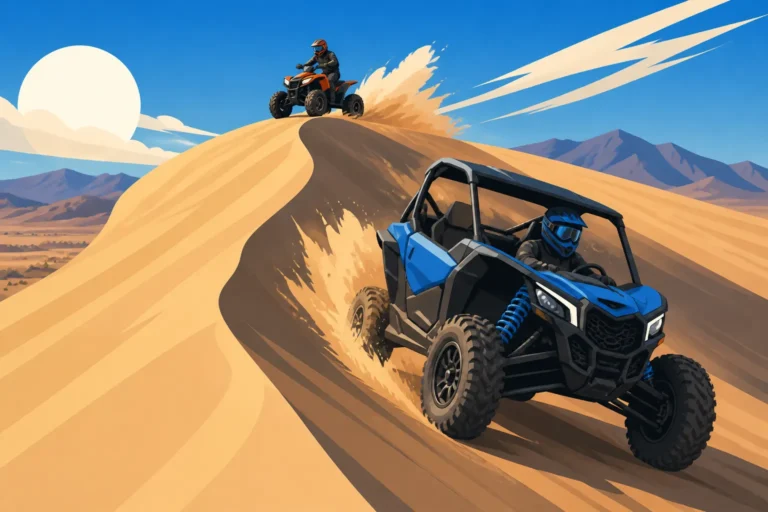
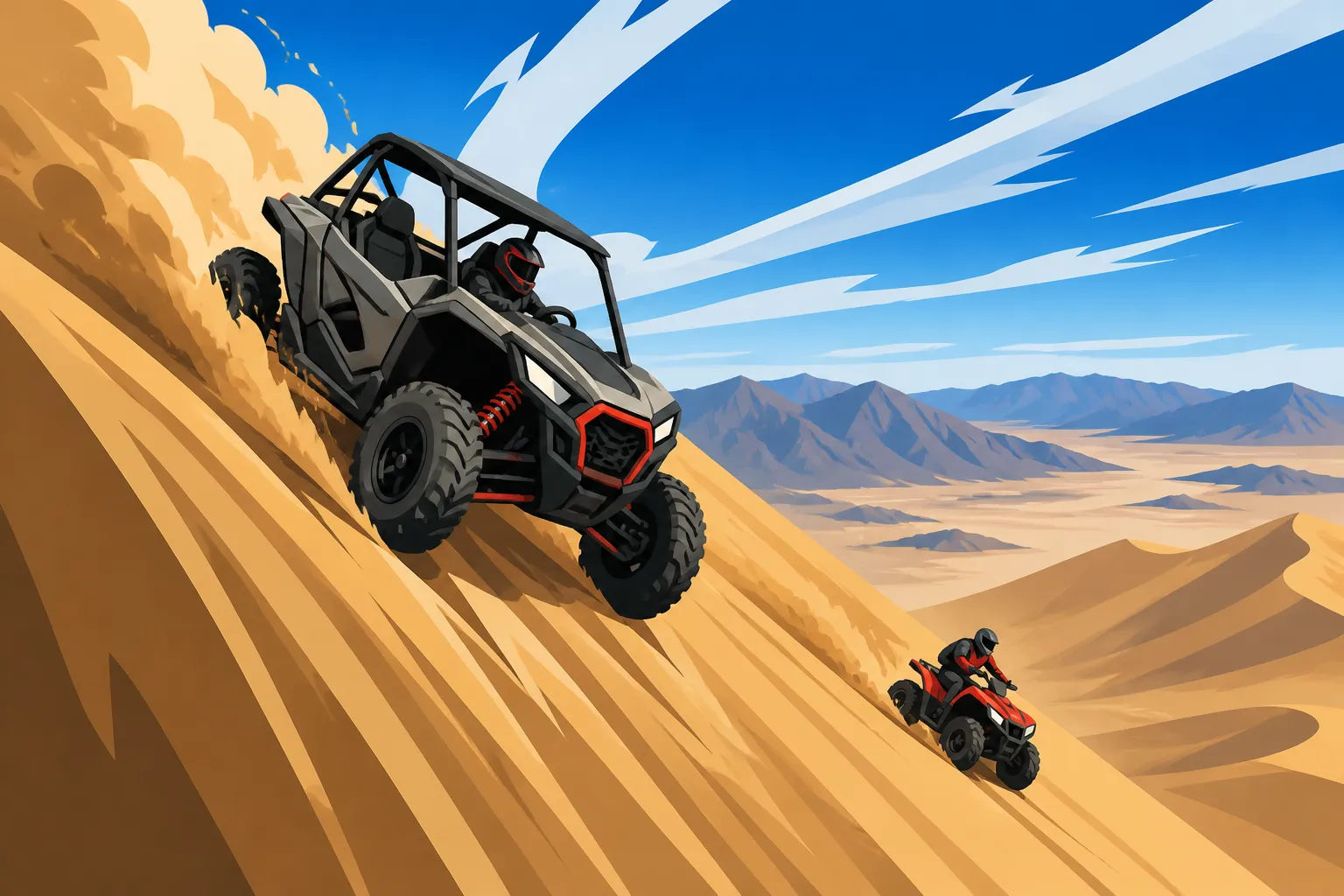
Big Dune, near Beatty in Nye County, is known for its tall, shifting sand terrain. The north face is especially imposing: from below, it may look like one clean slope, but the sand can vary in firmness and angle across the face. A line that felt manageable earlier in the day might be rutted, churned up, or softened by repeated traffic later.
That changing surface matters because sand does not give you the predictable grip of packed dirt. A tire can dig in, spin, or drift sideways, particularly when a rider slows abruptly or turns across a steep section. On a heavier side-by-side, momentum and steering response can feel different from what you expect on a familiar trail. A quad may feel more nimble, but that does not make a steep climb automatically safe.
Wind and recent riding also alter what you see. The crest may conceal the terrain on the other side, while tracks can make a route appear more established than it really is. Read the slope from a safe place before deciding whether to approach it. If the face is cut up, unusually soft, or busy with other riders, choosing another route is a sensible decision—not a failure to ride.
The crest creates a visibility problem
A steep dune is not only a traction problem. It is also a visibility problem. As you climb, the ground ahead may disappear from view before you can see what is happening over the top. Another rider could be approaching from the far side, or the surface beyond the crest may drop away more sharply than it looked from below.
That is why you should not aim for a crest simply because you can see it. Look for other riders, pause where you have a clear view, and avoid following someone so closely that you lose room to react. If you cannot tell whether the top is clear, do not assume it is. In a busy area, wait for a gap or choose a line with better visibility.
For a broader look at the terrain and planning considerations, start with [Nevada's 500-Foot Amargosa Big Dune]. If you are deciding whether this kind of terrain fits your experience, [Big Dune for a First Dune Trip] can help you think through a more cautious first visit.
The right decision may be to turn around
A steep face can trigger a familiar kind of pressure: you have driven out, unloaded the machine, watched other riders climb, and now feel that you should give it a try. But you do not owe the dune a summit. A safer ride may mean exploring lower areas, riding a gentler slope, or spending the day learning how your machine behaves in sand.
Use a simple stop-and-assess routine before you commit. Check the slope, the traffic, the condition of your tires and machine, and your own comfort level. Ask whether you have a safe way to stop or turn back if the climb feels wrong. If the answer is unclear, stay off that face for now. Riding within your limits is especially important when a mistake could leave you stopped on a steep, busy slope.
How to assess a climb before you commit
Read the slope from a safe position
Before approaching the north face, stop somewhere that gives you a useful view without putting you in the path of moving machines. Look for ruts, cut-up sand, cross-slope sections, loose material, and traffic coming from either direction. Take a moment to watch how other riders handle the area, but do not treat another person’s successful pass as proof that the same line is safe for you.
Pay attention to the slope’s shape, not just its steepest-looking section. A line may begin gradually and then become much steeper near the top. Another may look less direct but offer a smoother grade. If you cannot see the whole route, the blind section is part of the risk. Do not enter a climb unless you can make a reasonable judgment about the path ahead and have space to keep clear of other riders.
A map can help with trip planning, but it cannot tell you the exact condition of a dune face at the moment you arrive. Tools such as onX Offroad can help you review the surrounding area and organize a route before leaving, especially when you are unfamiliar with the access roads. Once on site, use what you can see, posted information, and local conditions to make your decision.
Check traffic and give other riders room
Dune traffic can move quickly and unpredictably. Riders may be climbing, descending, crossing between routes, or stopping to regroup. Before moving into a slope, scan for machines approaching from both sides and from above. Avoid stopping in a place where someone coming over a rise may not see you in time.
Stay well clear of active lines when you are waiting or watching. If your group is spread out, agree on a meeting place away from the crest and the main travel path. A rider who stops in the middle of a climb can become an unexpected obstacle for everyone behind them. Likewise, do not follow another machine so closely that you have no room to respond if it slows or slides.
For a closer look at the terrain’s access and conditions, see [Getting to Big Dune From Beatty] and [Amargosa Big Dune in Spring]. Before setting out, use onX Offroad to help review your planned approach and keep a route available offline if your phone loses reception. A map is a planning aid, not a substitute for watching the terrain and respecting signs or closures.
Know when the surface is working against you
There is no single visual cue that makes a slope safe or unsafe, but several warning signs should make you slow down your plans. Deep, uneven ruts can pull a machine off line. Very loose sand may make it harder to maintain control. A sharply angled route can put you in a position where a sideways slide is difficult to correct.
Wind can also affect comfort and visibility, while dust from nearby riders can hide movement. If you cannot see clearly, wait for conditions to improve rather than moving into a blind section. On a hot day, the pressure to ride quickly can lead to rushed choices; take breaks, drink water, and do not let fatigue make the decision for you.
| What you notice | Why it matters | A cautious response |
|---|---|---|
| Deep or uneven tracks | They can pull a machine off its intended line | Choose a different route or wait |
| A blind crest | You may not see traffic or the far-side terrain | Do not climb until you can assess the route |
| Heavy traffic | Other riders may cross or stop unexpectedly | Wait for a clear gap and keep out of active lines |
| Loose, churned sand | Traction and control may be less predictable | Avoid committing if the machine struggles |
| Dust or poor visibility | Riders and obstacles may be hard to see | Pause until you have a clear view |
| Fatigue or overheating | Judgment and reaction time can suffer | Stop, cool down, hydrate, or end the ride |
Preparing your ATV or UTV for Big Dune
Inspect the machine before leaving the staging area
A dune ride puts sustained demands on your machine. Before heading toward the north face, check that the tires are in good condition and that the controls, brakes, throttle, and steering are working as expected. Look for loose items that could shift on uneven ground, and make sure any protective equipment you rely on is secured properly.
Use the manufacturer’s guidance for your machine rather than guessing at setup. Tire pressure, gearing, and other adjustments can vary by model and rider, so avoid copying a setting just because another person uses it. If your machine is unfamiliar or has been modified, practice on easier terrain first. A climb is not the place to discover that a control feels different or that a mechanical problem is developing.
Carry basic supplies for a delay, including water, a charged phone, and any recovery or communication gear appropriate for your group. Do not assume you will have reliable cell service wherever you ride. A companion can help if a machine gets stuck or someone needs assistance, but group riding only helps when everyone knows the plan and stays together.
Match your approach to your experience
If you are new to dunes, start on gentler terrain and learn how your machine responds before considering a steep face. Sand behaves differently from firm ground, and a little practice can make it easier to recognize when you are losing traction or getting uncomfortable. Keep the first outing conservative, especially if you are riding with children, inexperienced passengers, or a group with mixed skill levels.
Experienced riders should also resist the urge to make a difficult line look easy. A powerful machine does not erase the risks of a blind crest, cross traffic, or changing sand. A passenger may have a different tolerance for steep terrain, and the driver is responsible for making a choice that suits everyone aboard. If anyone in the vehicle feels uneasy, stop and choose an easier route.
For a more focused look at riding conditions and trip preparation, read [Nevada Desert Riding in Summer Heat] and [Water and Fuel Planning in Nevada]. onX Offroad can be useful for checking your broader route before you leave, but do not rely on a digital map to judge the immediate grade, traction, or traffic on the dune itself.
Keep paperwork and area rules in mind
Before riding, confirm that your machine is properly registered or covered by the applicable visitor requirements, and carry the documents you may need. Nevada’s OHV decal is part of the state’s riding requirements for many machines; the details can depend on the machine and the rider’s circumstances. Review [Nevada OHV Permits Explained] if you need to understand the basics before your trip.
At the riding area, follow posted signs and stay within open routes. Conditions, closures, and permitted access can change, so check relevant area information before departure and again when you arrive. Do not ride around a closure just because a track appears on the sand. A visible track is not proof that the route is open or appropriate for OHV travel.
Planning a safer Big Dune ride
Build a flexible day plan
A good plan gives you options. Decide where your group will meet, how you will communicate if someone gets separated, and what time you will turn back. Choose a conservative first destination rather than making the steep north face the day’s only goal. If the dune is busy or the surface looks difficult, you can still enjoy the outing by exploring more manageable terrain.
Let someone outside your group know where you are going and when you expect to return. Bring enough water for the conditions and leave room in the schedule for breaks. If you are traveling from Beatty, account for the drive and the time needed to unload, inspect the machines, and orient yourself at the area. Rushing to make the most of daylight can lead to poor decisions once you arrive.
Use onX Offroad as one part of your planning routine: review your route in advance, save useful map information where possible, and keep a backup plan. But keep your attention on the terrain while riding. A map may help you understand where you are generally; it cannot show you a rider hidden beyond a crest or tell you how soft the sand is beneath your tires.
Make turning back part of the plan
Before anyone rides, agree that turning around is an acceptable outcome. This matters in groups, where one confident rider can unintentionally pressure others to follow. Set expectations plainly: no one needs to attempt the steep face, and anyone can call for a stop if the route feels unsafe.
If you decide not to climb, move well away from active travel lines before regrouping. Do not park at the base of a busy slope or stop where another rider may crest without seeing you. If someone in your group becomes stuck or has a problem, keep other riders clear and assess the situation before attempting recovery. Avoid putting people in the path of moving machines or on unstable sand.
For more context on routes and riding conditions, explore [Staying on Sand Mountain's Marked Trails] for general dune-area route awareness and [Nevada Trail Closures to Check Before You Go] before traveling. The safest Big Dune ride is not necessarily the one that reaches the highest point. It is the one where everyone returns with their machine, their judgment, and their enthusiasm intact.
Disclaimer
This article is for general informational purposes only and does not constitute professional advice. Laws, prices and regulations vary by location and change over time. Consult a qualified professional for guidance on your specific situation.