Amargosa Big Dune in Spring
Spring can make Amargosa Big Dune feel like a completely different ride from the hot, dry summer version: cooler air is welcome, but wind, soft sand, changing temperatures, and busy weekends can complicate a day out. This guide covers when to go, how to prepare your ATV or UTV, what to check before leaving, and how to ride the area responsibly.
What spring riding at Amargosa Big Dune is like
Amargosa Big Dune, near Amargosa Valley in Nye County, is a prominent sand-riding destination in southern Nevada. Spring often offers more comfortable daytime temperatures than midsummer, but “spring conditions” are not a guarantee of easy riding. A cool morning can turn into a warm afternoon, while gusty winds or recent weather can change the feel of the sand and the visibility around the dune.
The area is not a groomed track. Riders share open terrain, and the dune’s slopes can be steep, soft, and unpredictable. A sensible plan is to arrive with enough daylight to get oriented, ride within your skill level, and leave time to get back to the parking area without rushing.
Expect changing weather, not a perfect spring day
Desert weather can shift quickly. A sunny forecast does not necessarily mean calm conditions, and wind can blow sand across open areas or make it harder to see other riders. Before the trip, check the local forecast for Amargosa Valley and the surrounding area, paying attention to wind as well as temperature. If strong gusts, dust, or poor visibility are expected, consider postponing the ride rather than trying to push through a frustrating day.
Dress for both the drive and the ride. A light layer that feels comfortable at the trailhead may not be enough if the morning starts cold or the wind picks up. Bring eye protection that seals well, gloves, and clothing that covers exposed skin. A neck gaiter or similar face covering can be useful when sand is blowing, but it should not interfere with safe breathing or your helmet fit.
Spring conditions also affect how long you may want to ride without a break. Cooler air can make it easy to forget about hydration, especially while concentrating on the terrain. Keep water accessible, take regular breaks, and notice whether anyone in your group is getting tired, chilled, or uncomfortable. Fatigue can lead to poor decisions on sand just as easily as heat can.
Learn the dune before tackling its steepest terrain
The scale of Big Dune can be deceptive from a distance. Its main dune rises roughly 500 feet, and its steep north face is a particularly demanding feature. Read about [The 500-Foot Amargosa Big Dune](The 500-Foot Amargosa Big Dune) and [Big Dune's Steep North Face](Big Dune's Steep North Face) before deciding how much of the dune to attempt.
If you are new to sand riding, start on gentler terrain and watch how experienced riders approach the area. Avoid following someone onto a slope simply because they made it look easy. Sand depth, vehicle power, tire setup, rider experience, and the line chosen all affect whether a climb is manageable. If you are unsure about a slope, stay off it. A machine that bogs down or loses momentum on a steep face can create a hazard for its rider and for people above or below.
Make your approach visible and deliberate. Look for traffic before crossing a slope, avoid stopping in a place where another rider may not see you, and give uphill riders room. If a line is crowded, wait for a clear opening or choose another route. A patient start is better than committing to a climb with limited visibility or too many machines nearby.
Planning the drive and preparing your machine
A successful dune day starts before the wheels reach the sand. Amargosa Valley and Beatty are useful reference points when planning the approach, but distances, road conditions, fuel availability, and access directions should be checked for your own route. Do not rely on a remembered turn or a pin alone, particularly if you have not visited before.
Before departure, confirm where you are allowed to unload and park, whether the access route is open, and whether any temporary restrictions apply. Public-land access can change because of weather, maintenance, safety concerns, or resource protection. A map app can help you orient yourself, but it is not a substitute for posted signs or current land-management information.
Getting there without losing time to navigation
If you are approaching from Beatty, use [Getting to Big Dune From Beatty](Getting to Big Dune From Beatty) as a starting point for route planning, then confirm the exact approach before you set out. Build extra time into the drive, especially if you are towing. A trailer handles differently on unfamiliar roads, and a tight turn or soft shoulder can become an avoidable problem when you are trying to make up time.
Save an offline map before leaving an area with reliable service. onX Offroad can be one way to keep a route available on your phone, but treat any digital route as a planning aid rather than permission to travel across land. Check your position against signs and official land information. If a route appears closed, conflicts with posted instructions, or leads across private property, do not use it simply because an app shows a line there.
Phone coverage may be unreliable once you leave developed areas. Tell someone where you plan to ride and when you expect to be back. Carry a paper map or another backup navigation option if you have one, and keep your phone protected from sand. If your group becomes separated, agree in advance on a meeting point and a simple plan for reuniting.
For location-specific driving context, see [Getting to Big Dune From Beatty](Getting to Big Dune From Beatty) and [Driving to Big Dune From Beatty](Driving to Big Dune From Beatty). Use current directions and road information for the actual trip rather than assuming every route description will match your starting point or towing setup.
Prepare the ATV or UTV for sand
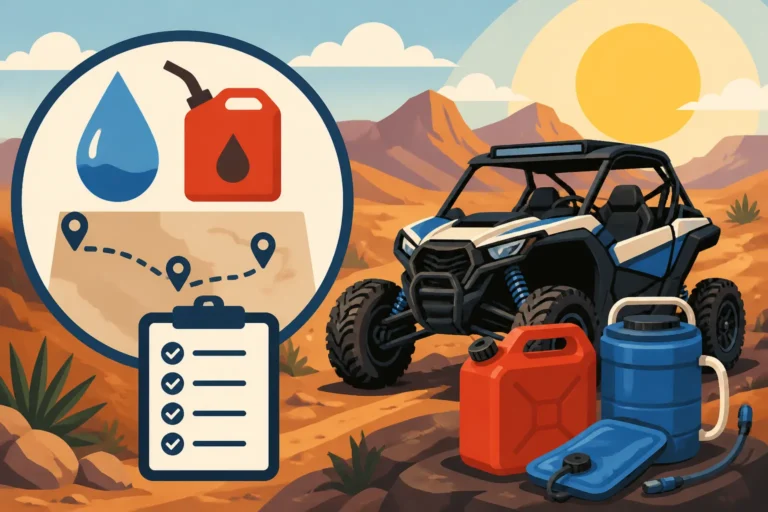
A quick pre-ride inspection can prevent a small mechanical issue from becoming a long recovery. Check tire condition and pressure according to the machine manufacturer’s guidance and your setup; do not copy another rider’s pressure without understanding the effect on your own tires and wheels. Inspect the throttle, brakes, steering, fluids, battery connections, and visible belts or chains as applicable. Make sure your machine is not carrying loose items that could shift on uneven terrain.
Bring tools and basic supplies that match your vehicle and your ability to use them. A tire repair kit, tow strap, compact air source, and spare belt where appropriate can be useful, but they do not replace knowing how to use them. Keep recovery gear secured so it cannot become a loose projectile. For a group ride, check that everyone knows who has recovery equipment and how to contact one another if machines are separated.
| Before leaving | What to check | Why it matters |
|---|---|---|
| Weather | Temperature, wind, and visibility | Wind and blowing sand can make riding uncomfortable or unsafe |
| Access | Road conditions, signs, closures, and parking | Access can change, and an app route may not show current restrictions |
| Machine | Tires, controls, fluids, and recovery gear | A basic inspection can catch issues before you reach the sand |
| People | Water, layers, eye protection, and riding ability | Comfort and fatigue affect judgment and control |
| Paperwork | Registration or decal requirements and proof of ownership | Requirements can depend on where the machine is registered and how it is used |
If you ride with a phone-based map, download the information you may need while you still have a dependable connection. onX Offroad can help with orientation, but do not use a map screen while moving. Stop somewhere safe before checking directions, and keep your attention on the terrain and other riders.
Riding responsibly and staying safe on the dune
Open sand can give the impression that you can ride in any direction, but that does not mean every route is appropriate. Follow posted signs, stay within authorized riding areas, and avoid vegetation or sensitive ground. Do not widen a track just to get around a difficult patch. If you are uncertain whether a route is open, stop and verify rather than treating the absence of a barrier as permission.
Riding responsibly also means accounting for other people. Families, beginners, experienced riders, and people recovering a stuck machine may all be sharing the area. Keep enough distance to react, avoid cutting across another rider’s line, and slow down near parking and staging areas.
Keep a conservative plan for climbs, crossings, and recovery
Before attempting a climb, look at the entire route rather than only the first few feet. Consider the slope, the sand, the available runout, traffic, and what you will do if the machine loses momentum. Do not climb toward a crest when you cannot see what is on the other side. A vehicle, person, or drop-off may be hidden from view.
Avoid riding directly below another machine on a steep face. If the rider above loses control, there may be little time to move. When approaching a dune crossing, pause where you can see clearly, check both directions, and cross only when the route is open. If you are stuck, stay visible and ask your group for help. Do not stand in a blind spot or try to push a machine while another rider is approaching.
Set expectations within the group before the ride begins. Agree on a pace, a regrouping point, and what to do if someone needs to stop. If riders have different levels of experience, choose routes that work for the least experienced person rather than splitting up without a plan. A small group that stays together is easier to check on than a spread-out line of machines in blowing sand.
Keep children and newer riders within a level of supervision appropriate to their skills and the machine they are operating. A beginner may need a slower route and more frequent stops, even if the rest of the group is eager to cover ground. Make sure helmets and protective gear fit properly, and give riders clear instructions before entering a busy area.
Check permits, closures, and local rules before unloading
Nevada OHV registration and out-of-state recognition can depend on the machine’s registration status and the rider’s circumstances. Review [Nevada OHV Reciprocity With Other States](Nevada OHV Reciprocity With Other States) and [Nevada's 15-Day Window for Out-of-State Machines](Nevada's 15-Day Window for Out-of-State Machines) if you are bringing a machine registered elsewhere. Do not assume that a decal from another state automatically answers every Nevada requirement.
For an overview of how Nevada’s system works, see [Nevada's Registration Decal as Your Permit](Nevada's Registration Decal as Your Permit). Check the rules that apply to your particular machine before the trip, and carry required documents in a secure, dust-resistant place. If your paperwork is on your phone, save it for offline access and keep the device protected.
Before riding, look for current access notices and on-site postings. Conditions or restrictions may change, and a route that was open on a previous visit may not be open now. onX Offroad can help you understand your position relative to mapped routes, while official signs and land-manager information should guide decisions about closures and permitted travel. If you find conflicting information, pause and seek clarification before continuing.
A practical spring day plan for Amargosa Big Dune
A little structure makes the day easier, especially if you are towing, riding with children, or meeting friends at the site. The goal is not to schedule every minute. It is to avoid the common frustrations: arriving without enough water, discovering a closure after unloading, or attempting a difficult climb when the wind and traffic are building.
Use a simple timeline
- Before the drive: Check the weather, access information, vehicle condition, required paperwork, and the route from your starting point. Save maps for offline use and let someone know your plan.
- At the parking or staging area: Read posted notices, secure your trailer, check that everyone has water and protective gear, and agree on a meeting point.
- At the start of the ride: Take time to observe traffic and the terrain. Begin on easier ground, confirm that each rider is comfortable, and regroup before moving toward more challenging slopes.
- During the ride: Take breaks, watch wind and visibility, and avoid unfamiliar lines with poor sightlines. Stop in a safe place before consulting a map or adjusting equipment.
- Before leaving: Account for every rider, inspect the machines, pack out trash, and make sure you have not left tools or personal items behind.
A useful approach is to decide in advance what would make you shorten or cancel the ride. Examples include strong wind, poor visibility, a mechanical problem, a rider who is uncomfortable, or an access notice you cannot resolve. Having that conversation before the group is excited and suited up makes it easier to make a calm decision later.
Keep the day enjoyable, even if conditions change
A spring trip does not have to involve climbing the highest or steepest part of the dune to be worthwhile. You can spend time getting comfortable with the sand, exploring permitted terrain, and learning how your machine responds. If the wind rises or the area becomes crowded, a shorter ride may be the better choice. The important part is returning with everyone and every machine accounted for.
If you are visiting for the first time, keep your route conservative and use other riders’ experience as information, not as a dare. Avoid chasing dust clouds or following a machine over a crest you cannot see. Take photos and check maps only when stopped safely. onX Offroad may help with orientation, but good judgment, posted instructions, and attention to the people around you matter more than a digital track.
A final pre-ride checklist can be brief: confirm the route and access, check weather and wind, inspect the machine, carry water and protective gear, verify paperwork, and agree on a regrouping plan. Those steps cannot control every desert condition, but they do help prevent many of the avoidable problems that turn a promising spring ride into a stressful one.
Disclaimer
This article is for general informational purposes only and does not constitute professional advice. Laws, prices and regulations vary by location and change over time. Consult a qualified professional for guidance on your specific situation.