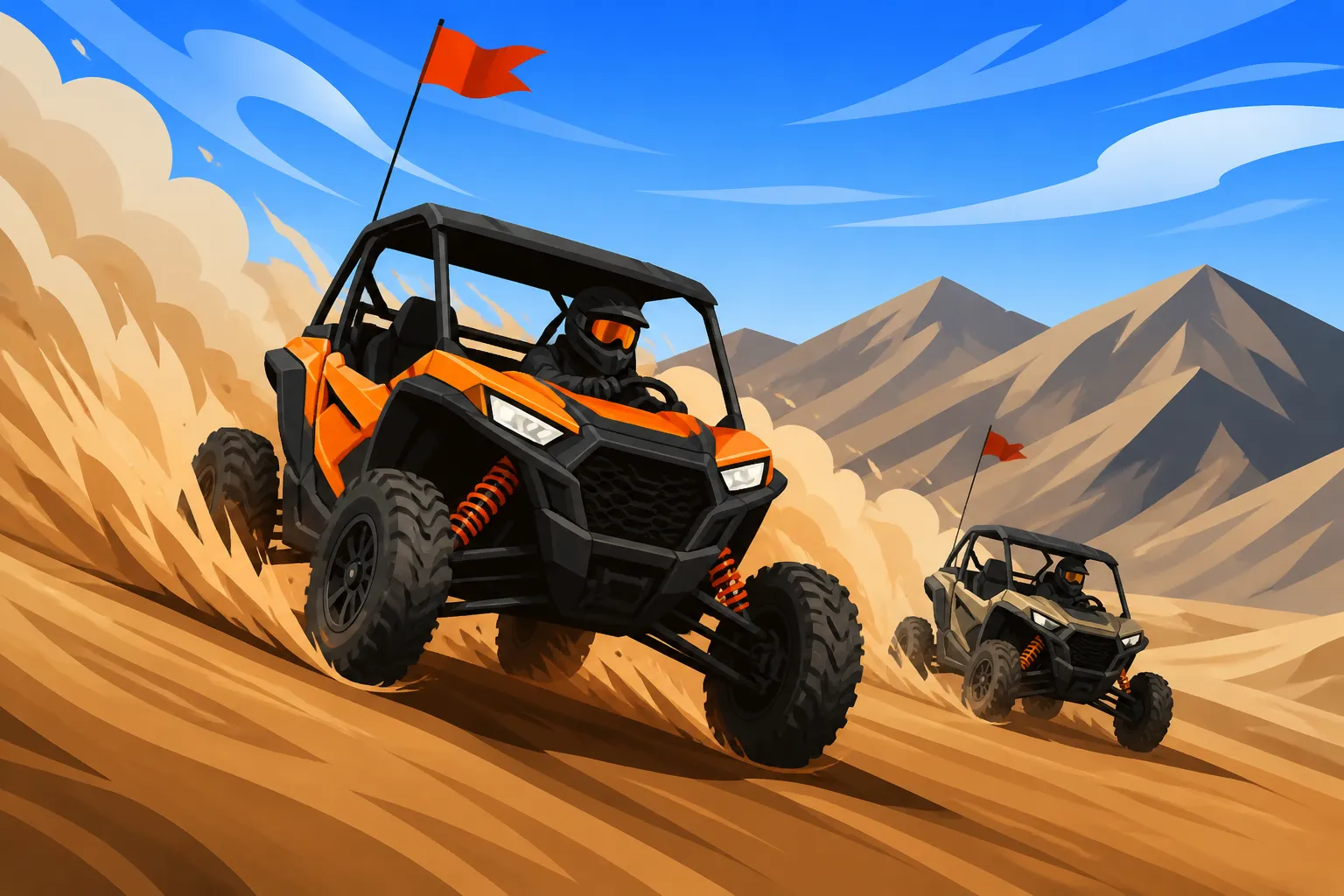
Sand Mountain When the Wind Picks Up
Wind can turn a fun Sand Mountain ride into a tiring, low-visibility slog faster than many first-time visitors expect. Blowing sand makes it harder to see terrain, follow your group, and judge dune edges, while gusts can leave you exposed far from the staging area. This guide explains how to assess conditions, adjust your ride, and know when it is safer to call it a day.
Why wind changes a Sand Mountain ride
Blowing sand affects visibility and judgment
At Sand Mountain, wind is more than an annoyance. Fine sand can sting exposed skin, get into eyes and equipment, and make it difficult to distinguish a dune’s shape from a cloud of airborne grit. You might still see the rider directly in front of you but lose sight of someone farther ahead, especially when the group spreads out across open terrain.
That loss of perspective matters on dunes. A slope that looks manageable from a distance may conceal a sharp drop, a changing surface, or another rider climbing on the far side. When airborne sand makes it difficult to read the terrain, slow down and give yourself more room to stop. If you cannot reliably see the route ahead, do not keep moving simply because the group is moving.
Wind can also make familiar terrain feel unfamiliar. Dune faces shift, tracks fill in, and landmarks become harder to recognize. Riders who have visited before may be tempted to navigate by memory, but memory is not a substitute for a clear view of the ground. Conditions can change during a ride, and a route that felt straightforward earlier may become confusing on the return.
Gusts can make riding and regrouping harder
A gust can push at a rider or vehicle, disturb balance, and make it harder to hold a steady line. The effect may be most noticeable when climbing, traversing a slope, or riding near an exposed crest. A UTV’s weight does not eliminate the problem: wind can still affect control, visibility, and the comfort of passengers.
Wind also complicates group riding. If riders become separated by blowing sand, they may not hear one another or see familiar hand signals. A rider who stops to adjust goggles can disappear from view while the rest of the group continues. Agree on a simple regrouping plan before leaving the staging area, and do not treat silence or a missing rider as a reason to press farther into the dunes.
For an overview of the riding terrain and marked routes, see [Sand Mountain's 23 Miles of Marked Trail]. Even with a route plan, use judgment on the day. A marked trail does not guarantee that visibility will be good or that every stretch will feel comfortable in gusty conditions.
How to decide whether to ride, change plans, or stop
Check conditions before unloading
Look at the wind forecast for the area before you leave, then check it again when you arrive. A forecast is a planning aid, not a promise: local conditions can differ from a nearby town or weather station, and the wind can rise or ease during the day. Look for gusts as well as the general wind outlook, because short bursts can be more disruptive than a steady breeze.
At the staging area, observe what is happening around you. Are people struggling to keep doors open, secure loose gear, or see across the parking area? Is sand visibly blowing across the ground? Can you comfortably communicate with your passengers and riding partners? These are practical clues that matter more than hoping the conditions will improve once you are moving.
Use a map to understand the area and plan where you might turn back. onX Offroad can help you review routes and save map information for use when cell service is unreliable, but a map cannot tell you how much sand is in the air or whether a particular slope is safe right now. Check the route against what you can actually see, and leave enough time to return without rushing.
| Conditions you notice | A sensible adjustment |
|---|---|
| Light breeze and clear visibility | Ride normally but keep your group together and watch for changes |
| Sand blowing across open ground | Slow down, increase spacing, and avoid spreading out |
| Frequent gusts or sand in your eyes despite protection | Stay near familiar routes and reassess before continuing |
| You cannot clearly see the next section or other riders | Stop in a safe place and regroup |
| Visibility stays poor or control feels uncertain | Return to the staging area or end the ride |
These are judgment cues, not official wind limits. The right decision depends on the rider, machine, visibility, terrain, and group. A cautious choice is especially reasonable if children, new riders, or passengers are with you.
Set a turnaround point before you start
It is easier to turn back when you decide in advance what would make you do so. For example, your group might agree to return if visibility drops enough that riders cannot keep the person ahead in sight, if gusts make it uncomfortable to control the machine, or if anyone feels anxious or unwell. A shared rule helps prevent one confident rider from setting the pace for everyone else.
Choose a destination that leaves a comfortable margin for getting back. Do not push deeper into the riding area in the hope that wind will settle later. If the conditions are already deteriorating, the ride back may take longer than expected because you will need to go more slowly and regroup more often.
Route planning tools can be useful for identifying your general position and possible return paths. With onX Offroad, download or save the map information you need before leaving service, then use it as a reference rather than as a reason to continue. Keep the group’s agreed meeting point and return plan clear, particularly if some riders are less familiar with the area.
Prepare yourself and your machine for blowing sand
Protect eyes, skin, and breathing
Well-fitting goggles are essential when sand is moving through the air. A loose fit can let grit in around the edges, and scratched or dusty lenses can make already poor visibility worse. Carry a clean cloth and a way to store goggles when they are not being worn. A spare pair can be useful if the first set becomes uncomfortable or too dirty to see through safely.
Cover exposed skin with suitable riding clothing, gloves, and a neck covering that does not interfere with safe movement or breathing. Dust and sand can be unpleasant to inhale, particularly during a long ride or while following another vehicle. If you or a passenger starts coughing, develops irritated eyes, or feels overwhelmed by the conditions, stop somewhere safe and reassess instead of trying to tough it out.
For a broader first-visit checklist, [Sand Mountain for a First Dune Trip] can help you think through the basics before heading out. Wind adds a few extra considerations: secure loose clothing, close storage compartments, and keep small items from becoming difficult-to-find grit-covered clutter.
Secure gear and keep the vehicle ready
Before riding, check that bags, tools, water, and other gear are fastened. Wind can catch loose items, while blowing sand can make it harder to retrieve something that falls out. Keep essentials in a closed, accessible container, and avoid leaving unsecured equipment in the staging area.
Pay attention to how sand is affecting your machine. Air intakes, filters, cooling, and visibility deserve extra attention in dusty conditions, particularly if you are riding behind a group. Follow the manufacturer’s maintenance guidance, and do not ignore warning signs such as an unusual temperature reading, reduced power, or a warning light. If your machine begins to behave differently, stop in a safe place and investigate rather than continuing into more exposed terrain.
Take enough water for the people in your group and plan your fuel so you are not relying on a last-minute stop or a nearly empty tank. Wind can make a ride feel physically demanding even when the temperature is comfortable, and returning slowly may use more time than expected. [Water and Fuel Planning in Nevada] offers broader preparation advice for Nevada rides.
Ride as a group and know when to leave
Use a conservative group plan
Agree on the leader, the order of riders, and what everyone should do if the group gets separated. Keep enough space to avoid following another machine too closely through a cloud of sand, but not so much that the next rider disappears. In poor visibility, a large gap can make it difficult to see turns, terrain changes, or a stop ahead.
Choose clear, easy-to-understand stopping points. If a rider needs to stop, the group should stop in a safe area rather than leaving that person to catch up alone. Avoid stopping on a steep face or in the path of other riders. When regrouping, account for everyone before moving on; do not assume a missing rider is just a few minutes behind.
A saved map can help with orientation, but do not rely on phones alone for group communication. Protect devices from sand, keep them accessible, and have a backup plan if batteries run down or service is unavailable. If you use onX Offroad, prepare your saved map before the ride and make sure the people who may need it know how to use it.
Choose an early return over a difficult one
There is no obligation to complete a planned route. If the wind picks up, visibility worsens, or riders are becoming fatigued, head back while the group can still travel together. The return trip is not automatically easier than the outbound ride; changing visibility and wind direction can make it feel quite different.
Be especially cautious near dune crests and on slopes where you cannot see the other side. Do not ride over a blind crest simply because tracks lead that way. If the terrain ahead is hidden by blowing sand, stop at a safe distance, communicate with your group, and choose a route you can see and assess.
Before you go, check for relevant local information and restrictions. [Nevada Trail Closures to Check Before You Go] is useful when planning around closures, while [Sand Mountain Day Use Hours] can help with timing your visit. If your trip falls on a busy date, [Sand Mountain on a Holiday Weekend] may also help you plan for heavier activity around the area.
When conditions become uncomfortable, getting back safely is a successful ride. If the wind makes it difficult to see, steer, communicate, or keep the group together, pack up and wait for a better day. The dunes will still be there when the weather is more cooperative.
Disclaimer
This article is for general informational purposes only and does not constitute professional advice. Laws, prices and regulations vary by location and change over time. Consult a qualified professional for guidance on your specific situation.