Nevada Trails for a Stock Side-by-Side
A stock side-by-side can handle plenty of Nevada riding, but “stock” does not mean every trail is a good fit. Soft sand, rocky climbs, narrow turns, heat, and long distances can turn an easy-looking route into a stressful day. This guide helps you choose sensible areas, assess your machine honestly, and plan a ride that does not depend on aftermarket upgrades.
What stock side-by-side means on a Nevada trail
Start with your machine’s real limits
A stock side-by-side is generally one that still has its original or near-original suspension, tires, wheels, clearance, and protective equipment. But factory condition alone does not tell you what it can safely do. A two-seat recreational UTV, a four-seat family model, and a utility side-by-side may all be stock while handling very differently.
Before choosing a route, check your owner’s manual for ground clearance, tire pressure guidance, payload, passenger capacity, and any warnings about steep grades or water crossings. Pay attention to the vehicle’s width and turning radius, too. A wide four-seat machine may fit comfortably on an open desert road but feel awkward on a tight, rocky track. Added passengers, coolers, tools, and camping gear also affect handling and available clearance.
It helps to separate “can drive there” from “will enjoy driving there.” A capable driver might coax a stock machine through an obstacle that leaves a newer rider anxious, but that does not make the route a sensible choice for a relaxed family outing. If the trip depends on scraping over rocks, charging through deep sand, or relying on a winch you do not have, choose an easier route.
Match the route to the tires, clearance, and driver
Tires are one of the first constraints to consider. The factory tires may be well suited to mixed riding, but they are not automatically ideal for deep, loose sand or sharp, rocky terrain. Keep an eye out for cuts, worn tread, low pressure, and damage from previous trips. A slow leak can be especially frustrating when the nearest paved road or service stop is far away.
Ground clearance matters when a route has ledges, exposed rocks, deep ruts, or uneven wash crossings. Do not judge an obstacle only by what you see from the driver’s seat: a rock that looks manageable ahead of the front tires may catch the center of the machine. If you are unsure, stop somewhere safe, inspect the line, and ask a passenger to help spot. Avoid standing where the vehicle could roll or slide into you.
Driver experience is part of the match as well. A beginner may prefer broad, open roads with clear sightlines, while an experienced driver may be comfortable with a rougher two-track. If a group includes mixed experience levels, choose a route that the least experienced driver can complete without pressure. A useful starting point is [Nevada Trail Difficulty for Beginners], then compare the route notes with your vehicle’s actual equipment.
Nevada riding areas to consider with a stock UTV
Logandale Trails for varied desert riding
Logandale Trails, near Overton and the Valley of Fire area, is a popular option for riders looking for desert scenery and a network of routes. Its variety makes planning important: “Logandale” does not describe one uniform trail. Some routes may feel open and approachable, while others can include rougher terrain, tighter sections, or obstacles that deserve a careful look before you commit.
For a stock side-by-side, build the day around conservative route choices rather than trying to cover as much ground as possible. A shorter loop gives you room to turn back if the track gets rougher than expected or the group’s pace slows. Study the route ahead of time, note where you can safely regroup, and avoid assuming that a route suitable for one UTV will be equally comfortable for a wider or longer machine. [Logandale Trails Difficulty Ratings] can help you think through route choice, while [Logandale Trails for a Day Trip] is useful when you are trying to keep the outing manageable.
Desert conditions can change the feel of a route. Rain may leave ruts, soft patches, or slippery surfaces, and wind can make visibility unpleasant when several machines are traveling together. Keep distance between vehicles, slow down when dust reduces visibility, and do not follow another driver blindly through an obstacle. Check for closures and local access rules before you leave; land status and open routes matter as much as vehicle capability.
Sand Mountain and Nellis Dunes require different planning
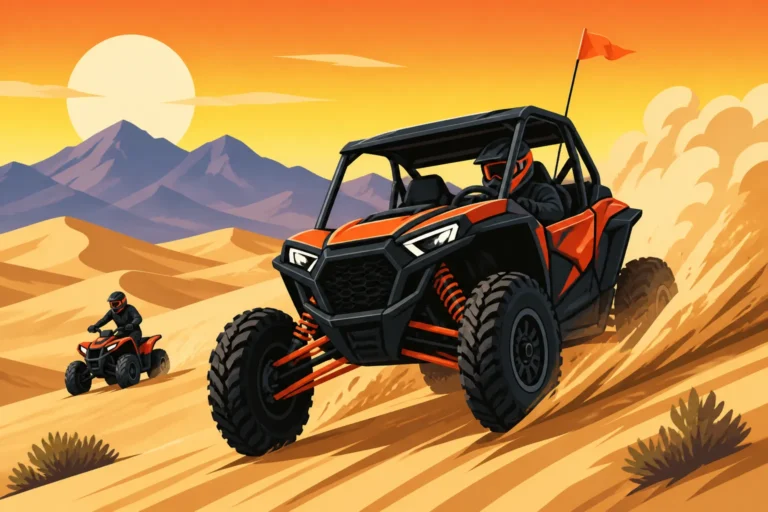
Sand Mountain near Fallon offers a very different experience from a rocky desert track. Sand can be demanding even when a machine has plenty of power: the surface shifts, momentum matters, and a vehicle can become stuck when a driver stops in a soft area or chooses a difficult line. Stock side-by-sides may be able to ride in suitable areas, but the driver should be conservative, avoid steep climbs beyond their comfort level, and understand how the machine behaves in sand before attempting more challenging terrain.
A dune ride calls for preparation beyond checking the map. Bring water, protect yourself from sun and blowing sand, and avoid riding alone in remote areas. Keep clear of other riders’ lines, especially near dune faces where visibility can be limited. If your UTV is heavily loaded or carrying several passengers, account for the extra weight and the way it affects momentum and recovery. For a first outing, [Sand Mountain for a First Dune Trip] offers a useful planning angle, and [Sand Mountain's 23 Miles of Marked Trail] can help frame the area as more than just open dune faces.
Nellis Dunes, near Las Vegas, can be convenient for a shorter outing, but convenience does not mean carefree riding. Expect dust, changing traffic, and other recreational users. Choose routes suited to your machine and ability, keep a safe following distance, and be especially cautious where sightlines are blocked by terrain. Read [Nellis Dunes for Beginners] before heading out if you are new to the area or to riding in a busy desert setting.
| Riding area | What to expect | Stock side-by-side planning |
|---|---|---|
| Logandale Trails | Varied desert routes and scenic terrain | Pick a conservative loop; check route access and conditions |
| Sand Mountain | Loose sand and dune riding | Start with manageable terrain, avoid risky climbs, and plan for recovery |
| Nellis Dunes | Desert riding near a major urban area | Expect dust and other riders; keep speeds and spacing sensible |
| Silver State Trail | A long route connecting communities and recreation areas | Plan fuel, water, overnight stops, and route segments carefully |
How to choose a trail your stock machine can handle
Check the route, not just the destination
A named riding area can contain several kinds of terrain. Before you go, check the specific route or segment you intend to ride, including its distance, surface, width, elevation changes, and any known obstacles. Look for official land-manager information and current closure notices. A social-media post or an old track file may not reflect today’s access conditions.
Mapping tools such as onX Offroad can help you review routes, identify nearby roads, and plan alternatives. Use a map as a planning aid rather than a guarantee that every line shown is open or suitable. Confirm access with the responsible land manager when details are unclear, and pay attention to posted signs once you arrive. The difference between a legal route and a visible tire track is important on public land. [Reading a BLM Travel Management Map] can help you understand why route status deserves a careful check.
For a first trip, make a simple plan with a clear turnaround point. If the surface becomes rougher than expected, the group is running behind, or the weather changes, turn back before the situation becomes a problem. Choosing a modest route is not a failure; it is often the reason everyone finishes the day with enough energy to enjoy the ride back to camp.
Prepare for heat, distance, and a stuck vehicle
Nevada riding can mean long stretches with limited shade, water, cell coverage, or services. Carry more drinking water than you expect to need, and make a fuel plan that includes the return journey and any detours. A small issue can become serious if the group is far from the trailhead during hot weather. Tell someone where you plan to ride and when you expect to return.
Bring basic items suited to the outing, such as a tire repair kit, tire gauge, first-aid supplies, tools for minor adjustments, and a way to communicate if phone service is unreliable. A tow strap or recovery equipment is only useful if you know how to use it safely and have suitable attachment points. Avoid improvising a recovery from a suspension component or another part not designed for towing. For remote rides, [Breaking Down Far From the Trailhead] and [Carrying Water for a Desert Ride] are worth reviewing before departure.
Heat affects both riders and machines. Take breaks, watch for signs of overheating, and stop if the vehicle shows warning lights or unusual behavior. Keep cooling-system openings clear of dust and debris when it is safe to inspect them. If a storm is nearby, a dry wash can become dangerous quickly; do not ride into a wash that could carry runoff. A flexible schedule gives you the option to wait, reroute, or end the ride early.
A practical checklist before you leave
Do a vehicle and paperwork check
The evening before a ride, look over the tires, lug nuts, brakes, steering, lights, belts, fluid levels, and visible suspension components. Check that the battery is secure and that the fuel level is sufficient for the plan. Make sure seat belts work, doors or nets close properly, and everyone knows how to use the safety equipment. A quick walk-around before loading can catch a loose strap or a damaged tire that might otherwise go unnoticed at the trailhead.
Carry the documents and registration information you are expected to have, and check the rules for the area you plan to ride. Nevada’s OHV registration requirements and visitor rules can depend on the machine and its circumstances, so do not assume that registration from another state automatically settles every question. Review [Nevada OHV Registration and Proof of Ownership] and [Riding Nevada With an Out-of-State Registration] if they apply to your situation.
Also check whether the ride is strictly off-highway or includes travel on a public road. Registration for off-highway use does not automatically make a machine legal for every road. Road use has separate rules and equipment requirements, and routes can pass close to highways without allowing you to ride along them. Confirm the route rather than treating a short road connection as an informal exception.
Keep the day comfortable for everyone
Pack for the riders, not just the machine. Dust goggles, gloves, sun protection, suitable clothing, snacks, and a change of layers can make a long day noticeably easier. Passengers should understand how to sit securely, keep arms and legs inside the vehicle, and follow the driver’s instructions. If children are riding along, choose an outing that allows frequent breaks and does not require them to tolerate long stretches of heat and dust.
Agree on simple group habits before starting: who leads, who follows, where you regroup, and what to do if someone has a problem. Keep a comfortable distance between machines, slow down near blind corners, and stop in places where other riders can see you. Avoid pressuring anyone to attempt an obstacle. If a route stops feeling right, the group can turn around together.
Good preparation is what makes a stock side-by-side feel capable. Choose a route that fits your machine and the least experienced person in your group, confirm access and conditions, and leave room in the plan for a slower pace. Nevada has options ranging from accessible desert routes to demanding dunes, so there is no need to force a stock UTV into terrain it was not set up for.
Disclaimer
This article is for general informational purposes only and does not constitute professional advice. Laws, prices and regulations vary by location and change over time. Consult a qualified professional for guidance on your specific situation.