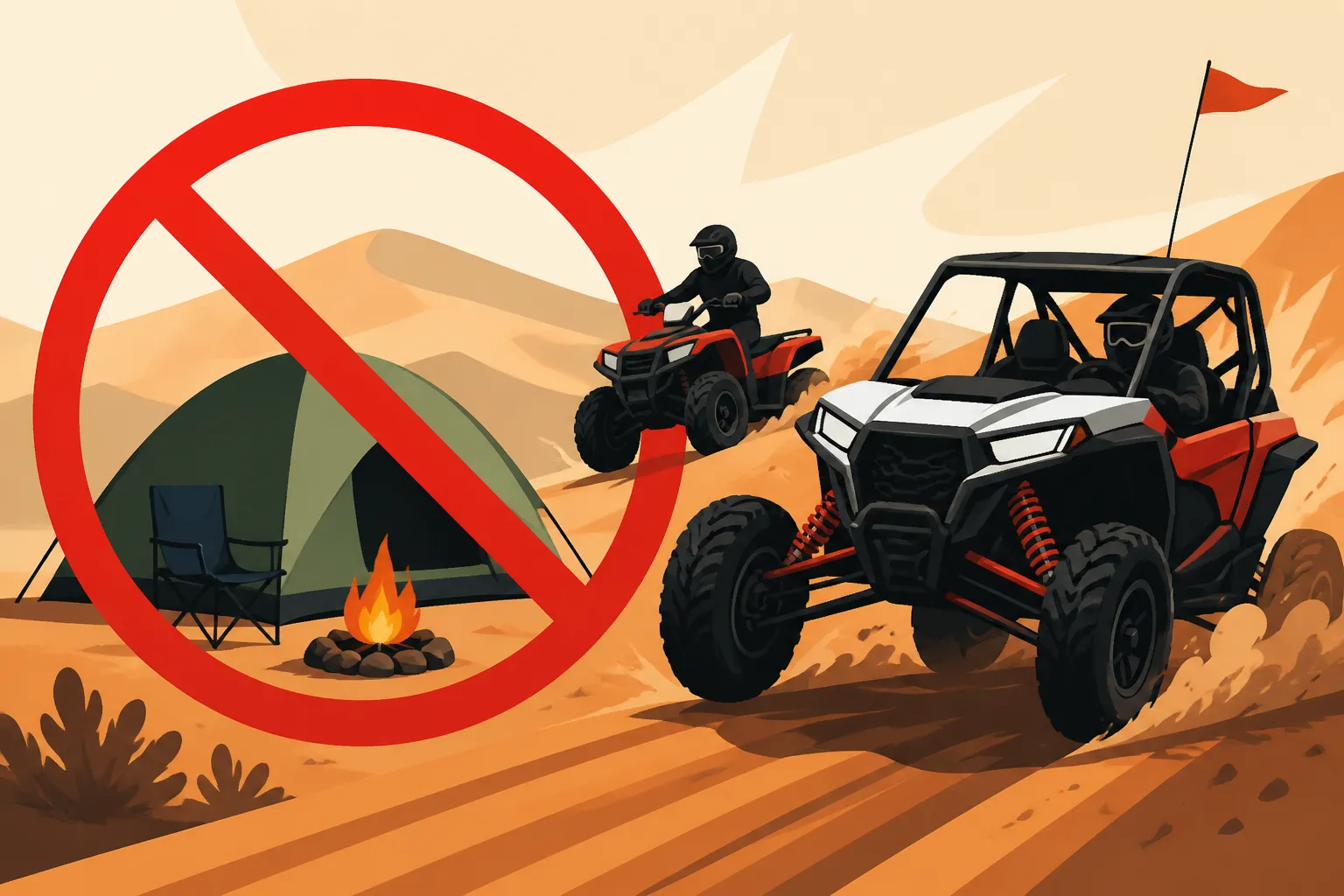
Why Nellis Dunes Bans Camping
Nellis Dunes is a popular place to ride near Las Vegas, but it is not a place to settle in for the night. That distinction can catch riders off guard, especially after a long drive with a trailer and camping gear. This guide explains what the no-camping rule means, why it matters, and how to plan an overnight stay without risking a frustrating end to your ride.
Nellis Dunes Is a Riding Area, Not a Campground
What the no-camping rule means for riders
At Nellis Dunes, plan to ride and then leave the area rather than pitch a tent, sleep in a vehicle, or use a trailer as an overnight base. Having an OHV registration decal, a permitted place to park, or a legal reason to ride does not automatically give you permission to camp. Riding access and overnight access are separate questions, and the rules for one do not answer the other.
That difference matters because camping does not always look like a tent and sleeping bag. A rider might arrive late, park beside a trailer, and assume that resting in the vehicle is fine because no tent is visible. Another might pull a travel trailer into a staging area and think that staying quietly overnight is different from setting up camp. If camping is prohibited, changing the style of accommodation does not necessarily make an overnight stay acceptable. Follow posted signs and any direction from the land manager.
For a day-trip overview, see Nellis Dunes, Nevada's Free Dune Ride and [Nellis Dunes for a Quick Evening Ride]. A short visit can work well when you treat the dunes as the riding destination, not as a place to sleep. If your schedule depends on arriving after dark or leaving the next morning, plan lodging or a lawful campsite separately before you head out.
Why a riding area is managed differently from a campground
An off-highway vehicle area and a campground serve different purposes. A riding area is organized around vehicle access, movement, and safe use of the terrain. A campground needs to accommodate overnight stays, including places to sleep, sanitation, waste handling, fire rules, and the movement of people who may be walking around after dark. A site can be suitable for riding without having the facilities or designation needed for camping.
This distinction also helps explain why a broad patch of public land is not automatically available for every kind of recreation. Land managers may allow certain activities in a defined area while restricting others. The fact that the surrounding landscape looks open does not mean every use is allowed everywhere. At Nellis Dunes, the practical approach is to respect the specific rules for the riding area rather than infer camping permission from the fact that the land is public or that other forms of recreation are taking place.
The rule is not a judgment about responsible campers. Even tidy visitors who pack out their rubbish and keep a low profile still need to camp only where it is allowed. A clear separation between riding and overnight stays helps reduce confusion at the site and makes it easier for riders to plan a trip that fits the area’s intended use.
Why Overnight Camping Can Create Problems at a Busy Riding Site
Moving vehicles and people after dark
A riding area can feel spacious during daylight, but the risks change when visibility drops. Vehicles may arrive or leave at different times, riders may be loading machines, and dust or uneven ground can make it harder to see people on foot. Someone stepping away from a vehicle to find a place to sleep is in a different situation from a rider seated in a machine with lights on. Darkness adds another layer of uncertainty to an area built around vehicle movement.
Camping can also keep people on-site during hours when other visitors are not expecting foot traffic. A person walking around a parked trailer, looking for equipment, or heading to a tent might be difficult to spot against the terrain. Even if everyone intends to be careful, shared spaces become more complicated when some visitors are riding and others are moving between sleeping areas and vehicles.
These are practical safety reasons that often inform restrictions at vehicle recreation areas; they should not be mistaken for a definitive statement of the specific reasoning behind every Nellis Dunes rule. For visitors, the key point is simpler: do not assume an overnight stay is safe or allowed because the area seems quiet at the moment. A daytime impression does not tell you how the site is managed after the riding activity winds down.
Sanitation, litter, and fire concerns
Overnight use brings different demands than a brief ride. More time on-site can mean more food packaging, wastewater, human waste, and other rubbish. Without campground services, those needs can be difficult to handle responsibly. Even a small amount of litter or waste can affect other visitors and create work for the people responsible for maintaining and managing public recreation land.
Fire is another concern in dry desert settings. A camp stove, cigarette, vehicle exhaust, or poorly managed flame can become a hazard, and restrictions may be designed to limit risks associated with overnight use. Rules about fires can vary by place and conditions, so never assume that a small fire or cooking setup is allowed simply because it seems controlled. Check the applicable land-management instructions and follow them closely.
Camping restrictions can also make expectations clearer. Visitors know they are coming to ride rather than establish a temporary camp, while people seeking an overnight stay can choose a site intended for that purpose. To understand how camping rules and riding access can differ across the state, read Camping at Nevada OHV Areas and [Nevada Dispersed Camping Rules for Riders]. Neither title should be read as permission to camp at Nellis Dunes; the rules for the specific location still control.
Plan Your Visit Without Counting on an Overnight Stay
Choose a separate place to sleep
The easiest way to avoid a late-night scramble is to decide where you will stay before you unload your ATV or UTV. Depending on your trip, that might be lodging in Las Vegas, a developed campground, or a dispersed camping location where overnight use is expressly allowed. These options are not interchangeable: each place has its own access rules, services, and limits.
If you are considering a campground or another public-land site, check whether it accepts the kind of vehicle and trailer you are bringing, whether overnight stays are permitted, and whether any fire, waste, or access restrictions apply. Do not assume that a nearby-looking area is part of Nellis Dunes or follows the same rules. Boundaries can be hard to recognize from a road or trail, and a place that appears close on a map may be managed separately.
Riders exploring options near the city can start with [Nevada OHV Areas Near Las Vegas], then verify the details for the specific site they choose. onX Offroad can help you review mapped routes and land boundaries while planning, but a map app is a planning aid, not permission to camp or ride. Confirm restrictions with the responsible land manager and heed signs on the ground.
Build the day around travel time and daylight
A common planning mistake is to underestimate how long a ride day takes. Loading machines, driving to the site, checking equipment, and riding can take longer than expected. If you also need to reach a hotel or campground afterward, leaving that decision until sunset can turn a fun day into a rushed search for somewhere to stay. Set a departure time that leaves a comfortable window to reach your overnight destination.
Think through the full route, not just the distance between your lodging and the riding area. A trailer, a large vehicle, or a group traveling in several cars can make even a short drive slower. You may also need time to refuel, secure machines, check tire straps, and account for dust or traffic. Having a clear end-of-day plan helps prevent the temptation to stay in a place where camping is not allowed.
Navigation tools can be useful when you are comparing access roads, staging areas, and nearby destinations. onX Offroad may help you orient yourself, but do not rely on a screen alone to decide where one management area ends and another begins. Download useful map information before leaving dependable service, carry a backup plan, and treat posted signs and official directions as the deciding information.
| Trip plan | What to arrange before leaving | Common assumption to avoid |
|---|---|---|
| Day ride from Las Vegas | Confirm the riding-area access and set a return time | Assuming a late departure means you can sleep at the riding site |
| Overnight trip with a trailer | Reserve or identify a lawful place for both the trailer and people | Assuming trailer parking permission includes overnight camping |
| Dispersed camping trip | Confirm that camping is allowed at the specific location and review restrictions | Assuming all public land permits dispersed camping |
| Evening ride | Check the route, daylight, and how you will leave the area | Treating a quiet staging area as an overnight spot |
| Group outing | Agree on a meeting point, departure time, and separate lodging plan | Assuming everyone can make a last-minute camping option work |
Keep Riding Access and Camping Rules Separate
Check the rules for the exact place you are using
Public-land boundaries and recreation-area rules can be confusing, especially around a growing city where roads, developed sites, and open desert sit close together. A parking area may be intended for day use; a road may pass near a different management unit; and a nearby piece of land may have its own restrictions. Do not use distance on a map as proof that a location shares Nellis Dunes’ access rules—or that it allows camping.
Before your trip, identify the riding area and the overnight location as separate destinations. Check who manages each place, what activities are allowed, and whether any temporary closures or restrictions apply. If the information is unclear, contact the responsible office before setting out. A quick confirmation is much easier than moving a trailer late at night after discovering that the site you chose is not suitable.
For general route planning, [Nevada Trail Closures to Check Before You Go] is a useful companion topic. onX Offroad can add context when reviewing mapped trails and land ownership, but maps cannot guarantee that every road is open or that every activity is permitted. Combine mapping with current official guidance and the signs you encounter in the field.
Treat signs and staff instructions as part of the plan
Signs at an entrance or staging area are not decorative details. They can identify boundaries, permitted activities, closures, and other site-specific rules. Read them when you arrive, even if you have visited before. A regular rider may know the general layout but still miss a changed instruction or a restriction posted in a different place.
If an employee, ranger, or other authorized representative gives you directions, do not argue based on what a map app appears to show. Ask a polite clarifying question if you need to understand where you can park, unload, or exit. Then follow the instruction. Staying calm and cooperative is especially important when several people in your group are tired, dusty, or frustrated by a plan that needs to change.
Prepare for weak or unreliable cell service by saving the information you need before you leave town. A downloaded map can help with orientation, but it cannot replace posted rules. Keep key contact details and your alternate overnight plan available offline so that a dead phone battery or lost signal does not leave your group without a next step.
Prepare for a More Comfortable Day Ride
Pack for desert conditions, not an overnight camp
Even if you are not camping at the dunes, you still need to prepare for a full day outdoors. Bring drinking water, sun protection, suitable clothing, and basic supplies for your machine and group. Desert conditions can feel deceptively manageable at the start of the day, especially when you are focused on unloading and getting on the trail. Plan for the heat, exertion, and exposure you may encounter rather than relying on a quick trip back to the vehicle.
Think about what happens if someone gets separated, a machine needs attention, or the group takes longer than expected to return. Carry what you need to stay comfortable while you sort out a delay, and tell someone where you are going and when you expect to be back. For more preparation ideas, see [Carrying Water for a Desert Ride]. The point is not to pack as if you are camping at Nellis Dunes; it is to make a day ride safer and less stressful.
A simple checklist can prevent common oversights. Make sure the group has enough water, a charged phone or other communication option, and any machine-specific tools or supplies you normally carry. Secure loose items before riding, and keep essentials easy to reach when you return to the staging area. The less time you spend searching through a dusty trailer, the easier it is to wrap up and leave on schedule.
Make the staging area part of your end-of-day routine
A calm exit starts before the last ride. Agree on a time to stop, regroup, and return to the staging area while there is still enough light to load safely. Riders who wait until everyone is tired and the sky is dark may rush tie-downs, overlook equipment, or leave rubbish behind. A planned finish makes it easier to respect the site and keep the drive to your overnight destination manageable.
Before leaving, check that every person is accounted for, machines are secured, and the area around your vehicles is clean. Pack out your rubbish and any items you brought in. Avoid blocking access or taking up space in a way that conflicts with posted directions. A tidy departure is considerate to the next group and helps maintain a clear distinction between temporary day use and an overnight camp.
If you are deciding whether to make Nellis Dunes part of a larger weekend, browse [Nellis Dunes on a Saturday] and [Nellis Dunes for Beginners] for related planning considerations. You can also use [Where to Park a Trailer at Nellis Dunes] to think through arrival logistics. Parking and unloading questions are worth sorting out, but they do not change the no-camping rule: arrange a separate, authorized place to spend the night.
Disclaimer
This article is for general informational purposes only and does not constitute professional advice. Laws, prices and regulations vary by location and change over time. Consult a qualified professional for guidance on your specific situation.