Can You Ride a Quad on a Nevada Sidewalk?
It's a common scenario for many of us who love the Nevada desert: you've just unloaded your quad or side-by-side, eager to hit the trails, but the staging area is a short distance down a paved road or across a small residential area. The thought probably crosses your mind: "Can I just hop on the sidewalk for a quick minute to get where I need to go?" It feels like a convenient shortcut, but the reality is, mixing off-highway vehicles (OHVs) with pedestrian paths is a recipe for trouble, and it's something Nevada law takes seriously. This guide will walk you through exactly why sidewalks are off-limits for your ATV or UTV in Nevada and where you can legally and safely enjoy your machine.
The Straight Answer: Sidewalks and Off-Highway Vehicles in Nevada
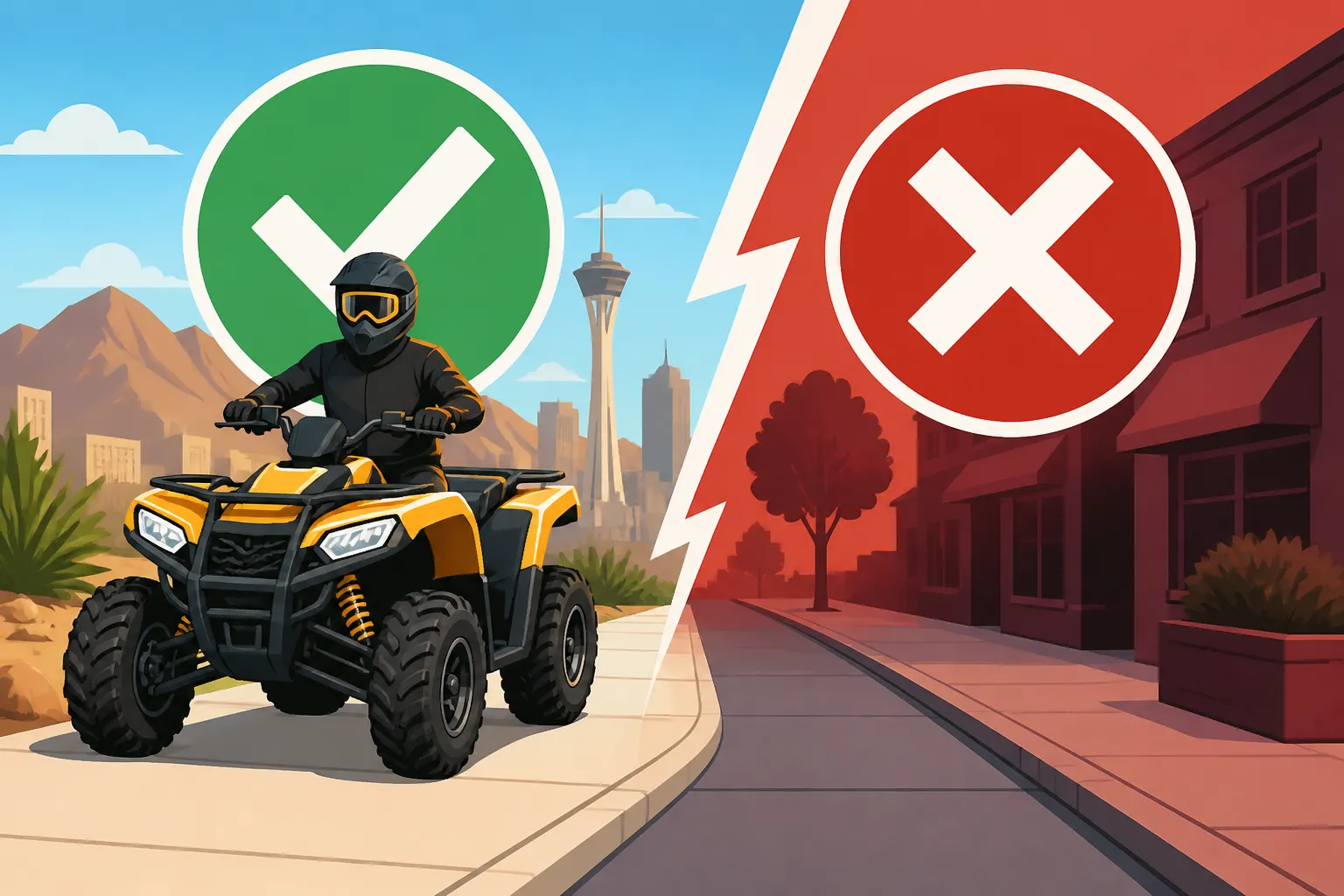
Let's cut right to the chase: no, you absolutely cannot ride a quad or any other off-highway vehicle on a sidewalk in Nevada. It's a clear violation of state law, and for very good reasons. While the convenience might be tempting, the legal and safety ramifications are significant. Nevada's laws are designed to keep both riders and pedestrians safe, and sidewalks are explicitly reserved for foot traffic.
Why Sidewalks Are Off-Limits (and the Law Behind It)
Imagine a busy Saturday morning: people are out walking their dogs, kids are riding bikes, and someone's enjoying a leisurely stroll. Now picture an ATV, which can weigh hundreds of pounds and travel at high speeds, suddenly roaring down that same path. It's a jarring and dangerous thought, isn't it? That's precisely why sidewalks are designated solely for pedestrians. Nevada Revised Statutes (NRS) clearly differentiate between off-highway vehicles and vehicles that are allowed on public roadways. An ATV or UTV, by its very definition as an OHV, is built for unpaved terrain and simply doesn't belong where people are walking.
The legal framework is pretty straightforward on this point. Sidewalks are considered part of the "pedestrian way," and OHVs are not permitted to operate there. This isn't just about traffic flow; it's fundamentally about safety. An OHV might be fun and exhilarating on the open trail, but its weight, speed, and lack of certain safety features (like turn signals or road-legal tires on many models) make it completely unsuitable for shared pedestrian spaces. Even if you're just trying to get from your driveway to the dirt access road, a sidewalk is not a permissible route. Law enforcement officers, whether it's a local police deputy or a state park ranger, are well aware of these distinctions and will not hesitate to enforce them.
The Core Distinction: Public Roads vs. Sidewalks
It's crucial to understand that even when an OHV is granted limited access to certain public roads in Nevada—under very specific circumstances, which we'll discuss next—this allowance never extends to sidewalks. Think of it this way: a road is designed for wheeled vehicles, and even then, OHVs have stringent rules about where and how they can operate on pavement. A sidewalk, however, is a completely different classification. It's an extension of the pedestrian experience, meant to provide a safe, separated pathway for people walking, jogging, or using wheelchairs.
The state defines "highway" or "roadway" for vehicle traffic, and "sidewalk" for pedestrian traffic. An ATV or UTV is designed to be off-highway. Even if you modify your machine with aftermarket parts from companies like SuperATV to enhance its trail performance, those modifications don't magically grant you the right to ride on a sidewalk. The rules are absolute: sidewalks are not for OHVs, period. Trying to blur that line creates unnecessary risk and invites legal trouble. It's about respecting the purpose of these different zones and ensuring everyone's safety.
Where You Can Ride Your ATV or UTV in Nevada (Legally!)
While sidewalks are a no-go, Nevada offers an incredible array of legal and thrilling places to ride your ATV or UTV. The key is knowing where those places are and understanding the rules that govern them. This state is a paradise for off-road enthusiasts, but responsible riding is paramount to keeping these areas open and enjoyable for everyone.
Designated Trails and BLM Land
Nevada is blessed with vast expanses of public land, much of which is managed by the Bureau of Land Management (BLM). These lands provide thousands of miles of trails, open areas, and stunning scenery perfect for OHV exploration. From the iconic dunes of Sand Mountain to the rugged beauty of [Logandale Trails Outside Las Vegas], and the expansive [Silver State Trail and Four Nevada State Parks], there are endless opportunities to experience the thrill of off-roading. These are the places your machine was built for!
When you're out on BLM land or designated trail systems, it's vital to stay on marked routes. This protects sensitive habitats, prevents erosion, and ensures you're not trespassing or inadvertently entering a closed area. Many of these areas have specific rules about camping, fire restrictions, and even protecting endangered species like the [How the Sand Mountain Blue Butterfly Closes Dune Areas]. Always check local regulations before you head out. Your Nevada OHV decal isn't just a registration; it's also your permit to ride these incredible public lands, with the funds often going back into trail maintenance and development. When you purchase a [Nevada's $20 OHV Decal and What It Covers], you're directly contributing to the preservation and expansion of these riding areas. Respecting the rules on these trails ensures that we all get to continue enjoying them for years to come.
Limited Road Use and the "Large ATV" Decal
Now, this is where it gets a little nuanced. While you can't ride on sidewalks, Nevada does have specific provisions for certain OHVs to operate on limited public roads. This is primarily for "Large ATVs" or what are often side-by-sides or UTVs that meet certain criteria, not typically traditional sport quads. If your UTV meets the state's definition of a "large all-terrain vehicle" as outlined in [What Nevada's NRS 490.043 Counts as a Large ATV], you might be able to apply for a special "Large ATV" decal. This decal, distinct from your regular OHV registration, allows you to operate on unpaved county roads and cross paved highways under strict conditions.
To qualify, these machines usually need specific equipment such as headlights, taillights, a stop lamp, mirrors, and a horn. You can find many of these road-legal accessories from aftermarket providers like SuperATV, which specializes in UTV upgrades. Even with the "Large ATV" decal, there are strict limitations:
- Paved Roads: You can generally only cross paved roads, not travel along them for extended distances, though some specific minor county roads might be exceptions. The [Nevada's 2-Mile Limit on Paved Highway] rule is crucial to understand here.
- Designated Routes: In some cities or counties, OHV use on public roads is permitted only on designated routes. Always check local ordinances, as some [Nevada Counties That Ban OHVs on County Roads] or [Nevada Cities That Require Designated OHV Routes].
- Driver's License & Insurance: If you're operating on public roads, you absolutely need a valid driver's license and proof of liability insurance, just like a regular car. This isn't optional. You can review the specifics on [Nevada Driver's License Rules for UTV Road Use] and [Insurance and Nevada OHV Registration].
- Helmet Rules: [Nevada Helmet Law for Road Riding] also comes into play when you're on public roads.
It's a completely different set of rules than what applies to a sidewalk, which remains unequivocally off-limits regardless of your machine's classification or decals. The purpose of the "Large ATV" decal is to facilitate access to trails, not to enable general street cruising or urban shortcuts.
Consequences of Illegal Sidewalk Riding in Nevada
Ignoring the rules about riding on sidewalks might seem like a small shortcut in the moment, but the potential repercussions are anything but minor. Nevada law enforcement doesn't take these violations lightly, and for good reason—public safety is at stake.
Fines, Penalties, and Machine Impoundment
If you're caught riding your ATV or UTV on a sidewalk in Nevada, you're looking at a range of serious consequences. First and foremost, you'll likely face a hefty citation, which can include significant fines. These aren't just minor parking tickets; they can put a real dent in your wallet. Beyond the financial hit, law enforcement has the authority to impound your machine. Imagine the headache: your day of riding is over, you're left stranded, and then you have to deal with impound fees, storage costs, and the hassle of retrieving your vehicle. This can quickly add up to hundreds, if not thousands, of dollars.
Furthermore, depending on the circumstances, such as reckless driving or causing property damage, you could face even more severe charges. This isn't just about a "slap on the wrist." Riding an OHV on a sidewalk is considered highly dangerous behavior due to the speed and mass of the vehicle interacting with unsuspecting pedestrians. It's a risk not just to yourself, but to children, pets, and anyone else who might be using the sidewalk responsibly. It's always a good idea to ensure all your paperwork is in order before you even start your engine. You don't want to compound the problem by riding an unregistered machine or having an expired decal. Always double-check [What a Nevada OHV Decal Actually Proves] and ensure your [Nevada OHV Registration Paperwork Checklist] is complete.
Impact on Public Perception and Access
Beyond the immediate legal and financial pain, illegal riding on sidewalks—or any other inappropriate area—has a much broader, negative impact on the entire off-road community. When people see ATVs or UTVs where they shouldn't be, especially in residential areas or on pedestrian paths, it fosters a negative perception of all OHV riders. This negative perception often leads to calls for stricter regulations, trail closures, and even outright bans in certain areas.
It's a frustrating reality: the irresponsible actions of a few can impact the access and enjoyment of many. Every time someone rides illegally, it provides ammunition for those who want to see less access to public lands for OHVs. We all have a responsibility to be good stewards of the land and respectful members of the community. By adhering to the rules, riding only in designated areas, and showing courtesy to others, we help ensure that Nevada's fantastic riding opportunities remain open for everyone. Protecting our access means riding smart and respecting the rules of the road—and the sidewalk.
Here's a quick overview of where your OHV belongs (and where it doesn't) in Nevada:
| Location Type | Permitted for OHVs? | Key Considerations |
|---|---|---|
| Sidewalks | No | Exclusively for pedestrian traffic. Riding here is illegal, dangerous, and can result in significant fines and impoundment. |
| Designated OHV Trails | Yes | Ideal and encouraged! Vast networks on BLM land and other public areas. Always stay on marked trails, respect closures, and follow posted rules. Your Nevada OHV decal is required. |
| BLM Land (Open Areas) | Yes | Many open areas are permissible for cross-country travel, but always verify local BLM travel management maps. Wilderness areas are strictly off-limits. Respect wildlife and pack out what you pack in. |
| Paved County Roads | Limited | Only for "Large ATVs" (UTVs) with a special [Applying for a Nevada Large ATV Decal]. Strict equipment, driver's license, and insurance requirements apply. Usually for access to trails or crossing, not extended travel. [Which Nevada County Roads Qualify for ORVs] is a good resource. |
| Paved State/US Highways | Very Limited | Generally for crossing only, with a "Large ATV" decal and proper road-legal equipment. Never for travel along the highway. Adhere strictly to the [Nevada's 2-Mile Limit on Paved Highway] for crossing. |
| Private Land | Yes (with consent) | Permitted if you own the land or have explicit permission from the landowner. Trespassing is illegal. Always confirm boundaries and obtain written consent if possible. |
| City Streets (Non-Des.) | No | Unless specifically designated by local ordinance for OHV use (rare), city streets are generally off-limits. Most [Nevada Cities That Keep OHVs Off the Street] unless very specific conditions are met, which almost never applies to quads. |
Ultimately, the rule is simple and clear: sidewalks are for pedestrians. While it might be tempting to use them for a short hop, the risks to safety and the legal consequences just aren't worth it. Nevada offers an incredible playground for OHV enthusiasts, from the towering dunes to endless miles of scenic desert trails. Focus your adventures where they belong—on the dirt—and help us all keep access to these amazing areas open for generations to come.
Disclaimer
This article is for general informational purposes only and does not constitute professional advice. Laws, prices and regulations vary by location and change over time. Consult a qualified professional for guidance on your specific situation.