Nevada Minimum Age to Ride on a County Road
Riding your ATV or UTV on Nevada's vast network of county roads can seem like a fantastic way to extend your adventures, especially when you're thinking about those short hops between trails or heading into town for a quick bite. However, the rules for off-highway vehicles (OHVs) on paved or graded county roads are much stricter than those for dirt trails, particularly when it comes to who can be behind the wheel. Many riders get frustrated, expecting the same flexibility they find off-road, only to discover a tangled web of regulations, especially regarding minimum age requirements. This guide is here to untangle that, laying out exactly what Nevada law says about how old you need to be to legally operate an OHV on a county road.
Understanding Nevada's "Large ATV" Classification for Road Use
Before we even dive into age, it's crucial to understand a fundamental distinction in Nevada law: not all off-highway vehicles are treated equally when it comes to riding on county roads. The state has a special classification known as a "Large All-Terrain Vehicle," defined under [What Nevada's NRS 490.043 Counts as a Large ATV]. This isn't just a casual term; it's a legal definition that determines whether your machine has any business on a county road at all. Essentially, for an OHV to be considered a Large ATV and thus eligible for limited county road use, it must meet specific criteria related to its size and seating capacity, typically having four or more wheels, a non-straddle seat, and certain dimensions or features like a truck bed.
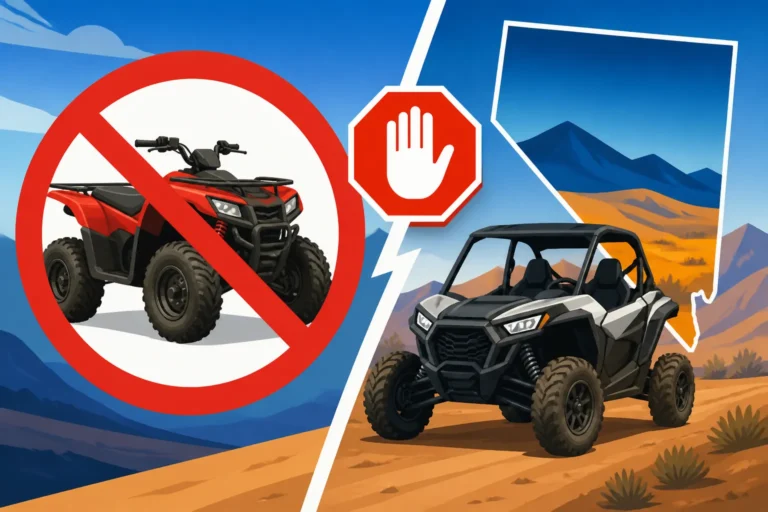
This distinction immediately rules out many popular machines that are perfectly fine for off-road fun. For instance, a classic two-seat sport quad, while an absolute blast on the dunes or trails, fundamentally fails Nevada's test for a Large ATV. Its straddle seat and often narrower stance mean it cannot legally be registered for county road use, even if the rider is fully licensed and the machine is equipped with all the necessary safety gear. This often surprises riders who've invested in upgrading their sport quads, only to find they're still restricted from pavement. The law is quite clear on this point, making it essential to know your machine's classification before planning any road excursions. For more on this, you can look into [Why a Two-Seat Sport Quad Fails Nevada's Test].
The Driver's License Requirement on County Roads
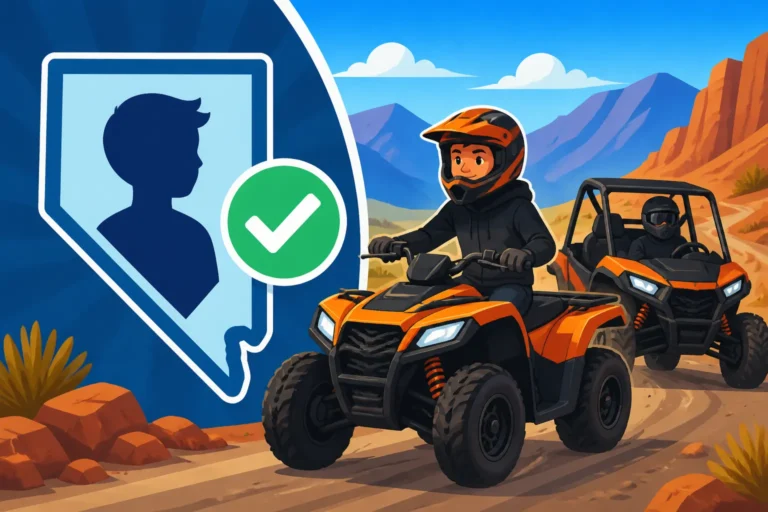
Now, let's talk about the person in the driver's seat. Even if your machine perfectly fits the "Large ATV" definition and is properly equipped for road use, the operator must hold a valid driver's license. This isn't a suggestion; it's a hard and fast rule that mirrors the requirements for operating any other motor vehicle on public roads. This means no provisional licenses, no learner's permits for unaccompanied driving, and certainly no unlicensed riders, regardless of their age or off-road experience. The moment your wheels touch a public county road, you're expected to meet the same licensing standards as someone driving a car or truck.
This requirement often creates a significant hurdle for younger riders. While a teenager might be a highly skilled and experienced off-road enthusiast, capable of navigating complex terrain, their ability to drive on a county road is entirely dependent on their age and possession of a full, unrestricted driver's license. A 16-year-old with a provisional license, for example, might be allowed to drive a car with certain restrictions, but those same restrictions often preclude them from operating an OHV on county roads without an accompanying adult who also meets all the requirements. It’s a critical detail that can lead to confusion and potential legal trouble if not understood properly. Understanding [The Driver's License Nevada Wants on Roads] is paramount.
Distinguishing County Roads from Off-Road Trails
It's easy to blur the lines between off-road trails and county roads, especially in Nevada's vast open spaces where a dirt road might seem to seamlessly transition into a graded county road. However, legally speaking, the distinction is enormous. Off-road trails are generally managed by agencies like the Bureau of Land Management (BLM) or state parks, and while they have their own set of rules, including age limits for operators, these are distinctly different from the rules governing public roadways. On an OHV trail, a minor might be allowed to operate a machine under direct adult supervision, depending on their age and the machine's engine size.
When you transition onto a county road—even an unpaved one—you are entering the realm of vehicular traffic laws. These roads, whether paved or gravel, are part of the public highway system and are subject to the Nevada Revised Statutes (NRS) governing motor vehicles. This is where the rules for [Nevada Minimum Age to Ride Off-Road] completely diverge from the topic at hand. The lenient supervision rules you might enjoy on a designated trail simply do not apply on a county road. Ignorance of this distinction is a common reason for citations. Familiarize yourself with [Nevada's General and Minor County Roads] to understand which routes are considered county roads and subject to these stricter rules.
Specific Age Rules for Operating an OHV on Nevada County Roads
So, what’s the magic number? In Nevada, there isn't a specific age for an OHV to be operated on a county road that differs from the general driving age. Instead, the rules for operating a Large ATV on a county road are directly tied to the state's driver's licensing laws. This means that to legally operate a qualifying Large ATV on any county road in Nevada, you must hold a valid, unrestricted driver's license. This generally means being at least 16 years old and having passed all the requirements for a standard driver's license. There's no special OHV road permit for younger drivers, and the concept of "supervised riding" that applies to off-road trails does not extend to county roads for the operator.
The emphasis here is squarely on the operator's legal ability to drive any motor vehicle on a public road. This is often where confusion arises, as parents might interpret general OHV age rules (which permit younger, supervised riders on trails) as applicable to roads. They are not. A deputy or state trooper encountering an underage driver on a county road will treat it no differently than finding an unlicensed minor driving a car. This is why understanding [Nevada Driver's License Rules for UTV Road Use] is critical; it highlights that the same rules apply as for any other vehicle.
The Role of a Valid Driver's License
A "valid driver's license" is not a flexible term in Nevada. It specifically refers to a full, unrestricted license issued by the state (or another state if you are a visitor with reciprocity). This explicitly excludes learner's permits, which typically require an accompanying licensed adult, and provisional licenses, which often come with restrictions on driving times, passenger counts, or unaccompanied driving. For the purpose of operating a Large ATV on a county road, you need to be able to jump in and drive it legally, just as you would your everyday car.
This distinction is important because while some states allow provisional license holders to operate certain vehicles under specific conditions, Nevada's approach for OHVs on county roads leans heavily on the standard motor vehicle licensing framework. So, if your child has a learner's permit for a car, they are not legally able to operate a Large ATV on a county road by themselves, even if you are following behind in another vehicle. The law mandates an operator with a full license, reflecting the state's view of county roads as part of the formal transportation system, not extended play areas.
Passenger Rules and Age Considerations
While the driver of a Large ATV on a county road must be fully licensed, passenger rules can be a bit different, primarily focusing on safety equipment. If your Large ATV is designed to carry passengers (i.e., it has multiple seating positions with appropriate safety restraints like seatbelts), then minors can typically ride as passengers, provided they meet any specific age or size requirements for the machine's seating and, crucially, wear a helmet if under a certain age. Nevada law generally requires helmets for riders under 18 when operating or riding an OHV off-road, and these rules often extend to road use for minors, especially for those on motorcycles, ATVs, and UTVs.
However, it's essential to note that the driver is responsible for ensuring all passengers, especially minors, comply with safety laws. For example, if a child passenger is under the age where a helmet is mandated, the driver could face a citation if the child is not wearing one. This is also where the design of the machine plays a role. A UTV with proper seating and seatbelts is much safer and more legally compliant for carrying passengers than trying to have two people ride a single-rider ATV. Always ensure everyone, especially kids, is properly secured and protected. More details can be found regarding [Nevada Helmet Rules for Passengers].
Equipping Your OHV for County Road Travel and Supervision
Getting your OHV ready for county road use isn't just about the driver's age; it's also about the machine itself. Nevada law outlines specific equipment requirements for a Large ATV to be considered road-legal on county roads. This isn't just about making it look the part; it's about making it safe and visible to other traffic. Think of it like taking a dirt bike and making it street-legal – it needs more than just gas. These requirements help ensure the safety of everyone on the road, regardless of who is driving. You can learn more about these requirements in [Nevada Equipment List for Road-Legal UTVs].
Essential equipment typically includes functional headlights, taillights, brake lights, and turn signals, all visible from specific distances. For example, [Headlights and Taillights Visible 500 Feet] is a common standard. You’ll also need at least one mirror that provides a clear view of the roadway to the rear, a horn, and a muffler with a spark arrester. Many off-the-shelf UTVs don't come with all these features from the factory, especially turn signals or a horn. This is where aftermarket accessories come into play, allowing riders to upgrade their machines to meet these standards. Companies like SuperATV offer a wide range of accessories, from full street-legal kits with turn signals and horns to mirrors and DOT-approved windshields, making it easier for riders to bring their machines into compliance. Installing these components correctly is crucial, as an improperly equipped machine, even with a licensed driver, is still illegal on county roads.
Supervision Requirements for Younger Riders (Off-Road vs. On-Road)
This is a point of frequent misunderstanding: the rules for supervising young riders on off-road trails are completely different from the rules on county roads. Off-road, Nevada has specific guidelines for supervising riders under 16, often tied to engine size and requiring a certified adult presence. However, when an OHV, even a Large ATV, ventures onto a county road, those supervision rules are effectively overridden by the general motor vehicle licensing laws. There is no provision in Nevada law that allows an unlicensed minor to operate a Large ATV on a county road, even with a licensed adult supervising them from the passenger seat or another vehicle.
To be absolutely clear, if a person is not old enough or does not possess a valid, unrestricted driver's license, they cannot legally drive an OHV on a Nevada county road, regardless of adult supervision. This is a critical distinction, and deputies will enforce the driver's license requirement without exception for county road operation. For more on this, you can delve into [Nevada Rules for Riders Under 16 on Roads], which underscores this prohibition. Similarly, a deputy will not view [Supervising a Teenager on a County Road] as a valid exemption if that teenager is operating the machine without a license.
Consequences of Non-Compliance
The penalties for operating an OHV on a Nevada county road without a valid driver's license or for allowing an underage, unlicensed driver to do so can be significant. It's not just a slap on the wrist. Law enforcement, whether it's a local sheriff's deputy, state trooper, or park ranger, takes these infractions seriously because they pertain to public safety on established roadways. Expect fines, potential vehicle impoundment, and points on a supervising adult's driver's license if they knowingly permitted the violation. The severity of the consequences often depends on whether it's a first offense, if there was an accident involved, or if other violations were present.
A citation for an unlicensed driver operating an OHV on a county road can include fines that quickly add up, and in some cases, could lead to more serious legal action, particularly if there was any property damage or injury. The state wants to ensure that anyone operating a motor vehicle on its public roads is qualified and accountable. Therefore, trying to sneak a younger rider on a short stretch of county road, even with good intentions, carries substantial risk. For a general overview of the financial side of non-compliance, check out [Nevada Tickets for Riding Where You Should Not].
Practical Considerations and Local Ordinances
While Nevada state law sets the baseline for OHV use on county roads, it's vital to remember that local jurisdictions—counties and cities—have the authority to impose additional restrictions or even outright bans. This means that a county road that is legally open to Large ATVs in one part of the state might be completely closed to them in another. This patchwork of regulations can be frustrating for riders, but it's a reality that demands diligence. For instance, [Nevada Counties That Ban OHVs on County Roads] exist, and their ordinances must be respected.
Some densely populated counties or cities, concerned about noise, traffic, and safety, have passed ordinances explicitly prohibiting OHVs on many or all of their county roads, regardless of whether the machine is a "Large ATV" or the driver is licensed. A prime example is [Washoe County Ordinance 1507], which restricts OHV use on certain county roads within its boundaries. Conversely, some smaller, more rural communities might be more permissive, but even then, it's never a guarantee. Riders often hear anecdotes about "open" towns like [Mesquite and Its Reputation for Open Streets], but even there, specific routes and rules apply, and one cannot assume carte blanche.
Checking Local Regulations Before You Ride
Given the variability of local rules, the best advice for any rider planning to use county roads is to do your homework before you ever load up the trailer. Don't rely on hearsay or what "everyone else does." Contact the local sheriff's department or city hall for the specific area you plan to ride in. Many jurisdictions have their ordinances published online, or you can often get clear guidance with a phone call. This is especially important if you're venturing into a new riding area. What's legal around [Reno Streets and Where OHVs Cannot Go] might be completely different from an area in rural Lincoln County.
Imagine you're planning a trip to a new riding spot. You've checked the state laws, your UTV is a Large ATV, and you're fully licensed. But a quick call reveals that the county has an ordinance closing all county roads to OHVs, forcing you to trailer everywhere. That's a hassle you want to avoid. Being proactive will save you time, potential fines, and a lot of frustration. Even a friendly check with a local business or gas station in the area can sometimes provide useful insights, though always verify with official sources.
Here's a quick summary to help clarify the nuances of OHV operation in Nevada:
| Feature/Area | Off-Road Trails (BLM/State Park) | Nevada County Roads (Public) |
|---|---|---|
| Machine Type | All registered OHVs (ATV, UTV, dirt bike, etc.) | Only "Large ATVs" (as defined by NRS 490.043) |
| Minimum Driver Age | Varies (e.g., 8-16 with supervision/safety course, 16+ without) | Minimum 16 years old |
| License Required | No driver's license required | Valid, unrestricted driver's license REQUIRED |
| Supervision for Minors | Often permitted with certified adult/specific conditions | NOT permitted for driving; driver must be licensed |
| Required Equipment | Spark arrester, muffler, flag (dunes) | Headlights, taillights, brake lights, turn signals, horn, mirrors, muffler, spark arrester |
| Helmet for Minors | Generally required for riders under 18 | Generally required for riders under 18 (as operator or passenger) |
| Local Authority | BLM/State Park rules, some local ordinances | County/City ordinances can add further restrictions or bans |
| Purpose | Recreation, trail riding | Limited access for travel between trails, designated crossings, or specific routes |
This article is for general informational purposes only and does not constitute professional advice. Laws, prices and regulations vary by location and change over time. Consult a qualified professional for guidance on your specific situation.