Riding to the Trailhead, Not to the Store
It's a familiar scenario for many of us: you've got your side-by-side or ATV ready to roll, the sun is shining, and the trails are calling. But there's that nagging thought – do you really have to load it onto a trailer, drive just a few miles down the road, unload, and then finally hit the dirt? It feels like an unnecessary hassle, especially when the trailhead is practically within shouting distance. This guide is here to untangle the complexities of Nevada's road rules for off-highway vehicles, showing you when and how you might be able to ride legally from your home straight to the adventure, focusing strictly on getting you to the dirt, not cruising through town for groceries.
The Lure of Riding from Your Doorstep and Why It's Tricky in Nevada
There's a distinct freedom that comes with just hopping on your machine and riding out. The idea of skipping the trailer, the hitching, the loading, and the unloading is incredibly appealing. But Nevada, like many states, has specific rules about where and how off-highway vehicles (OHVs) can interact with paved roads. It’s not always as simple as "if it has wheels, it can go."
The Dream: A Seamless Ride to the Dirt
Imagine this: you've got your helmet on, your gear packed, and your UTV is idling in the driveway. Instead of spending precious riding time wrestling with a trailer, you simply pull out of your driveway, turn onto a quiet street, and within minutes, you're on a dirt road leading directly to your favorite trail system. This dream is about convenience, pure and simple. It saves on fuel for your tow rig, eliminates the stress of finding trailer parking at busy trailheads, and makes spontaneous rides much more feasible. For those of us living in communities with direct access to BLM land or vast trail networks, the thought of trailering for just a mile or two can be incredibly frustrating. We want to maximize our time in the saddle, not behind the wheel of a truck.
The Reality: Nevada's Specific Road Rules for OHVs
While the dream of a seamless ride is strong, the reality in Nevada is shaped by specific laws designed to balance OHV access with public safety and infrastructure protection. Nevada isn't an "open state" where you can just ride your ATV down any paved road. Instead, it operates on a more nuanced system, particularly concerning what machines can be on which roads, and under what conditions. The state's laws, primarily outlined in Nevada Revised Statutes (NRS) Chapter 490, define various categories of OHVs and their permissible uses. This means that while some form of road-riding for access might be possible, it's highly regulated and specific. Understanding these nuances is crucial to avoid tickets, and more importantly, to ensure everyone's safety on shared roadways. What works in a neighboring state with more lenient laws might land you in hot water here, so it's always best to know your local rules.
Nevada's "Large All-Terrain Vehicle" Designation: Your Key to Pavement
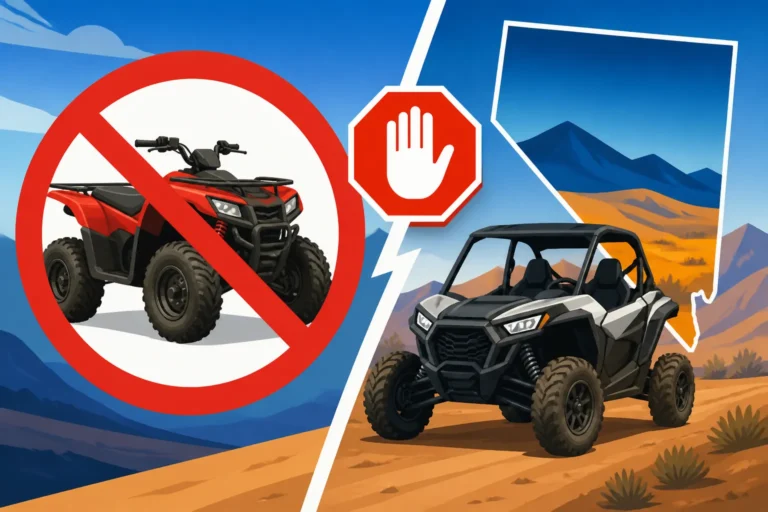
When it comes to getting your OHV onto paved roads in Nevada, the most important concept to grasp is the "large all-terrain vehicle" designation. This isn't just about the size of your machine; it's a specific legal classification that unlocks limited road access. Without meeting this definition, your machine generally has no business on paved public roads, even for short distances.
What Exactly Qualifies as a "Large ATV" in Nevada?
Here's where many riders get tripped up. In Nevada, a "large all-terrain vehicle" isn't simply any big ATV or UTV. The state's law, specifically [What Nevada's NRS 490.043 Counts as a Large ATV], defines it very precisely: it must be a side-by-side (UTV) that has either four or more seats OR a truck bed. This means that most two-seat sport quads, even if they're quite powerful, do not qualify because they lack both the four-seat capacity and a truck bed. Similarly, smaller two-seat sport UTVs might not meet the criteria if they don't have a dedicated "truck bed" in the legal sense.
Think of it this way: Nevada is primarily looking at utility and multi-passenger machines for this designation. A Polaris General, a Can-Am Defender with its cargo box, or a four-seat RZR XP 1000 would generally fit the bill. These machines often have features that lend themselves more readily to road-specific safety additions, and their larger footprint is seen as more akin to a small vehicle. It's not about horsepower or suspension travel; it's about the basic configuration that dictates eligibility for the large ATV decal. This distinction is paramount, as trying to get a road decal for a machine that doesn't legally qualify will be a fruitless endeavor.
The "Large ATV" Decal: Not a License Plate
Once you've determined your machine qualifies as a "large ATV," your next step is to obtain the special decal. It's important to understand that [Nevada's Large All-Terrain Vehicle Decal] is precisely that – a decal, not a traditional license plate like you'd find on a car or motorcycle. This decal is issued by the Nevada Department of Motor Vehicles (DMV) OHV Section and signifies that your large ATV meets the state's requirements for limited road use. It typically goes on the left side of the machine, clearly visible, just like your standard OHV registration decal.
The application process usually involves filling out specific forms, providing proof of ownership (like a title or MCO), and ensuring your machine has the necessary safety equipment, which we'll cover in more detail shortly. Don't confuse this with trying to get a full "street legal" conversion and a vehicle license plate; Nevada does not allow OHVs to be plated as traditional street vehicles, with this large ATV decal being the closest you'll get for regulated road access. There is a fee associated with this decal, which helps fund the program and maintain OHV areas. You'll want to check the current [Nevada Large ATV Decal Cost] on the DMV website, as fees can change. It's a small price to pay for the added convenience and legality of connecting trails.
Where You Can Legally Ride Your Large ATV on Nevada Roads
Even with the "large ATV" decal affixed to your machine, you can't just drive anywhere. Nevada has very specific rules about which roads are permissible and how far you can travel on them. This section will help you understand the boundaries, ensuring you stay on the right side of the law as you head to the trailhead.
Minor County Roads and Designated Routes
The primary avenue for riding your large ATV on pavement is on what Nevada classifies as "minor county roads." These are typically unpaved or lightly paved roads in rural areas, maintained by the county, that see lower traffic volumes than state highways or major thoroughfares. The intent here is to allow riders to connect trails through less populated areas without disrupting main traffic flows. [Nevada County Roads Open to UTVs] are often clearly identified on county maps or through local ordinances. You might find yourself on a paved section of a rural road, connecting two dirt segments, and that's perfectly legal as long as it's designated as a minor county road and your machine has the proper decal and equipment.
However, it's not a universal free-for-all. Some counties in Nevada have exercised their right to opt-out or create their own restrictions. It's crucial to be aware that [Nevada Counties That Ban OHVs on County Roads] do exist, so always check with the local county sheriff's office or planning department for the specific area you plan to ride. Additionally, some cities or towns, particularly those near popular riding areas, may have "designated routes" that allow large ATVs to travel specific streets for access purposes, often leading directly to trailheads. These routes are usually well-marked, but it's your responsibility to know them.
The Two-Mile Pavement Limit and Crossing Highways
One of the most critical rules to internalize is the "two-mile pavement limit." This rule states that a large ATV, even with its decal, can only travel a maximum of [How Far You Can Ride Pavement in Nevada] on a paved highway to connect one dirt trail to another. This isn't a license to joyride on the highway for short stretches; it's strictly for establishing a connection between off-highway routes. The moment your two miles are up, or you're no longer clearly heading to an off-highway route, you're out of compliance.
Crossing state highways or other major paved roads is also permissible under specific conditions. [Nevada Rules for Crossing a State Route] dictate that you must do so at approximately a 90-degree angle, yielding to all traffic, and getting off the paved road as quickly and safely as possible. You cannot travel along a state highway shoulder or ditch for any significant distance, even if it feels like a convenient shortcut. The goal is minimal impact on mainstream traffic and maximum safety for all road users. Remember, the intent is to facilitate access to the trails, not to open up public roads for OHV travel as a mode of transport.
Places Where Road Riding is Generally Restricted or Banned
While the "large ATV" decal offers some flexibility, there are definite no-go zones for OHVs on Nevada's paved roads. For instance, cities with populations exceeding 100,000, such as Las Vegas, Reno, Henderson, and Sparks, have much stricter regulations. [Nevada Cities That Require Designated OHV Routes] will generally prohibit OHV use on city streets unless those streets are specifically designated as part of an OHV trail system by local ordinance. You cannot simply ride your large ATV through the heart of these urban centers, even if it technically has a decal.
Furthermore, interstate highways are absolutely off-limits to OHVs. There's a clear [Nevada Interstate Highway ATV Ban] in place for safety reasons, as OHVs are not designed for the speeds or traffic conditions of an interstate. Beyond major highways and cities, common sense dictates other areas where OHV use is restricted. You cannot ride your ATV or UTV on sidewalks under any circumstances; [Can You Ride a Quad on a Nevada Sidewalk?] is a definitive no. Private property without permission is also strictly forbidden and constitutes trespassing. The key takeaway here is that while some road access is granted, it is highly targeted at rural, minor county roads and very short connections, keeping your machine away from high-traffic urban areas and major highways.
Essential Equipment and Requirements for Road-Legal OHVs
Getting that "large ATV" decal is a big step, but it's only part of the equation. To legally and safely operate your machine on approved Nevada roads, you need to ensure it's outfitted with specific safety equipment and that you, as the driver, meet certain requirements. Skimping on these details isn't just illegal; it's a significant safety risk.
Mandatory Safety Equipment for Street Use
When you're riding on public roads, even minor county ones, your large ATV needs to be seen and heard, just like any other vehicle. Nevada law specifies several pieces of equipment that must be present and functional. First and foremost, you need proper lighting. This includes a headlight that can illuminate persons and vehicles at a distance of 500 feet, and a taillight visible from 500 feet to the rear. [Nevada Headlight Requirements for Road Use] are not suggestions; they're legal mandates. Your machine also needs a working stop lamp (brake light) that activates when you apply the brakes, visible from 500 feet. [Nevada Stop Lamp Requirement for UTVs] is crucial for preventing rear-end collisions. Reflectors are also required, often integrated into the taillight assembly or added separately.
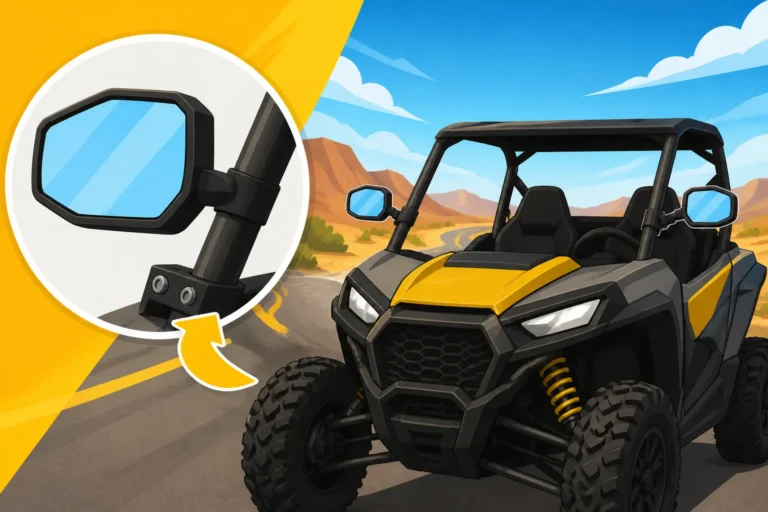
Beyond lighting, you'll need mirrors. At least one rear-view mirror is typically required to provide a clear view of traffic behind you. A horn is also mandatory, allowing you to signal your presence to other drivers or pedestrians. Finally, a spark arrester is not just for trail riding; it's also a requirement for road-legal OHVs to prevent wildfires. Many aftermarket companies, including SuperATV, offer a wide range of compliant accessories like mirrors, horns, and lighting kits designed to meet these road-legal specifications. It's often a good idea to check their product lines for robust and reliable upgrades that stand up to the rigors of off-road use while providing the necessary road safety features. Ensure any modifications you make are designed for durability and meet the legal standards.
Driver Requirements, Insurance, and Supervision
It's not just the machine that needs to be ready for the road; the driver does too. To operate a large ATV on designated Nevada roads, you must possess a valid driver's license. [Nevada Driver's License Rules for UTV Road Use] are clear: you need to be a licensed driver, just as if you were driving a car. This isn't a situation where an OHV registration or an off-road permit substitutes for a driver's license.
Crucially, you also need liability insurance for your large ATV when operating it on public roads. [Insurance Nevada Requires for Road Use] is the same liability insurance that applies to other motor vehicles, intended to cover damages or injuries you might cause in an accident. Always carry proof of insurance with you. As for helmets, [Nevada Helmet Law for Road Riding] is generally stricter than off-road rules. While off-road helmet laws vary by age, when on a public road, most riders, especially those under 18, will be required to wear a helmet, and it's always recommended for all occupants for maximum safety.
If you have passengers, especially minors, there are rules. [Passengers on a Nevada Road-Legal UTV] must be properly seated, and if they are children, they must meet age and height requirements for any integrated safety restraints. For riders under 16, [Nevada Rules for Riders Under 16 on Roads] mandate adult supervision. This means a licensed adult must be present and supervising the minor's operation of the machine. These rules are in place for everyone's safety, ensuring that those operating and riding in large ATVs on public roads are competent and protected.
Paperwork and Roadside Stops
Let's talk about the dreaded roadside stop. Even if you're doing everything right, a deputy or ranger might pull you over to verify compliance. To avoid any issues, always have your essential paperwork with you. This includes your valid driver's license, proof of your large ATV decal registration, and your insurance card. [Keeping Paperwork Dry in a Dusty Machine] is critical – consider waterproof pouches or a sturdy document holder to protect these vital papers from dust, water, and vibration. A tattered, unreadable registration card won't do you any favors.
When [What a Nevada Trooper Looks For on a County Road], they're primarily checking for the large ATV decal, current registration, proper safety equipment (lights, mirrors, horn), a valid driver's license, and proof of insurance. They'll also be observing your driving behavior to ensure you're operating the machine safely and appropriately for the road conditions. If you're caught without the proper decal, equipment, or paperwork, you could face significant penalties. [Nevada Fines for No Large ATV Decal] can be costly, and repeated offenses could lead to more serious consequences. The best approach is always to be prepared, know the rules, and demonstrate a commitment to safe and legal riding.
Strategic Riding: Getting to the Trailhead Smartly
The entire point of the "large ATV" designation and the associated road rules in Nevada is to facilitate access to off-highway trails, not to transform your UTV into a street cruiser. Approaching road riding with this mindset is key to staying legal, safe, and respectful of other road users.
Planning Your Route: Identifying Legal Connections
Before you even turn the key, grab your maps. Whether it's a physical recreation map or a digital mapping app, you need to identify those minor county roads that can serve as your legal bridges to the dirt. Look for stretches of paved road that clearly connect two segments of off-highway trails or lead directly from a residential area to a designated OHV access point. It’s always a good idea to scout the route first, if possible, even in your truck, to ensure there are no surprises like "private road" signs or unexpected closures. Don't assume; verify.
Using digital mapping tools that show parcel lines or county road designations can be incredibly helpful. The goal is to minimize your time on pavement and maximize your time on the trails. By strategically planning routes that utilize short, legal stretches of road, you can significantly reduce the need for trailering. This is where the magic happens – converting what would have been loading and unloading time into actual riding time. Just remember, these paved connectors are for getting from Point A (pavement) to Point B (dirt), and back again.
Mindset: Access, Not Transport
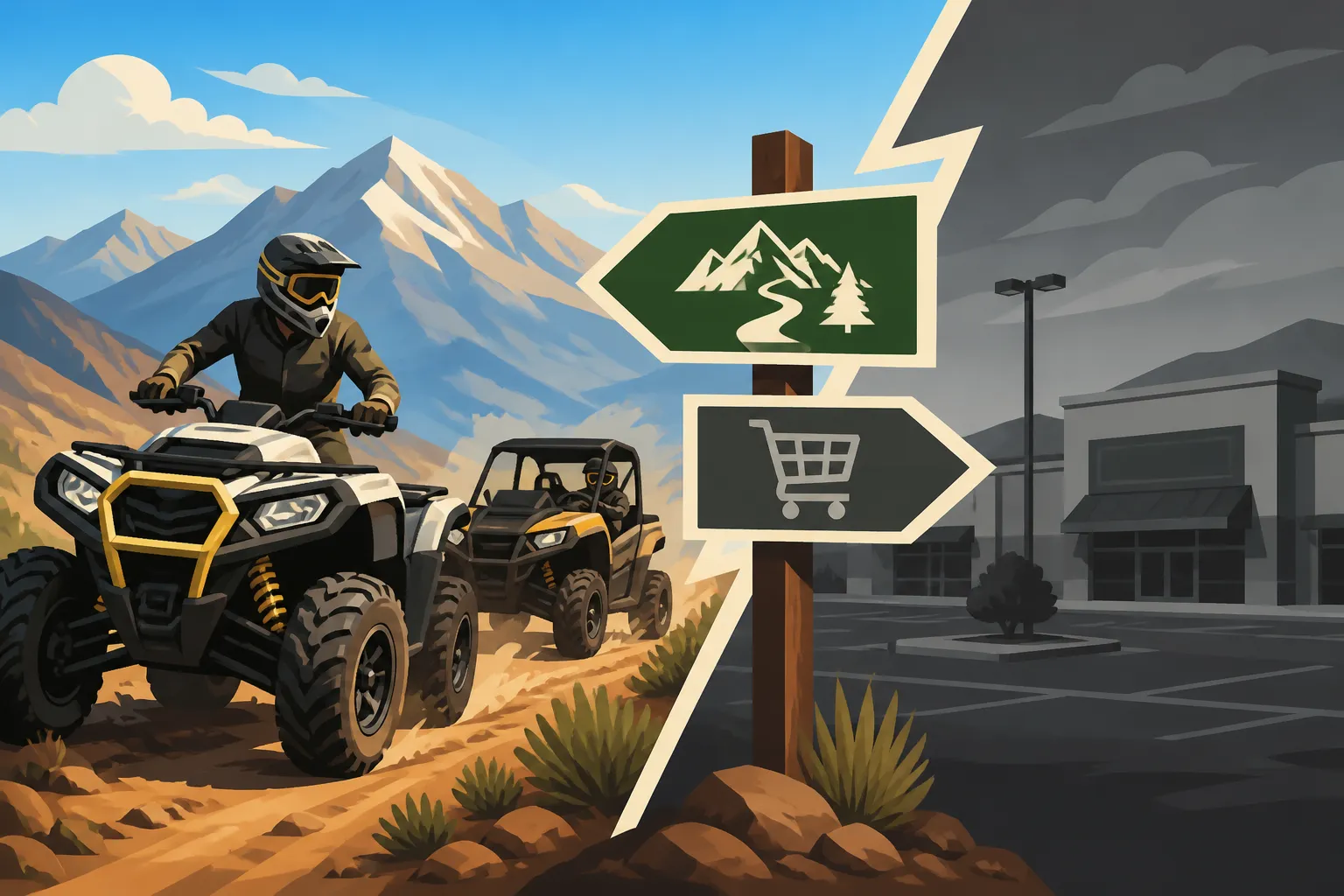
This is perhaps the most crucial mindset shift for Nevada OHV riders. The road access provisions are specifically for [Riding to the Trailhead, Not to the Store]. This distinction is more than just a catchy phrase; it's the core principle behind the law. You are permitted to use these specific roads to access off-highway riding areas. You are not permitted to use your large ATV as a general mode of transportation for running errands, visiting friends, or simply cruising through town.
Law enforcement officers are generally adept at recognizing the difference. If you're seen riding your properly decaled and equipped large ATV down a short stretch of minor county road, helmeted and clearly heading towards or away from a known trail system, you're likely to be left alone. However, if you're spotted pulling up to a convenience store, cruising down Main Street, or weaving through a populated residential area, it sends a very different signal. This kind of misuse jeopardizes the limited access privileges that riders currently enjoy and can lead to citations, even if your machine technically has the decal. The spirit of the law is to keep OHVs on trails, with limited, purpose-driven exceptions for connecting those trails. Respect that distinction, and you'll keep the roads open for legitimate access.
Nevada Large ATV Road Rules: At a Glance
| Feature | Standard OHV (No Large ATV Decal) | Large ATV (With Decal) on Designated Roads |
|---|---|---|
| Paved Road Use | Generally prohibited on paved public roads | Limited to minor county roads & designated routes for access |
| Interstate Highways | Prohibited | Prohibited |
| Major City Streets | Prohibited (unless specifically designated) | Prohibited (unless specifically designated) |
| Max Paved Distance | N/A | 2 miles to connect trails |
| Crossing Highways | N/A | At 90-degree angle, yield to traffic |
| Machine Type | Any registered ATV/UTV | UTV with 4+ seats OR a truck bed |
| Required Decal | Standard OHV registration decal | Standard OHV decal + Large ATV decal |
| Driver's License | Not required off-road (age/supervision rules) | Required (valid, current) |
| Insurance | Not required off-road | Liability insurance required on roads |
| Helmet (On-Road) | N/A | Generally required for all, especially minors |
| Lights | Required for night riding off-road | Headlight, taillight, stop lamp (500 ft visibility) |
| Mirrors | Not required off-road | Required (at least one rearview) |
| Horn | Not required off-road | Required |
| Spark Arrester | Required off-road | Required |
| Purpose | Recreation/off-road travel | Access to off-road trails |
Disclaimer
This article is for general informational purposes only and does not constitute professional advice. Laws, prices and regulations vary by location and change over time. Consult a qualified professional for guidance on your specific situation.