What Nevada’s NRS 490.043 Counts as a Large ATV
Many Nevada riders dream of taking their off-highway vehicles (OHVs) onto public roads, especially those scenic backroads that connect trails. But the path to street legality often hits a confusing roadblock: understanding exactly what Nevada considers a "Large ATV" for road use. It's not as simple as just adding a few accessories. This guide will deep dive into Nevada Revised Statute (NRS) 490.043, clarifying the precise criteria your machine needs to meet to qualify, so you can ride with confidence and stay on the right side of the law.
Deciphering Nevada's "Large ATV" Definition NRS 490.043
The term "Large ATV" might sound like it applies to any big quad or side-by-side, but in Nevada, its legal definition is very specific, found within NRS 490.043. This particular statute is the gatekeeper for whether your off-highway vehicle can even begin to be considered for a "Large ATV" decal, which is necessary for limited street use. Misunderstanding this definition can lead to frustration, wasted effort, and even citations if you try to ride a non-compliant machine on a public road.
Why the Definition Matters for Road Use
For many OHV enthusiasts, the ability to legally traverse a short stretch of paved road – perhaps to connect to another trail, access a fuel stop, or simply get from camp to the nearest general store – is a game-changer. It eliminates the need to load and unload a machine onto a trailer for every little move, greatly enhancing the convenience and enjoyment of a riding trip. However, Nevada isn't like some states where a simple turn signal kit and horn make an ATV street legal. The law here first categorizes your vehicle, and that initial categorization hinges entirely on the "Large ATV" definition. If your machine doesn't fit this specific legal mold, it simply cannot obtain the special decal required for road privilege, regardless of any other modifications you've made. It's a fundamental hurdle that must be cleared before you can even think about what equipment you need.
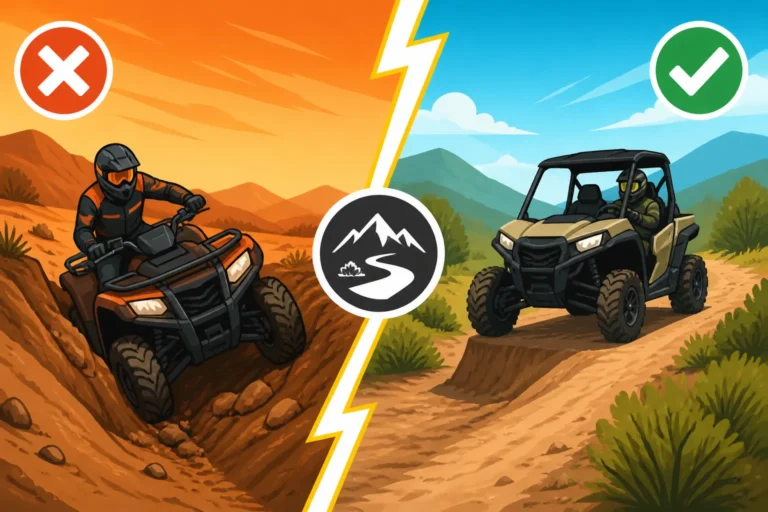
The frustration for many riders stems from the common misconception that "large" simply refers to physical size or engine displacement. You might have a massive 1000cc sport quad, but it won't qualify as a "Large ATV" under this statute. Or you might have a tricked-out two-seater side-by-side that feels huge, but it still might not make the cut. The law doesn't care about your engine size or how wide your machine is; it cares about very specific design elements. Failing to understand this often leads riders down a rabbit hole of buying expensive lights and mirrors, only to find out their base vehicle isn't eligible in the first place, leading to disappointment when a deputy explains the nuances of the law during a roadside stop.
The Core Criteria: Seating and Cargo
NRS 490.043 establishes two distinct criteria, either of which can qualify a machine as a "Large ATV." Your OHV needs to meet one of these two tests:
- Designed for four or more passengers: This means the vehicle, as originally manufactured, was intended to safely accommodate a driver and at least three passengers. We're talking about factory-installed seats with appropriate seatbelts and passenger hand-holds. This isn't about how many people you can squeeze onto a bench seat or how many you've added an aftermarket seat for; it's about the manufacturer's original design intent.
- Designed by the manufacturer with a truck bed: This criterion refers to utility-focused machines that come from the factory with a dedicated cargo area resembling a small pickup truck bed. This isn't a small rear rack often found on ATVs or even the tiny storage bins sometimes integrated into sportier UTVs. It needs to be a distinct, open-box cargo area designed for hauling loads, typically with a tailgate and flat floor.
The phrase "designed by the manufacturer" is paramount here. It means aftermarket modifications, no matter how well-integrated or functional, generally do not change the vehicle's classification under this statute. For example, if you add a secondary bench seat to a two-seater side-by-side, or bolt a large cargo box onto a utility quad's rack, you haven't magically transformed it into a "Large ATV" in the eyes of Nevada law. The original design intent dictates the classification.
Four Seats or More: The Passenger Capacity Test
One of the primary ways an OHV can qualify as a "Large ATV" in Nevada is by being designed by the manufacturer to carry four or more passengers. This distinction is critical because it immediately separates many popular two-seat sport side-by-sides from larger, family-oriented or utility-focused machines. It's all about what the manufacturer built the vehicle to do from the ground up, not what you might modify it to do later.
Understanding "Designed for Four or More Passengers"
When the law states "designed for four or more passengers," it's not looking at the maximum number of people you could potentially squeeze into your machine. Instead, it refers to the explicit intent and engineering put into the vehicle by its original manufacturer. This means permanent, factory-installed seating positions, complete with appropriate safety restraints like seatbelts, and often handholds for passengers. Think about a typical family sedan designed for five people; it has five distinct seating positions with seatbelts. The same principle applies here. These are vehicles like the four-seat Polaris RZR XP 4, Can-Am Maverick X3 MAX, or various four-seater utility UTVs that come off the assembly line with four or more bucket seats or a combination of bucket seats and a bench seat clearly intended for multiple occupants. [Does a Four-Seat RZR Pass Nevada's Seating Test?] is a common question, and generally, if it comes from the factory with four distinct seating positions, the answer is yes for this criterion.
Contrast this with many two-seat sport side-by-sides, which are built primarily for a driver and one passenger. Even if there's a little extra space behind the seats, or you could theoretically fit a small child, the manufacturer didn't design it with that intent or provide the necessary safety infrastructure for additional passengers. Similarly, standard ATVs, even those designed for two riders (often called "two-up" ATVs), typically don't count because they are rarely designed for four or more. The statute specifically targets larger, multi-passenger UTVs that fundamentally alter the vehicle's capacity and purpose from a recreational two-seater to a more communal or family-friendly transport.
The Practical Implications for Your Machine
So, how do you verify if your machine meets this specific criterion? The best place to start is your owner's manual or the manufacturer's official specifications. These documents will clearly state the intended seating capacity. Look for explicit mentions of "four-passenger," "five-passenger," or similar designations. Dealers, especially those specializing in OHVs, can also be a valuable resource in confirming a model's original design. If the manufacturer's literature states it's a two-seater, adding a third or fourth aftermarket seat won't magically transform its legal classification under NRS 490.043. The law focuses on the original design intent, which is a fixed characteristic of the vehicle.
This means that owners who modify their machines by adding extra seating after the fact, perhaps by installing a SuperATV rear bench seat kit, need to understand that while these modifications might enhance their vehicle's utility or passenger capacity for off-road use, they do not change the fundamental "designed by the manufacturer" classification for street legality purposes in Nevada. The statute is rigid in its requirement for factory-built capacity. So, while you might be able to take your friends along on the trails with your new aftermarket seats, don't expect it to help you get that "Large ATV" decal for road travel if the machine wasn't originally engineered for four or more passengers. This is a common point of confusion and one that law enforcement will verify by checking the vehicle's original specifications, not its current modifications.
The "Truck Bed" Clause: Cargo Functionality
The second pathway to qualifying as a "Large ATV" under NRS 490.043 hinges on the presence of a "truck bed." This criterion is designed to include utility-focused side-by-sides that function much like mini-pickup trucks, providing significant cargo-carrying capabilities as a core part of their design. It's important not to confuse this with any small storage area or an aftermarket add-on.
Defining "Designed by the Manufacturer with a Truck Bed"
When Nevada law refers to a "truck bed," it's picturing a dedicated, open-box cargo area at the rear of the vehicle, akin to what you'd find on a conventional pickup truck, albeit on a smaller scale. This cargo bed is typically separate from the passenger compartment, has distinct sides, a floor, and often a tailgate that can be lowered or removed for easier loading and unloading. These features indicate the manufacturer's clear intent for the vehicle to be used for hauling significant loads, not just carrying a small cooler or a backpack. Vehicles that commonly fit this description include utility-oriented side-by-sides like the Polaris Ranger, Can-Am Defender, John Deere Gator, or Honda Pioneer. These machines are engineered for work, often seen on farms, ranches, or construction sites, and their beds are central to their design and purpose.
The key phrase, again, is "designed by the manufacturer." This means the truck bed must be an integral part of the vehicle's original design and factory build. It's not something you add on later. This distinguishes utility UTVs from their sportier counterparts or traditional ATVs. For instance, a Polaris Ranger Crew, with its four seats and a substantial cargo bed, easily meets both criteria. Similarly, a two-seat Can-Am Defender with its dedicated, often tiltable, truck bed would qualify under this clause. [Why a Defender's Truck Bed Meets Nevada's Definition] is a great example of how a utility-focused machine explicitly fulfills this requirement, offering genuine cargo functionality that is central to its design.
Why a Small Rear Rack Isn't Enough
Many off-highway vehicles, including traditional ATVs and some sportier UTVs, come equipped with front and/or rear racks or small, integrated storage compartments. This is where a lot of confusion arises. A small metal rack on the back of an ATV, designed to strap down a cooler or a gas can, does not constitute a "truck bed" under NRS 490.043. These racks are typically open, much smaller in capacity, and lack the enclosed, box-like structure and functionality (like a tailgate) of a true truck bed. Even a sport UTV with a small, flat cargo area behind the seats that might fit a spare tire or a small bag is generally not what the statute means by a "truck bed." The law is looking for genuine utility, a specific type of cargo carrying capability built into the vehicle from the factory.
Aftermarket accessories, while incredibly useful for expanding your machine's utility, also do not change its classification in this regard. You might install a robust cargo box or a large storage system from a company like SuperATV onto your ATV or sport UTV's existing rack. These products are fantastic for increasing your carrying capacity for off-road adventures, making your machine more versatile for camping trips or hauling gear to a remote spot. However, bolting on an aftermarket cargo box, even a very large and durable one, does not magically transform your vehicle into one "designed by the manufacturer with a truck bed." The legal definition is fixed to the original design. Therefore, while enhancing your machine's storage with quality aftermarket parts is a smart move for trail riding, it won't help you meet the specific "Large ATV" criteria for Nevada's street legal decal.
Machines That Typically Don't Qualify as "Large ATVs"
Understanding what does qualify as a "Large ATV" under Nevada law is only half the battle. It's equally important, and often more frustrating for riders, to recognize the types of machines that, by definition, generally fall outside this specific classification. This clarity can prevent wasted time, money, and disappointment for those hoping to gain limited road access.
Two-Seat Sport Quads and Standard ATVs
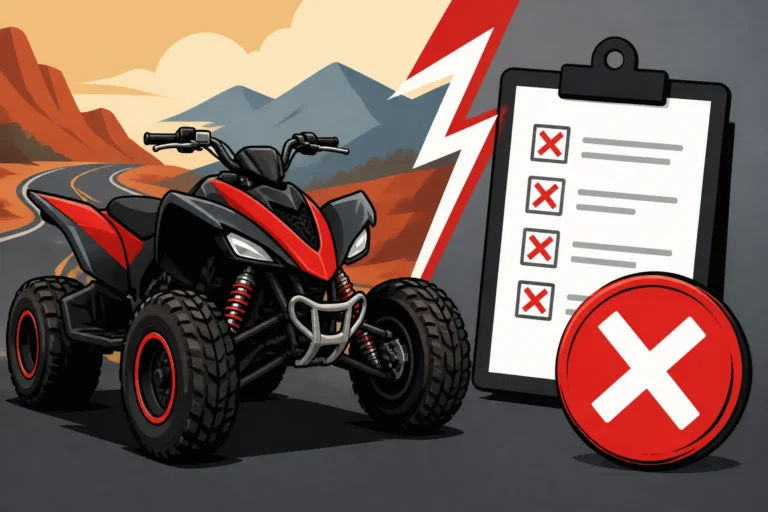
This is where many riders encounter their first roadblock on the journey to street legality. The vast majority of standard ATVs, even large, powerful ones, and almost all two-seat sport quads, simply do not meet the "Large ATV" definition. Why? Because they are virtually never "designed by the manufacturer for four or more passengers" nor are they "designed by the manufacturer with a truck bed." A standard ATV, whether a utility model or a sport model, is typically designed for one rider, or occasionally two riders in the case of a "two-up" model. Even if it has sturdy racks front and rear for cargo, these are distinct from the enclosed, truck-style bed that the law specifies.
Sport quads, the high-performance, often two-wheel-drive machines built for speed and agility, are even further from the definition. They are designed for a single rider and thrilling off-road performance. [Why a Two-Seat Sport Quad Fails Nevada's Test] is a common scenario. While you might see people riding them on county roads in other states, Nevada's specific statutes make it clear: these machines are not considered "Large ATVs" and therefore cannot obtain the specialized decal for road use. This can be incredibly frustrating for owners who love their sport quads and wish to ride them to a nearby trailhead without trailering. Unfortunately, under current Nevada law, that simply isn't an option for these types of machines.
Modified Machines and Aftermarket Additions
Another critical aspect of Nevada's "Large ATV" definition is its strict adherence to the manufacturer's original design intent. This means that any modifications or aftermarket additions you make to your OHV, no matter how substantial or well-engineered, generally will not change its legal classification under NRS 490.043. Let's say you have a two-seat sport side-by-side that you want to make road legal. You might invest in a custom fabrication to add a third row of seating, or you could install a large, robust cargo box onto the rear frame where a small storage area once was. While these modifications might make your machine more functional or allow you to carry more people off-road, they do not alter the fact that the vehicle was originally designed as a two-seater without a truck bed.
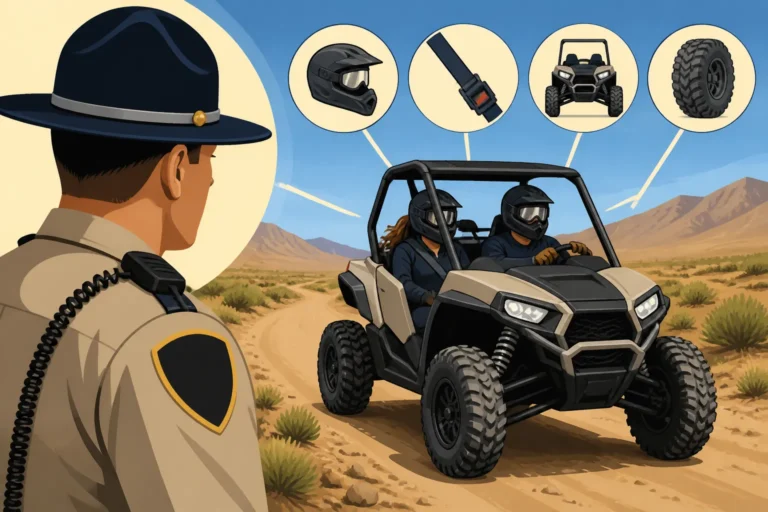
The law looks at the vehicle as it left the factory. A deputy conducting a roadside stop or a DMV agent reviewing your application will refer to the vehicle's make, model, and year to determine its original specifications, not its current configuration of aftermarket parts. Even adding high-quality accessories from a reputable brand like SuperATV — be it a larger cargo bed extension, a new roof rack system, or even a full cab enclosure — enhances your vehicle's capabilities for off-road use, but it cannot fundamentally change its classification as a "Large ATV" if it didn't meet the criteria from the start. This is a crucial distinction that often catches riders by surprise, leading them to spend money on street-legal conversion kits before realizing their base machine isn't even eligible for the initial "Large ATV" designation.
The Application Process for a Large ATV Decal
Once you've confirmed that your off-highway vehicle actually meets Nevada's specific definition of a "Large ATV" under NRS 490.043, the next step is navigating the application process to get your special road-use decal. While it's certainly more involved than simply getting a standard OHV registration, it's a clear process once you know the steps and what documentation you'll need. Don't skip any steps, as missing paperwork can cause significant delays.
Gathering Your Documentation
Before you even think about heading to the DMV or an authorized dealer, you'll need to meticulously gather all the required paperwork. This preparation is key to a smooth application process. First and foremost, you'll need proof of ownership, which typically means your vehicle's title. Ensure the title is clear and in your name. If you recently purchased the machine, you might still be working on getting the title transferred, so make sure that's squared away first. Next, you'll need the proper application form; often, this is the same form used for standard OHV registration, but you'll indicate that you're seeking the "Large ATV" designation. It's always a good idea to download the latest forms from the Nevada DMV website or pick them up in person, as they can sometimes be updated.
Perhaps the most critical, and often misunderstood, piece of the puzzle is the VIN inspection. Unlike standard OHV registrations, a "Large ATV" decal requires a specific VIN verification to ensure the machine matches its documentation and is indeed the vehicle being registered. However, it's vital to know that [The VIN Inspection Nevada DMV Will Not Do] for OHVs. You cannot simply drive your UTV to the DMV and expect them to do it. Instead, you'll need to have a VIN inspection performed by either a licensed Nevada OHV dealer or a sworn law enforcement officer. Make sure you get the proper form filled out and signed by the inspecting party. This step verifies the machine's identity and is a non-negotiable part of the process for all new "Large ATV" decals.
Where and How to Apply
With your documentation in hand, including your title and completed VIN inspection form, you have a couple of options for where to submit your application. You can visit a Nevada Department of Motor Vehicles (DMV) office that handles OHV transactions, or you can go through an authorized Nevada OHV dealer. Many dealers offer this service as a convenience, often for a small fee, which can save you a trip to the DMV and potentially some waiting time. If you choose the DMV route, be prepared for potential wait times, especially if you go during peak hours.
Regardless of where you apply, you'll need to present your proof of ownership, the completed application form, the VIN inspection document, and payment for the applicable fees. These fees typically include the registration fee for the decal, and potentially a title fee if you're titling the machine for the first time or transferring ownership. [Applying for a Nevada Large ATV Decal] involves specifying on the application that you are requesting this particular designation. The state will review your documentation to confirm your machine meets the NRS 490.043 criteria before issuing the special "Large ATV" decal, which signifies your vehicle's eligibility for limited road use. Remember, once you receive the decal, it needs to be properly affixed to your machine in the designated spot, usually the rear or left side, where it's clearly visible.
Comparing OHV Types and "Large ATV" Criteria
To help clarify which types of off-highway vehicles generally meet Nevada's "Large ATV" definition under NRS 490.043, let's look at a comparison. This table highlights common machine types and how they typically align with the two key criteria: designed for four or more passengers, or designed with a truck bed.
| OHV Type | Designed for 4+ Passengers (Factory) | Designed with a Truck Bed (Factory) | Generally Qualifies as "Large ATV" | Example Models |
|---|---|---|---|---|
| Standard Sport Quad | No | No | No | Yamaha Raptor 700, Honda TRX450R |
| Utility ATV (Single/Two-Up) | No | No (only racks) | No | Polaris Sportsman 570, Can-Am Outlander |
| Two-Seat Sport UTV | No | No (small storage only) | No | Polaris RZR XP 1000, Can-Am Maverick X3 |
| Four-Seat Sport UTV | Yes | No (small storage only) | Yes | Polaris RZR XP 4 1000, Can-Am Maverick X3 MAX |
| Two-Seat Utility UTV | No | Yes | Yes | Polaris Ranger 570, Can-Am Defender HD5 |
| Multi-Seat Utility UTV (4+ seats) | Yes | Yes | Yes | Polaris Ranger Crew 1000, Can-Am Defender MAX |
Note: This table reflects general classifications based on common manufacturer designs. Always verify your specific vehicle's factory specifications and consult current Nevada statutes and DMV guidance. Aftermarket additions do not change a vehicle's original "designed by the manufacturer" status.
Disclaimer
This article is for general informational purposes only and does not constitute professional advice. Laws, prices and regulations vary by location and change over time. Consult a qualified professional for guidance on your specific situation.