Why Nevada’s 70cc Cutoff Decides Registration
It can be incredibly confusing trying to figure out if your off-highway vehicle (OHV) needs to be registered with the Nevada Department of Motor Vehicles. You've got a quad or a side-by-side, maybe a dirt bike, and you just want to hit the trails without running afoul of the law, but the rules aren't always crystal clear. This guide is here to shed light on a very specific but crucial part of Nevada's OHV registration puzzle: the 70cc engine displacement cutoff, and why it makes all the difference for many riders.
Understanding Nevada's Off-Highway Vehicle Registration System
Before we dive into the specifics of engine size, let's take a moment to understand the bigger picture of OHV registration in Nevada. The state has a robust system in place to ensure that off-road vehicles are properly identified and that funds are generated to maintain the very trails and riding areas we all love. It’s not just about a sticker; it's about responsible recreation.
Many riders, especially those new to Nevada or new to OHV ownership, often assume that if a machine isn't street-legal, it doesn't need any kind of official paperwork. This couldn't be further from the truth. If you plan to ride your OHV on public lands in Nevada – and that includes many of the vast and beautiful desert trails, dunes like Sand Mountain, or designated riding areas like Logandale Trails – it almost certainly needs to be registered.
The registration process typically involves submitting an application, providing proof of ownership (like a title or a bill of sale, which you can draft using services like LawDepot), and paying the necessary fees. Once approved, you receive a registration decal that must be prominently displayed on your machine, proving you’re compliant. This decal is your passport to legal off-road adventure. Ignoring these requirements can lead to citations and fines, which nobody wants when they're out enjoying the wide-open spaces. For a general overview, you might want to read up on [Registering an ATV in Nevada].
The 70cc Engine Displacement Rule: What It Means
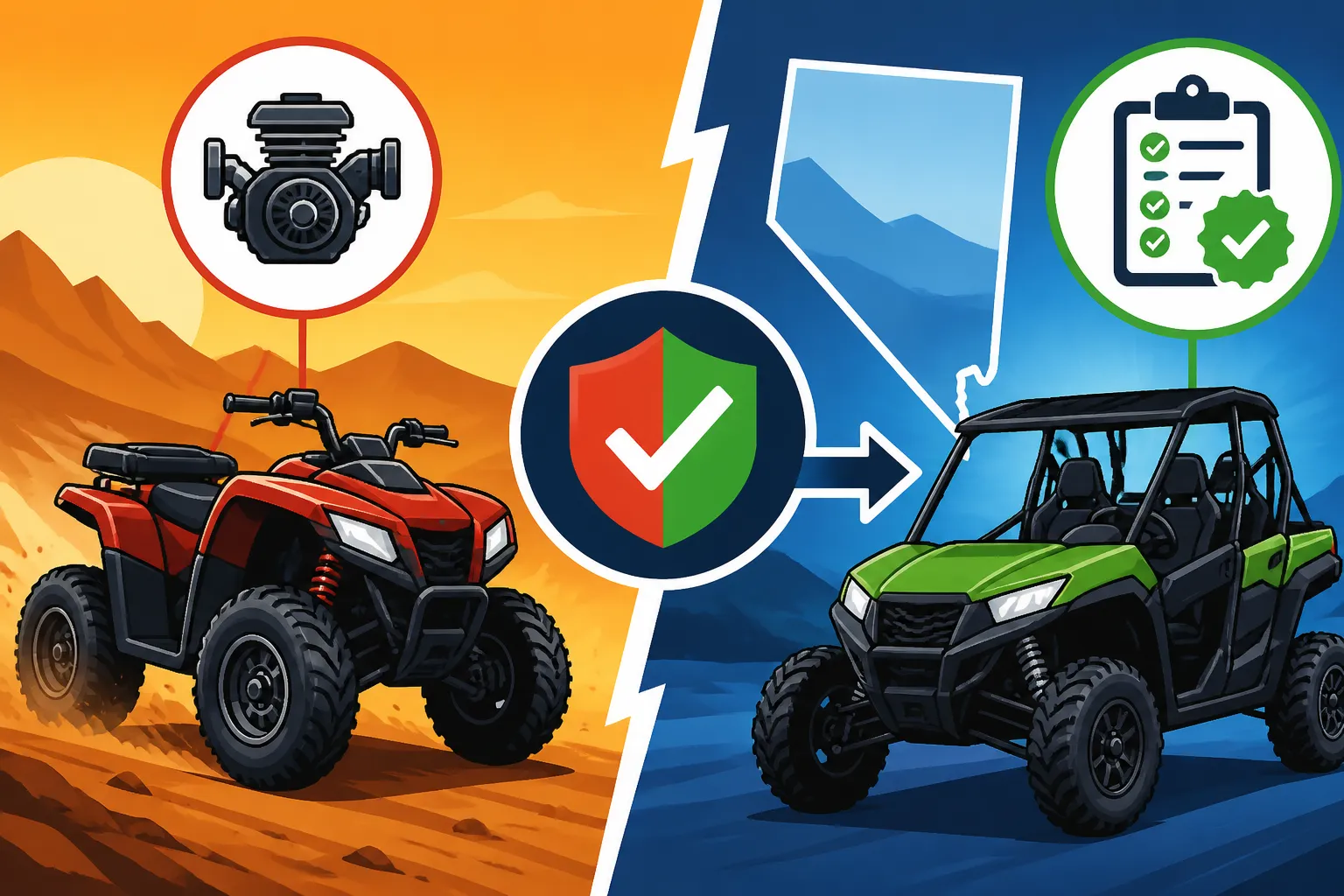
Now, let's get to the heart of the matter: the 70cc cutoff. Nevada law stipulates that an off-highway vehicle must be registered if its engine displacement is 70 cubic centimeters (cc) or greater. This is a bright-line rule that simplifies things for many, but also catches some off guard. It's not about the physical size of the machine, whether it has two wheels or four, or if it's considered a "youth" model. It's solely about the internal volume of the engine's cylinders.
Imagine you've just bought a small, electric-start ATV for your young child, something like a 50cc or 60cc quad. Under Nevada's rules, because this machine is less than 70cc, it is exempt from the state's OHV registration requirement. You don't need a decal, and you don't need to go through the annual renewal process. This is a huge relief for parents who might otherwise be navigating paperwork for a machine their child will outgrow in a few years. This exemption is explicitly designed for the smallest, entry-level machines often ridden by very young children, acknowledging their limited use and power.
Conversely, if your ATV, UTV, or dirt bike has an engine that measures 70cc or more, then it absolutely needs to be registered. This includes most youth models above the smallest tier, all adult-sized quads and side-by-sides, and virtually every dirt bike out there. Even a vintage 70cc Honda Mini Trail, if you plan to ride it on public land, would fall under this registration requirement. This distinction is critical because mistaking an exempt machine for a registrable one, or vice-versa, can lead to unnecessary hassle or, worse, a fine. Understanding [Does a 70cc Machine Need Nevada Registration?] is paramount for many families.
Practical Implications and Other Exemptions
This 70cc rule has significant practical implications, especially for families with multiple machines or for those looking to buy used OHVs. For instance, if you have two children, one with a 50cc quad and another with a 90cc quad, you'll only need to register the 90cc machine. This clarity helps in budgeting for registration fees, understanding annual renewals, and knowing exactly what paperwork to carry when you head to the dunes or trails. It also means that while you might not need to register that 50cc machine, having some form of ownership documentation, perhaps a simple bill of sale created with LawDepot, is still a very good idea, especially if you ever need to prove it belongs to you.
It's important to remember that the 70cc cutoff isn't the only exemption from registration. Nevada also exempts machines manufactured prior to January 1, 1976, sometimes referred to as "vintage" OHVs, regardless of their engine size. So, if your grandfather's old 125cc dirt bike from 1974 is still roaring, it doesn't need a current Nevada OHV decal. Additionally, machines used exclusively for husbandry purposes (like on a working ranch) are also typically exempt, though documentation proving such use might be required if questioned by law enforcement. To avoid confusion, familiarizing yourself with [Machines Nevada Exempts From Registration] can save you a lot of guesswork.
Common Scenarios and What to Watch For
- The "In-Between" Machines: Some manufacturers make machines that hover right around the 70cc mark. Always check the exact engine displacement listed in your owner's manual or on the manufacturer's specifications. Don't guess! A 69cc machine is exempt, a 70cc machine is not.
- Youth Machines: Parents often buy "youth" ATVs. While a 50cc or 60cc might be exempt, a 90cc or 125cc youth model will require registration. Don't assume "youth" automatically means "exempt." This applies to [Nevada OHV Registration for a Youth Machine] specifically.
- Proof of Ownership for Exempt Machines: Even if a machine is exempt from registration, you still want to be able to prove ownership. If you're buying a used machine, especially something under 70cc, make sure you get a clear bill of sale. A template from LawDepot can be invaluable here. While you won't be submitting it to the DMV for registration, it's vital for personal records and avoiding potential issues if the machine is ever stolen or if you later decide to sell it. The general principles of [Buying a Used ATV Privately in Nevada] still apply.
| Engine Displacement (cc) | Nevada OHV Registration Required? | Typical Rider Age Group | Common Machine Types |
|---|---|---|---|
| Under 70cc | No | Very Young Children (4-8) | Small ATVs, Mini Bikes |
| 70cc and above | Yes | Youth (8+) to Adult | Most ATVs, UTVs, Dirt Bikes |
| Pre-1976 (any cc) | No | N/A (Collector/Vintage) | Older Motorcycles, Quads |
| Husbandry Use (any cc) | No | N/A (Farm/Ranch) | Utility ATVs/UTVs |
Navigating the Registration Process for Compliant Machines
So, you've confirmed your machine is 70cc or larger, and it's not pre-1976 or used exclusively for husbandry. What's next? You'll need to go through the standard OHV registration process in Nevada. This involves a few key steps to ensure you get that all-important decal.
First, you'll need the right paperwork. This typically includes a completed application form, proof of ownership (like your manufacturer's certificate of origin if new, or a title/bill of sale if used). If you're buying from a private seller, having a detailed bill of sale is crucial, and knowing [What a Nevada ATV Bill of Sale Should Carry] can protect you. In some cases, if you don't have a title for an older machine that does require registration, you might be able to apply for [Nevada OHV Registration Without a Title], but that's a more involved process.
Next, your machine might need a VIN inspection. While the Nevada DMV itself generally doesn't perform these, a licensed OHV dealer or a sworn law enforcement officer can. This step is vital to verify the machine's identity and ensure it's not stolen. Once your paperwork is in order and any required inspection is complete, you submit your application and fees to the DMV's OHV section. They will process your application, and if everything is correct, issue your registration decal and a registration card. This decal, once applied, is a clear visual indicator that your machine is properly registered and ready for the trails. For a complete guide, check out [Nevada OHV Registration Paperwork Checklist].
Finally, remember that OHV registration in Nevada is not a one-time event. You'll need to renew your decal periodically, typically either annually or every three years, depending on the option you choose at initial registration. This helps ensure that the funds continue to flow into trail maintenance and enforcement, keeping Nevada's off-road areas in great shape for everyone to enjoy. A valid decal isn't just a rule; it's what [What a Nevada OHV Decal Actually Proves] – your commitment to legal and responsible riding.
Disclaimer
This article is for general informational purposes only and does not constitute professional advice. Laws, prices and regulations vary by location and change over time. Consult a qualified professional for guidance on your specific situation.