Nevada Sound Limits on Public Land
A loud ATV or UTV can draw complaints, disrupt wildlife and create trouble on a public-land ride, even when the machine is registered. Nevada riders need to separate basic equipment requirements from restrictions set for particular routes or areas. This article explains what to check, how to reduce noise, and why a registration decal does not excuse riding in a restricted place.
What Nevada’s sound rules mean for public-land riders
Start with the machine, not the map. Nevada’s OHV requirements include having a muffler or noise-reducing device in good working order and in constant operation. A machine with a missing muffler, a damaged exhaust, or an exhaust setup designed to bypass noise control can create a compliance problem before a rider reaches a trail.
That does not mean every public riding area has one simple sound limit that applies in the same way everywhere. Requirements may depend on the type of land, the specific route, a posted restriction, or the conditions for an organized event. A rule that applies to a particular facility or activity should not automatically be treated as a statewide public-land decibel limit.
When checking a ride, distinguish three questions:
- Is the machine properly equipped? The exhaust should include a functioning muffler or other required noise-control equipment. Check for loose joints, leaks, missing parts, or an altered system that makes the machine substantially louder.
- Does the land manager impose an additional condition? A route, recreation area, event permit, or temporary closure may have requirements beyond the basic vehicle equipment rule.
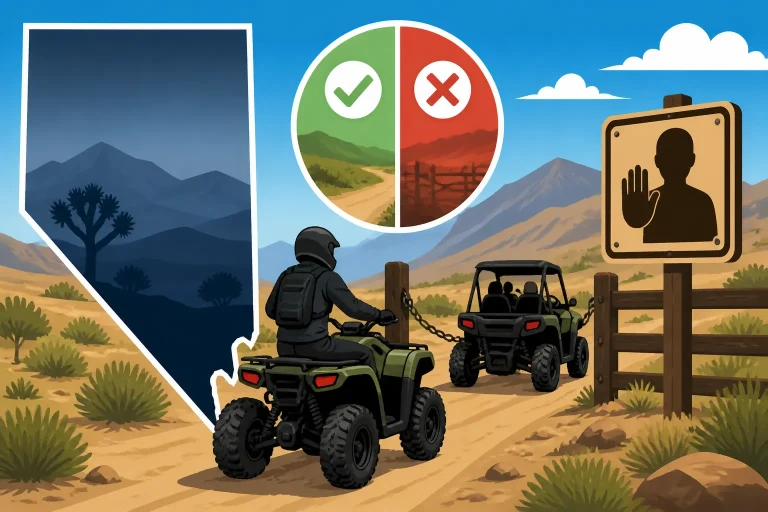
- Is the ride allowed on that route at that time? A registration decal does not open a closed road or waive local restrictions.
The distinction matters because “public land” is not one uniform riding area with a single manager and identical rules. A route can cross land with different management, pass near a sensitive resource, or be subject to temporary restrictions. Before a trip, review the applicable route information and, when the rule is unclear, contact the local office responsible for the area. The broader overview in Nevada Rules for Riding Federal Land can help explain why route status and land-manager rules matter alongside state requirements.
A Nevada OHV decal is important for riding where registration is required, but it is not a blanket permission to ride wherever a machine can physically go. The decal does not cancel an area closure, make an unauthorized route legal, or replace a special permit for an organized activity when one is required. For the role of registration in public-land riding, see Nevada’s Registration Decal as Your Permit.
How to check a route or area before riding
Noise questions are easiest to resolve before unloading the machine. Start with the land manager’s current information for the destination, then check the exact route you plan to use. A general map or a past trip report may not reflect a closure, seasonal condition, event restriction, or updated travel plan.
Use this checklist:
- Identify who manages the route. A ride may involve federal, state, county, or other land. Do not assume one office’s guidance covers every segment.
- Look for current route and area notices. Check official maps, travel-management information, closure notices, and any posted conditions for the riding area.
- Read permit or event terms carefully. If you are joining an organized ride, race, or permitted activity, the organizer or permit may set conditions riders must follow.
- Ask a specific question if the wording is unclear. Give the office the route name or location and ask whether there is a current noise-related restriction, equipment standard, or operating condition.
- Check again close to departure. Conditions and access can change. A route that was open on a previous visit may not be open for the next one.
If a route is closed, avoid using it even if the machine is quiet. Nevada Rules for Riding a Closed Route explains the separate issue of where riding is allowed. Noise compliance and route compliance are related, but one does not substitute for the other.
A broad sound restriction may also be only one part of an area’s rules. Riders should check for fire restrictions, wildlife protections, seasonal closures, speed limits, camping rules, and other conditions that apply to the planned trip. The same preparation helps avoid misunderstandings at the trailhead and reduces the chance of having to turn around after unloading.
If official online information is incomplete or contradictory, call the office that manages the route. Calling a BLM Field Office Before a Ride is a useful next step when a ride involves Bureau of Land Management routes or unclear access information. Ask the office to identify the relevant rule or map rather than relying on a general answer about “the area.” Save a copy of the map or notice you used, but remember that a saved copy does not override a newer closure or instruction posted at the site.
Practical ways to keep an ATV or UTV quieter
The most reliable way to reduce avoidable noise is to maintain the exhaust system and ride considerately. A machine can sound much louder when a muffler is worn, a connection has loosened, or an aftermarket component changes the exhaust path. Fixing a mechanical problem is more dependable than trying to compensate with careful throttle use alone.
Before leaving home, inspect:
- The muffler and exhaust components for damage, looseness, or missing parts.
- Exhaust connections for leaks, unusual vibration, or soot around joints.
- Any replacement exhaust parts to make sure they are intended to retain effective noise control.
- The machine for rattling accessories, loose body panels, or cargo that may add unnecessary noise.
If you are considering a replacement part, check its fit and intended use against your machine and the rules for where you ride. A part described as high-performance is not necessarily suitable for a public-land trip. Keep the original components if you may need to restore the machine to a quieter configuration.
Riding style also affects what other people hear. Avoid unnecessary revving, repeated high-speed passes, and prolonged idling near campsites, homes, trailheads, or other riders. Use the route as intended instead of creating extra noise by accelerating hard in a sensitive area. If you stop to regroup, choose a suitable place and shut the machine off rather than leaving it running while the group talks.
These habits are especially considerate around wildlife, livestock, and people using the area for activities other than riding. They do not replace equipment requirements or make an otherwise prohibited route legal, but they can reduce disturbance and conflict. If your trip involves animals or working land, Nevada Rules for Riding Near Livestock offers related guidance.
A handheld sound meter or phone app can help identify a machine that seems unusually loud, but it is not a reliable substitute for an official test. Measurement results can vary with distance, angle, surface, wind, background noise, engine condition, and test procedure. Consumer sound meters sold through retailers such as Amazon may be useful as a rough maintenance check; do not assume their reading proves legal compliance. If a land manager specifies a test method or limit, follow that instruction and ask how compliance is determined.
| Check | What it can tell you | What it cannot establish |
|---|---|---|
| Visual exhaust inspection | Whether parts appear missing, loose, or damaged | Whether the machine passes a formal sound test |
| Listening for leaks or rattles | Whether a repair may be needed | Whether a route has a noise restriction |
| Phone app or consumer meter | Whether the machine seems louder than expected | Official compliance under a prescribed test |
| Current land-manager notice | Whether a local condition or restriction is posted | Whether the machine’s exhaust is mechanically sound |
| Direct question to the responsible office | How a rule applies to a specific route or activity | Permission to ride a closed or unauthorized route |
If a machine is noticeably louder after an exhaust change, do not wait for a complaint to investigate. Restore effective noise control and confirm the setup is appropriate for the intended riding area. For general public-land conduct, Nevada Trail Etiquette on Shared Dunes also covers the practical courtesy that makes busy riding areas safer and more enjoyable.
What to do if you are stopped or receive a complaint
Stay calm and listen to the ranger, officer, land manager, or other official giving the instruction. Do not argue that a current decal settles the issue; registration and operating conditions are separate matters. Ask which rule or area condition applies, and whether the concern is the machine’s equipment, a route restriction, a posted local requirement, or the way the machine is being operated.
If you are asked to stop riding or leave a route, comply while you clarify what is required. Continuing to ride while disputing the instruction can turn a straightforward equipment or access question into a more serious enforcement issue. If the concern appears to involve a mechanical defect, inspect the exhaust only when it is safe to do so and arrange a repair before returning to the route.
Afterward, write down the location, the nature of the instruction, and any rule or notice cited. If you believe the rule was misunderstood, contact the responsible office later with those details. Avoid relying on a secondhand account from another rider when resolving a location-specific question; ask the agency or land manager directly.
For future trips, carry your registration information and know the route you intend to ride. Nevada OHV Registration and Proof of Ownership covers the paperwork side of a ride, while route maps and current notices address access. Keeping those issues separate makes it easier to respond clearly if an official asks about either one.
The practical takeaway is simple: use a properly functioning muffler, avoid unnecessary noise, and verify the current conditions for the exact public-land route. Do not assume a registration decal, a quiet machine, or a past visit grants permission to ride everywhere.
Disclaimer
This article is for general informational purposes only and does not constitute professional advice. Laws, prices and regulations vary by location and change over time. Consult a qualified professional for guidance on your specific situation.