Riding the Logandale Trails After Rain
Rain can change a Logandale ride from dusty and predictable to slick, rutted, or unexpectedly impassable. The tricky part is that conditions may differ across the trail system: one route can be drying while a nearby wash is still moving water. This guide explains how to judge whether to ride, what to check before leaving Overton, and how to protect your group and the terrain after a storm.
How Rain Changes the Logandale Trails
Expect different conditions across the same riding area
The Logandale Trails sit in a desert landscape where rainfall can affect routes unevenly. A brief shower may leave exposed rock damp but passable, while a heavier storm can send runoff into low spots and washes. Soil, slope, shade, and drainage all influence how quickly a section dries. That means yesterday’s report—or the conditions at the trailhead—may not tell you what to expect farther along.
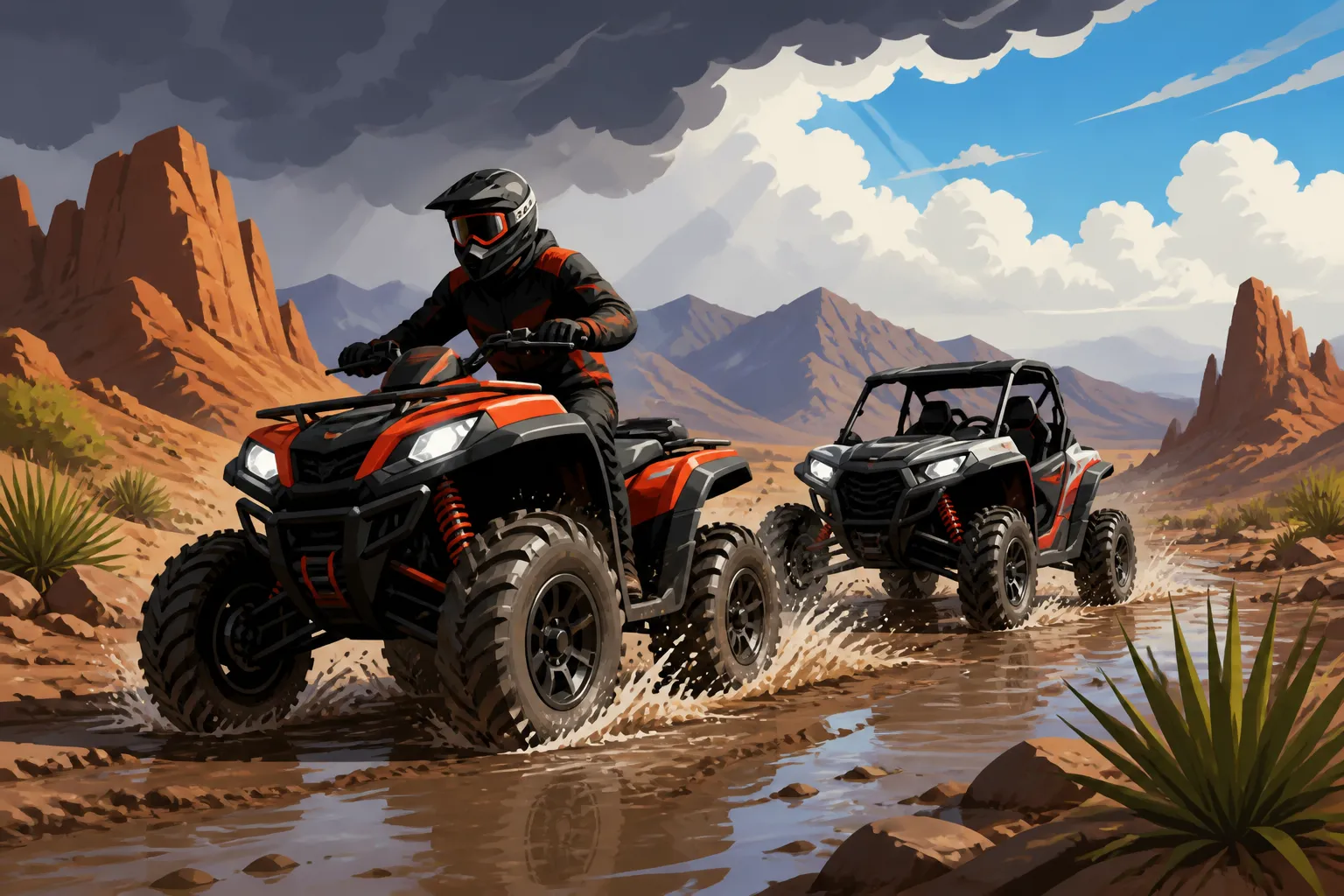
After rain, loose sand can become heavy and compacted, and fine soil may turn slick or cling to tires. Ruts can deepen when vehicles pass through soft ground, especially where runoff has already cut channels. Rock surfaces may also have less grip when wet. A route that felt easy in dry weather can take more care when traction changes, even if there is no standing water.
The familiar red-rock scenery around Logandale can make it tempting to keep moving toward a favorite viewpoint or loop. But the better choice is to reassess as you go. If the surface is breaking apart under your tires, water is still flowing, or your vehicle is sliding on a mild slope, turn around before the situation becomes difficult to manage.
Washes deserve special attention
A dry wash can look harmless from a distance, but rain may send runoff through it from storms well beyond the spot where you are riding. Water can arrive quickly, carry debris, or make the bottom soft and unstable. Never assume a wash is safe to cross just because the sky above you is clear. Conditions upstream can differ from those at your location.
Avoid entering a wash with moving water, an uncertain bottom, or steep, slippery banks. Do not park or wait in a low channel while deciding what to do. If water is rising or the route is unclear, turn around and move to higher ground if you can do so safely. The practical guidance in [Riding a Desert Wash Safely] and [Flash Flood Season in the Desert] is worth reviewing before a wet-weather trip.
A wash can also be a poor place to attempt a recovery. A stuck vehicle, a group gathering to help, and flowing water are a dangerous combination. Keep everyone away from the channel and choose a safer route back rather than trying to push through a crossing that has become questionable.
Mud can damage more than your machine
It is easy to focus on whether an ATV or UTV can get through a muddy section. The more important question is whether riding through will leave lasting damage. Spinning tires can gouge soft ground, widen an existing track, and create ruts that direct later runoff. Repeated passes can turn a short-lived wet patch into a lasting erosion problem.
If your tires begin to dig in, stop spinning them. Back out along your own tracks if the ground allows, or choose a firm, already-established route. Avoid making a new bypass around a puddle or muddy stretch; those detours can broaden the disturbed area and damage fragile desert ground.
How to Decide Whether to Ride After Rain
Check access and conditions before leaving
Before heading out, look for current land-management notices and route information. An area may be accessible while individual routes are unsuitable, or a temporary closure may affect travel after weather or other concerns. Do not treat an open gate or a visible trail as proof that every route is open and safe. Check [Nevada Trail Closures to Check Before You Go] and contact the appropriate land-management office if the status is unclear.
Maps can help you understand where established routes run and where route choices may be limited. An app such as onX Offroad can help you review mapped routes and prepare for a trip, particularly if you download maps before leaving service. Still, a digital line on a screen cannot tell you whether a wash is flowing or a slope is too slick to climb. Use mapping as a planning aid, not a substitute for on-the-ground judgment.
A useful pre-ride routine is to check the forecast for the broader area, review any access updates, confirm your intended route, and tell someone where you expect to ride. Rain may have fallen outside Logandale itself but still affect drainage in the area. If the forecast suggests more storms, consider postponing rather than committing to a route with limited ways out.
Use a conservative go-or-no-go test
There is no single amount of rain that makes every Logandale route safe or unsafe. The storm’s intensity, its location, soil conditions, drainage, and the vehicle all matter. Instead of relying on a fixed waiting period, assess what is happening on the ground and be willing to change plans.
| What you observe | Safer response |
|---|---|
| Water is flowing through a wash | Do not enter or cross it; turn around and seek a safe route away from low ground |
| Tires slide or spin on a gentle section | Stop before the surface is damaged; backtrack if safe or choose a firm established route |
| Deep mud, fresh ruts, or unstable banks | Avoid the section and do not create a bypass |
| The route is firm, visibility is good, and access is confirmed | Proceed cautiously, reassessing conditions as the route changes |
| Storms are nearby or more rain is forecast | Delay the ride or choose a safer plan with straightforward exit options |
If several riders are together, agree on these decisions before anyone takes the lead. A group can feel pressure to continue because the trailhead is far behind or someone has already driven through a difficult section. Make it clear that any rider can call for a turnaround when conditions change.
Match the route to the group and the machine
A route that is manageable for an experienced rider in a well-equipped UTV may be a poor choice for a beginner on a smaller ATV after rain. Wet conditions make it harder to correct a slide, stop on a slope, or recover from a mistake. Review [Logandale Trails Difficulty Ratings] when choosing routes, and then be more conservative than you might be in dry weather.
Consider the least experienced rider, the youngest passenger, and the vehicle with the least suitable tires or ground clearance. If one machine is struggling, the group should not split up and leave that rider behind. A slower ride on a firm route is usually more enjoyable than trying to extract a vehicle from soft ground while weather and daylight are changing.
Families may also want to revisit [Logandale Trails With Kids] before a post-rain trip. Children can become cold, tired, or unsettled during a long delay, and a wet-weather ride may take longer than expected. Build in extra time and make sure everyone knows the plan if the group turns around.
Riding Carefully When Conditions Are Wet
Protect traction and avoid unnecessary strain
Use smooth, gradual control inputs. Sudden acceleration can break traction, while abrupt braking may cause a slide on slick ground. Keep a generous following distance so you are not forced to stop sharply if the rider ahead encounters a soft patch or an unexpected washout.
Choose a line that stays on firm, established ground. Avoid steep slopes if the surface looks slick, and do not attempt a climb simply because it was easy in dry conditions. If you cannot see what is over a rise or around a bend, slow down enough to stop safely. Mud can hide rocks, holes, or freshly cut channels.
Before riding, inspect tires, brakes, steering, and the vehicle’s recovery equipment. Mud packed around wheels or components can affect handling, and wet conditions can make a minor mechanical problem harder to solve. Carry water, basic tools, a first-aid kit, and a way to communicate. Cell service can be unreliable in remote riding areas, so do not make a phone signal your only emergency plan.
Stay on established routes and respect closures
A tempting bypass around a muddy section may look harmless, especially if another set of tracks already crosses it. But those tracks do not establish that the route is open or that the ground can withstand more traffic. Stay on designated routes and avoid widening the disturbed area. [Reading a BLM Travel Management Map] can help you understand mapped route boundaries and avoid assuming that every visible track is an authorized route.
If you encounter a closure sign or a barrier, respect it rather than riding around it. Conditions after rain may be one reason access is restricted, but the sign itself is the direction to follow. If you are unsure whether a route is open, stop and verify rather than treating uncertainty as permission.
For route planning, an offline map in onX Offroad or another mapping tool can be useful when service is limited. Download it ahead of time and make sure everyone in the group understands the route and turnaround options. Keep in mind that maps may not show temporary closures, fresh erosion, or storm damage. Local conditions take priority over the planned line.
Leave the area in better shape
If a route is soft enough that your tires are cutting deep tracks, the most responsible move is to stop riding that section. Continuing can compact and reshape the soil, creating ruts that hold water and worsen erosion. A day of patience can prevent a short wet spell from leaving damage that lasts long after the ground dries.
When the ride is over, clean mud from the machine before it hardens, following the manufacturer’s guidance around electrical parts, bearings, and seals. Check for debris around the wheels and undercarriage, and inspect the tires for damage. If you had to use recovery equipment, inspect it before storing it so it is ready for the next trip.
Also give the group time to dry out, clean gear, and check that everyone is accounted for before leaving the area. If you planned an overnight stay, review [Logandale Trails Camping Spots] and confirm that your chosen site is suitable and accessible under the conditions you encounter. Do not assume a campsite or access road will be unaffected by rain just because the riding route looked manageable.
A Practical Plan for a Post-Rain Logandale Ride
Before you go
Start with access and weather checks, then choose a conservative route with clear options to turn around. Share the plan with someone who is not riding with you. Pack for a slower trip than usual: water, food, warm and dry layers, first aid, tools, recovery gear, and offline navigation. A day trip guide such as [Logandale Trails for a Day Trip] can help with broader planning, but wet-weather decisions still need to be based on conditions on the ground.
Think through the group’s limits in advance. Decide what will trigger a turnaround, such as moving water, soft ground that is rutting, poor visibility, or a forecast that worsens. This avoids having to negotiate the decision while people are cold, tired, or already committed to a difficult section.
If you use onX Offroad to plan, save the relevant map before traveling and identify more than one route back. Marking a reasonable turnaround point can help prevent a common mistake: continuing farther than planned because everyone assumes the trail will improve just ahead.
During the ride
Start slowly and treat the first section as a condition check. Pay attention to how the tires grip, whether water is draining across the route, and whether the surface is firm enough to support the vehicle without rutting. Reassess at every major change in terrain. Conditions on a rock ledge, a sandy stretch, and a wash can be very different within a short distance.
Keep the group together without crowding. Riders should be able to stop without colliding, and the person behind should know when the lead rider is slowing or turning around. If someone is uncomfortable, take that seriously. A cautious retreat is a successful decision, not a failed ride.
If the route becomes unsafe, do not let the desire to reach a landmark override the conditions in front of you. Turn around early, avoid flowing water and unstable ground, and choose the safest established route available. A dry-weather ride at Logandale will still be there when conditions improve.
After the ride
Let someone know you are back, especially if you shared a planned return time. Clean and inspect the machines, dry wet clothing and gear, and note any route sections that were soft or damaged. If you observed a closure, washout, or hazard, share that information with the appropriate land manager rather than posting it as a route to try.
Most importantly, leave no new tracks outside established routes and do not encourage others to cross a wash or muddy section that was unsafe for your group. A careful post-rain ride is less about finding a way through every obstacle and more about recognizing when the desert needs time to recover.
Disclaimer
This article is for general informational purposes only and does not constitute professional advice. Laws, prices and regulations vary by location and change over time. Consult a qualified professional for guidance on your specific situation.