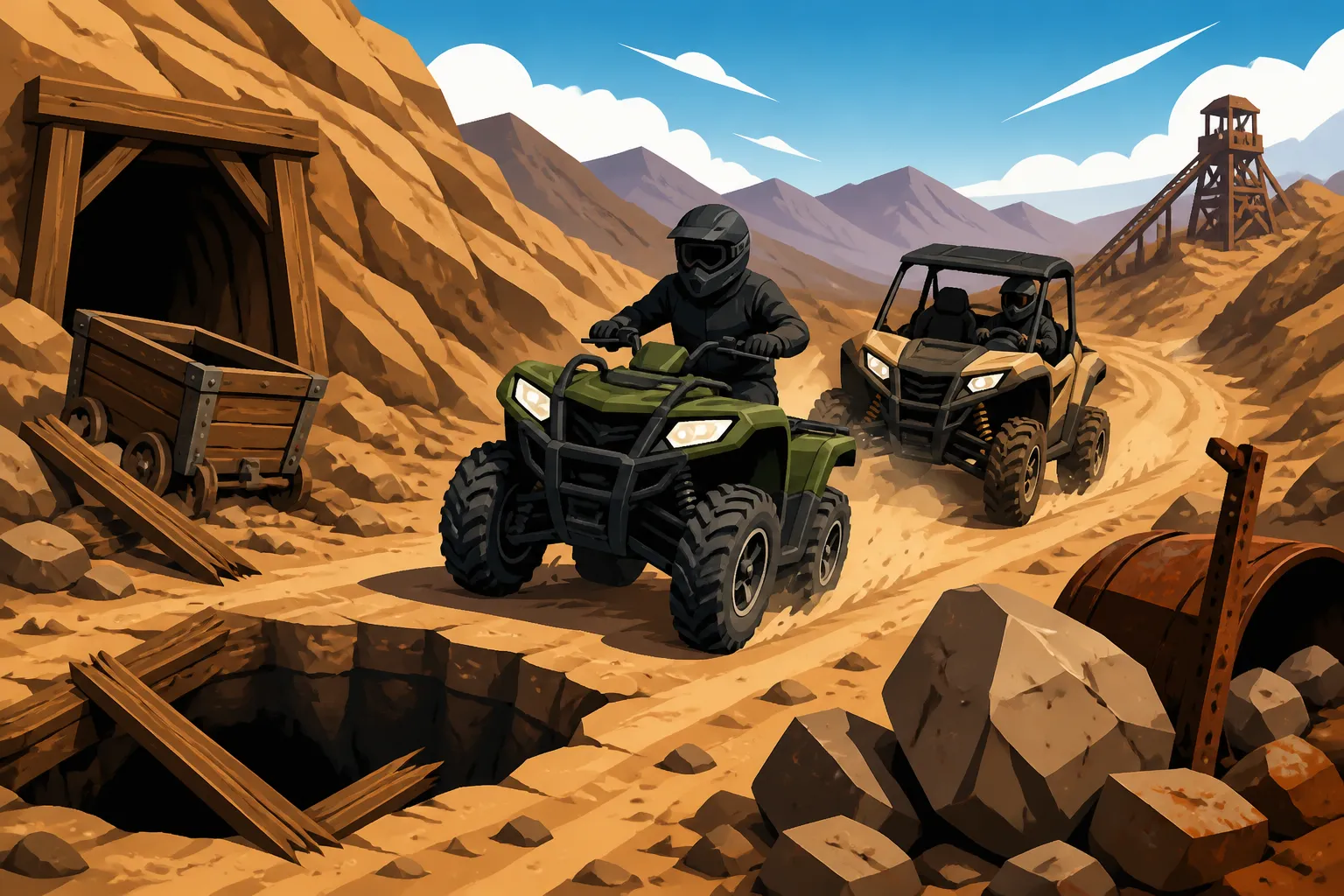
Nevada Mining Road Hazards
A Nevada mining road can look like an easy shortcut across open desert, then turn into loose gravel, a washed-out crossing, or a route that ends at an old mine opening. This guide explains the hazards ATV and UTV riders should watch for, how to check whether a route is open, and what to do when the ground or road conditions feel uncertain.
Why Nevada mining roads can be risky
Old mine features may be hard to spot
Nevada’s mining history is visible across much of the state, from the hills around Tonopah and Goldfield to old workings near Ely, Searchlight, and Nelson. A ride on a former mining road can pass close to abandoned shafts, adits, pits, trenches, and unstable structures. Some openings are easy to see; others may be partly covered by brush, debris, or a thin crust of soil.
Do not assume an opening is safe because it looks shallow, has a fence nearby, or appears on a map as an old mine. Barriers can be damaged or missing, and a fenced feature may not be the only hazard in the area. Keep your machine on the established road, stay well away from openings and edges, and never ride over a mound or patch of ground that could conceal a void.
Tailings and waste rock can also be unstable. A slope that looks firm from the road may crumble under a tire, especially after rain or repeated vehicle traffic. If a route passes through a former mine site, slow down, avoid climbing piles, and do not stop where your vehicle could block an active access road. For a broader look at these risks, see [Nevada Mining Road Hazards] and [Open Shafts and Why You Stay on the Road].
The road surface can change without warning
Mining roads were built for specific work, not necessarily for recreational riding. They may be steep, narrow, deeply rutted, or cut into a hillside with little room to turn around. A road that seems manageable on the way in can become much harder when you meet a washout, loose rock, or a sharp drop-off on the return trip.
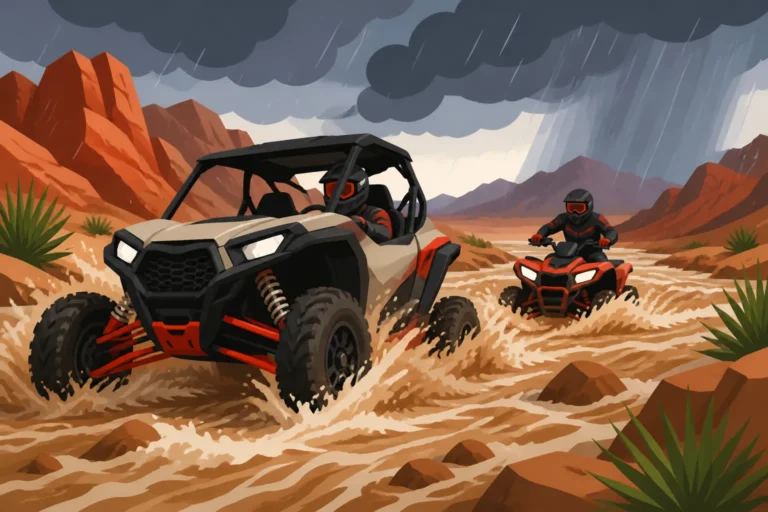
Water is a major reason conditions change. A dry wash can carry fast-moving water during a storm, while runoff can carve channels across a road or undermine its edge. Even if the sky is clear where you are riding, rain elsewhere in the drainage may send water downstream. Check the route and forecast before leaving, and do not enter a flooded crossing or drive around a closure to find another way through.
Mining traffic can add another layer of risk. Work vehicles may use roads that look abandoned, and dust can limit visibility around bends. If you encounter a truck, loader, or other work vehicle, move to a safe place without driving onto soft shoulders or unstable ground. Leave room for larger vehicles to pass, and do not assume a quiet road is unused.
Land ownership and access are not obvious from the road
A road’s appearance does not tell you whether it is public, private, open to motorized travel, or restricted. In Nevada, a route can cross public land, private parcels, mining claims, or a mix of land types. A visible track on a map is not, by itself, permission to ride it.
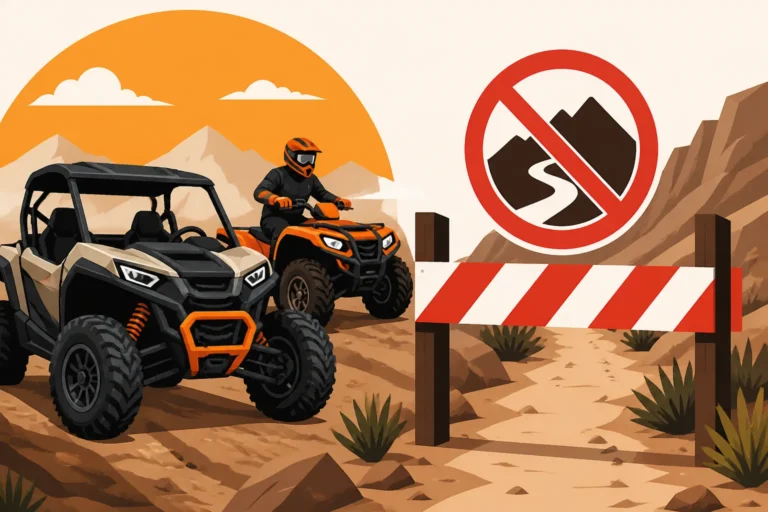
Pay attention to signs, gates, fences, and posted restrictions. Never bypass a barrier or continue past a sign that closes a road. If a route becomes unclear, stop and check your map rather than following tire tracks across the desert. Tracks can lead onto private property, into a closed area, or toward a feature that is unsafe to approach.
Before your trip, review the land manager’s travel information and compare it with a navigation tool. onX Offroad can help riders examine routes and land boundaries while planning, but map layers should be treated as planning aids, not as a substitute for posted signs or official closure information. For more on map use and access rules, read [Reading a BLM Travel Management Map] and [Nevada Rules for Riding a Closed Route].
How to check a mining road before you ride
Plan the route and a way back out
Start with a route that matches your group’s experience and machine. A narrow two-track with steep side slopes may be a poor choice for a wide side-by-side, even if the road is technically passable. Consider the vehicle’s ground clearance, tire condition, turning space, passenger comfort, and whether anyone in the group has experience with loose rock or steep grades.
Look at the entire route, not just the destination. Identify places where you could turn around, likely fuel stops, and sections where a breakdown could leave you far from help. A plan should include an alternate route or a clear decision point where the group will turn back if the road deteriorates. Share your intended route and expected return time with someone who is not riding with you.
Use more than one source when checking route access. onX Offroad may help you follow mapped roads and review land boundaries, while official travel maps and local land-management information can help clarify restrictions. Keep an offline map available because cellular service can be unreliable in remote areas. For general route planning, see [Planning a Ride With Trail Finder] and [Riding Open BLM Land Versus Marked Trail].
Inspect conditions instead of trusting a map line
A digital route can show where a road was mapped, but it cannot promise that the road is currently passable or open. A storm, fire restriction, work project, or land-management decision may change conditions. Before setting out, check for relevant notices and closures, then reassess at the trailhead if you find new signs or barriers.
As you ride, stop at safe pullouts to look ahead. Check for loose rock, sharp washouts, drainage cuts, undercut edges, and places where the road narrows. Do not drive onto a questionable shoulder to test it. If the road is too narrow to turn around safely, think carefully before continuing into a steeper or rougher section.
A useful rule is to turn around before the road becomes difficult to reverse. Riders often feel pressure to “just see what’s around the next bend,” especially after driving a long way to reach the area. But the next bend may leave no room for a multi-point turn, and backing down a loose slope can be more dangerous than stopping early. A conservative turnaround is a good ride decision, not a failed trip.
| Hazard | What it can look like | Safer response |
|---|---|---|
| Mine opening | Shaft, adit, pit, trench, or an obscured hole | Stay on the established road and keep well away |
| Loose or unstable slope | Crumbling rock, tailings, steep edge, or fresh slumping | Avoid climbing or driving along the edge |
| Washout | Deep rut, missing road surface, or undercut crossing | Stop before the damaged area and assess from firm ground |
| Flash-flood risk | Dry wash, storm clouds, or runoff channels | Do not enter flowing water; turn back if conditions change |
| Restricted access | Gate, sign, fence, or marked closure | Do not bypass it; choose another legal route |
| Poor visibility | Dust, blind bends, or narrow road | Reduce speed, leave space, and watch for work vehicles |
Staying safe around mines, claims, and remote routes
Keep a clear distance from mine features
Give old workings more space than you think they need. Do not walk or ride right up to an opening to take a photograph, and do not climb on mine structures or tailings piles. The ground near an opening may be unstable beyond the visible edge, while old buildings and equipment can have sharp metal, weak floors, or concealed drop-offs.
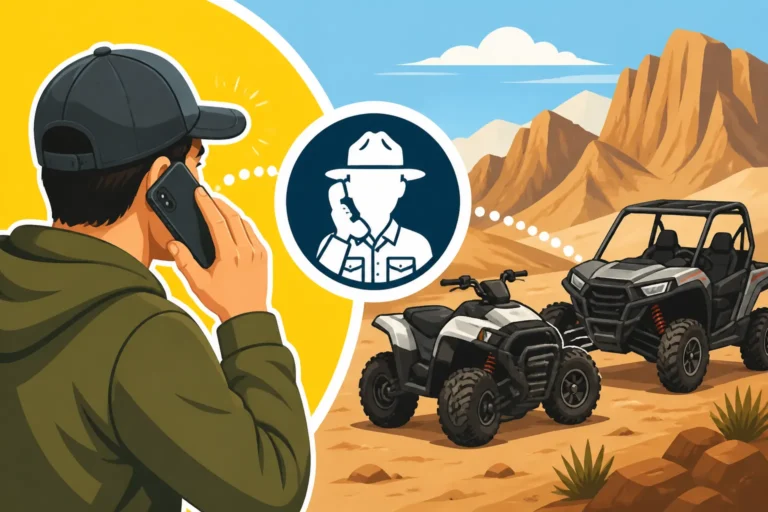
If a rider spots an opening or damaged barrier, tell the group to stop in a safe place and keep everyone away. Do not try to inspect the feature, move debris, or enter an old structure. If there is an immediate danger to other people, report it to the appropriate land manager or local authority when you have a safe opportunity.
Keep children and inexperienced riders close, especially around historic mining areas where curiosity can pull someone away from the group. Establish a simple rule before the ride: nobody leaves the road or approaches mine features without the group leader’s approval. This is especially important when dust, noise, or terrain makes it difficult to keep everyone in view. More practical guidance is covered in [Riding Near an Active Mine] and [Nevada Mining Road Hazards].
Carry supplies for a delay or breakdown
A remote mining road can become a long wait if a tire fails, a machine overheats, or the route becomes impassable. Carry enough drinking water for the people in your group, plus extra for an unexpected delay. Bring basic first-aid supplies, a charged phone, a tire repair kit suited to your machine, and tools for minor repairs.
Do not rely on phone service as your only way to communicate. In parts of central and eastern Nevada, service may be limited or absent once you leave a town or paved highway. A satellite messenger or other emergency communication device can provide another way to call for help, but it does not replace trip planning, safe riding, or telling someone where you are going.
Before you leave, check fuel range and avoid assuming that a small town or remote station will have fuel available when you arrive. Keep your group together, especially if one machine has a mechanical problem. If you must stop, choose stable ground away from traffic, mine openings, and wash channels. For more preparation advice, see [Water and Fuel Planning in Nevada] and [Breaking Down Far From the Trailhead].
Ride with space and patience
Mining roads often have limited sightlines. Leave enough room between machines to see through dust and react to hazards ahead. If a rider disappears in a cloud, slow down rather than trying to catch up. On a narrow road, avoid bunching together near bends, steep edges, or places where another vehicle may need to pass.
Use a spotter only when the person can stand well away from the vehicle’s path and from any unstable slope or mine feature. A spotter should never stand below a machine on a steep grade or near a blind corner. If the driver cannot see the spotter clearly, stop and reset the approach instead of guessing.
Agree on group signals and a turnaround plan before starting. Make sure every rider knows what to do if the group becomes separated: stop somewhere safe, avoid riding farther down an unfamiliar track, and use the agreed communication method. When conditions are uncertain, it is safer to return together than to split up in search of a shortcut.
A practical decision checklist for Nevada mining roads
Before you leave
Check that the route is open to motorized travel and review any land-management notices that apply. Look at the forecast for the route and surrounding drainages, not only the town where you are staying. Confirm that the machines are suitable for the road, and that each rider understands the group’s skill level and turnaround plan.
Download or save maps for offline use and carry a backup way to navigate. Tools such as onX Offroad can make it easier to review a planned route and nearby land boundaries, but do not treat a mapped track as proof that access is legal or that the road is passable. If information conflicts, follow posted restrictions and seek clarification from the responsible land manager.
Tell someone outside the group where you plan to ride and when you expect to return. Include the general area, your planned route, and what they should do if you do not check in. A route plan is most useful when it is shared before the ride, not reconstructed after a problem occurs.
When to turn around
Turn back if you see a closure, a gate you cannot lawfully pass, an unstable slope, a mine opening near the route, or a washout you cannot cross without risking a rollover or getting stuck. Also reconsider if weather is moving in, visibility is poor, fuel is running low, or the group is tired and making rushed decisions.
If the road gets narrower or steeper than expected, stop on stable ground and decide as a group. Avoid letting one confident rider pressure everyone else into continuing. A machine may be capable of climbing a difficult section, but that does not mean the entire group can safely descend it, turn around, or recover if something goes wrong.
When you are unsure whether a road is open or safe, choose another route. Nevada has plenty of places to ride, and a canceled spur road is a small inconvenience compared with an injury, a damaged machine, or an access problem. To compare route options and conditions, see [Nevada Trail Closures to Check Before You Go] and [Nevada Mining Road Hazards].
Disclaimer
This article is for general informational purposes only and does not constitute professional advice. Laws, prices and regulations vary by location and change over time. Consult a qualified professional for guidance on your specific situation.