Nevada Sand Dune Flag and Whip Rules
A dune crest can hide an approaching quad or side-by-side until the last moment, especially when everyone is kicking up dust. Nevada’s sand-dune flag and whip rules are meant to make machines easier to see before they meet over a ridge. This guide explains the basic equipment to carry, how to mount and check it, and what to consider at popular riding areas.
Nevada sand dune flag and whip requirements
What the flag and whip do
The flag is the visible signal; the whip is the flexible pole that holds it above the machine. Together, they help other riders spot you when dunes, terrain, or dust block the view. A flag that sits low behind a passenger or disappears against the sky at a crest may technically be attached, but it is not doing its most important job.
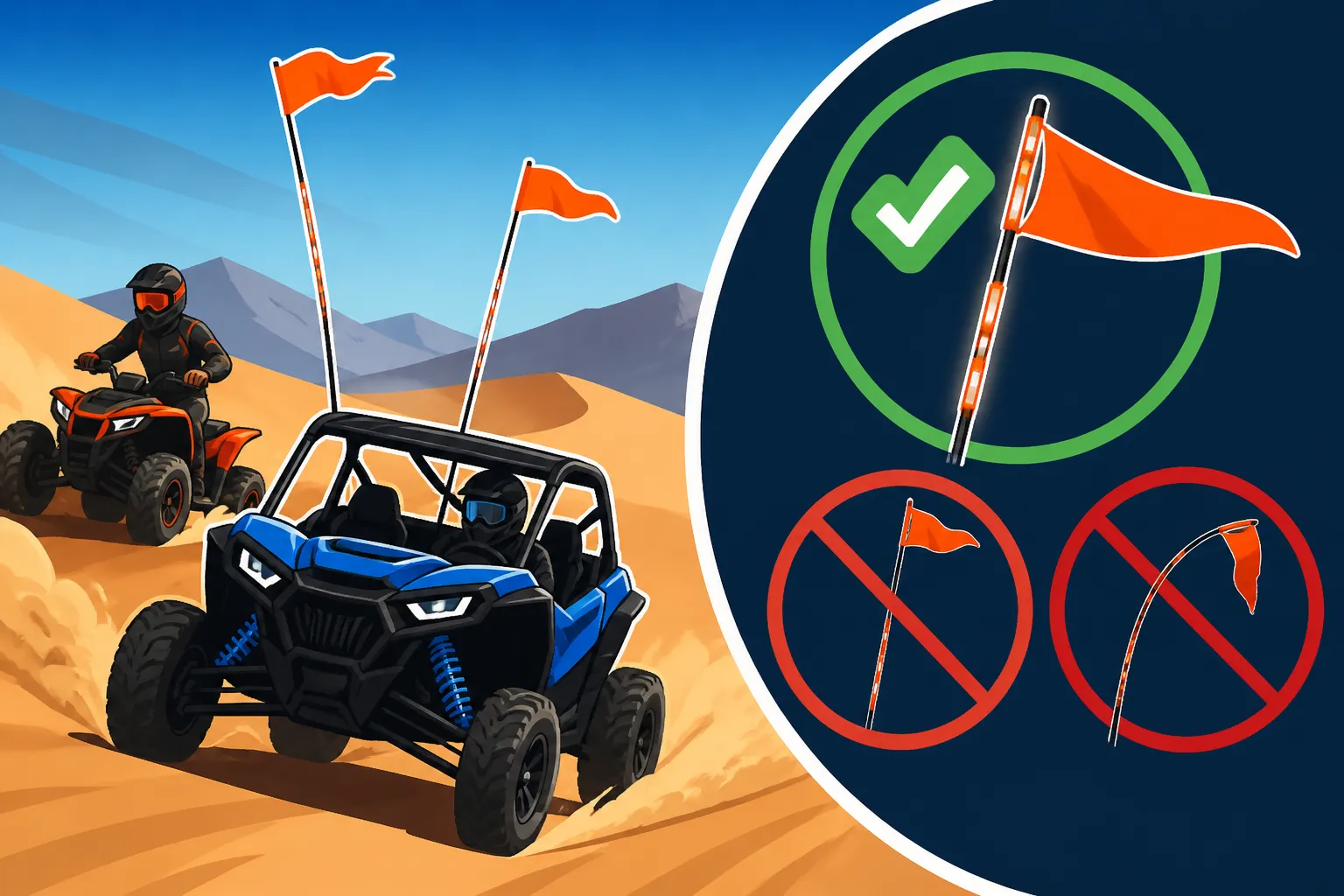
Nevada’s sand-dune requirement calls for a brightly colored flag on a pole or whip, with a minimum flag size of 6 by 12 inches and the top of the flag at least 8 feet above the ground. Treat those measurements as a minimum, not a promise that the flag will be easy to see in every situation. Check the rules for the specific riding area before setting out, since local land managers may provide additional instructions.
A quad and a side-by-side face the same basic visibility problem: another rider may approach from the other side of a ridge with little warning. The whip gives the flag height, while its flexibility helps it move and remain visible over uneven ground. It is not a substitute for slowing down near blind crests, keeping a lookout, or following designated routes.
What to check before you ride
Before leaving the staging area, make sure the flag is securely attached and that the whip has not cracked, bent out of position, or worked loose. Check the height with the machine on level ground. A tall whip can flex when riding, and a flag that seems high while parked may sag or catch on the vehicle once you start moving.
Look at the flag from several directions. It should be bright, easy to see, and free of tears that reduce its visible area. Dust and sun can make colors look dull, while a folded or tangled flag may be much harder to spot from a distance. Carrying a spare flag or a simple repair option can save a trip if a branch, rollover, or rough trail damages the setup.
| Check | What to look for | Why it matters |
|---|---|---|
| Flag size | At least 6 by 12 inches | Meets the stated minimum size |
| Flag height | Top reaches at least 8 feet above ground | Helps riders see you across dunes |
| Color and condition | Bright, clean, and not badly torn | Keeps the flag visible in dust and glare |
| Mount and whip | Secure, upright, and not damaged | Prevents the assembly from loosening or falling |
| Local rules | Any extra area-specific requirements | A site may have instructions beyond the general baseline |
If you are planning your first outing, it helps to get familiar with the terrain and staging setup before the riding day. [Sand Mountain for a First Dune Trip] can help you think through the practical details of a first visit, while [Nevada Sand Dune Flag and Whip Rules] is a useful reference topic to revisit when checking your equipment plan.
Setting up a flag on an ATV or UTV
Choosing a mount that stays put
A flag is only useful if the mount stays attached over bumpy ground. Choose a mounting point designed for the vehicle and compatible with its frame or accessory system. Avoid improvised placements where the whip can interfere with a passenger, block a light, snag on cargo, or contact moving parts. On a side-by-side, consider how the pole sits in relation to the roof, bed, rear cage, and any accessories.
After mounting, gently test the assembly by hand. It should be secure without being so rigid that normal whip movement is prevented. Follow the flag and mount manufacturer’s installation instructions, especially if the mount uses a clamp or a specific bracket. If you are carrying cargo, check that bags, coolers, or tie-downs cannot catch the pole.
A useful pre-ride check is to have someone stand a short distance away and look at the vehicle from the front, rear, and sides. This can reveal a flag that is partly hidden by a roofline or passenger. It is a small check that is easy to skip when everyone is eager to start riding, but it can catch a poor setup before you are out on the dunes.
Keeping the flag visible during the ride
A flag can be installed correctly and still become less visible as conditions change. Wind can twist fabric around a whip, dust can coat it, and a loose connection can let the pole lean or vibrate. Stop periodically to check it, especially after rough sections or a close encounter with brush. If the flag wraps around the pole, untangle it before continuing.
Visibility also depends on how you ride. Avoid charging over a crest without knowing what lies on the other side. Slow down before the top, keep to the appropriate route, and be prepared for someone coming toward you. A flag helps other riders see your machine, but it does not guarantee that they will notice you in time.
For route planning, onX Offroad can be one tool for reviewing mapped trails and thinking through where you intend to ride. Use it as a planning aid rather than as proof that a route is open or that a particular flag setup meets local requirements. Check land-manager information and posted signs as well, since access conditions and site rules are separate from what a map shows.
Rules and riding conditions at Nevada dune areas
Do not assume every dune area has identical instructions
Sand Mountain near Fallon, Nellis Dunes near Las Vegas, and Winnemucca Dunes are different riding areas, with different terrain and site conditions. The general Nevada flag-and-whip baseline is a starting point, but posted signs and land-manager instructions for your destination matter. Look for directions at the entrance or staging area, and check the relevant land-management information before you travel.
Sand Mountain’s wide, shifting terrain makes visibility particularly important near crests and busy riding zones. Learn the route layout and stay aware of where other riders may cross or gather. [Staying on Sand Mountain's Marked Trails] offers useful context on keeping your ride within established routes, and [Sand Mountain When the Wind Picks Up] is relevant when weather begins to change the visibility and feel of the dunes.
At any site, avoid assuming that a rule you heard from another rider applies everywhere. Someone may be describing a different location, a special event, or an older setup. If a posted instruction is more specific than the general rule, follow the site instruction and ask the land manager if anything is unclear.
Dust, wind, and busy weekends
Dust can flatten contrast and make a bright flag harder to pick out. Wind can also push sand across routes, reduce visibility, and make a flag whip around or wrap itself around the pole. If the flag becomes damaged or cannot be kept visible, stop somewhere safe and fix it before continuing. In a group, make sure everyone knows where to pull over without stopping on a blind crest or in the middle of a busy route.
Riding etiquette matters as much as equipment. Keep space between machines, avoid stopping where other riders cannot see you, and do not assume a flag gives you right of way. If you are riding with a group, agree on a simple plan for regrouping and for handling a machine that needs attention. [Nevada Trail Etiquette on Shared Dunes] covers the kind of shared-space habits that make a busy riding day less stressful.
If you use onX Offroad to organize a route, download or save the information you need before leaving reliable service, then confirm the route and any closures through the appropriate land manager. A map can help you orient yourself, but it cannot show every temporary restriction or replace posted site directions. [Nevada Trail Maps Worth Downloading] can help you think about map preparation, and [Nevada Trail Closures to Check Before You Go] is a useful reminder to verify access before loading up.
A practical pre-ride checklist
Before leaving home
Do a quick equipment check while the vehicle is still easy to work on. Confirm the flag is the required size, the top of the flag reaches the minimum height above level ground, and the mount is secure. Inspect the whip for damage and make sure the flag is not faded, torn, or likely to snag on the vehicle. If the flag kit is new to you, install it before ride day so you have time to solve fit issues without holding up the group.
Check the riding area’s instructions and pack any tools or replacement parts that fit your setup. Keep your route plan realistic: a long ride across unfamiliar dunes is not the best time to discover that a mount slips loose or a whip has cracked. For planning, onX Offroad may help you review mapped routes, but confirm access and current instructions with the land manager.
At the staging area and on the dunes
At the staging area, recheck the flag once the vehicle is loaded and occupied. Passengers, cargo, or accessories can change what is visible from behind or from the side. Look for posted area rules and make sure every rider in your group has the required setup before heading out.
During the ride, keep the flag upright and visible, slow down near blind crests, and stop in a place where approaching riders can see you if something needs attention. If the flag comes loose, gets badly damaged, or drops below the required height, fix it before continuing. A few minutes spent checking the whip and flag is far less frustrating than realizing the problem after you are deep into a ride.
The basic idea is straightforward: carry a bright, appropriately sized flag, mount it so its top reaches at least 8 feet above the ground, keep the assembly in good condition, and follow any additional rules posted for your destination. Pair that equipment with cautious dune-riding habits, because visibility gear helps other riders notice you but cannot make a blind crest safe on its own.
Disclaimer
This article is for general informational purposes only and does not constitute professional advice. Laws, prices and regulations vary by location and change over time. Consult a qualified professional for guidance on your specific situation.