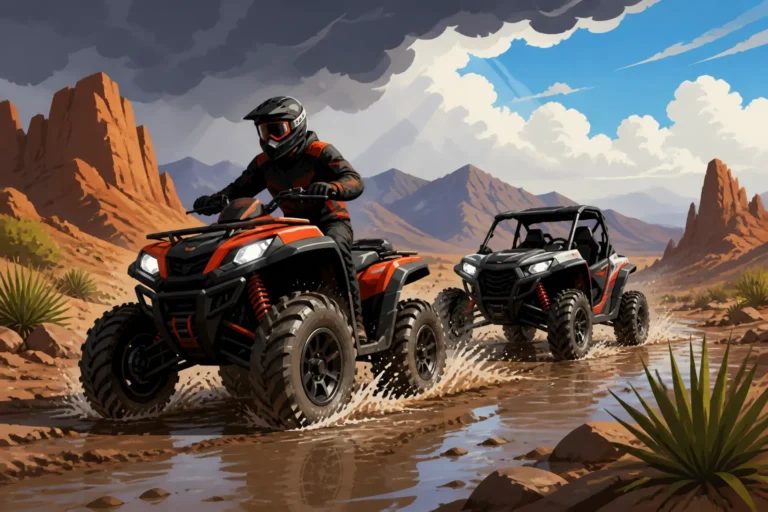
Nevada Desert Riding in Summer Heat
Nevada’s summer desert heat can turn an enjoyable ride into a tiring, risky day faster than many visitors expect. This guide explains how to choose a cooler riding window, plan water and fuel, prepare your ATV or UTV, recognize heat illness, and make sensible decisions at places such as Sand Mountain, Logandale Trails, and Nellis Dunes.
Why Nevada Desert Heat Changes a Ride
Heat affects riders and machines
In the desert, high temperatures are only part of the challenge. Sun exposure, reflected heat from sand and rock, dust, exertion, and limited shade all add up. A rider who feels comfortable at the staging area may feel very different after a few hours of climbing dunes or navigating rough ground. Even a short walk to help a stuck vehicle can become strenuous in the heat.
Heat also changes how your body handles effort. You may tire sooner, become less alert, or find it harder to make clear decisions. Those changes matter on a trail: fatigue can affect your balance, reaction time, and judgment about whether a slope or route is within your ability. A family group may notice the youngest or least experienced rider struggling before anyone else does, so check in with one another rather than assuming everyone is fine.
Your machine has its own limits. Slow riding, soft sand, steep climbs, heavy loads, and long periods of idling can put extra strain on a cooling system. If a temperature warning appears, steam or an unusual smell develops, or the engine begins behaving differently, stop somewhere safe and follow the owner’s manual. Continuing simply to reach the next landmark can turn a manageable pause into a breakdown in a poor location.
Pick the route and timing for the conditions
For summer riding, the most important planning choice may be when to ride, not where. Start early, aim to finish the strenuous part of the trip well before the hottest part of the day, and avoid treating a full-day itinerary as a goal you must complete. A dawn start can mean cooler conditions, but it also calls for careful attention to visibility, other trail users, and any site-specific rules.
Choose terrain that matches the least experienced rider and the day’s conditions. A familiar route with room to stop may be a better choice than a long, technical loop or a steep dune face. At Sand Mountain, for example, climbing soft sand takes effort from both rider and machine. At Nellis Dunes or Logandale Trails, a route that looks short on a map can still involve exposed riding, loose surfaces, and little shade.
Check the forecast for the riding area itself, not only the nearest city. Conditions can vary with elevation and distance, and a forecast for Las Vegas may not describe what you will encounter near Fallon or Beatty. Review access information and closures before leaving, and use resources such as [Nevada Desert Riding in Summer Heat] alongside [Riding Seasons in the Nevada Desert] when deciding whether the planned outing makes sense.
Plan Water, Shade, and a Way to Turn Back
Carry more than you expect to use
Water planning should account for every person, the length and intensity of the ride, the heat, and the possibility of a delay. Do not count on finding drinking water at a trailhead or recreation area unless you have confirmed it is available and working. Some remote riding locations have basic facilities but no dependable water supply. Pack drinking water where it is easy to reach, and keep an additional reserve secured in the tow vehicle or camp when practical.
Drink regularly rather than waiting until you feel parched. Bring food and electrolytes if they suit your needs, but do not treat them as a substitute for water, rest, or ending a ride when someone feels unwell. A rider with a medical condition, a child, or anyone who is not used to the heat may need a more careful plan. If you are unsure what is appropriate for a specific health concern, ask a qualified medical professional before the trip.
A practical packing list includes water for the ride and the drive back, a way to keep it accessible, sun protection, a first-aid kit, and a means of communication. Keep the group’s supplies together or make sure each vehicle carries enough for its occupants. For more planning ideas, see [Carrying Water for a Desert Ride] and [Nevada Desert Riding in Summer Heat].
Make the route easy to shorten
Before you unload, agree on a turnaround time and a simple signal for stopping. This can be as straightforward as deciding that anyone can call for a break without having to justify it, and that the group will head back if a rider or machine shows signs of trouble. That agreement helps avoid the common pressure to keep going because the group has already driven a long way to the riding area.
Share your route and expected return time with someone who is not riding with you. Identify a meeting point and a backup plan if vehicles get separated. In remote areas, cell service may be unreliable, so do not assume a phone call will always be possible. Download maps in advance and consider carrying a suitable satellite communication device if the route or remoteness warrants it.
An offline map can help you understand where you are and find a practical way back, but it is not a substitute for checking land access, current closures, or navigation skills. Some riders use onX Offroad to review routes and save map information before losing service. Whatever mapping tool you choose, confirm your route against current land-management information and avoid treating a line on a screen as proof that a route is open. [Nevada Trail Maps Worth Downloading] and [Cell Coverage on Nevada Trails] offer useful preparation context.
Prepare Your ATV or UTV for Summer Conditions
Do a pre-ride check with heat in mind
A quick inspection before unloading can prevent some avoidable problems. Check tires for damage and appropriate pressure, inspect the brakes and controls, look for leaks, and confirm that the battery and lights are working. Review the owner’s manual for maintenance items that are especially important for your machine, including coolant and air-filter care. Sand and dust can build up quickly, so do not assume a filter that looked clean last weekend is still ready for another ride.
Look over the cooling system without opening a hot radiator cap. Check for visible damage, loose connections, or debris that could block airflow, and follow the manufacturer’s directions for cleaning. If your machine has overheated recently or has a warning light, deal with that before heading into a remote area. A small problem noticed at home is much easier to handle than one discovered on a hot trail.
Secure tools, recovery gear, food, and water so they cannot shift during rough riding. Make sure everyone knows where essential supplies are stored. For a UTV, keep the cab organized and avoid blocking access to safety equipment. For a quad, pack carefully so cargo does not interfere with movement or controls.
Keep the workload reasonable
A hot day is not the time to test an unfamiliar machine at its limits. Reduce the load where possible, avoid unnecessary idling, and take breaks in safe places with room to pull clear of traffic. If the engine temperature rises or a warning appears, stop and let the machine cool according to its manual. Never remove a hot radiator cap; pressurized coolant can cause severe burns.
Soft sand can demand sustained throttle and effort, especially on climbs. Choose a line you can ride with control, leave room to stop, and do not follow another vehicle so closely that its dust hides the terrain. A group should keep enough spacing for visibility while maintaining a way to communicate. If a machine becomes stuck, pause to assess the situation before repeated hard attempts create more heat for the rider and vehicle.
Carry basic recovery equipment suited to your machine and know how to use it before you need it. Recovery work in the open sun can be more exhausting than the ride itself. If the vehicle cannot be recovered safely, or a rider is becoming unwell, focus on people first and seek assistance rather than pushing on to protect the schedule. [Breaking Down Far From the Trailhead] and [Desert Heat and Your Cooling System] cover related planning concerns.
Recognize Heat Illness and Respond Early
Watch for changes in behavior and coordination
Heat illness can begin with symptoms that are easy to dismiss as ordinary tiredness. Headache, dizziness, nausea, unusual weakness, heavy sweating, cramps, and irritability are reasons to stop, get out of direct sun, and assess the person. Do not leave someone alone to rest while the rest of the group continues. A companion can notice changes in speech, balance, or behavior that the affected rider may not recognize.
Move the person to shade or another cooler location, loosen unnecessary layers, and use cool water or wet cloths to help lower body temperature. Offer small, frequent sips of water only if the person is alert and able to swallow safely. Do not force fluids. If symptoms are severe, getting worse, or not improving, contact emergency services and follow the dispatcher’s instructions.
Confusion, fainting, seizure, loss of consciousness, or very hot skin can signal a life-threatening emergency. Call emergency services immediately and begin rapid cooling while help is on the way, if you can do so safely. Do not wait for a person to “sleep it off” or try to drive a severely ill person a long distance without getting emergency guidance. If you are riding far from roads or reliable service, that is another reason to keep the route conservative and tell someone your plan.
Treat the group’s limits as real
A common mistake is to judge the entire group by its strongest rider. Children, older adults, first-time riders, and people who have not acclimated to the heat may need more frequent breaks or an earlier turnaround. Ask direct questions and watch how people respond; “Are you okay?” can be difficult to answer honestly when someone feels pressure not to slow everyone down. It can help to ask, “Do you feel dizzy, nauseated, unusually weak, or confused?”
Make stopping normal, not a sign that someone has failed. Choose a shaded or otherwise safe place where the group can get off the machines without blocking the route. If there is no shade nearby, prioritize stopping in a safe location and use whatever cooling supplies you have. A planned ride is flexible; a person’s health is not.
If symptoms appear, do not restart the ride simply because the person says they feel a little better after a brief pause. Make a conservative decision about returning, and seek medical advice when symptoms warrant it. See [Nevada Riding Before the Heat of the Day] and [Water and Fuel Planning in Nevada] for related trip-planning considerations.
Choose Riding Areas and Conditions Carefully
Match the destination to your group
Different riding areas create different demands. Sand Mountain is known for dune riding, where soft sand and climbing can make a short session physically demanding. Logandale Trails has varied terrain and can involve exposed routes. Nellis Dunes may suit a shorter outing near Las Vegas, but proximity to the city does not make summer conditions mild. For every destination, check access, surface conditions, facilities, and current restrictions before departure.
Think beyond the name of the recreation area. Ask how far the staging area is from the route you want, whether there is shade, whether drinking water is available, and how easy it is to return if someone needs a break. A plan that works for an experienced adult group may not work for a family with young riders or a first-time driver. Keep the first ride of the day short enough to learn how the group and machines respond to the conditions.
If the day feels too hot for the planned route, changing the plan is a good outcome. You could shorten the ride, choose a less demanding area, or postpone the trip. Nevada’s landscapes are worth seeing, but no particular dune climb or trail segment is worth risking someone’s health. [Best Places to Ride an ATV in Nevada] and [Nevada OHV Areas Near Las Vegas] can help with destination research.
Use a simple go, adjust, or cancel check
A useful pre-departure check is to consider the weather, the group, the route, and the equipment together. If the forecast is severe, someone is already feeling unwell, the machine has a cooling issue, or the route depends on supplies you cannot confirm, adjust or cancel. One concern may be manageable; several concerns together can make the outing a poor choice.
| Check before leaving | Green-light approach | Reason to adjust or cancel |
|---|---|---|
| Weather | Conditions and timing suit the group’s experience | Extreme heat, strong winds, or conditions that make the route unsafe |
| People | Riders feel well and understand the plan | Anyone is already dizzy, nauseated, unusually tired, or unwell |
| Route | Short, familiar, and easy to shorten | Long, exposed, technical, or difficult to exit |
| Supplies | Water, communication, and basic safety gear are ready | Water is limited, communication is uncertain, or key gear is missing |
| Machine | Pre-ride check is complete and no warning signs are present | Overheating, leaks, damaged tires, or unresolved mechanical concerns |
This check is not a formal safety rating. It is a prompt to make the decision before the group is committed to a remote route. Conditions can change, so keep reassessing throughout the day. If the wind rises, the surface becomes difficult, or a rider begins to struggle, shorten the ride rather than waiting for the original turnaround time.
For navigation, onX Offroad may help you review and save route information before heading out, particularly where service is limited. Use it alongside official land-management updates and local notices; neither a downloaded map nor a familiar track guarantees that access is open. Before a destination-specific trip, review [Calling a BLM Field Office Before a Ride] and [Nevada Trail Closures to Check Before You Go].
Disclaimer
This article is for general informational purposes only and does not constitute professional advice. Laws, prices and regulations vary by location and change over time. Consult a qualified professional for guidance on your specific situation.